
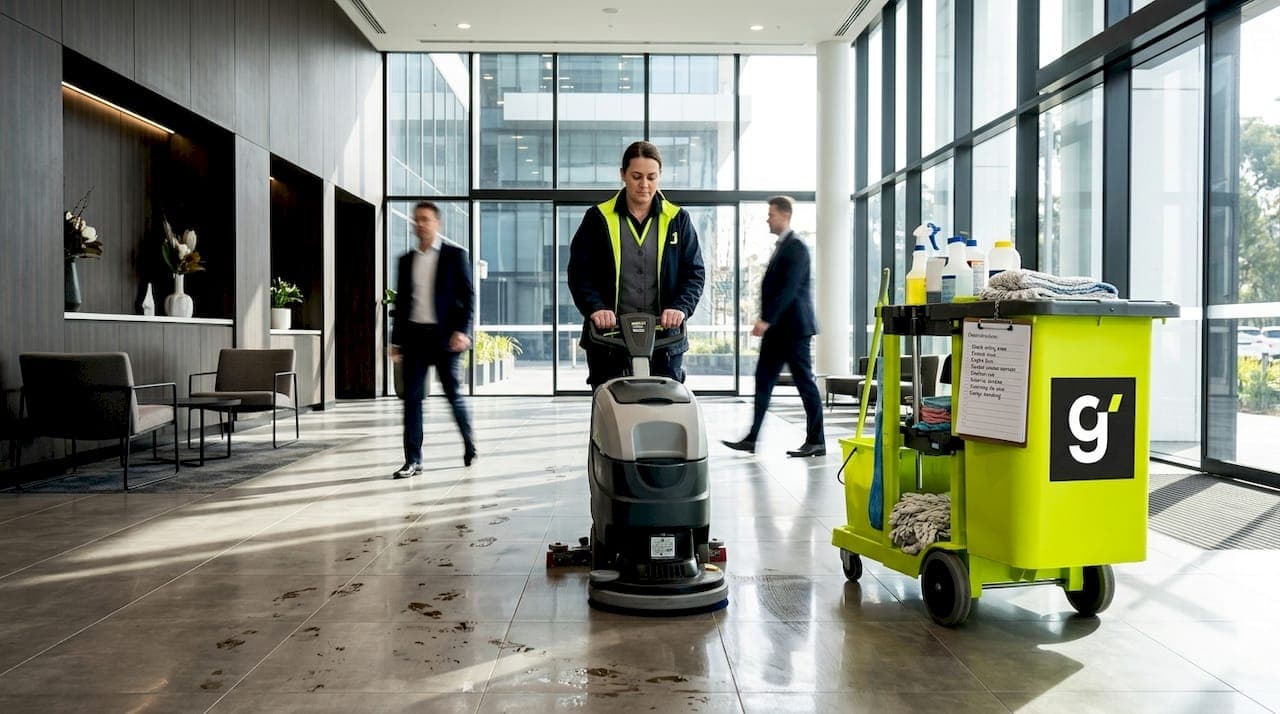
Grime doesn't announce itself. It accumulates quietly in doorways, along corridors, across car parks, and under entrance mats until one day a guest checks in, a client walks through your door, or a tenant raises a complaint. For property managers, short-term rental hosts, and business owners, this high-traffic area grime removal guide covers everything from the right tools and surface-specific techniques to maintenance schedules that actually hold up under pressure. Get this right and you protect your ratings, your surfaces, and your reputation.
Table of Contents
- Key takeaways
- What you need before starting grime removal
- Cleaning indoor high-traffic floors and carpets
- Outdoor grime removal for sidewalks and car parks
- Maintenance scheduling to keep grime from returning
- Troubleshooting common grime removal problems
- What I've learned from years of high-traffic cleaning work
- Professional grime removal that protects your property
- FAQ
Key takeaways
| Point | Details |
|---|---|
| Start with the right tools | Match your cleaning agents and equipment to the surface type before you begin any grime removal. |
| Layer your indoor defence | Entrance matting captures up to 85% of incoming dirt, dramatically reducing how often deep cleans are needed. |
| Use zone-based outdoor cleaning | Phased cleaning prevents debris from being pushed into drains and corners during pressure washing. |
| Schedule, don't react | A structured maintenance calendar reduces grime build-up and extends the life of surfaces significantly. |
| Treat oil stains separately | Oil and grease require a dedicated degreasing workstream, not the same approach used for general dirt. |
What you need before starting grime removal
No cleaning task goes well without the right preparation. Before you touch a surface, you need to know what you're cleaning, what you're cleaning it with, and how to protect yourself and the area in the process.
Here's a quick reference for the core supplies you'll need across most high-traffic area cleaning jobs:
| Category | Items needed | Notes |
|---|---|---|
| Protective gear | Gloves, safety glasses, non-slip boots | Non-negotiable for chemical and pressure work |
| Indoor cleaning tools | Vacuum, mop, microfibre cloths, spot spray | Choose attachments suited to carpet vs hard floor |
| Outdoor equipment | Pressure washer, stiff-bristle brush, squeegee | Check pressure settings before use on each surface |
| Cleaning agents | Degreaser, alkaline cleaner, enzyme-based spotter | Match product pH to surface and stain type |
| Specialised items | Wet/dry vac, gum remover, algae treatment | Keep these on hand for recurring problem areas |
The single biggest mistake property managers make is using one all-purpose cleaner across every surface. Concrete, carpet, pavers, and timber all respond differently to chemical exposure. An alkaline cleaner that works brilliantly on a concrete car park can strip the finish off a sealed timber deck. Read the product data sheet before you start, not after something goes wrong.
- Always test cleaning agents on a small, inconspicuous area first
- Wear eye protection when working with any spray-based chemical, indoors or out
- Keep bystanders and pets away from treated surfaces until fully dry
- Store chemicals in their original containers with lids secured
Pro Tip: Keep a laminated quick-reference card in your cleaning kit that lists which product is approved for each surface type in your property. It takes ten minutes to make and saves hours of damage control.
Cleaning indoor high-traffic floors and carpets
Indoor surfaces take a relentless beating. Corridors, lobbies, rental property entryways, and commercial reception areas see constant foot traffic, and the grime that comes with it embeds fast. The good news is that a consistent routine prevents most of the serious build-up before it starts.
High-traffic carpet should be vacuumed daily, with edge-detail vacuuming and mat cleaning done weekly. This isn't excessive. Dry soil left in carpet fibres acts like sandpaper underfoot, grinding down the pile with every step. Regular vacuuming removes that abrasive layer before it embeds deeper, and periodic hot-water extraction removes the residues that vacuuming can't reach.
Here's a step-by-step process for keeping indoor high-traffic floors clean:
- Daily vacuum all carpeted areas, paying extra attention to entry points and corridors where soil concentrates.
- Spot clean spills immediately. Blot, don't rub. Work from the outside of the stain inward to prevent spreading.
- Identify the stain type before applying any product. Protein-based stains (food, blood) need an enzyme cleaner. Oil-based stains need a solvent or degreaser.
- Clean entrance mats weekly. Entrance matting systems capture around 85% of dirt and moisture before it reaches your floors. A dirty mat is worse than no mat.
- Schedule hot-water extraction based on traffic volume. A short-term rental property turning over weekly needs this monthly. A low-traffic office corridor might manage quarterly.
- Allow full drying time before reopening the area to foot traffic. Damp carpet attracts soil faster than dry carpet.
Pro Tip: For short-term rental properties, do a quick black-light scan of carpets during turnover. It reveals stains invisible to the naked eye that guests will definitely notice, giving you the chance to treat them before the next check-in.
For hard floors, the principle is the same: remove dry soil first, then treat with the appropriate wet method. Mopping a floor before sweeping or vacuuming just spreads grime around. On polished concrete or tiles, a neutral-pH cleaner used regularly prevents the dulling that comes from detergent residue build-up.
Outdoor grime removal for sidewalks and car parks
Outdoor high-traffic surfaces present a different set of challenges. You're dealing with vehicle fluids, organic growth like algae and moss, chewing gum, and weather-deposited grime, all on surfaces that vary from poured concrete to clay pavers to asphalt. Getting this right requires a phased approach and the right equipment settings.
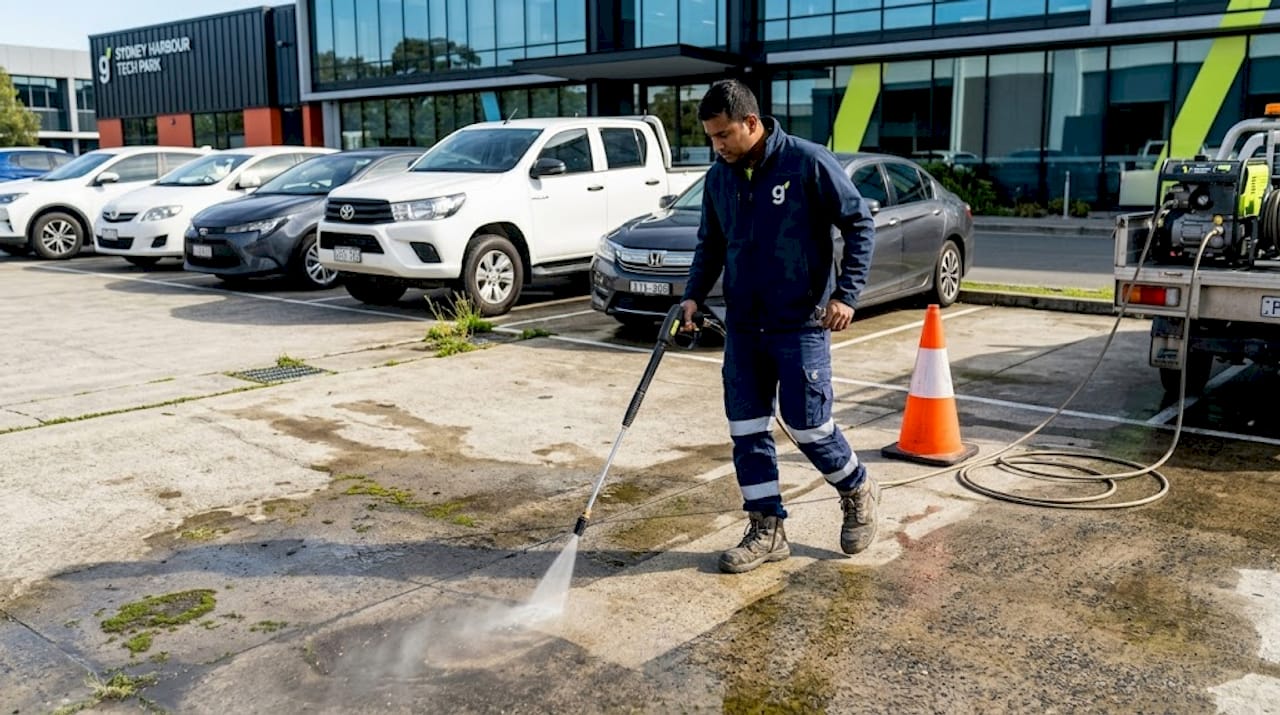
Phased zone cleaning reduces disruption to business operations and improves thoroughness in large areas. Use cones and signage to section off areas, and clean in a direction that pushes water away from drains and building entrances, not toward them.
Follow this sequence for outdoor grime removal:
- Clear loose debris first. Sweep or blow leaves, gravel, and rubbish away from the work zone. Pressure washing over debris just redistributes it.
- Protect nearby plants and drains. Cover garden beds with plastic sheeting and place drain guards before applying any chemical treatment.
- Apply pretreatment and allow dwell time. For concrete sidewalks, pretreating with cleaners before scrubbing and rinsing is critical. Allow 5 to 7 minutes of dwell time but do not let the product dry on the surface. Dried pretreatment creates its own residue problem.
- Select the correct pressure washer nozzle. A 25° or 40° nozzle protects concrete and brick from surface damage. Keep the nozzle 12 to 24 inches from the surface and move in consistent, overlapping passes.
- Treat problem areas separately. Oil stains, algae patches, and embedded gum each need their own treatment before the main pressure wash.
- Rinse thoroughly from the highest point to the lowest, working water toward a collection point rather than a stormwater drain where possible.
When it comes to oil stains in car parks, a standard pressure wash will not cut it. Vehicles tend to park in the same spots repeatedly, which means oil contamination compounds over time. Treat these areas with a dedicated degreaser, agitate with a stiff brush, and allow the product to break down the oil before rinsing. Skipping the agitation step is the most common reason oil stains persist after cleaning.
- For algae and moss, use a biocide treatment a few days before the main clean. This kills the organism and makes physical removal far easier.
- Chewing gum responds best to a freeze-and-lift approach using a commercial gum remover before pressure washing.
- Avoid starting pressure washing at the edge of an area and working inward. This pushes debris into corners and blocks drainage systems.
Pro Tip: For pressure washing techniques on mixed-surface areas, always start with the lowest effective pressure setting. You can increase pressure if needed, but you can't undo surface etching on pavers or concrete.
Maintenance scheduling to keep grime from returning
Cleaning once is not a strategy. Grime returns faster in high-traffic areas than anywhere else, and without a structured schedule, you'll find yourself doing emergency deep cleans instead of efficient routine maintenance. The goal is to make grime removal a predictable, manageable part of property operations.
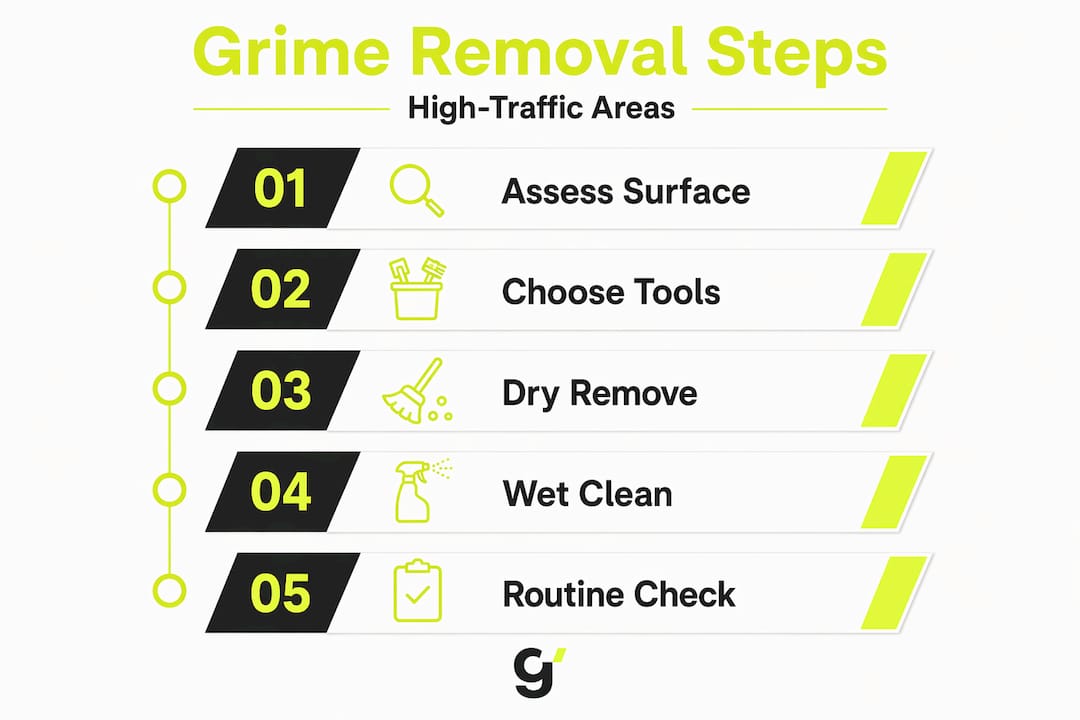
Here's a practical maintenance schedule framework:
| Frequency | Task |
|---|---|
| Daily | Vacuum carpets, spot clean spills, empty bins, wipe entry glass |
| Weekly | Clean entrance mats, sweep outdoor areas, inspect for new stains or damage |
| Monthly | Inspect carpet condition, spot treat outdoor oil stains, check mat placement |
| Quarterly | Rotate furniture to redistribute carpet wear, deep clean hard floors, sweep and spot-treat car park |
| Annually | Review matting systems, schedule professional deep clean, assess surface condition for repairs |
Imperial Dade's 2025 maintenance schedule recommends monthly inspection and quarterly furniture rotation as standard practice for high-traffic carpet. This isn't just about appearance. Rotating furniture prevents permanent compression lines and reveals wear patterns that signal where additional protection is needed.
Beyond the schedule itself, a few operational habits make a real difference:
- Keep a maintenance log. Record what was cleaned, when, and with what product. This helps you spot patterns, like a section of carpet that needs spot treatment every week, which might indicate a drainage or ventilation issue nearby.
- Train maintenance staff in immediate spill response and correct stain identification. A staff member who treats a protein stain with the wrong product can set it permanently.
- Map your high-touch and walk-off zones. Entry points, lift lobbies, and kitchen corridors accumulate grime at a different rate than general office space. Tailor your cleaning frequency to the actual traffic pattern, not a one-size-fits-all schedule.
Pro Tip: For short-term rental properties, attach a cleaning checklist to each turnover task list. Consistent documentation means nothing gets missed during a rushed changeover, and it protects you if a guest disputes a cleanliness rating.
Troubleshooting common grime removal problems
Even with the right tools and a solid schedule, things go wrong. Here's how to handle the most common problems without making them worse.
Patchy results after pressure washing usually come from inconsistent nozzle distance or overlapping passes that are too far apart. Work in methodical, parallel passes with about a 50% overlap. If patchiness persists, the surface may need a second pretreatment pass before re-washing.
Stains that reappear after cleaning are almost always a wicking problem. On carpet, this means the stain was treated at the surface but residue remained deep in the backing. Hot-water extraction with a proper rinsing cycle, not just a surface spray, is the fix. On concrete, reappearing stains often mean the contamination has penetrated the substrate and needs a longer-dwell chemical treatment or professional remediation.
Surface damage from cleaning is more common than most people realise. High-pressure washing on aged or unsealed concrete can erode the surface. Harsh alkaline cleaners on natural stone can etch the finish permanently. Always match the cleaning method to the surface condition, not just the surface type.
Systematic grime management consistently outperforms relying on stronger chemicals or higher pressure. The right sequence and dwell times do more work than brute force ever will.
Recurring grime build-up in the same spots is a sign that the root cause hasn't been addressed. A doorway that always gets grimy might need better matting. A section of car park that constantly accumulates oil needs a drainage assessment, not just more frequent cleaning. Fix the source, not just the symptom.
What I've learned from years of high-traffic cleaning work
I've seen property managers spend thousands on deep cleaning that could have been avoided with a twenty-dollar entrance mat and a weekly vacuuming schedule. The gap between properties that stay clean and properties that don't is almost never about cleaning products. It's about systems.
The most effective operations I've worked with treat grime removal the same way they treat any other maintenance function. They schedule it, document it, and train for it. They don't wait for a complaint or a bad review to trigger action. They know which zones accumulate grime fastest, and they address those zones before they become visible problems.
One thing that surprises most people is how much damage improper cleaning causes. I've seen carpets worn out years ahead of schedule because staff were vacuuming with a brush roll set too low. I've seen concrete car parks etched and pitted from pressure washing at the wrong angle. The cleaning itself becomes the source of damage when the technique is wrong.
My practical advice: build your maintenance schedule around your actual traffic patterns, not a generic template. Audit your high-traffic zones monthly. And when a stain or build-up problem keeps coming back, treat it as a diagnostic signal, not just a cleaning task.
— Lead
Professional grime removal that protects your property

Managing grime in high-traffic areas is genuinely demanding work, and even the best in-house routines have limits. When build-up has gone beyond what routine maintenance can address, or when a property needs a guaranteed reset before a new guest or client arrives, professional intervention makes the difference.
Grimescene's short-term rental cleaning services are built specifically for the turnover demands hosts face. The Scene Reset protocol delivers a thorough, documented clean that protects your ratings and prepares the property for the next guest without harsh chemicals that linger in the space. For commercial properties and workplaces, Grimescene's commercial cleaning services address the kind of entrenched grime that standard maintenance misses.
If you're ready to take the guesswork out of your cleaning programme, book an appointment with Grimescene's rapid response team and get a cleaning plan tailored to your property's specific traffic patterns and surface types.
FAQ
How often should high-traffic carpets be deep cleaned?
High-traffic carpets should be deep cleaned by hot-water extraction at a frequency scaled to use. A short-term rental turning over weekly typically needs monthly extraction, while a lower-traffic commercial corridor may manage quarterly.
What is the best way to remove oil stains from a car park?
Oil stains require a dedicated degreasing workstream. Apply a commercial degreaser, agitate with a stiff brush, allow dwell time, and rinse thoroughly. Standard pressure washing alone will not remove embedded oil contamination.
Why does grime keep coming back in the same spots?
Recurring grime in specific zones usually points to an unresolved source issue such as poor drainage, inadequate matting, or a surface that is no longer sealed. Cleaning the symptom without addressing the cause will produce the same result every time.
What pressure washer nozzle should I use on concrete sidewalks?
A 25° or 40° nozzle is recommended for concrete and brick surfaces. Keep the nozzle 12 to 24 inches from the surface to avoid etching, and move in consistent overlapping passes for an even result.
How can entrance matting reduce indoor grime build-up?
Quality entrance matting systems can capture around 85% of dirt and moisture at the door before it reaches interior floors. For matting to remain effective, it needs to be cleaned weekly, as a saturated mat transfers grime rather than trapping it.