
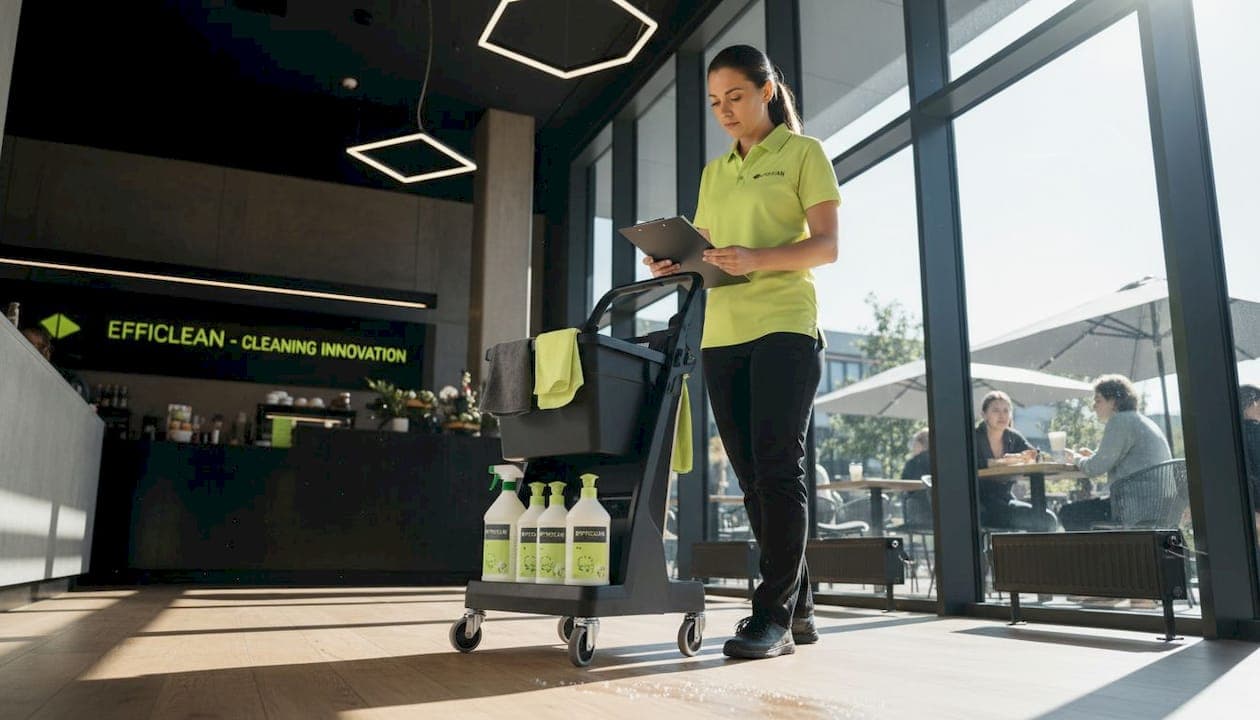
Most people assume that choosing eco-friendly cleaning products means accepting a weaker result. That assumption is wrong, and it's costing businesses money, productivity, and compliance standing. Understanding what is commercial-grade eco cleaning means recognising that today's plant-derived formulations can match conventional chemicals on performance while eliminating the toxic load that harms staff, surfaces, and waterways. This article breaks down the chemistry, the certifications, the real-world benefits, and the practical steps to implement these solutions whether you manage a single rental property or an entire commercial facility.
Table of Contents
- Key takeaways
- What commercial-grade eco cleaning actually means
- How eco cleaning works: the chemistry behind it
- Benefits of eco cleaning for businesses and households
- Common misconceptions about eco cleaning
- Choosing and implementing eco cleaning solutions
- My perspective on where eco cleaning is heading
- How Grimescene delivers commercial eco cleaning
- FAQ
Key takeaways
| Point | Details |
|---|---|
| Performance is comparable | EPA Safer Choice certified products remove 94% of test soils versus 96% for conventional cleaners, with the primary difference being dwell time. |
| Ingredients define the grade | Commercial-grade eco products use plant-derived surfactants and enzymes that biodegrade within 28 days, not petroleum-based VOCs. |
| Greenwashing is a real risk | Only products with verified eco-labels like USDA BioPreferred or EPA Safer Choice genuinely meet biodegradability and safety standards. |
| Concentration reduces waste | Eco cleaning concentrates cut plastic waste and transport emissions, but accurate dilution is non-negotiable for results. |
| Health benefits are measurable | Switching to eco cleaning reduces respiratory irritants and aquatic toxicity by 70 to 90 per cent. |
What commercial-grade eco cleaning actually means
The phrase "commercial-grade" gets thrown around loosely, so let's be precise. Commercial-grade eco cleaning refers to formulations that meet industrial performance benchmarks while using non-toxic, biodegradable ingredients that replace the VOC-containing chemicals found in traditional cleaning products. The eco-label certified cleaning market is projected to reach USD 5.8 billion by 2036, which tells you this is not a niche trend. It's a structural shift in how facilities are maintained.
What separates a genuine commercial eco cleaning solution from a supermarket "green" spray comes down to three things: ingredient transparency, certified performance, and concentration ratios suited to professional use.
Key characteristics of commercial-grade eco cleaning products include:
- Non-toxic, biodegradable actives. Plant-derived surfactants, enzymes, and pH-adjusted carriers that break down grime without leaving harmful residues.
- Recognised certifications. Products carrying USDA BioPreferred, EPA Safer Choice, or equivalent Australian eco-labels have been independently verified for both safety and efficacy.
- Industrial concentration. Commercial formulas are designed for dilution at scale, meaning a single litre can yield many litres of ready-to-use solution.
- Surface compatibility. Genuine commercial eco products are formulated to perform across a range of substrates including stone, stainless steel, fabric, and food-contact surfaces.
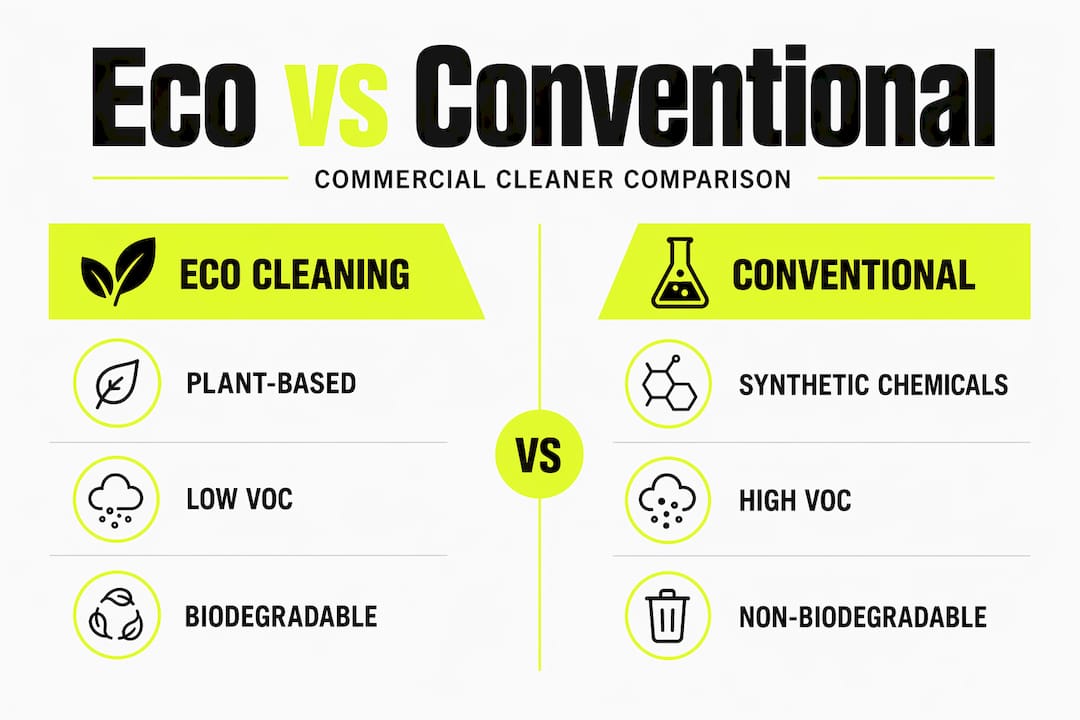
Compare that with conventional commercial cleaners, which frequently rely on quaternary ammonium compounds, chlorinated solvents, and synthetic fragrances that contribute to indoor air pollution and persist in waterways long after use.
| Feature | Commercial-grade eco cleaning | Conventional commercial cleaning |
|---|---|---|
| Active ingredients | Plant-derived surfactants, enzymes | Petroleum-based surfactants, VOCs |
| Biodegradability | Within 28 days | Often months to years |
| Indoor air quality | Low VOC, low irritant | High VOC, respiratory risk |
| Certifications | EPA Safer Choice, USDA BioPreferred | Varies widely, often uncertified |
| Concentration efficiency | High, reduces packaging waste | Variable |
| Surface safety | Broad compatibility | Can degrade sensitive surfaces |
How eco cleaning works: the chemistry behind it
Understanding how does eco cleaning work starts with surfactants. Surfactants are molecules with a water-attracting head and an oil-attracting tail. When they contact a soiled surface, the oil-attracting tail binds to grease and grime while the water-attracting head pulls the whole complex away during rinsing. Plant-derived surfactants do this just as effectively as petroleum-based ones, and they biodegrade 90% faster than their synthetic counterparts, breaking down into non-toxic compounds within 28 days.
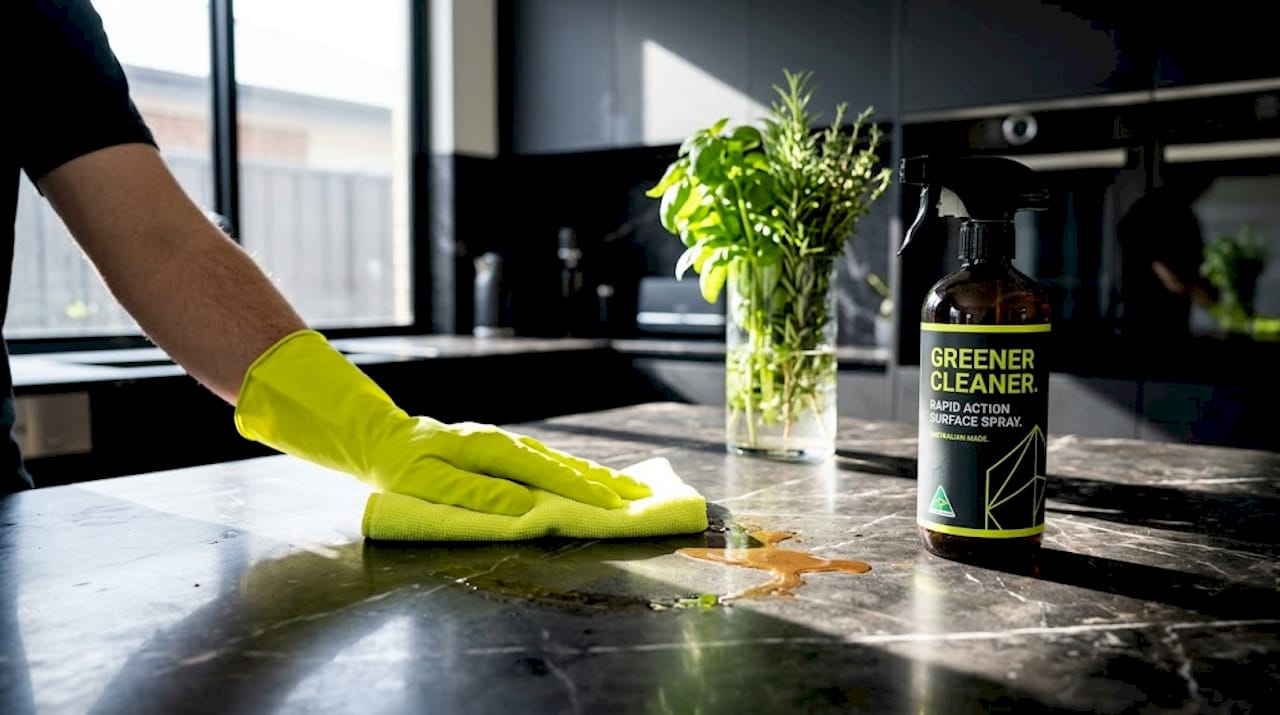
Enzymes add another layer of cleaning power. Protease enzymes break down protein-based soils like blood and food residue. Lipase enzymes target fats and oils. Amylase enzymes attack starch. Together, they handle the complex soil profiles found in commercial kitchens, healthcare settings, and short-term rental properties without requiring harsh acids or bleach.
Here is how to apply commercial eco cleaning products for maximum results:
- Read the dilution ratio first. Commercial concentrates are formulated for specific dilution rates. Using them undiluted wastes product and can leave residue. Using them over-diluted reduces efficacy.
- Apply and allow dwell time. Plant-based formulas need contact time to work. Apply the solution, then wait the recommended period before agitating or wiping. Skipping this step is the most common reason eco products underperform.
- Use mechanical action. Scrubbing and mechanical agitation are integral to commercial eco cleaning because plant-based products benefit from physical assistance to lift embedded soils.
- Rinse thoroughly. Particularly on food-contact surfaces or high-touch areas, a clean water rinse removes any remaining surfactant film.
- Assess and adjust. For heavily soiled environments like post-construction sites or rental turnovers, a second application or a higher-concentration dilution may be warranted.
Pro Tip: Set a timer when applying eco cleaning products to surfaces. Most professionals underestimate dwell time by 30 to 50 per cent, which is the single biggest reason plant-based formulas appear to underperform against conventional alternatives.
Benefits of eco cleaning for businesses and households
The benefits of eco cleaning extend well beyond the environmental argument, though that argument alone is compelling. Eco-friendly commercial cleaning reduces respiratory irritants and aquatic toxicity by 70 to 90 per cent compared to conventional products. For a business operating in a shared workspace, that translates directly to fewer sick days and lower staff turnover.
The health and operational advantages are significant:
- Improved indoor air quality. Fewer VOCs and synthetic fragrances mean lower rates of sick building syndrome, headaches, and respiratory complaints among staff and occupants.
- Reduced liability. Shifting to eco-friendly cleaning reduces exposure to chemical-related liability claims, a growing concern for facility managers and property owners.
- Simplified procurement. Certified eco cleaning chemicals allow businesses to consolidate their product range, reducing the number of SKUs, safety data sheets, and training requirements.
- Long-term cost efficiency. Concentrated commercial eco products reduce packaging, storage space, and transport costs. A business that switches from 20 individual products to five concentrated eco formulas often finds the transition pays for itself within a year.
- Regulatory readiness. As Australian state and federal regulations around chemical use in commercial settings tighten, businesses already using certified eco products are ahead of compliance requirements.
For property owners managing short-term rentals, the guest experience benefit is equally tangible. Guests notice the absence of harsh chemical odours after a clean. That sensory detail influences reviews, and reviews influence occupancy rates.
Common misconceptions about eco cleaning
The biggest myth is that eco means weak. It persists because early green cleaning products genuinely did underperform, and that reputation has stuck. The chemistry has moved on considerably since then. EPA Safer Choice certified products achieve 94 per cent soil removal compared to 96 per cent for conventional products. That two per cent gap closes entirely when dwell time and mechanical action are applied correctly.
Greenwashing is the second major issue. A product labelled "natural" or "plant-based" on its packaging is not automatically a commercial eco cleaning solution. Without verified certification, those claims are marketing, not chemistry. Genuine eco products biodegrade 90 per cent or more within 28 days and carry third-party verification to prove it.
Other misconceptions worth addressing:
- "Eco products cost more." Concentrated formulas often cost less per use than ready-to-use conventional products once dilution ratios are factored in.
- "Staff need extensive retraining." The adjustment is real but modest. The primary change is building dwell time into workflows, not learning an entirely new system.
- "Eco cleaning doesn't work on heavy contamination." Post-construction grime, biohazard remediation, and deep decontamination are all achievable with commercial eco cleaning solutions when the right product, concentration, and mechanical action are combined.
Pro Tip: When evaluating a new eco cleaning product, ask the supplier for the Safety Data Sheet and the biodegradability test results. If they cannot provide both within 24 hours, treat the product's eco claims with scepticism.
Choosing and implementing eco cleaning solutions
Selecting the right commercial eco cleaning solutions requires more than reading a label. Work through this process before committing to a product or supplier:
- Verify certification. Confirm the product carries a recognised eco-label. In Australia, look for certifications aligned with EPA Safer Choice standards or equivalent international bodies.
- Match the product to the soil type. Enzymatic cleaners suit organic soils. Surfactant-based formulas handle grease and general grime. pH-adjusted products address mineral deposits and hard water scale.
- Request technical data. A credible supplier of commercial-grade cleaning products will provide dilution guides, dwell time recommendations, and surface compatibility charts without hesitation.
- Run a controlled trial. Before rolling out across a facility, test the product on a representative area. Measure results against your current standard and document the findings.
- Train your team on application. The primary challenge in transitioning to eco cleaning is adapting operational processes. A 30-minute briefing on dilution ratios and dwell times prevents most of the common failures.
- Build in a feedback loop. Review results monthly for the first quarter. Adjust dilution, dwell time, or product selection based on real-world performance data.
Sustainable cleaning practices work best when they are embedded into existing workflows rather than added as an afterthought. Assign responsibility for monitoring product performance to a specific person, and make it part of your regular facility review.
My perspective on where eco cleaning is heading
I've watched the cleaning industry shift from treating eco products as a liability to treating them as a competitive advantage, and the change has been faster than most people expected. What I've found working across commercial and residential remediation is that the businesses which struggle with eco cleaning are almost always the ones that tried to implement it without adjusting their processes. They swapped the product but kept the same rushed application habits, then blamed the chemistry when results fell short.
The innovation in enzymatic and cold-water activated products is genuinely exciting. These formulas are closing the performance gap with conventional chemicals in conditions that previously required heavy-duty synthetic products. What this means practically is that the operational adjustments required are getting smaller with each product generation.
My honest take is that commercial-grade eco cleaning is no longer a values-based choice for businesses. It's a strategic one. Liability reduction, staff health, regulatory compliance, and procurement simplification all point in the same direction. The businesses that treat it as optional today will find it mandatory within five years, and they'll be implementing it under pressure rather than on their own terms.
— Lead
How Grimescene delivers commercial eco cleaning
If you're ready to move from understanding eco cleaning to actually experiencing it, Grimescene is built for exactly that. Their approach uses advanced non-toxic agents that neutralise grime rather than masking it, covering everything from routine maintenance to deep decontamination across residential and commercial settings.
For property managers and short-term rental hosts, the Scene Reset service handles complete turnovers using eco-certified products that leave no chemical odour and no residue. For commercial clients, workplace cleaning services are structured around your operational schedule, not the other way around. If you want to see what genuinely effective eco cleaning looks like in practice, book a service and let the results speak for themselves.
FAQ
What makes a cleaning product "commercial-grade"?
Commercial-grade means the product meets industrial performance benchmarks for soil removal, surface compatibility, and concentration ratios suited to professional use. It goes beyond household-strength formulas in both efficacy and formulation rigour.
How does eco cleaning work differently from conventional cleaning?
Eco cleaning uses plant-derived surfactants and enzymes to lift and break down soils rather than relying on VOCs or synthetic solvents. It requires accurate dilution and adequate dwell time to match the performance of conventional products.
Are commercial eco cleaning products as effective as traditional ones?
Yes, when applied correctly. EPA Safer Choice certified products achieve 94 per cent soil removal compared to 96 per cent for conventional cleaners, with the difference attributable to dwell time rather than ingredient capability.
How do I spot greenwashing in eco cleaning products?
Look for third-party certification such as EPA Safer Choice or USDA BioPreferred. Products that claim to be "natural" or "green" without verified eco-labels and published biodegradability data are making marketing claims, not scientific ones.
What are the main benefits of eco cleaning for businesses?
The core benefits include improved indoor air quality, reduced liability from chemical exposure, simplified procurement, long-term cost savings from concentrated formulas, and stronger compliance positioning as chemical regulations tighten.