
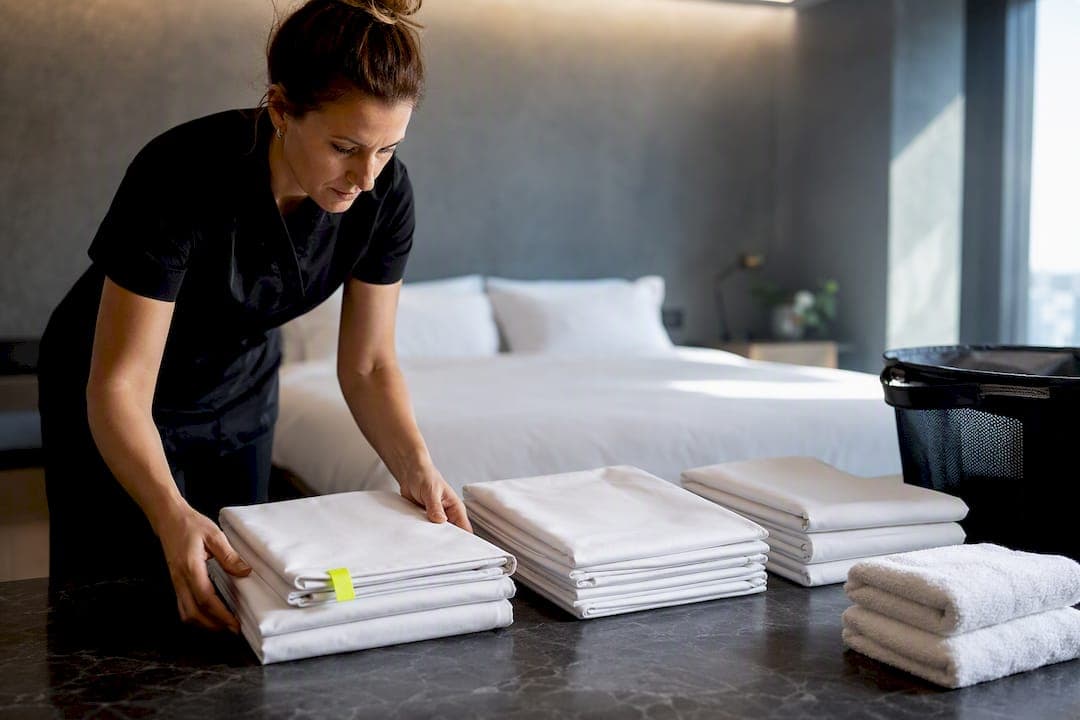
The minimum you owe a guest under Airbnb's Essentials rule is one bed sheet set, one pillow with a case per guest, and one towel per guest. A host running an actual business needs more than that: at least multiple complete sets per bed, a wash after every stay, and a stain triage system<br>that identifies stains early to reduce replacement costs. Everything else in your linen operation builds on those three rules.
TL;DR:
- Providing at least two complete linen sets per bed is necessary for same-day turnovers or multiple listings to prevent shortfalls.
- Choosing durable, mid-quality cotton or cotton-poly blend linens ensures they withstand repeated industrial washes without deterioration.
- Implementing a strict stain inspection, pre-treatment within two hours, and a hot wash cycle significantly reduces linen replacement costs.
- Storing linens in airtight containers with moisture absorbers prevents musty smells, especially in humid environments.
- Labelling linen sets and maintaining a rotation log minimizes loss and makes replacement planning more efficient.
Table of Contents
- What counts as an Airbnb linen essential (and why you should exceed it)
- How many sets of linen do you actually need?
- Picking linen that survives commercial washing, not just one guest
- The turnover laundering and stain triage routine that actually works
- Storage that stops linen going musty between guests
- A rotation and labelling system that stops linen disappearing
- In-house laundry vs a commercial linen service: which model fits?
- How long linen actually lasts, and what to budget for replacement
- Scene Reset: a professional deep clean for heavy soiling or new listings
- Matching linen sizes to your actual bed dimensions
- Detergent, fabric softener and getting the wash chemistry right
- Presentation standards that change how guests perceive your listing
- Guest-provided linens and allergy requests: setting a clear policy
- What to do when you run short on linen at the last minute
- Why consistency, not luxury, is what actually protects your reviews
- Sources
What counts as an Airbnb linen essential (and why you should exceed it)
Airbnb's own guidance is narrow. If your listing selects "Essentials," you're obligated to provide linens for each bed, one pillow with a case per guest, and one towel per guest — nothing more. Fall short of that and you risk a listing penalty, not just a bad review.
But the platform floor isn't a hospitality standard, it's a compliance minimum. A guest-ready property needs a fuller kit:
- Fitted sheet, flat sheet or duvet cover, and a light blanket or quilt for every bed
- Two pillows per guest, not one, plus a spare firm and soft option where space allows
- A full bath towel, hand towel, and face washer per guest, not a single shared towel
- A dark-coloured "makeup towel" left visibly on the rail, which quietly protects your white towels from foundation and fake tan stains
- A bath mat, because stepping onto a wet tiled floor is the fastest way to tank a five-star review
None of this is expensive. It's the difference between meeting a policy and running a business guests want to rebook.
How many sets of linen do you actually need?
The industry converges on a simple formula: multiple complete sets per bed — one on the bed, one in the wash, one clean and ready to go. That's your baseline for any property with a standard turnaround of a day or more between guests.
Increase to more than three sets per bed if you run same-day turnovers, manage multiple listings from one laundry setup, or don't have reliable same-day drying (a real issue in humid climates). Here's how to work out your number tonight:
- Count beds, not bedrooms. A queen and a set of bunks in one room are two separate linen needs.
- Multiply beds by three for your baseline sheet and pillowcase par.
- Multiply your guest capacity by three for towels, since towels see harder wear than sheets.
- Add one extra bath mat and hand towel set per bathroom for margin.
- Write the final number down somewhere you'll actually check it, not just in your head.
Run this once and you'll never again be short a set at 3pm before a check-in.
Picking linen that survives commercial washing, not just one guest
Skip the 800-thread-count sheets you'd buy for your own bed. Rental linen needs to survive weekly industrial washing, not look good in a single Instagram photo. mid-quality percale cotton or a durable cotton-poly blend, holds up far better under repeated hot washes than delicate high-thread-count cotton, which pills and thins fast.
For towels, look for ring-spun cotton with moderate weight. Heavier towels feel luxurious but take longer to dry between turnovers, which matters if you're on a tight same-day schedule.
- Choose percale or a poly-cotton blend over sateen or Egyptian cotton for sheets
- Match towel weight to your drying window, not to hotel-brochure expectations
- If you use a cleaning contractor, ask what fabric they can process. Fragile linens that need delicate cycles or hand-washing are a fast route to bottlenecked turnovers
White bedding remains the practical default. It's bleachable, photographs cleanly, and signals cleanliness instantly to a guest walking in, even though it shows makeup and fake-tan marks more readily than a patterned set. That trade-off is worth it if you're disciplined about stain triage, which is the next thing to nail down.
The turnover laundering and stain triage routine that actually works
Most linen damage isn't caused by the stain itself. It's caused by what happens between strip and wash, when a stain sits, dries, and gets thrown into a hot dryer before anyone's looked at it. Fix the sequence and you fix most of your replacement costs.
- Strip and inspect immediately. Check every sheet and towel under good light before it goes anywhere near a machine.
- Pre-treat within two hours. Stains identified at strip and pre-treated within two to four hours have the best chance of coming out completely. Wait until the next day and you've likely lost the item.
- Wash on the recommended cycle, not the fastest one. Whites can take a hotter wash with oxygen bleach; coloured linens need a cooler, gentler cycle to protect fibres.
- Dry and re-check. A hot dryer sets any stain that wasn't fully lifted, so inspect again before it goes in.
- Retire anything that failed twice. Two failed treatment attempts means it's a cleaning rag now, not guest linen.
Pro Tip: Keep a small spray bottle of stain pre-treater at the strip station itself, not in a cupboard down the hall. The two-hour window disappears fast when the treater is a five-minute walk away.
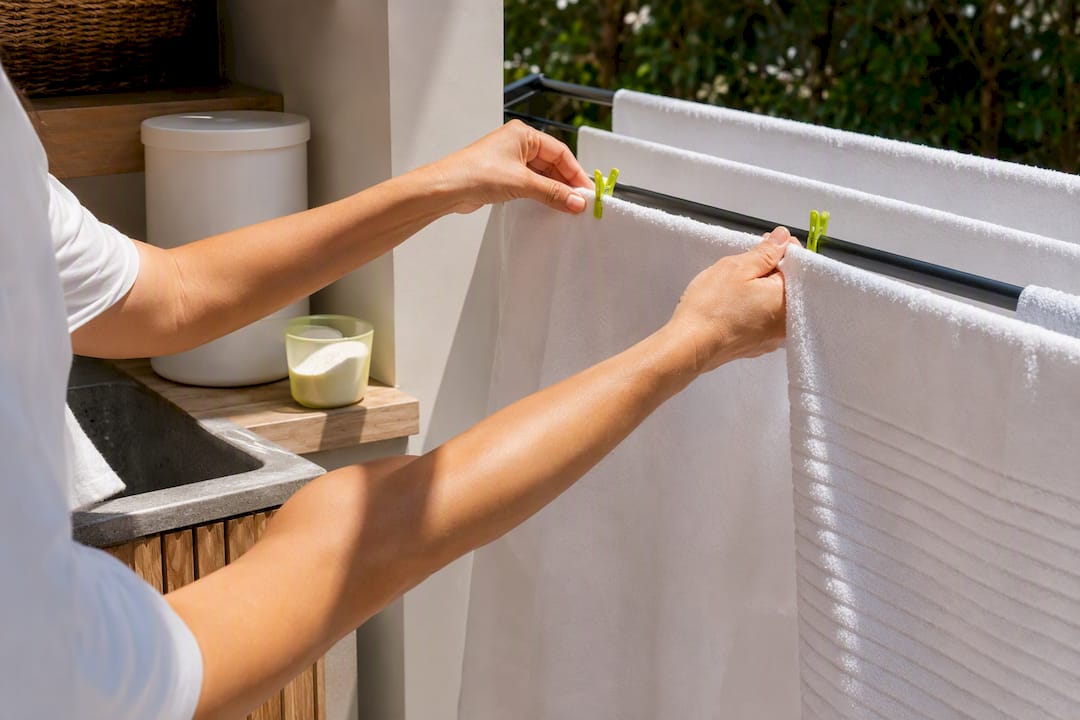
Oxygen bleach works well on white cotton without the fibre damage straight chlorine bleach causes over repeated washes. Line-drying towels when you can extends their life noticeably compared to constant tumble drying.
Storage that stops linen going musty between guests
Clean linen isn't guest-ready linen if it smells wrong. In humid climates, fresh linen can develop a musty smell within 48 hours if it's stored in an open cupboard rather than sealed away.
- Store finished sets in lidded, airtight tubs or fully enclosed shelving, not open shelving exposed to bathroom or kitchen humidity
- Drop a silica gel pack or moisture absorber into each storage tub, especially in coastal or tropical properties
- Run the "nose test" before every make-up: pick up the linen, smell it, and if there's any hint of mustiness, rewash before it goes on the bed
- If your storage runs humid, bump your par up by one extra set per bed. You'll need the buffer for the sets pulled aside for a rewash
A rotation and labelling system that stops linen disappearing
Unlabelled linen has no story. You can't tell which set is six months old and due for retirement, and you can't tell if a set has gone missing until you're short one at check-in. Labelling fixes both problems at once.
- Tag each set with a property code and a letter (Set A, Set B, Set C) using a laundry marker, sewn tag, or heat-stamped label
- Rotate sets in strict sequence rather than grabbing whichever is on top, so wear spreads evenly across your inventory
- Choose turnover-based rotation for high-frequency properties or week-based rotation for lower-turnover listings
- Labelled sets with a consistent rotation rule reduce unexplained shrink and make it obvious when a set has gone missing
- Keep a simple log, even a shared spreadsheet, noting when each set entered service and any repairs or stain incidents
- Use that log to trigger replacement decisions instead of eyeballing linen that "still looks fine"
In-house laundry vs a commercial linen service: which model fits?
In-house laundry gives you full control over quality and timing, but it costs real hours. Washing, drying, folding and inspecting a full set typically adds 60 to 90 minutes per turnover, and that's before you've factored in a broken machine on a busy weekend.
Commercial linen services remove that bottleneck entirely, delivering pre-washed sets on schedule. Pricing generally runs $15 to $40 per turnover depending on property size and location, which starts looking cheap the moment you're managing more than two or three listings or running same-day turnovers.
- In-house suits single-property hosts with flexible turnaround windows and space for a washer and dryer on site
- Outsourcing suits multi-property hosts, same-day turnovers, or anyone whose laundry keeps eating into cleaning time
- A hybrid model, in-house for everyday wear and a commercial service as overflow during peak season, works well for hosts scaling past one property
Before switching, trial a commercial service for a month on one property and compare turnover speed and linen condition against your current setup.
How long linen actually lasts, and what to budget for replacement
Sheets in commercial rotation typically need replacing after 12 to 24 months of weekly washing, depending on fabric quality and wash temperature. Towels wear faster, often needing replacement within 12 to 18 months because friction and bleach cycles break down fibres quicker than on sheets. Mattress protectors should be checked every six months and replaced at the first sign of a stain that won't lift, since a compromised protector puts your actual mattress at risk.
- Budget for gradual replacement rather than a lump sum. Set aside a small percentage of turnover income each month specifically for linen
- Track individual set age using your rotation log so replacement is planned, not reactive
- Reduce shrink with simple guest guidance: leave a card noting the makeup towel is provided so guests use it instead of a white one
- Guest profile matters. Share houses and party-friendly listings will chew through towels faster than a quiet couples' retreat
Scene Reset: a professional deep clean for heavy soiling or new listings
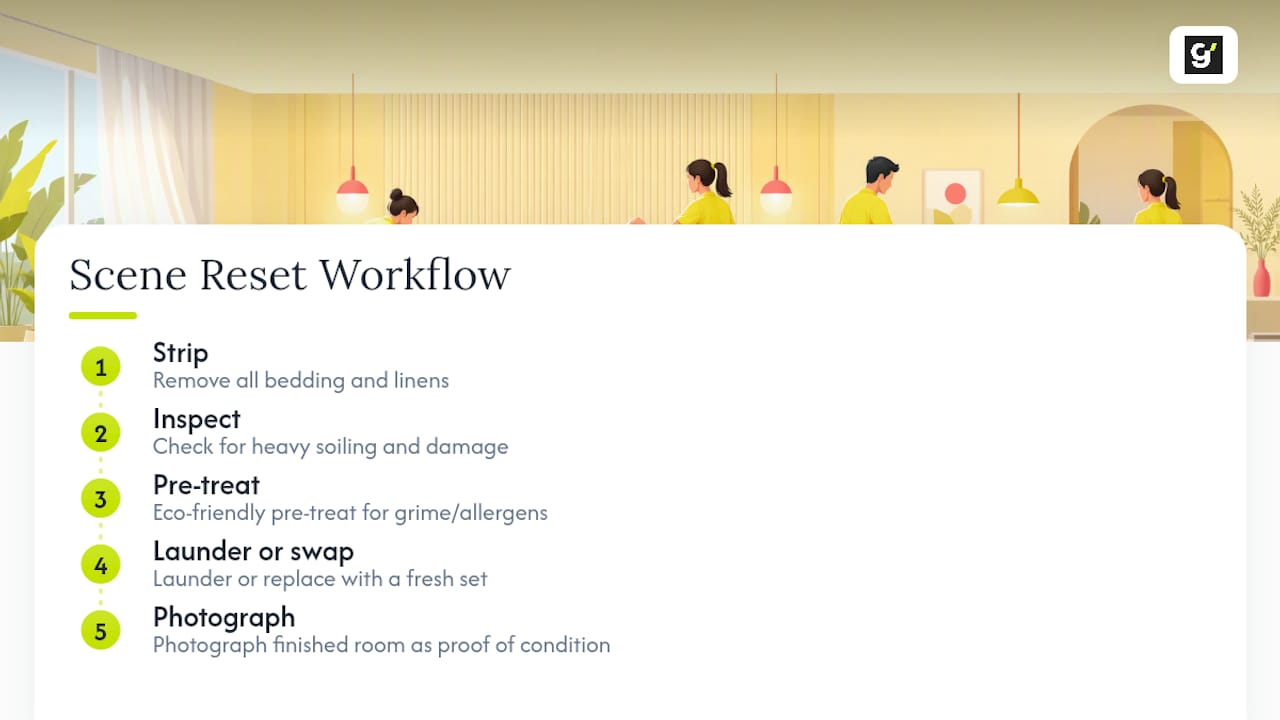
Some turnovers go beyond a strip-and-wash routine, particularly after a rowdy stay, a pet incident, or when you've just finished renovation work and dust has settled into every fibre in the room. That's where a structured protocol like Grimescene's Scene Reset approach earns its place: strip, inspect, pre-treat, launder or swap in a fresh set, then photograph the finished room as proof of condition.
Eco-friendly deep decontamination matters here because it tackles embedded grime and allergens without harsh chemical residue that can irritate the next guest or cleaning staff. If you're facing a one-off heavy clean, a post-construction turnover, or you simply need a guaranteed rapid remediation before a same-day check-in, bringing in a professional service beats stretching your own SOP past its limits.
Matching linen sizes to your actual bed dimensions
Buying the wrong size linen is the single most common mistake new hosts make, usually because they've bought "queen" sheets for a bed that's actually a king, or grabbed a generic size online without checking the mattress depth. Get this wrong and you'll spend every turnover fighting with a sheet that won't tuck.
Standard Australian bed and linen dimensions to work from:
A few things trip hosts up specifically:
- Mattress depth, not just length and width, determines fitted sheet fit. A pillow-top or thick mattress protector adds several centimetres you need to account for
- Duvet covers should be sized to the doona itself, which is often slightly larger than the mattress, not to the mattress dimensions
- If you run mixed configurations (a queen that converts to twins, for example), keep separate labelled sets for each configuration so cleaners aren't guessing on turnover day
- Buy one size up on fitted sheet pocket depth if you're unsure. A pocket too shallow will pop off the corners overnight, and that's a guest complaint waiting to happen
Measure your actual mattresses once, write the numbers down, and hand that list to whoever's ordering replacement stock. It saves an argument with a supplier six months from now.
Detergent, fabric softener and getting the wash chemistry right
The detergent question trips up more hosts than it should. Standard supermarket laundry powder works fine for coloured linens, but whites benefit from an oxygen-based bleach additive rather than straight chlorine bleach, which weakens cotton fibres over dozens of wash cycles and yellows fabric over time.
Fabric softener is where hosts unintentionally sabotage their own towels. Softener coats fibres in a waxy layer that reduces absorbency, which means a "soft" towel that guests actually find less effective at drying them off. Skip softener on towels entirely. Use it sparingly, if at all, on sheets, and never on anything with a fire-retardant or antimicrobial finish, since it can strip those treatments.
A practical detergent routine looks like this:
- Use a standard enzyme-based detergent for the general wash cycle across sheets and towels
- Add oxygen bleach (not chlorine) to every white linen load for stain lift and brightening without fibre damage
- Skip fabric softener on all towels; if you want a softer feel, use half a cup of white vinegar in the rinse cycle instead, which also helps cut detergent residue
- Wash new linen once before first use to remove manufacturing residues and check for shrinkage before it ever reaches a guest
- Keep a separate wash load for anything visibly stained rather than mixing it with a general load, since cross-contamination can spread a stain onto clean items
Get the detergent and softener balance right once and it becomes a non-issue. Get it wrong and you'll spend a year wondering why your towels feel thin and don't dry anyone properly.
Presentation standards that change how guests perceive your listing
Guests judge cleanliness within the first ten seconds of walking into a bedroom, and a crisply made bed reads as clean even before they've checked anything else. You don't need hotel-grade pressing equipment to get there.
Neat folding and tucking of sheets and blankets gives a tidy, deliberate bed appearance without ironing anything. Fold pillowcases with the opening facing away from the door, so the room looks finished rather than half-made from the entrance. For towels, a simple tri-fold or roll placed on the rail looks considerably more polished than a towel dumped flat, and it takes no extra time once your cleaner has the habit.
Ironing is optional but does add a visible lift, particularly on duvet covers and pillowcases, which show wrinkles more obviously than fitted sheets. If you iron anything, prioritise the pillowcases and top of the duvet cover, the two things guests see first, rather than trying to press an entire set.
Small touches compound. A folded hand towel with a fresh soap sitting on top, a bath mat squared to the tub edge, and pillows fluffed rather than flattened all signal the same thing: someone checked this room before you walked in. That perception directly shapes review language, and "clean and well-presented" shows up far more often in five-star reviews than any specific amenity does.
Guest-provided linens and allergy requests: setting a clear policy
Guests occasionally ask to bring their own linen, usually for allergy reasons, and hosts need a clear policy rather than an on-the-spot decision. Generally, allow it. A guest managing a genuine allergy to synthetic fibres, wool, or a specific detergent has every reason to prefer their own bedding, and accommodating this costs you nothing.
Where it gets trickier is liability and cleanliness expectations. State clearly in your house rules or welcome guide that guest-supplied linen isn't laundered or handled by your cleaning team, and that responsibility for it during the stay sits with the guest. This avoids any confusion about whether a stained personal item becomes your problem at checkout.
For guests who disclose an allergy but don't bring their own linen, keep one hypoallergenic set in reserve, laundered in fragrance-free detergent and stored separately from your standard stock. It doesn't need to be your whole inventory, just enough for the occasional request. Mention in your listing description if you can accommodate fragrance-free or hypoallergenic requests, since this small detail influences booking decisions for guests managing sensitivities and rarely gets addressed anywhere else in a listing.
What to do when you run short on linen at the last minute
Every host eventually gets caught short, whether it's a double-booked cleaning slot, a delivery that didn't arrive, or a set that failed stain triage the morning of a check-in. Having a backup plan sorted in advance turns a potential five-star-review disaster into a non-event.
Keep a small emergency reserve, at minimum one extra set per bed type, stored separately from your working par and never touched during normal rotation. This is your break-glass stock, not spare inventory for a busy week.
If the reserve itself runs out, know your fast-sourcing options before you need them: a 24-hour homewares store, a local linen hire company, or a same-day delivery service through a major retailer. Save these contacts in your phone now, not while you're standing in an empty linen cupboard forty minutes before check-in.
For hosts managing multiple properties, a same-day professional turnover service that includes linen supply as part of the job removes this risk entirely, since the linen arrives with the clean rather than depending on your own stock levels. If shortages keep happening, that's usually a sign your par count is too tight for your actual turnover volume, not just bad luck, and it's worth revisiting your numbers from the par calculation above.
Why consistency, not luxury, is what actually protects your reviews
Guests rarely mention thread count in a review. They mention whether the bed felt clean, whether the towels smelled fresh, and whether anything felt off. That's a consistency problem, not a quality-tier problem, and it's the gap most hosts get backwards, chasing better linen when what's actually failing is the system behind it.
Implementing a labelled linen rotation and timely stain treatment improves guest experience more than upgrading linens alone. Both changes cost almost nothing to implement and both are fully within your control this week.
Pick one thing from this guide, your par count, your stain triage timing, or your labelling system, and put it into practice on your very next turnover. Then watch what happens to your review language over the following month.
— Lead
Sources
- Providing essential amenities for guests — Airbnb Help Centre
- Airbnb linens that last: pars, rotation and stain triage — STR Specialist
- Airbnb Linen & Laundry Service Guide — GleamSync
- Linen turnover standards — The Guest Man (Cairns playbook)