
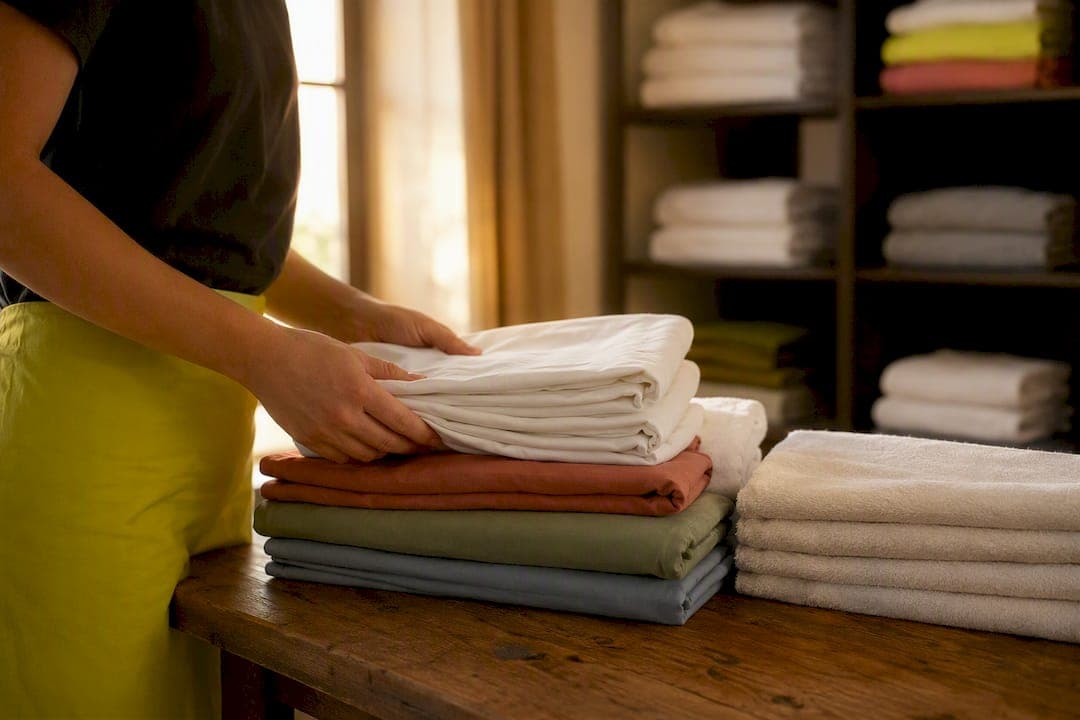
Airbnb's own minimum is thin: one towel, one pillow per guest, and linens for every bed if you've ticked the "essentials" amenity. That's a compliance floor, not an operating standard. Run your property on multiple full linen sets per bed and at least two bath towels per guest in circulation, and you'll stop scrambling on same-day turnovers. Check your linen closet tonight, count what's actually clean and ready, and order whatever's short before your next guest arrives.
TL;DR:
- Keeping at least three linen sets per bed and three towels per guest ensures smooth turnovers and prevents shortages during same-day cleaning cycles.
- Using 600-800 GSM towels provides a plush feel while allowing enough drying time between guests, with a minimum of two towels per guest as a basic standard.
- Standardizing on a small range of quality linens and retiring sheets after roughly 200 wash cycles prolongs fabric life and maintains a premium guest experience.
- Outsourcing linen cleaning is more cost-effective and less labor-intensive once managing three or more properties or frequent same-day turnovers.
- Implementing a strict stain triage process and clear storage labeling helps extend linen lifespan and prevents damage caused by improper handling or delays.
Table of Contents
- What are Airbnb's actual linen requirements?
- How many linen sets should you keep per bed?
- What linen quality actually holds up for rental use?
- How many towels does an Airbnb need, and what GSM matters?
- In-house laundry vs a linen service: which model fits your portfolio?
- What's the right stain triage process to save damaged linen?
- How should you store and label linen to stop mixups?
- What should you ask a linen service before signing on?
- How does a professional turnover protocol protect linen life?
- What actually moves the needle when you're running linen at scale
- Get a turnover done properly without owning a single spare sheet
- Sources
What are Airbnb's actual linen requirements?
Airbnb's essentials guidance is specific but sparse. If you list "essentials" as an amenity, Airbnb requires at least one towel and one pillow per guest, plus linens for each bed in the listing. Advertise essentials and fail to deliver them, and you risk a platform penalty, not just a bad review.
That's the legal floor. It's not what earns five stars.
Guests judging a listing in the first ten minutes look at two things above almost everything else: how the bed looks and whether the towels feel right. A single flat sheet and one thin pillow per person technically satisfies Airbnb. It also reads as bare minimum to anyone who's stayed in a property that tried harder. The gap between "compliant" and "impressive" is small and cheap to close.
A few upgrades cost little and move guest perception a lot:
- An extra pillow per bed (four instead of two on a queen) signals comfort, not just occupancy.
- Two bath towels per guest instead of one removes the "am I meant to reuse this" awkwardness.
- A folded hand towel and face washer in the bathroom, even if unlisted, read as thoughtful rather than obligatory.
- Spare blanket in a cupboard for climate‑sensitive guests avoids the 11pm "we're cold" message.
Hosts who add these small extras consistently see fewer cleanliness complaints in reviews, because reviews GuestReady tracks show guests judge cleanliness by bedding and towels before anything else in the property. A listing with visibly generous linen counts also photographs better, which matters before a guest ever checks in.
How many linen sets should you keep per bed?
Par level is the number of complete sets you need in rotation to never run short, and the industry answer for short-term rentals is consistent: multiple sets per sleeping surface. One set is on the bed, one is in the wash or with your laundry provider, and one is a clean spare sitting on the shelf in case a turnover happens faster than the wash cycle allows. Operational guidance from STR Specialist treats this 3x figure as the baseline any host running same-day turnovers should hold, alongside three towels per guest capacity.
Working out your own numbers takes five minutes with a calculator:
- Count sleeping surfaces (not bedrooms) across every bed size in the property.
- Multiply by three to get your total linen sets needed for that bed size.
- Repeat for towels: multiply your maximum guest capacity by three.
- Add a 20% safety buffer on top of that total to cover slow-drying loads, stray stains that pull a set from rotation, or a laundry provider running a day late.
- Round up to the nearest full set, never down.
For a two-bedroom, one-bathroom unit sleeping four (one queen, two singles), that's three sleeping surfaces, so nine sheet sets and nine pillowcase sets, plus twelve towels (four guests times three).
A three-bedroom, two-bathroom house sleeping eight scales up fast: five sleeping surfaces (assume two queens, one king, two singles counted as separate beds) means fifteen sheet sets, and twenty-four towels before the buffer.
If you run same-day turnovers regularly, or your laundry provider has a 24 to 48 hour lead time, push your buffer closer to 30%. The maths costs nothing; running out of a clean queen sheet set on turnover day costs you a booking.
What linen quality actually holds up for rental use?
Sheets and pillowcases live two lives: they need to feel good enough for a paying guest to photograph and rave about, and they need to survive commercial-strength washing every few days for years. Those two demands pull in different directions, which is why so many hosts overspend on the wrong fabric.
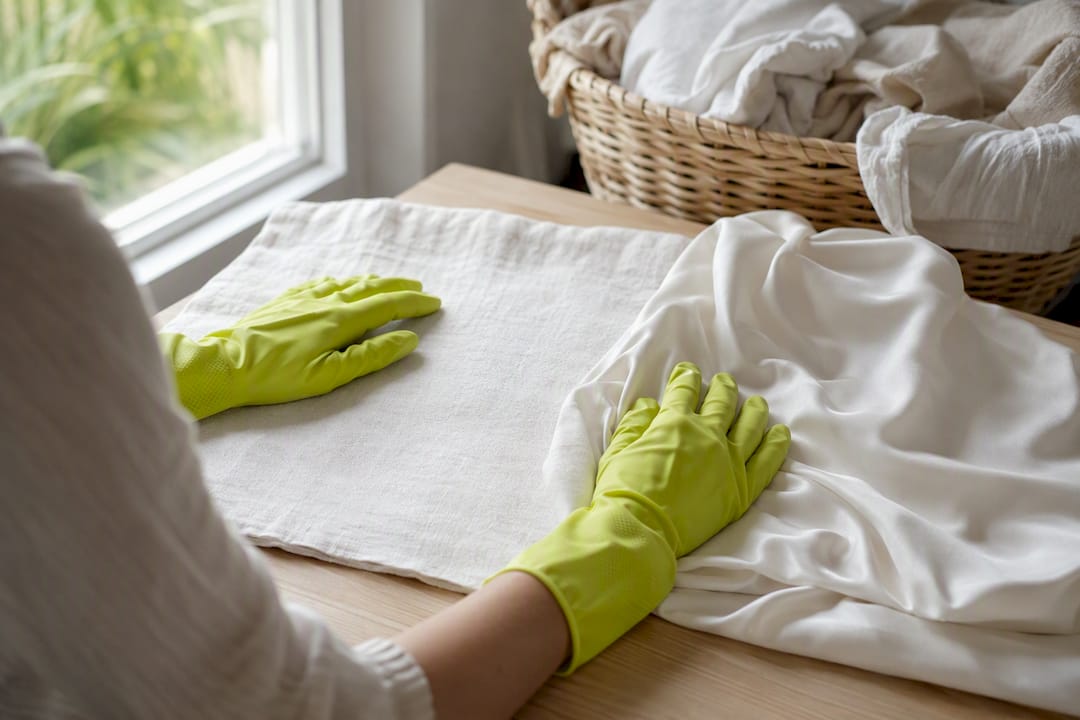
Percale and sateen are the two weaves you'll choose between. Percale has a crisp, matte, hotel-sheet feel and tends to breathe better in warm climates. Sateen has a subtle sheen and a softer drape but traps more heat. For guest rooms, 200 to 400 thread count percale or 300 to 500 thread count sateen sits in the sweet spot: high enough to feel premium, not so high that the weave becomes delicate under repeated commercial washing. Long-staple cotton, whether Egyptian or Pima, resists pilling far better than cheap short-staple blends, which matters more than the thread-count number itself.
Microfibre is worth considering for high-turnover properties or budget-tier listings. It's more durable against abrasion, dries faster, and costs less to replace, though it doesn't breathe as well as cotton and can feel synthetic to guests used to hotel linen.
A few buying rules save headaches down the track:
- Standardise on one or two SKUs per bed size so mismatched sets never end up half-and-half.
- Buy pillowcases and sheets from the same range, so colour and weight stay consistent across sets.
- Retire sheets after roughly 200 wash cycles, when fibres thin and tear risk climbs.
- Avoid anything below 180 thread count. It pills fast and looks tired within months.
Pro Tip: Buy one extra pillowcase for every three sheet sets. Pillowcases wear out faster than fitted sheets because they get washed after every single stay, even on multi-night bookings.
How many towels does an Airbnb need, and what GSM matters?
Towel weight is measured in GSM, grams per square metre, and it's the single biggest driver of how a towel feels versus how long it lasts. Heavier towels feel luxurious but take longer to dry between guests, which matters if your laundry turnaround is tight.
For bath towels, aim for 600 to 800 GSM. That range gives guests the plush, absorbent feel they associate with quality without the excessive drying time of anything heavier. Hand towels can sit lower, at 400 to 600 GSM, since they don't need the same bulk.
On quantity, GuestReady's host guidance recommends two to three towel sets per guest, and STR Specialist's par framework treats three as the safer number once you're running frequent same-day changeovers. Practical minimums to work from:
- Two bath towels per guest as an absolute floor.
- Three per guest in active rotation once you're doing back-to-back turnovers.
- Beach or pool properties need a separate stack of dedicated pool towels, since guests will otherwise use bath towels outdoors and ruin them with sunscreen and chlorine stains.
- Retire towels after roughly 100 to 150 washes, when the loop pile flattens and absorbency drops noticeably.
A simple written log next to your linen shelf, noting purchase date on each set, makes replacement timing far easier than guessing by feel.
In-house laundry vs a linen service: which model fits your portfolio?
Every host eventually faces this decision, and the right answer depends almost entirely on how many units you run and how tight your turnover windows are.
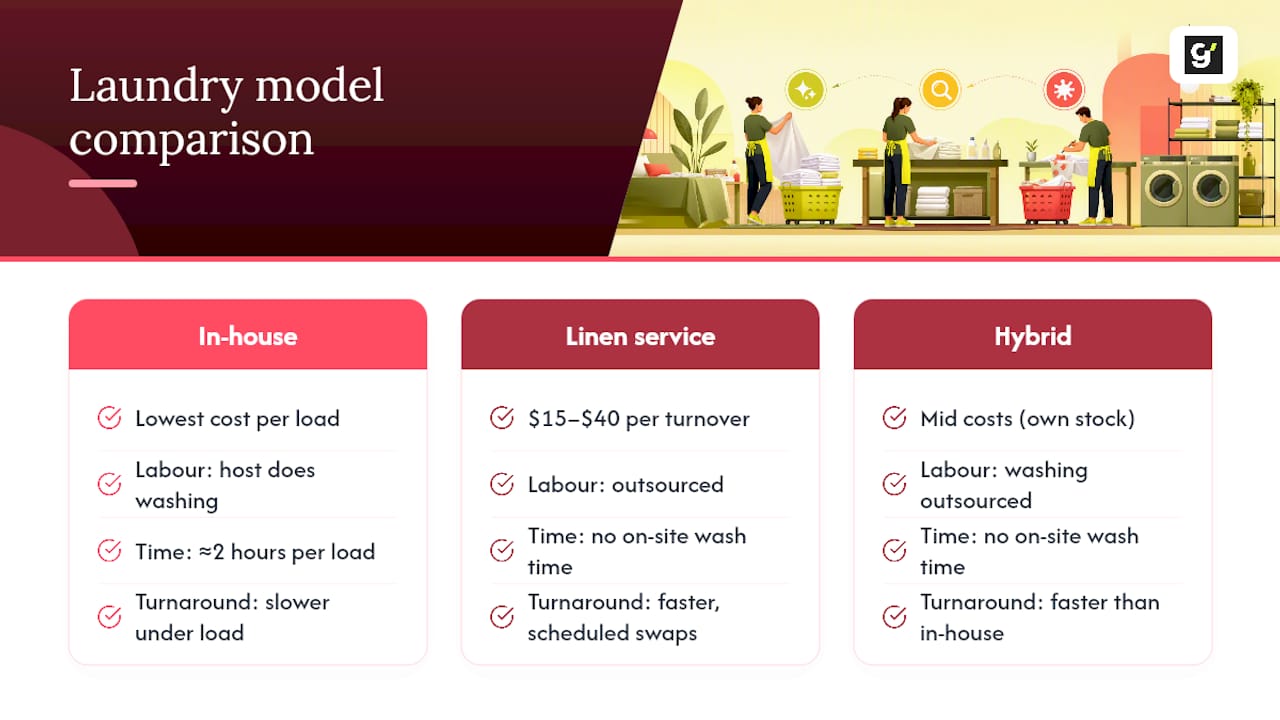
Washing linens yourself keeps costs lowest per load and gives you full control over detergent, water temperature and drying. It works well for one or two properties with a day or more between checkout and check-in. The catch is time and equipment strain: a single load of queen sheets plus towels can run two hours washing and drying, and that's before folding. Run three same-day turnovers in one morning and your washer becomes the bottleneck that delays every cleaner behind it.
A commercial linen service removes that bottleneck entirely. You send dirty linen out, clean linen comes back on a schedule, and your cleaner never touches a washing machine. Cost guidance from The Quote Yard puts typical pricing between $15 and $40 per turnover, depending on property size, linen quality and how the provider structures delivery.
A hybrid model, where you own your linen stock but a laundry service washes it rather than buying and managing their own inventory, splits the difference. You keep control over quality and branding while offloading the labour.
The tipping point is fairly consistent across the industry: once you're managing three or more units, or same-day turnovers become a weekly rather than occasional occurrence, the labour saved almost always justifies the $15 to $40 per-turnover cost. Below that threshold, in-house washing usually still wins on cost. Whichever model you choose, keep your washer running at a proper commercial temperature. Detailed appliance calibration guidance is worth reviewing if your machine hasn't been serviced recently.
What's the right stain triage process to save damaged linen?
Most stained linen gets ruined not by the stain itself but by what happens in the four hours after it's stripped from the bed. A wine stain that sits in a laundry bag overnight sets permanently. The same stain, caught and pre-treated within an hour, often washes out clean.
A workable stain triage SOP looks like this:
- Inspect every item at strip time, before it goes into the laundry bag, and tag anything stained with a reusable clip or marker.
- Pre-treat within four hours of stripping, using a stain-specific treatment rather than throwing it straight into a general wash.
- Separate stained items from the general wash load and run them on a cycle suited to that stain type (protein stains need cold water first; oil-based stains need enzyme detergent and warmer water).
- Never tumble-dry a stained item until the stain is confirmed gone. Heat sets whatever's left permanently.
- Log any item that gets pulled for the same stain type twice. Repeat offenders are candidates for retirement or a guest damage charge.
Rotation matters as much as triage. Label your sets A, B and C and cycle through them in strict order rather than always grabbing whichever set is closest on the shelf. STR Specialist's rotation data suggests a proper FIFO system adds 20 to 25% extra life to your linen stock simply by spreading wear evenly instead of hammering the same favourite set every week.
Pro Tip: Give your cleaner a laminated stain-triage card that lives in the laundry bag itself. Written instructions taped to the wall get ignored; instructions physically attached to the dirty linen get followed.
How should you store and label linen to stop mixups?
A locked spare closet, a consistent labelling code and a weekly count are the three things that separate a smooth linen operation from one where cleaners are texting you mid-turnover asking where the queen sheets are.
Label every set with a simple three-part code: property abbreviation, bed size, and set letter (for example, "OAK-Q-B" for a queen set at your Oak Street property, set B). Store folded sets with the pillowcase tucked inside the fitted sheet so a full set moves as one unit rather than three separate items a cleaner has to hunt for.
Shelve by type, not by property, if you manage multiple units from one storage point. That keeps rotation visible at a glance.
Keep a minimal spreadsheet with four columns: item type, current count, purchase date, and estimated wash cycles to date. Update it weekly, not monthly. Inventory tracking guidance from STR Specialist treats this weekly cadence, paired with a locked spare closet, as the difference between catching a shortage before a turnover and discovering it during one.
What should you ask a linen service before signing on?
Not every provider structures pricing or service the same way, and the differences matter more than the headline dollar figure. Ask these questions before comparing quotes:
- What's the replacement policy for damaged or lost items, and who absorbs that cost?
- Do they offer a choice of fabric quality, or is it one standard grade across all clients?
- Are they insured for loss or damage during transit and washing?
- What's the delivery schedule, and can it flex for a same-day emergency turnover?
- Is pricing per piece or per turnover, and does that change with volume?
Red flags worth walking away from: no written service level agreement, vague language around what happens when linen goes missing, and pricing that seems well below the $15 to $40 typical range, which usually means lower-grade fabric or slower replacement cycles.
If you're coordinating a linen service alongside your own cleaner, agree on a bag-exchange system upfront: dirty linen goes into a marked bag at strip time, clean linen arrives in a separate marked bag, and nobody ever has to guess which is which. This coordination detail matters more on same-day turnovers, where a five-minute mixup can delay a whole check-in. A clear turnover checklist for your cleaner removes most of that friction before it starts.
How does a professional turnover protocol protect linen life?
Grimescene's Scene Reset protocol was built around exactly this problem: linens fail early when turnover cleaning treats them as an afterthought rather than a system. Every strip-and-make gets a stain check first, with anything flagged pre-treated before it goes anywhere near a wash load. Wash temperature and cycle are matched to the fabric and stain type, sets rotate on a labelled A-B-C schedule, and every piece pulled for retirement gets logged rather than silently replaced.
The eco-friendly angle matters here beyond the marketing line. Harsh bleach strips cotton fibres faster than a properly matched enzyme-based, non-toxic treatment does, which means linen washed under a bleach-heavy regime wears out sooner regardless of thread count or GSM. Avoiding repeated chlorine exposure on cotton preserves both the fabric's feel and its lifespan, which is a direct cost saving on replacement cycles over a year of bookings.
For hosts who'd rather not build and monitor this system themselves, Grimescene's short-term rental services fold linen handling into the full turnover, so the stain triage and rotation logic runs automatically every changeover.
What actually moves the needle when you're running linen at scale
The single biggest change most hosts can make isn't buying more expensive sheets. It's standardising SKUs across every property you manage, so a queen fitted sheet from unit A fits perfectly on unit B, and your cleaner never has to guess or improvise mid-turnover. That one decision cuts far more time and stress out of a laundry operation than any thread-count upgrade.
The second is knowing your own tipping point. Somewhere around three units, or once same-day turnovers stop being the exception and start being the Tuesday-to-Friday norm, the maths tips firmly toward outsourcing. Hosts who wait until they're overwhelmed to make that call usually lose a booking or a review first.
Here's a task you can do in the next 48 hours: count every linen set you own right now, compare it against the 3x-per-bed par, and write down exactly what's missing. Most hosts discover they're short by more than they expected.
— Lead
Get a turnover done properly without owning a single spare sheet
If you're managing three or more properties, or your calendar keeps stacking same-day turnovers back to back, the laundry itself becomes the constraint on how many bookings you can accept. Grimescene's deep decontamination and full sweep service handles the entire turnover, including linen handling and restocking, using non-toxic agents that protect fabric life instead of bleaching it thin.

The Scene Reset protocol built into every rental job covers stain triage, correct wash cycles and rotation tracking automatically, so you're not the one checking par levels at 11pm before a check-in. Premium listings benefit particularly, since guests notice linen quality first and Grimescene's process is built to protect that impression stay after stay. If your portfolio has hit the point where laundry is eating hours you'd rather spend on bookings, get a quote through Grimescene's short-term rental services and see what a managed turnover actually costs against what you're spending in time right now.
Sources
- Airbnb help: Essentials
- Airbnb linens that last: pars, rotation and stain triage (STR Specialist)
- Airbnb linen service cost NSW 2026 (The Quote Yard)