
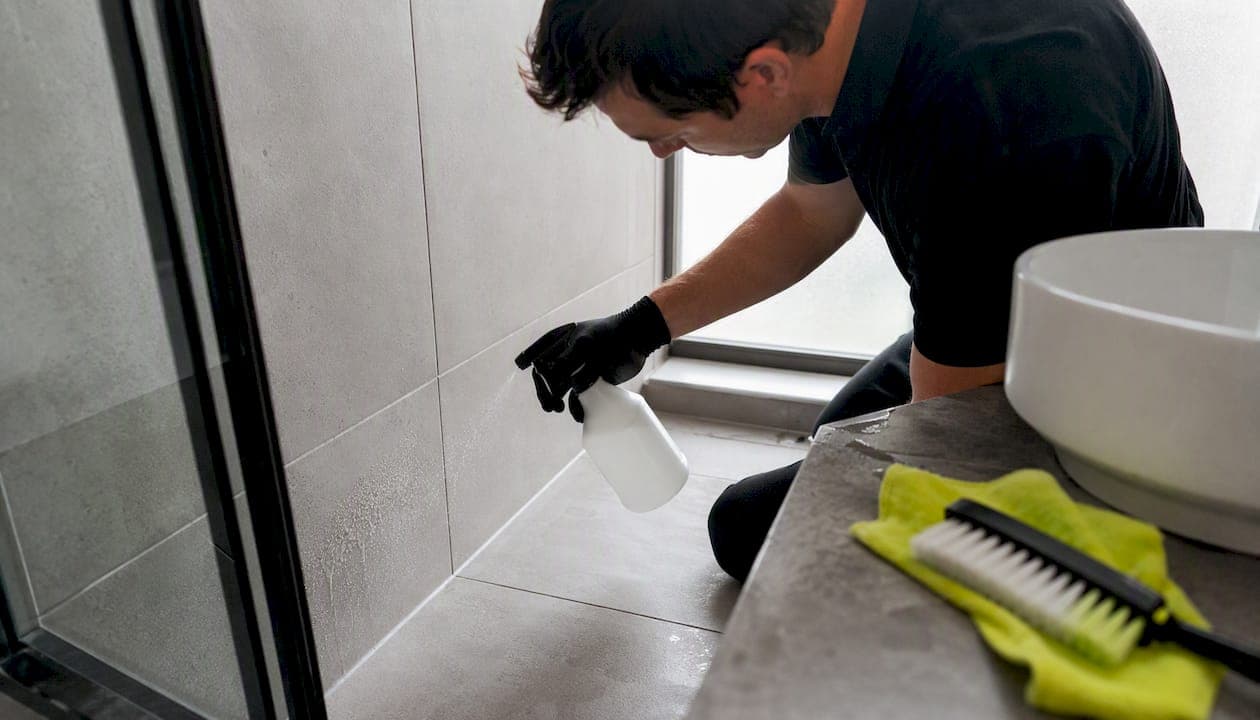
The system that prevents most cleaning complaints is three steps: a standardised room-by-room checklist, photo-verified inspection at every turnover, and a two-hour remediation protocol when something slips. Hosts who run all three consistently see fewer disputes, faster complaint resolution, and ratings that hold up under volume. Start today by updating your listing to mention your cleaning process, handing your cleaner a short checklist, requiring three photo check-ins per turnover, and setting a two-hour response window for any cleanliness issue raised at check-in.
Quick wins you can action in the next 24 hours:
- Reorder your cleaner's task sequence: bathrooms and kitchen before bedrooms and floors
- Add a pre-checkout message asking guests to strip beds and bag rubbish (reduces turnover time by several minutes)
- Set a restocking protocol: toilet paper, soap, and coffee pods checked and photographed before every departure
- Create a three-photo minimum rule: toilet base, shower corner, and under-bed before the cleaner leaves
- Update your listing description to reference your cleaning checklist and photo verification
Table of Contents
- How do cleaning standards affect your star rating and revenue?
- What are the most common guest cleaning complaints, and how do you fix them?
- What does a reliable turnover workflow actually look like?
- How do you train cleaning staff and keep quality consistent?
- How do you handle a cleanliness complaint and recover the review?
- When should you hire a professional cleaning service?
- What should your cleaning templates actually contain?
- Key takeaways
- Grimescene's Scene Reset: professional eco-friendly turnover for Australian hosts
How do cleaning standards affect your star rating and revenue?
Higher cleanliness and review scores directly correlate with the ability to charge more per booking and better placement in OTA search results. On platforms like Airbnb and Booking.com, the cleanliness sub-score feeds directly into your overall rating, and a single point drop can push you below the threshold for Superhost or Preferred Partner status. That is not a minor inconvenience. It affects how often your listing appears, how many guests click through, and whether you qualify for promotional placements.
A single cleanliness complaint in a review can drag your average down for months, particularly on smaller properties with fewer total reviews. Guests read those reviews carefully. Research on review-reading behaviour consistently shows that cleanliness is among the first things prospective guests check, and a negative mention is disproportionately influential compared to praise.
Why the investment in cleaning systems pays off:
- OTA algorithms weight recent reviews heavily, so one bad cleanliness score can suppress visibility for 30–60 days
- Hosts with consistently high cleanliness ratings can command a price premium over comparable listings in the same suburb
- Eligibility for Airbnb Superhost and Booking.com Preferred Partner requires sustained high scores across all sub-categories, including cleanliness
- Cleaning scores influence your Airbnb algorithm ranking directly, not just your reputation
Safe Work Australia also provides practical guidance on staff safety, PPE requirements, and safe chemical handling for cleaning teams. If you employ or contract cleaners, understanding those obligations protects both your staff and your business.
What are the most common guest cleaning complaints, and how do you fix them?
Most complaints cluster around the same dozen failure points. The good news: every one of them is preventable with a targeted checklist item and a photo checkpoint.
| Area | Common complaint | Quick fix | Photo-verify? |
|---|---|---|---|
| Bathroom | Hair on floor, in drain, on surfaces | Lint-roll all surfaces; vacuum then mop; check drain | Yes |
| Bathroom | Grout mould, soap scum | Spray and scrub grout weekly; use squeegee after each clean | Yes (shower corner) |
| Bathroom | Toilet base and behind bowl | Dedicated brush and cloth for base; wipe behind cistern | Yes (toilet base) |
| Kitchen | Sticky benchtops, splashback grease | Degrease splashback and rangehood filter every turnover | No |
| Kitchen | Fridge interior odour or residue | Wipe all shelves and check for forgotten items | Yes (fridge interior) |
| Bedroom | Under-bed debris, dust bunnies | Vacuum under bed with attachment; check with torch | Yes (under-bed) |
| Bedroom | Stained or odorous linen | Replace mattress protector quarterly; wash at 60°C | No |
| Living areas | Dusty surfaces, skirting boards | Add skirting boards to weekly rotation, not just turnover | No |
| General | Musty or stale odour | Run exhaust fans during clean; use non-toxic odour neutraliser | No |
| General | Missed appliances (microwave, oven) | Add appliance check to appliance cleaning standards checklist | No |
The four items that generate the most disputes are toilet base, shower corner, under-bed, and fridge interior. A detailed checklist with photo verification on high-failure items prevents most of these complaints before a guest ever raises them.
What does a reliable turnover workflow actually look like?
Room cleaning should follow a set order, and that order matters more than most hosts realise. Starting with bathrooms and kitchen while surfaces are still drying means you finish floors last, which is the correct sequence. Skipping the sequence is how items get missed.
| Task | Responsible | Est. time |
|---|---|---|
| Pre-checkout message sent (night before) | Host | 2 min |
| Guest checkout tasks (strip beds, bag rubbish) | Guest | 5 min |
| Entrance and high-touch surfaces (door handles, light switches, remotes) | Cleaner | — |
| Bathrooms (full clean, photo check: toilet base, shower corner) | Cleaner | 20 min |
| Kitchen (appliances, benchtops, fridge, photo check) | Cleaner | 20 min |
| Bedrooms (linen change, under-bed check, photo check) | Cleaner | — |
| Living areas and skirting boards | Cleaner | — |
| Floors (vacuum then mop, all rooms) | Cleaner | — |
| Restocking (consumables, linen, amenities) | Cleaner | 5 min |
| Final staging and inspection walkthrough | Cleaner / Host | — |
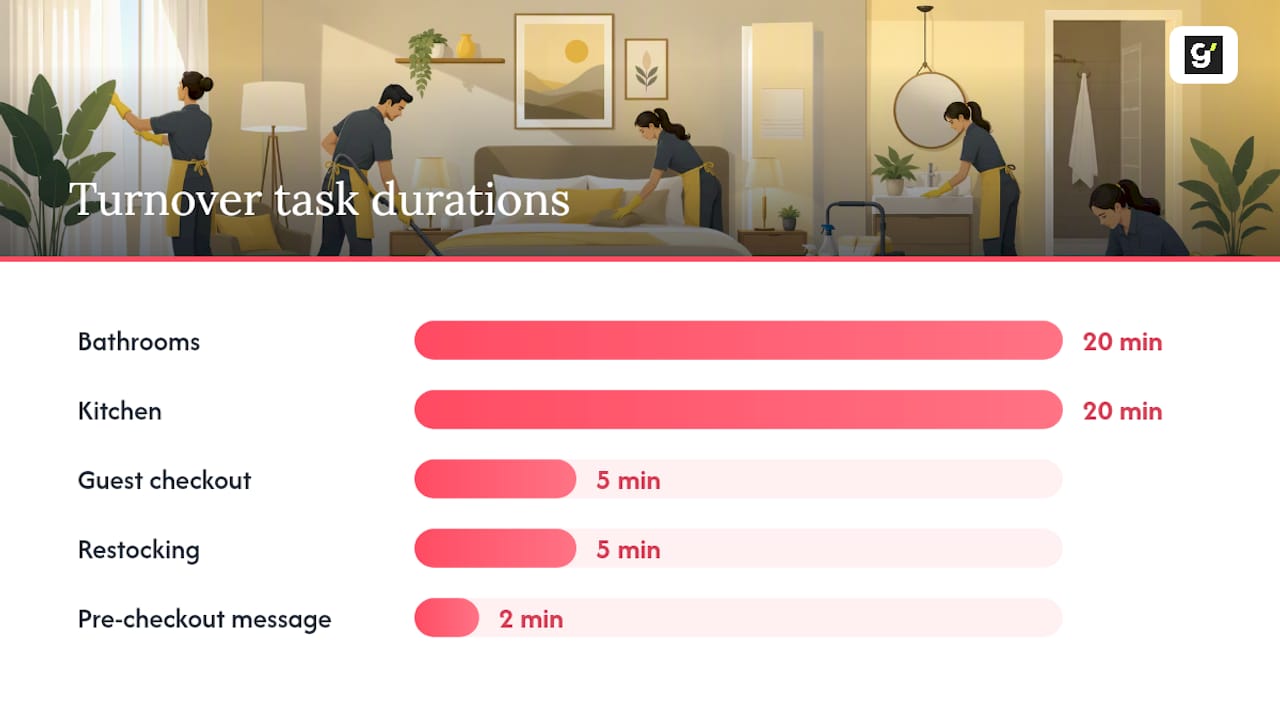
Turnover timing benchmarks run approximately 1.5–2 hours for a one-bedroom property and 3–4 hours for a three-bedroom. If your cleaner is finishing a two-bedroom in under 90 minutes, something is being skipped. Time your turnovers occasionally to validate what is actually happening.
Deep cleans are separate from turnover cleans. Schedule a seasonal deep clean every 90 days to address grout, mattress protectors, rangehood filters, and behind appliances. Turnover cleans maintain the standard; deep cleans reset it.
How do you train cleaning staff and keep quality consistent?
Onboarding a new cleaner without a structured process is how standards drift. The first turnover should always be a shadow shift: the new cleaner works alongside an experienced one, following the checklist item by item. After that, the first three solo turns should include a host or supervisor spot-check.
Onboarding and minimum expectations:
- Provide a printed and digital copy of the room-by-room checklist on day one
- Require photo submission at three minimum checkpoints before leaving the property
- Set clear expectations: restocking accuracy, photo quality (well-lit, full frame), and task sequence
- Review the first three solo turns with the cleaner and score against the inspection template
Inspection and scoring process:
- Daily: review submitted photos for each turnover; flag any missing or low-quality shots
- Weekly: score each cleaner against the inspection template (see Section 9 for fields); share results
- Quarterly: update the checklist using three inputs: guest review themes, cleaner performance data, and any seasonal property changes
Living checklists and photo verification materially reduce guest complaints and stop checklist effectiveness from degrading over time. A checklist that never changes stops being useful within a few months because it stops reflecting what guests are actually complaining about.
Pro Tip: Tie a small performance bonus to a cleaner's monthly inspection score rather than to hours worked. It shifts the incentive from speed to quality, which is exactly what you need during high-occupancy periods.
How do you handle a cleanliness complaint and recover the review?
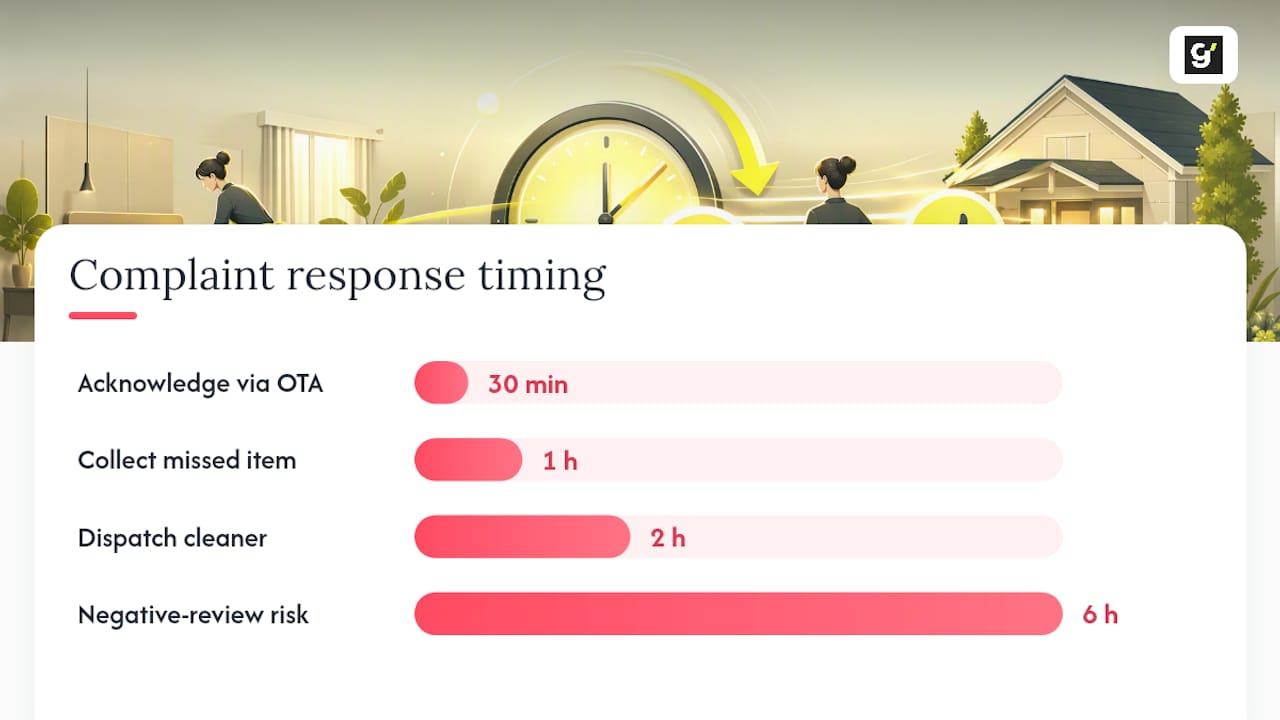
Speed is the variable that determines whether a complaint becomes a one-star review or a five-star recovery story. An immediate, tangible fix often converts a complaint into a positive outcome. Guests who feel heard and helped within two hours rarely leave negative reviews; those who wait six hours almost always do.
Step-by-step complaint response workflow:
- Acknowledge within 30 minutes via the OTA messaging platform
- Apologise specifically (name the issue, not a generic "sorry for any inconvenience")
- Confirm the fix: state exactly what will happen and when (e.g. "a cleaner will be there within two hours")
- Act: dispatch a rapid-response clean or send the host to address the issue immediately
- Follow up after the fix to confirm the guest is satisfied
- Log the incident: what was missed, which cleaner, which checklist item, and what was changed
Sample responses you can adapt:
Hair found in bathroom: "Thank you for letting us know straight away. We're sorry that was missed. A cleaner will be with you within two hours to re-clean the bathroom completely. We'll also review our inspection process for this property."
Odour complaint: "We're sorry the property wasn't fresh on arrival. We're sending someone now to ventilate the space and treat the source. Please let us know if there's anything else we can do to make your stay comfortable."
Missed item (e.g. dishes left in dishwasher): "Apologies for that oversight. We'll have someone collect those within the hour. In the meantime, please feel free to use the kitchen as needed."
A unified reviews dashboard that pulls feedback from multiple platforms speeds response time and helps identify cleaning trends across properties. If the same issue appears across three consecutive reviews, it is a system failure, not a one-off.
When should you hire a professional cleaning service?
Some situations are beyond what a casual cleaner or self-managed turnover can reliably handle. Knowing when to bring in professionals saves your ratings and, often, your sanity.
Clear triggers to hire a professional service:
- Two or more cleanliness complaints in a single month
- High-turnover periods (school holidays, long weekends) where internal capacity can't keep up
- Post-construction or renovation residue requiring specialist treatment
- Mould, grout staining, or odour problems that have persisted through multiple standard cleans
- Bio-hazard incidents (sewage, pest activity, significant bodily fluid exposure)
- End-of-lease or pre-sale deep cleans where presentation is critical
What to expect from a professional vendor in Australia:
Professional short-term rental cleaning services in Australia typically offer fixed-price turnover packages and hourly deep-clean rates. Rapid-response options (two-hour tactical cleans) are available from specialist providers and are worth having on standby for complaint situations. When briefing any vendor, request photo verification as a standard deliverable, confirmation of eco-friendly or non-toxic agents, and a clear remediation SLA.
Pro Tip: Brief your vendor with the same checklist your internal cleaners use. A professional team working from your checklist produces consistent results; a professional team working from their own generic list may miss your property's specific failure points.
For hosts managing types of rental reset protocols, understanding the difference between a turnover clean and a full Scene Reset helps you book the right service for the situation.
What should your cleaning templates actually contain?
Templates are only useful if they are specific enough to be followed without interpretation. Generic checklists get ignored; itemised ones with photo checkpoints get used.
Room-by-room checklist (printable/PDF):
- Each room listed separately with individual task items (not "clean bathroom" but "scrub toilet base, clean behind cistern, wipe mirror, squeegee shower screen")
- Photo checkpoint markers on high-failure items: toilet base, shower corner, under-bed, fridge interior
- Restocking section: quantities for each consumable (e.g. "2 toilet rolls per bathroom")
- Scoring column: pass/fail or 1–5 for each item, completed by the inspector
Inspection log fields:
| Field | Purpose |
|---|---|
| Property address | Identifies the specific listing |
| Cleaner name | Tracks individual performance over time |
| Turnover date and time | Flags timing anomalies |
| Photo checkpoint status | Confirms verification was completed |
| Items flagged | Records what was missed or substandard |
| Score | Weekly and quarterly performance tracking |
| Action taken | Documents corrective steps |
Guest-response script templates:
- Rapid remediation script: for complaints raised within two hours of check-in; focus on speed and specifics
- Refund/partial credit script: for complaints where a fix wasn't possible in time; acknowledge, compensate, and close
- Apology and fix script: for post-stay review responses; thank the guest, acknowledge the failure, state the corrective action taken
All three templates work best as editable PDFs or a shared Google Doc your team can access from their phone during a turnover.
Key takeaways
Maintaining guest review cleaning standards requires a standardised checklist, photo-verified inspections, and a two-hour remediation protocol working together as a single repeatable system.
| Point | Details |
|---|---|
| Implement checklist and photo verification | Use a room-by-room checklist with photo checkpoints on toilet base, shower corner, under-bed, and fridge interior at every turnover. |
| Set a two-hour remediation SLA | Respond to cleanliness complaints within 30 minutes and dispatch a fix within two hours to recover the guest experience. |
| Log and iterate from reviews | Update your checklist quarterly using guest review themes, cleaner scores, and seasonal property changes. |
| Present cleaning in your listing | State your checklist and photo verification process specifically in your listing description and check-in message to reduce complaints before they happen. |
| Grimescene for high-risk situations | Book Grimescene's Scene Reset or rapid-response service when complaints repeat, turnover volume spikes, or a deep decontamination is needed. |
The cleaning system that actually holds up under pressure
Most hosts focus on the checklist and forget the feedback loop. A checklist without quarterly updates based on actual guest complaints is just a document that makes you feel organised. The properties that consistently hold five-star cleanliness scores are the ones treating their checklist as a living system: every negative review triggers a checklist review, every complaint gets logged, and every cleaner gets scored.
Photo verification is the piece most hosts underinvest in. It is not about distrust. It is about having a record that protects you in a dispute and a data set that tells you which cleaner needs retraining and which room is your persistent failure point. Score those photos weekly and you will know more about your property's cleaning performance than most professional hotel operators know about theirs.
The other thing worth saying plainly: speed of response matters more than the complaint itself. A guest who gets a fix within two hours almost never writes a bad review. A guest who waits six hours almost always does. Build the two-hour SLA into your process before you need it, not after a one-star review forces your hand.
Grimescene's Scene Reset: professional eco-friendly turnover for Australian hosts
Repeated complaints and busy turnover periods are exactly where self-managed cleaning systems break down. Grimescene's Scene Reset protocol is built for short-term rental hosts who need a reliable, photo-verified turnover without the chemical residue that irritates guests with sensitivities. Every clean uses non-toxic, bleach-free agents that neutralise buildup rather than masking it, which means the result holds up between stays rather than fading by day two.
For hosts who need an immediate fix, the rapid-response two-hour tactical clean is available for complaint situations and emergency turnovers. For properties that need a full reset after a difficult guest, a long vacancy, or a mould or odour problem, the deep decontamination service covers every surface with photo verification included. Recurring turnover schedules, linen rental, and consumable restocking are available through Grimescene's short-term rental service.
Book a service or get a quote at grimescene.services.
Useful sources
- Hotel reputation management software
- GuestTouch — reviews dashboard
- Cleaning standards in hotels: Protocols and benefits | Mews
- Cleaning standards that guarantee 5-star reviews
- The Airbnb cleaning checklist that keeps your reviews at five stars | GuestIntro Blog
- Safe Work Australia