

Six actions prevent the vast majority of bad cleaning reviews before they ever get written: a room-by-room pre-departure checklist, timestamped photo verification, an SMS feedback trigger 30 minutes after job completion, a first response within 15 minutes of any complaint, a clear partial-refund policy, and monthly quality audits. Apply even three of these consistently and the pattern of avoidable one-star reviews breaks quickly.
The evidence backs the timing piece hard. SMS surveys sent shortly after job completion achieve significantly higher response rates compared with batch email surveys. That gap is the difference between catching a problem while the cleaner is still nearby and reading about it on Google three days later. Start this week: add a single photo-upload step to your job-completion workflow and set one automated SMS trigger.
Table of Contents
- What does a pre-service checklist actually prevent?
- How do you time review requests to capture praise and catch problems early?
- How should you respond to a complaint before it becomes a public review?
- When should you offer compensation or a partial refund?
- What quality-control systems stop recurring negative reviews?
- Why does eco-friendly deep decontamination reduce complaints?
- Short-term rental turnover tactics that protect your listing rating
- When should you escalate to professional remediation instead of re-cleaning?
- Key takeaways
- Why trust beats perfection in cleaning services
- Grimescene: eco-friendly remediation for hosts and property managers
- Useful sources and further reading for Australian operators
What does a pre-service checklist actually prevent?
Most negative cleaning reviews trace back to a handful of missed items: hair in bathroom drains, grime inside appliances, dust under furniture, and smudged light switches. A room-by-room verification routine catches these before the client ever sees them.
Before leaving any property, verify:
- Bathrooms: drain clear of hair, toilet rim and base wiped, mirror streak-free, surfaces dry
- Kitchen: inside microwave and oven wiped, stovetop degreased, sink drain clear, benchtops free of residue
- Bedrooms: under-bed dust check, light switches and door handles wiped, wardrobe interiors spot-checked
- Living areas: skirting boards, ceiling fan blades, behind furniture, odour check throughout
- Entry and laundry: floor mopped to the door edge, lint trap cleared, bins emptied
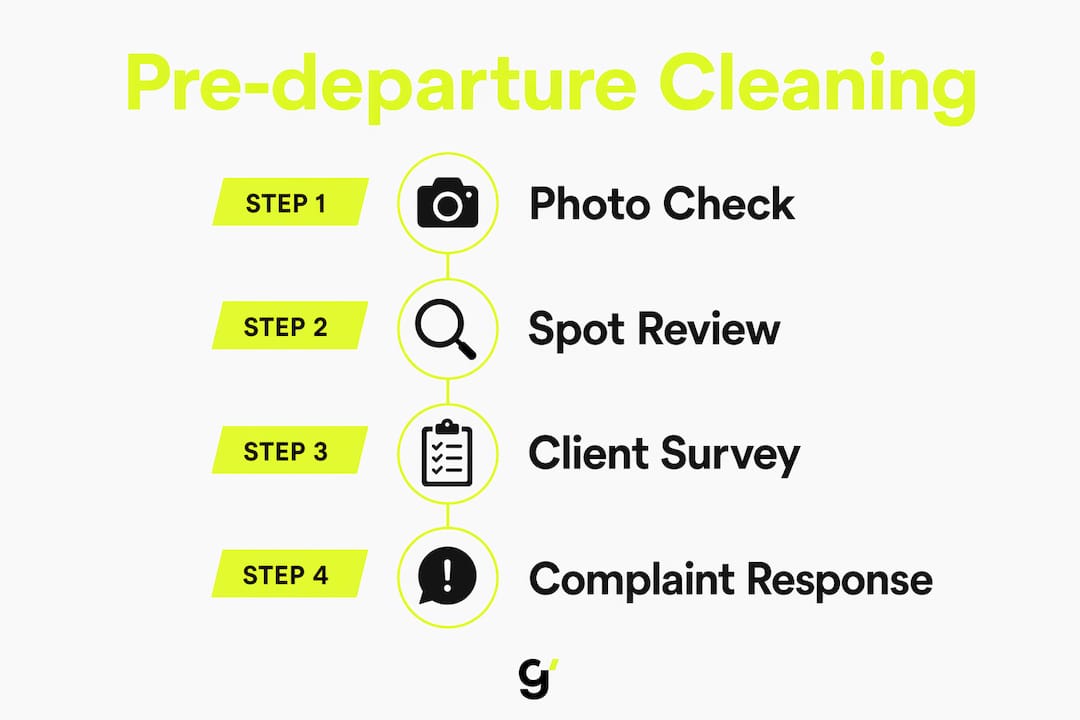
Photo verification with timestamped images and a 60–90 minute review window before check-in significantly reduces last-minute problems and public complaints. Upload photos of the bed, bathroom, and kitchen before marking the job complete. This creates a closed record that protects both the cleaner and the operator.
Pro Tip: Require a short photo set (three to five images) plus a one-line completion note from the cleaner. If a complaint comes in, you have a timestamped record to review before responding.
For a deeper look at the spots most often missed, Grimescene's guide to hidden dirty spots at home covers twelve common oversights that reliably trigger complaints.
How do you time review requests to capture praise and catch problems early?
Timing is the single biggest lever in review management. Solicit feedback immediately after a positive transaction — the window closes fast.
| Trigger | Channel | Timing | Action |
|---|---|---|---|
| Job marked complete | SMS survey | 30 minutes post-completion | Two-question survey: overall rating + one improvement prompt |
| Score 4 | Automated follow-up | Within 2 hours | Invite to leave a public review on Google or relevant platform |
| Score ≤ 3 | Human escalation | Within 15 minutes | Named team member contacts client directly |
| No response | Email follow-up | — | Single reminder, no pressure |
Two-question surveys outperform long forms because they reduce friction and produce a clear signal: a rating plus one open field. The rating routes the client; the open field gives you training material.
Write every score back into your CRM so poor scores automatically trigger a corrective action ticket and flag the cleaner for coaching. Without that write-back step, the data sits in a survey tool and changes nothing.
Pro Tip: Never ask for a review in the same message as the satisfaction survey. Send the survey first, confirm the client is happy, then send the review invitation as a separate message.
Actively asking for reviews after positive interactions and responding to negative ones publicly demonstrates accountability and builds the review volume that offsets the occasional low score.
How should you respond to a complaint before it becomes a public review?
Respond within 15 minutes to acknowledge the issue and offer a concrete remedy. Follow-up action within an hour improves recovery significantly.
A complaint response that works follows this sequence:
- Acknowledge immediately. "Thank you for letting us know. I'm sorry this wasn't right — that's not the standard we hold ourselves to."
- Name a specific fix. "I can have a cleaner back to you within [X hours], or I can arrange a credit of [amount] applied to your next service — whichever works better for you."
- Explain what changes. "I'll review the job record and brief the team today so this doesn't happen again."
- Confirm the outcome. Follow up after the re-clean or credit is applied to confirm the client is satisfied.
Never blame the cleaner, cite a tight schedule, or dispute the client's account publicly. Offer a concrete proactive fix — a re-clean at a specific time or a pre-emptive credit — and explain the process change made to prevent recurrence. That combination is what turns a detractor into a neutral or even a promoter.
When to escalate beyond the standard template: send a branch manager when the complaint involves biological contamination, significant property damage, or a repeat failure at the same property. Log every formal incident in the CRM for training review.
When should you offer compensation or a partial refund?
Partial refunds are a reasonable mitigation for legitimate cleanliness failures. Typical practice is a credit equal to 15–30% of one night's rate or a proportionate portion of a single service fee, varying with issue severity.
| Scenario | Recommended remedy |
|---|---|
| Minor lapses (such as one missed item, quickly fixed) typically merit a modest credit on the next service. | |
| Clear substandard cleans (multiple failures) may warrant a partial credit or re-clean plus a small credit. | |
| Significant failure (odour, biological, structural grime) | Full re-clean at no charge, consider additional credit |
| Repeat failure at same property | Re-clean plus credit, mandatory audit, escalate to manager |
A $40–$80 credit on a $300 service is a fraction of what a single public one-star review costs in lost future bookings. The maths are straightforward.
Pro Tip: Record every compensation payment and its reason in the CRM. If the same issue triggers credits three times in a row, that's a training problem, not a one-off. Spotting the pattern early stops you overpaying for a recurring cause.
What quality-control systems stop recurring negative reviews?
Consistent outcomes require three things working together: written SOPs that define "done," photo verification at job completion, and measurable audits that feed back into training.
SOPs for high-risk items should define the exact standard:
- Shower drains: hair-free, no soap scum ring, water drains freely
- Inside appliances: microwave interior wiped, oven racks removed and cleaned, fridge shelves wiped if included in scope
- Upholstery: vacuumed including under cushions, spot-treated for visible marks
Track these four metrics to know where your system is breaking down:
| Metric | What it tells you | Review cadence |
|---|---|---|
| Survey response rate | Whether clients are engaging with feedback requests | Weekly |
| Detractor rate (scores ≤ 3) | Frequency of serious dissatisfaction | Weekly |
| Average time-to-recovery | How fast complaints are resolved | Weekly |
| Cleaner quality score | Individual performance patterns | Monthly |
73 % of repeat cleaning service users say trust drives loyalty and 67 % are willing to pay around 10 % more for exceptional customer experience. Investing in audit cadence pays back in retention, not just reputation.
Run weekly random photo checks, monthly deep audits across a sample of jobs, and quarterly training refreshes. Assign ownership clearly — a quality audit with no named owner doesn't get done. For practical guidance on briefing and auditing cleaners, Grimescene's guide to managing cleaning contractors covers the operational side in detail.
Why does eco-friendly deep decontamination reduce complaints?
Quick turnovers miss the grime sources that generate recurring complaints: odour trapped in soft furnishings, grease behind appliances, mineral build-up in coffee machines, and mould beginning behind tiles. A standard re-clean passes over these. A targeted deep decontamination addresses them.
Grimescene's non-toxic agents neutralise buildup rather than masking it, which means the odour or residue that prompted the original complaint doesn't return two weeks later. That distinction matters for short-term rentals especially, where the same guest-facing failure can repeat across multiple bookings before anyone identifies the root cause.
Eco-friendly deep decontamination isn't a premium add-on — it's the step that breaks the cycle of recurring complaints. When a property keeps generating odour or residue complaints despite regular cleaning, the issue is almost always a contamination source that surface cleaning can't reach.
Grimescene's Scene Reset protocol applies this logic directly to rental turnovers: a guaranteed deep-clean standard that protects host ratings by addressing the hidden sources, not just the visible surface. For hosts, the connection between cleaning depth and listing performance is direct — cleaning affects your Airbnb algorithm ranking in ways a single low cleanliness score can compound quickly.
Short-term rental turnover tactics that protect your listing rating
A two-layer approach prevents the most common review-trigger failures: a fast pre-check before every guest arrival, plus a scheduled deep decontamination every four to six turnovers.
Pre-arrival turnover checklist:
- Timestamped photos of bed, bathroom, and kitchen uploaded before check-in window opens
- All appliances checked and wiped inside
- Linen protocol confirmed (no stains, correct fold, spares in place)
- Pre-check-in buffer of at least 60 minutes between cleaner departure and guest access
- Odour check in every room, windows cracked if needed
Guest communication template (pre-arrival): "Welcome! The property has been freshly prepared for your stay. If anything isn't right when you arrive, please message us immediately — we can usually have someone with you within two hours."
Guest communication template (mid-stay check-in): "Checking in to make sure everything is comfortable. Any feedback at all, we'd love to hear it now so we can sort it straight away."
When to send a rapid-response tactical clean versus scheduling a deep decontamination: if the issue is a single missed item or a surface-level complaint, a rapid-response tactical clean resolves it. If the complaint involves persistent odour, recurring stains, or biological contamination, that's a remediation job. For hosts wanting to understand how professional cleaning boosts occupancy rates, the link between turnover reliability and booking performance is well documented.
When should you escalate to professional remediation instead of re-cleaning?
| Trigger | Recommended action |
|---|---|
| Visible residue or odour after a standard re-clean | Schedule deep decontamination |
| Recurring stain in same location across multiple cleans | Investigate substrate; escalate to remediation |
| Biological contamination (mould, sewage, pest evidence) | Professional remediation, notify client immediately |
| Post-construction grime or renovation dust | Full deep decontamination before any occupancy |
| Slow drains despite regular cleaning | Build-up remediation, not a surface re-clean |
Document the decision and the reason in writing, then notify the client promptly. A message that says "we've identified a deeper issue and are escalating to remediation — here's what that involves and the timeline" preserves trust far better than a second failed re-clean.
Pro Tip: If a property generates three complaints in the same category within 60 days, treat it as a remediation trigger, not a cleaning performance issue. The problem is structural, not operational.
Key takeaways
Preventing bad cleaning reviews comes down to one principle: fix the problem before the client has a reason to write about it, using photo verification and a 30-minute SMS feedback loop as your first line of defence.
| Point | Details |
|---|---|
| Photo verification first | Upload timestamped photos before marking any job complete — this is the single highest-ROI operational change. |
| 30-minute SMS feedback | Event-triggered SMS surveys achieve 35–45% response rates versus 8–12% for batch email, catching problems while they're still fixable. |
| Respond within 15 minutes | Acknowledge any complaint fast and offer a concrete remedy within an hour to prevent escalation to a public review. |
| Partial refund decision rule | Minor lapse: partial refund; clear substandard clean: 15–30% of one service rate or a re-clean plus credit. |
| Grimescene Scene Reset | For rental turnovers and recurring complaints, Grimescene's Scene Reset protocol addresses hidden contamination sources that standard re-cleans miss. |
Why trust beats perfection in cleaning services
The conventional wisdom in reputation management is that you need to be perfect to get good reviews. That's not quite right. What the data actually shows is that clients forgive mistakes — what they don't forgive is silence, deflection, or a second failure in the same spot.
73% of repeat cleaning clients say trust drives their loyalty. Trust isn't built by never making a mistake; it's built by how you respond when you do. A 15-minute acknowledgement and a genuine offer to fix the problem converts most detractors before they ever open a review platform.
The deeper point is that negative reviews, handled well, can actually strengthen credibility. A business with 200 reviews and a handful of thoughtful responses to criticism looks more credible than one with 50 perfect scores and no engagement. Use detractor feedback as training inputs, not reputational liabilities. The operators who build the strongest review profiles are the ones who treat every complaint as a system signal, not a personal attack.
Grimescene: eco-friendly remediation for hosts and property managers
Grimescene delivers what a standard re-clean can't: targeted, non-toxic deep decontamination that eliminates the hidden contamination sources driving repeat complaints. For short-term rental hosts, the Scene Reset protocol guarantees a clean that protects your listing rating, not just one that looks right on the surface.
Whether you need a rapid-response tactical clean to recover a guest experience fast, or a full deep decontamination to break a cycle of recurring complaints, Grimescene's eco-friendly protocols are available for residential, commercial, and short-term rental properties across Australia. Book directly through the service pages or contact the team to discuss your property's specific needs.
Useful sources and further reading for Australian operators
| Source | What it supports |
|---|---|
| US Tech Automations — Cleaning Survey Automation | SMS survey timing, high response rate data, CRM escalation guidance |
| Properly Blog — Guest Cleaning Complaints | Response timelines, partial-refund ranges, complaint-handling templates |
| GuestIntro — Airbnb Cleaning Checklist | Photo verification and pre-check-in buffer guidance |
| Zipdo — Cleaning Industry Customer Experience | Trust and loyalty statistics for repeat cleaning clients |
| U.S. Chamber of Commerce — Customer Reviews | Review timing and solicitation best practices |
| U.S. Small Business Administration — Positive Reviews | Review platform monitoring and response policy guidance |
| business.com — Getting Good Reviews | Active review solicitation and public response strategy |
| Grimescene — Short-Term Rental Services | Scene Reset protocol and rental turnover service options |