

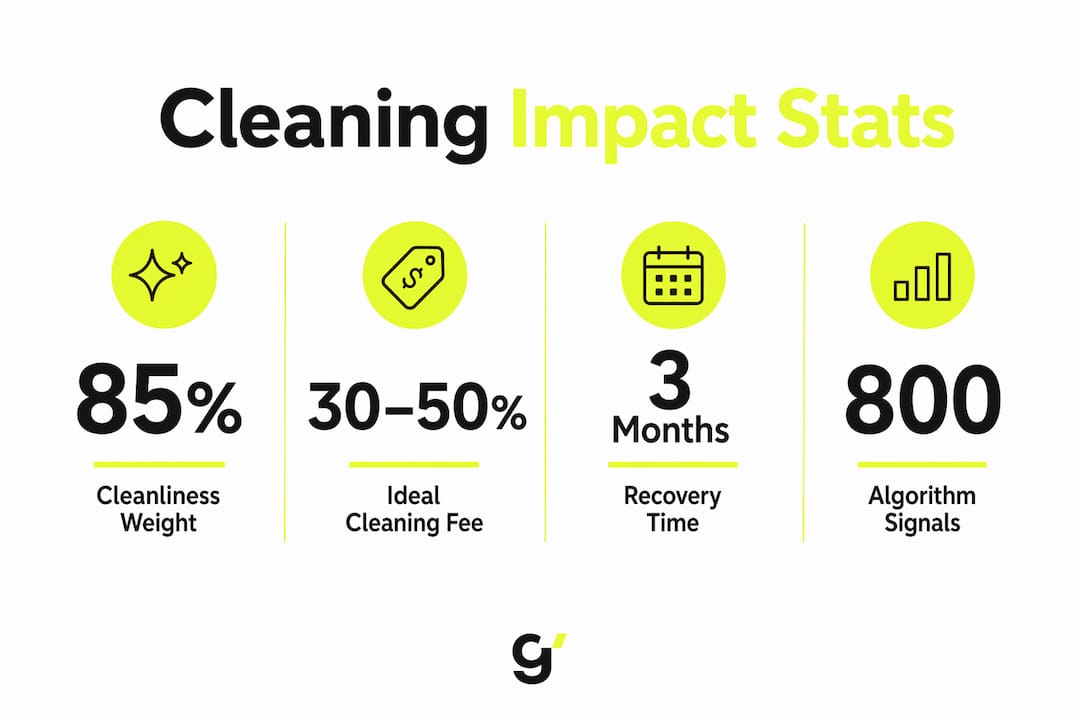
Cleanliness is the single most influential factor in Airbnb's 2026 algorithm, directly shaping your search placement, booking conversion rate, and Superhost eligibility. Understanding how cleaning affects the Airbnb algorithm means recognising that every turnover is not just a chore. It is a ranking event. 68% of negative Airbnb reviews cite cleanliness as the primary cause, and a single dirty complaint can push your overall rating below the critical 4.8 threshold. Hosts who treat cleaning as an operational pillar, not an afterthought, consistently outperform those who do not.
How does the Airbnb algorithm evaluate cleaning in 2026?
Airbnb's ranking system, formally known as its search algorithm, uses over 800 signals to determine where your listing appears in search results. Cleanliness consistency is one of the strongest predictors of 5-star reviews and low guest support ticket rates. The algorithm punishes listings that generate support tickets, because tickets signal a failed guest experience.
The most important thing to understand is that recency matters more than volume. A cluster of recent 5-star cleanliness reviews will lift your ranking faster than a long history of average scores. Conversely, a single 3-star cleanliness review can suppress your ranking for up to three months. That is not a minor setback. For a busy property, three months of reduced visibility translates directly into lost bookings.
Here is what the algorithm tracks most closely in relation to cleaning:
- Cleanliness rating recency. Reviews from the past 30–90 days carry significantly more weight than older ones.
- Guest support ticket rate. Complaints about dirty properties trigger algorithmic penalties that are separate from your public star rating.
- Conversion rate. Listings with high cleanliness scores convert more views into bookings, which the algorithm reads as a quality signal.
- Review response speed. Hosts who respond quickly to reviews signal active management, which the algorithm rewards.
Consistent, clinical-level cleanliness is the strongest single signal the algorithm uses to predict ongoing 5-star reviews. Superficial aesthetics, like a nicely staged photo, do not substitute for genuine cleanliness that guests experience on arrival.
How do cleaning fees affect Airbnb ranking and guest expectations?
Cleaning fees are a ranking factor that most hosts underestimate. Airbnb's algorithm factors in the total price including cleaning fees when assessing price competitiveness. Listings priced too high relative to comparable properties get penalised in search placement, regardless of how clean the property actually is.
The data on fee structure is clear. Listings that charge cleaning fees in the 25–50% of average daily rate (ADR) range generate significantly higher annual revenue than those with no cleaning fee at all. That fee range signals professionalism without pricing guests out. Every $52 increase in cleaning fee above the optimal range results in a 13% lower probability of achieving a 4.8+ rating, which directly reduces search visibility.
| Cleaning fee as % of ADR | Effect on ranking and revenue |
|---|---|
| Under 25% | Underpriced; may signal low quality to guests |
| 25–50% | Optimal range for revenue and search placement |
| Over 50% | Reduces bookings; suppresses search visibility |
| Excessive (>35% ADR for budget listings) | Guests expect hotel standards; rate cleanliness more critically |
Guests who pay a meaningful cleaning fee arrive with higher expectations. They expect hotel-quality presentation, not just a tidy space. If the property does not meet that standard, the cleanliness rating suffers more than it would for a no-fee listing. Transparent, reasonable fees paired with genuinely high standards protect your Superhost status and your ranking.
Pro Tip: Set your cleaning fee by checking the ADR of your three closest comparable listings, then price your fee at 30–40% of that figure. Review it every quarter as your nightly rate changes.
What are the best practices for maintaining high cleanliness ratings?
Operational discipline separates hosts who hold a 4.9 cleanliness rating from those who hover around 4.5. The average turnover window for a short-term rental is 3–5 hours. Underestimating that window is the most common cause of rushed cleans, missed spots, and the reviews that follow.
Missed turnovers and poor cleaning cause 12–18% annual revenue loss from same-day booking misses, review drops, and refunds. For a property generating $40,000 per year, that is $5,000–$7,000 lost to cleaning-related operational failures. Most of that loss is invisible because hosts never see the bookings they did not receive.
The most effective operational framework follows these steps:
- Schedule the full turnover window. Block 3–5 hours between checkout and check-in. Never compress this for a same-day booking without a confirmed, experienced cleaner on site.
- Use photo-verified turnovers. Automated photo proof reduces review disputes and prevents 1-star cleanliness reviews caused by turnover miscommunication. It also creates accountability without micromanaging your cleaning team.
- Build a backup cleaner network. One sick cleaner should never cause a cancellation. Maintain at least two vetted backup cleaners for every property.
- Schedule deep cleans every 90 days. Deep cleans every 90 days or every 30 turnovers prevent the gradual quality decline that causes slow algorithmic rank decay. Deep cleans cover baseboards, appliances, cabinets, carpet, and window washing.
- Offer late checkout as a paid upsell. A late checkout fee of $30–$50 accommodates your cleaning window and adds revenue without compressing the turnaround.
Pro Tip: Use a rental reset cleaning protocol with a room-by-room checklist and photo sign-off. It takes five extra minutes per turnover and eliminates the most common causes of cleanliness complaints.
Managing your cleaning contractors well is as important as the clean itself. A structured approach to contractor coordination reduces missed jobs, last-minute scrambles, and the ranking damage that follows.
How does consistent cleaning protect your Airbnb search placement over time?
Ranking recovery after a bad cleanliness period takes longer than most hosts expect. A bad month of 3-star cleanliness reviews causes a measurable drop in search placement lasting a full quarter. That means four to six weeks of reduced visibility even after you have fixed the underlying problem. The algorithm does not reset immediately when you improve.
Hosts frequently suffer invisible ranking decay by neglecting behavioural signals like cleaning complaints that the algorithm tracks silently. You may not see a dramatic drop in your star rating, but your listing slides down the search results page week by week. By the time you notice the booking decline, the damage is already months old.
The most effective way to protect placement over time includes:
- Monitor guest feedback within 24 hours of checkout. Early detection of a cleanliness issue lets you address it before the guest submits a review.
- Respond to every review publicly. Responses signal active management and improve the likelihood of future guests leaving reviews, which increases your review volume and ranking weight.
- Automate guest messaging. Automated post-stay messages that prompt guests to leave a review improve both review volume and speed. Both factors feed the algorithm's recency weighting.
- Track your cleanliness sub-rating separately. Your overall star rating can mask a declining cleanliness score. Watch the cleanliness sub-rating as its own metric.
- Schedule a seasonal deep clean at least four times per year. Seasonal cleans catch the gradual buildup that routine turnovers miss and prevent the slow score erosion that causes long-term rank decay.
The algorithm prioritises consistent standards over occasional excellence. A property that delivers a reliable 4.9 cleanliness experience every stay outperforms one that alternates between 5-star and 3-star results, even if the average is similar. Consistency is the signal the algorithm trusts.
Key takeaways
Cleanliness is not a soft metric on Airbnb. It is a hard ranking input that affects search placement, booking conversion, and annual revenue in measurable, documented ways.
| Point | Details |
|---|---|
| Recency outweighs volume | Recent cleanliness reviews carry more ranking weight than your total review count. |
| Fee structure affects placement | Cleaning fees in the 25–50% ADR range produce the best revenue and search visibility outcomes. |
| One bad review costs months | A single 3-star cleanliness review can suppress your ranking for up to three months. |
| Deep cleans prevent decay | Scheduling a deep clean every 90 days stops the gradual score erosion that silently lowers rankings. |
| Operational systems protect revenue | Photo-verified turnovers and backup cleaner networks prevent the 12–18% annual revenue loss tied to cleaning failures. |
What I have learned from managing short-term rental cleaning at scale
The hosts I have seen struggle most with Airbnb rankings share one blind spot. They treat cleaning as a cost to minimise rather than a system to build. They hire the cheapest cleaner available, skip the deep cleans, and then wonder why their ranking drifts down every quarter despite decent reviews.
The recovery timeline after a bad cleanliness period is the part that surprises people most. Three months of suppressed ranking is not an abstract penalty. It is real bookings going to the listing below yours on the search page. I have watched hosts spend money on professional photography and listing rewrites while their cleanliness sub-rating quietly sat at 4.6. The photography did nothing. Fixing the cleaning system moved the needle within six weeks.
Cleaning fees are also misunderstood. Hosts either charge too little and attract guests who still expect perfection, or charge too much and get penalised in search before the guest even arrives. The 25–50% ADR range is not a suggestion. It is the range where guest expectations and actual cleaning costs align well enough that your reviews reflect the quality of the clean, not the sting of the fee.
The single best investment a host can make is a documented deep clean schedule with photo verification at every stage. It removes the guesswork, creates accountability, and gives you evidence when a guest disputes a cleanliness claim. That evidence matters both for Airbnb resolution and for your own peace of mind.
— Lead
Grimescene's short-term rental cleaning services
Short-term rental hosts need a cleaning partner who understands that every turnover is a ranking event, not just a room reset.
Grimescene's short-term rental cleaning service is built around the operational realities of back-to-back guest stays. The Scene Reset protocol delivers photo-verified turnovers with eco-friendly, non-toxic agents that neutralise buildup rather than masking it. For urgent situations where a last-minute booking or a difficult checkout threatens your cleanliness rating, the rapid response tactical clean restores your property to Superhost standards within two hours. Your ranking depends on what guests find when they walk through the door.
FAQ
How does cleanliness affect Airbnb search ranking?
Airbnb's algorithm uses cleanliness ratings as a core ranking signal, with recent reviews weighted more heavily than older ones. A single 3-star cleanliness review can suppress your search placement for up to three months.
What cleaning fee percentage is best for Airbnb rankings?
Cleaning fees set at 25–50% of your average daily rate produce the best combination of search visibility and annual revenue. Fees above that range reduce booking conversion and can lower your search placement.
How often should I deep clean my Airbnb property?
Deep cleans every 90 days or every 30 turnovers prevent the gradual quality decline that causes slow algorithmic rank decay. Deep cleans should cover baseboards, appliances, cabinets, carpet, and windows.
Can a bad cleanliness review permanently damage my ranking?
A bad cleanliness review does not permanently damage your ranking, but recovery takes time. A poor month of cleanliness scores causes a measurable ranking drop lasting a full quarter, even after the underlying issue is resolved.
What is the biggest operational mistake hosts make with cleaning?
The most costly mistake is underestimating the turnover window. Compressing the clean into less than 3 hours increases the risk of missed areas, which leads to cleanliness complaints and the algorithmic penalties that follow.