

Cleaning frequency is a critical determinant of property condition, tenant health, and long-term financial value. Property owners and managers who treat cleaning as a reactive chore rather than a scheduled maintenance discipline pay for it twice: once in accelerated surface wear, and again in tenant turnover. How cleaning frequency affects property is not a soft question about appearances. It is a hard question about microbial contamination, structural integrity, and rental income. The evidence is clear. Regular, frequency-based cleaning reduces pathogen load, preserves finishes, and keeps tenants satisfied enough to renew their leases.
How cleaning frequency affects property condition and health
Cleaning frequency directly controls how much biological and physical soil accumulates on surfaces between sessions. Soil buildup is not merely cosmetic. Grime acts as an abrasive on flooring finishes, grout, and fixture coatings, accelerating wear that would otherwise take years longer to appear. The industry term for this cumulative damage is deferred maintenance liability, and it compounds silently until a repair bill arrives.
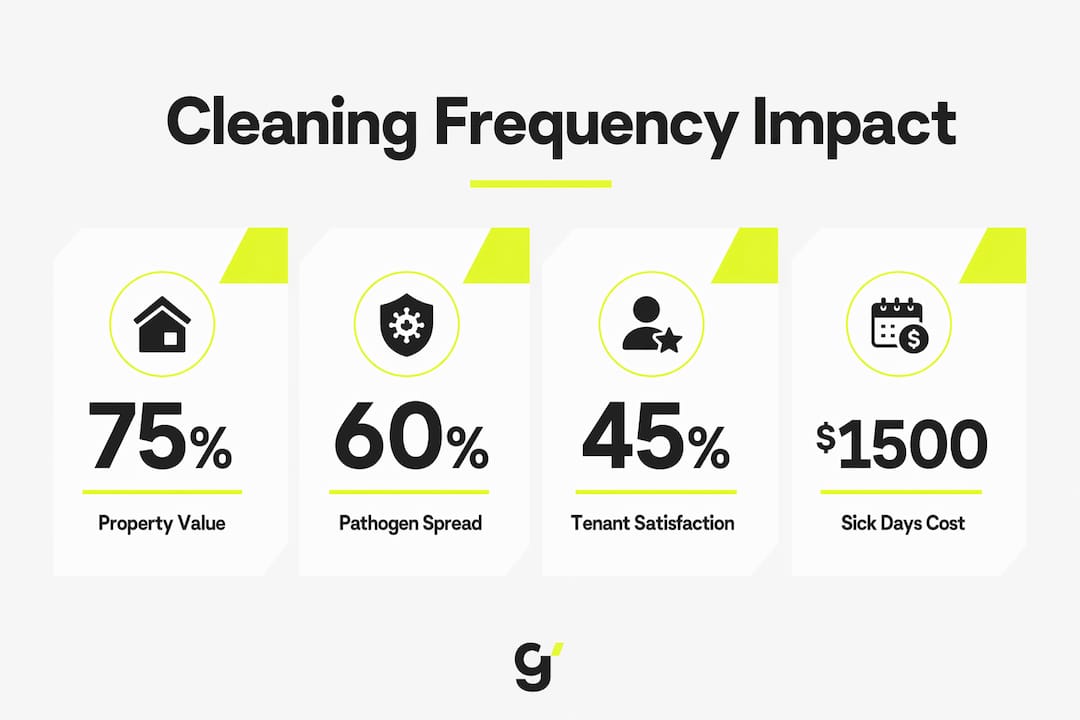
The health dimension is equally concrete. Targeted cleaning combined with air filtration can reduce infection-related sick days by 12%–19% and improve asthma control from 27% to 67% in studied populations. That is not a marginal gain. For a residential property with asthmatic tenants, or a commercial space with dozens of staff, those numbers translate directly into fewer complaints, fewer lease disputes, and lower liability exposure.
Pathogens spread faster than most property managers expect. Office phone contamination spreads to 40%–60% of shared surfaces within hours of initial contact. That single data point reframes the entire cleaning schedule conversation. Frequency is not about aesthetics. It is about interrupting transmission cycles before they affect occupant health and your property's reputation.

What cleaning schedules work best for different property areas?
Cleaning frequency should match the contamination risk of each area, not the size of the space. A large open-plan office with low foot traffic needs less frequent attention than a small shared kitchen used by twenty people daily.
The following schedule framework reflects current commercial and residential best practice:
- Restrooms and kitchens: Daily cleaning is the minimum. These spaces accumulate biological soils, moisture, and odour-causing bacteria faster than any other area. Skipping even one day creates conditions that are difficult to reverse with a single clean.
- High-touch surfaces (door handles, lift buttons, light switches, shared equipment): Restrooms require daily cleaning; high-touch surfaces need attention 3–5 times per week, with daily disinfection during respiratory illness seasons.
- Private offices and low-traffic areas: Two to three times per week for general cleaning is sufficient under normal occupancy. Frequency increases when illness is circulating in the building.
- Deep cleaning: Deep cleaning every 3–6 months maintains properties in good condition, with the interval depending on household size, pet ownership, and occupancy intensity. For commercial properties, quarterly deep cleans are the standard for high-use spaces.
One insight that surprises most property managers: restrooms are not the primary pathogen transmission zone. High-touch shared surfaces, more than restrooms alone, are the primary vectors for pathogen spread in office environments. Concentrating your cleaning budget on bathrooms while neglecting shared desks, phones, and entry points is a common and costly mistake. A commercial deep cleaning schedule that maps high-touch zones by contamination risk will outperform one organised by room type every time.
Pro Tip: During winter or flu season, temporarily increase high-touch surface disinfection to daily. The cost of one extra clean per week is a fraction of the cost of a tenant illness outbreak or a negative review.
How does cleaning frequency affect health outcomes and tenant satisfaction?
Frequent cleaning reduces microbial contamination at a measurable rate. Research using fluorescent marking technology found that cleaning adherence rose from 15.67% to 74% when monitoring and training were introduced, and Klebsiella pneumoniae contamination dropped from 16% to 4.17% in the same period. That is a 74% reduction in a multidrug-resistant organism. The implication for property managers is direct: without a monitored cleaning programme, your cleaning adherence is likely far lower than you assume.
Tenant satisfaction follows cleanliness closely. Occupants who perceive their building as well-maintained are more likely to renew leases, report maintenance issues early, and treat the property with care. The reverse is also true. Visible grime, persistent odours, and poorly maintained shared spaces signal neglect. Tenants read those signals as evidence that management does not value the property or its occupants.
The financial case for frequency-based cleaning is compelling. Preventable sick days in a 50-person office can cost $150,000–$350,000 annually, while a professional cleaning programme for the same space costs $18,000–$36,000 per year. The return on investment is not close. Cleaning is one of the few property maintenance expenses that pays for itself through reduced absenteeism, lower turnover, and preserved asset condition.
Pro Tip: Track tenant complaints about cleanliness separately from other maintenance requests. A spike in cleanliness-related complaints is an early warning that your current cleaning frequency is falling short, before the damage to surfaces or tenant relationships becomes serious.
The link between cleaning and tenant retention is well-documented. Property managers who treat cleaning as a cost centre rather than a retention tool consistently underinvest in frequency, and consistently face higher vacancy rates as a result.
What happens when cleaning frequency is too low?
Inadequate cleaning frequency creates a cascade of problems that accelerate over time. The damage is not linear. Neglect compounds.
- Surface degradation: Accumulated grime acts as an abrasive on floors, benchtops, and fixtures. Grout discolours permanently. Timber finishes dull and crack. Stainless steel pits. Each of these outcomes requires costly remediation or replacement rather than routine maintenance.
- Mould and moisture damage: Infrequent cleaning in bathrooms, kitchens, and laundry areas allows moisture and organic matter to combine. Mould establishes within 24–48 hours under the right conditions. Remediation costs dwarf the cost of the cleaning sessions that would have prevented it.
- Indoor air quality decline: Allergens including dust mite waste, pet dander, and mould spores accumulate between cleans. The EPA notes that allergen triggers can persist for 4–6 months despite cleaning if the source remains present. Cleaning frequency alone does not eliminate allergens, but it does reduce their concentration and slow their accumulation.
- Property value erosion: Visible grime, odours, and worn finishes reduce market appeal. Prospective tenants and buyers discount properties that show signs of deferred maintenance. The perception of neglect is as damaging as the physical neglect itself.
- Vacancy and turnover costs: Tenants who are dissatisfied with building cleanliness leave. Vacancy periods, reletting fees, and make-good costs consistently exceed the cost of the cleaning programme that would have retained the tenant.
Pro Tip: Before increasing cleaning frequency across an entire property, conduct a condition audit. Photograph surfaces, note odours, and check grout and sealant condition. The audit creates a baseline and makes the ROI of increased frequency visible and measurable.
How to build a cleaning frequency schedule for your property
An effective cleaning schedule starts with a use-pattern assessment, not a generic template. Every property has different traffic flows, tenant behaviours, and risk zones.
- Map your high-risk areas first. Identify every surface that multiple people touch daily: entry handles, lift buttons, shared kitchen appliances, bathroom taps, and communal workstations. These areas set your minimum cleaning frequency floor.
- Segment by contamination risk. Divide your property into three tiers: daily cleaning zones (restrooms, kitchens, high-touch surfaces), three-times-weekly zones (corridors, private offices, reception), and monthly or quarterly zones (storage areas, plant rooms, low-traffic stairwells).
- Build in deep clean intervals. Routine cleaning maintains surface hygiene. Deep cleaning removes the biological and chemical buildup that routine cleaning misses. Schedule deep cleans every 3–6 months for residential properties and quarterly for high-use commercial spaces.
- Use monitoring to verify compliance. Multimodal cleaning training and monitoring programmes significantly improve cleaning compliance and reduce environmental contamination. Fluorescent marker audits, photographic checklists, and sign-off logs all increase adherence without adding significant cost.
- Adjust for seasons and events. Winter respiratory illness seasons, post-construction periods, and high-turnover periods for short-term rentals all require temporary frequency increases. Build these adjustments into your schedule as standard operating procedure, not emergency responses.
A multi-component approach combining cleaning frequency, staff training, and indoor air quality management consistently outperforms cleaning frequency alone. Frequency is the foundation, but it works best alongside ventilation, filtration, and occupant education.
Key takeaways
Cleaning frequency is the single most controllable variable in property maintenance, and the one most consistently underinvested in by property owners and managers.
| Point | Details |
|---|---|
| Frequency drives condition | Regular cleaning prevents surface wear, mould, and allergen buildup that routine repairs cannot reverse. |
| High-touch zones are the priority | Door handles, shared equipment, and communal surfaces spread pathogens faster than restrooms and need more frequent attention. |
| Financial ROI is clear | A professional cleaning programme costs a fraction of the sick-day and vacancy costs it prevents. |
| Deep cleans supplement routine cleaning | Schedule deep cleans every 3–6 months to remove buildup that daily cleaning misses. |
| Monitoring improves compliance | Auditing tools and training programmes increase cleaning adherence and reduce contamination rates measurably. |
The real cost of getting cleaning frequency wrong
Property managers often ask me whether they can reduce cleaning frequency to cut costs during slow periods. My honest answer is: you can, but you will pay for it later, and the bill will be larger than the saving.
The properties I have seen suffer the most from deferred maintenance are not the ones with the smallest budgets. They are the ones where cleaning was treated as a variable cost to be trimmed rather than a fixed maintenance discipline. The pattern is consistent. Frequency drops, surfaces degrade faster than expected, a tenant complains, a make-good is required, and the cost of one quarter of reduced cleaning is recovered in a single repair invoice.
The evidence-based approach is to prioritise high-risk zones and maintain frequency there without compromise, while applying flexibility to low-traffic areas. That is where the genuine cost savings exist. Cutting daily kitchen cleaning to save money is a false economy. Reducing corridor cleaning from five times a week to three times a week in a low-traffic building is a legitimate adjustment.
Seasonal adaptation is also underused. Most property managers set a cleaning schedule and leave it unchanged for twelve months. The smarter approach is to treat cleaning frequency as a dynamic variable, increasing it during winter illness seasons and post-occupancy periods, and pulling it back slightly during low-traffic periods. That approach delivers better outcomes at the same or lower annual cost.
Professional cleaning partners matter here. A good provider does not just execute a schedule. They flag when conditions change, recommend frequency adjustments, and bring the monitoring discipline that most in-house programmes lack.
— Lead
Grimescene's approach to property cleaning frequency
Property owners and managers who want a cleaning programme that actually matches their property's risk profile have a practical option.
Grimescene's Rapid Response Tactical Clean is built for situations where standard cleaning schedules have fallen short and the property needs immediate remediation. Whether you are managing a short-term rental turnover, a post-construction site, or a commercial space that has accumulated grime between scheduled cleans, Grimescene deploys non-toxic agents that neutralise buildup rather than masking it. The Scene Reset protocol is specifically designed for rental properties, preserving host ratings and tenant satisfaction with every turnover. You can book a rapid response team directly and have a crew on site within hours.
FAQ
How often should high-touch surfaces be cleaned in a commercial property?
High-touch surfaces require cleaning 3–5 times per week under normal conditions, with daily disinfection during respiratory illness seasons. Door handles, lift buttons, and shared equipment are the highest priority zones.
Does cleaning frequency affect property value?
Consistent cleaning frequency preserves surface finishes, prevents mould, and reduces deferred maintenance liability, all of which directly support property value. Visible neglect reduces market appeal and gives prospective tenants and buyers grounds to discount their offer.
How often should a residential property be deep cleaned?
Deep cleaning every 3–6 months is the standard recommendation, with the interval shortening for larger households, pet owners, and high-occupancy periods.
Can cleaning frequency alone control allergens?
Cleaning frequency reduces allergen concentration but does not eliminate triggers rapidly. The EPA notes that allergens can persist for 4–6 months if the source remains present. A multi-component approach combining cleaning, filtration, and source control delivers the best results.
What is the financial return on a professional cleaning programme?
For a 50-person office, preventable sick-day costs run $150,000–$350,000 annually, while a professional cleaning programme costs $18,000–$36,000. The return on investment is substantial and measurable.