

A commercial workspace deep cleaning schedule is a structured plan that assigns thorough cleaning tasks to specific zones, frequencies, and responsible parties across a facility. Property managers and business owners who treat this plan as a living document, rather than a one-off exercise, maintain stronger hygiene standards and stay ahead of regulatory requirements. The industry term for this approach is a facility sanitation programme, and it sits above routine janitorial work in both scope and impact. Getting the frequency and zoning right from the start saves money, reduces liability, and keeps staff healthier year-round.
What does a commercial workspace deep cleaning schedule actually cover?
A deep cleaning schedule goes well beyond daily surface wiping. It covers tasks that routine janitorial work never reaches: grout scrubbing, air vent decontamination, upholstery extraction, and full sanitisation of high-contact surfaces. The schedule assigns each task a frequency, a responsible party, and a quality check point. Without that structure, critical areas get missed and hygiene gaps accumulate invisibly.
Standard commercial offices require a full deep clean semi-annually, while high-traffic environments such as medical facilities and retail spaces need quarterly cycles. That difference matters because foot traffic drives contamination load, not just visible dirt. A quarterly rhythm applied to a low-traffic back office wastes budget. A semi-annual rhythm applied to a busy reception area creates a hygiene risk.
How do you assess your workspace needs for deep cleaning frequency?
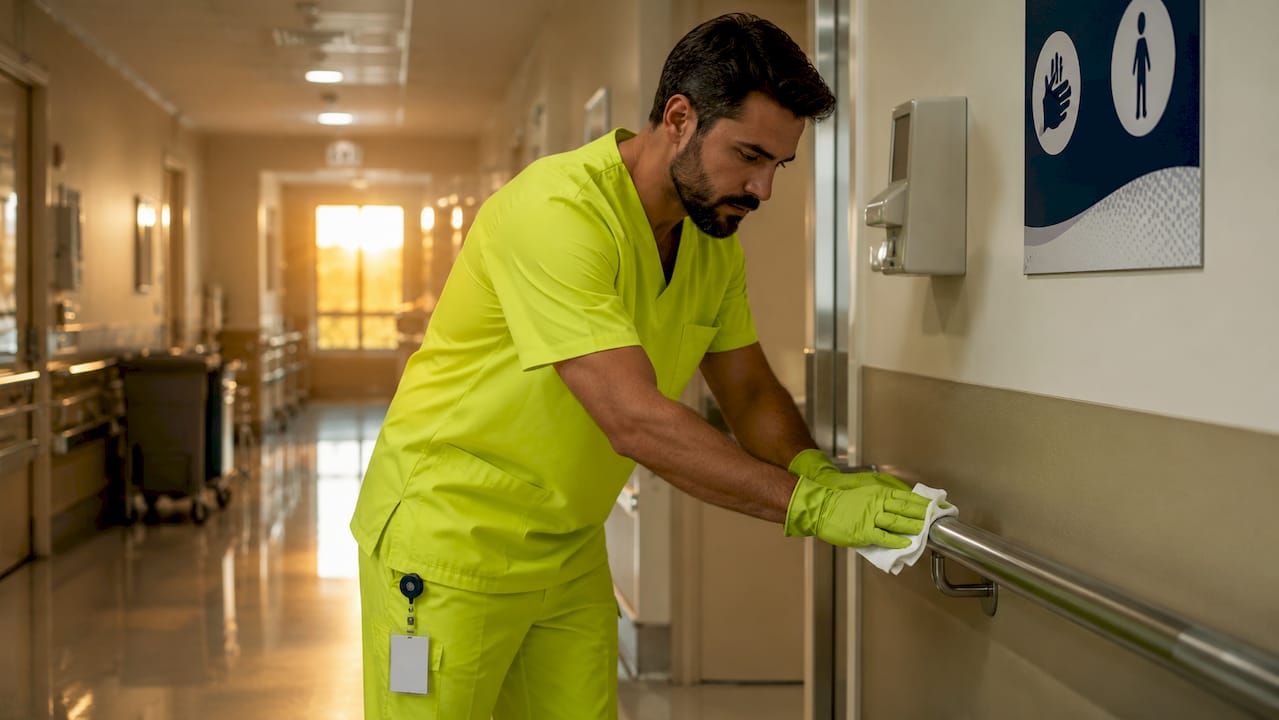
The right office cleaning frequency starts with an honest audit of your building. Walk every zone and rate it on three factors: occupancy density, surface contact rate, and visible soiling between routine cleans. Zones that score high on all three need more frequent deep cleans than the building average.
Key factors to assess during your audit:
- Building type and purpose. A medical practice, food preparation area, or childcare centre carries a higher contamination risk than a standard office floor.
- Occupancy and foot traffic. A 50-person open-plan office accumulates grime faster than a private suite with five staff.
- Zone intensity. Restrooms, kitchens, and reception areas are high-traffic zones that need more attention than storage rooms or server closets.
- Lease and compliance obligations. Some commercial leases and industry regulations specify minimum cleaning standards. Check these before setting your baseline.
- Seasonal and event-driven spikes. End-of-financial-year periods, product launches, or large client visits can temporarily push a low-traffic space into a high-traffic category.
Pro Tip: Photograph problem zones during your audit. Time-stamped photos create a baseline record and make it far easier to justify budget requests for increased cleaning frequency.
Adaptive scheduling produces better results than static timetables because it responds to actual usage rather than assumptions. Review your schedule quarterly and adjust frequencies whenever occupancy or building use changes significantly.
What are the recommended deep cleaning frequencies by workspace type?
Most commercial offices benefit from quarterly deep cleaning, with medical facilities and schools often requiring monthly attention. The table below gives practical benchmarks for common workspace types and their key zones.
| Workspace type | General areas | High-traffic zones |
|---|---|---|
| Standard office | Semi-annually | Quarterly |
| Retail premises | Quarterly | Monthly |
| Medical or dental practice | Monthly | Fortnightly |
| Food preparation or hospitality | Monthly | Weekly to fortnightly |
| Warehouse or light industrial | Annually | Semi-annually |
| Short-term rental property | Between every tenancy | Between every tenancy |
A tiered scheduling approach assigns quarterly deep cleans to restrooms, break rooms, and reception areas while reserving annual or semi-annual full resets for lower-use zones. This approach keeps hygiene standards high where they matter most and prevents budget blowout on areas that simply do not need the same attention.
Pro Tip: Label your zones on a floor plan and colour-code them by cleaning tier. A visual map makes it far easier to brief cleaning vendors and spot gaps in your workspace sanitation plan.
The tiered model also helps with budgeting. Property managers who separate hot-spot costs from general-area costs can negotiate more accurately with professional cleaning services and track spend against actual hygiene outcomes.
How do you build and manage an effective deep cleaning schedule?
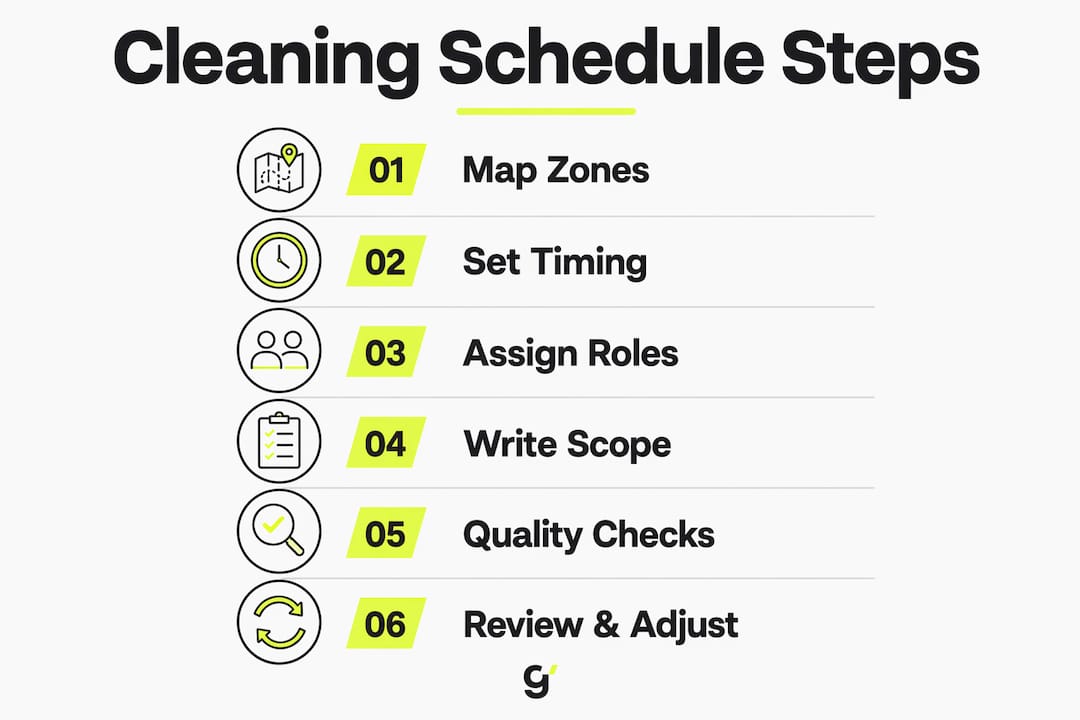
A well-built commercial cleaning timetable follows a clear sequence from planning through to quality review. Skipping any step creates ambiguity, and ambiguity is where cleaning standards collapse.
Step 1: Map your zones and tasks
List every area in the facility and assign it a cleaning tier based on your audit. For each zone, write out the specific tasks required. Restrooms need grout scrubbing, fixture descaling, and exhaust fan cleaning. Kitchens need appliance degreasing, drain sanitisation, and splashback scrubbing. General offices need carpet extraction, window cleaning, and air vent vacuuming.
Step 2: Set your timing
Schedule deep cleans on Friday evenings or weekends to minimise disruption to business operations. Early morning starts on non-trading days also work well for retail premises. The goal is to have the facility fully ready before staff or customers arrive. Never schedule a full deep clean during peak trading hours unless the zone can be isolated completely.
Step 3: Assign roles clearly
Decide which tasks go to your in-house team and which go to a specialist vendor. In-house staff can handle interim surface cleans between scheduled deep cleans. Tasks like carpet extraction, high-pressure washing, or specialist sanitisation belong with a professional provider. Document who is responsible for each task in writing.
Step 4: Write a scope of work
A detailed scope of work removes ambiguity and improves execution quality. It specifies which surfaces get treated, which products are approved, and what the sign-off standard looks like. Without a scope of work, vendors interpret "deep clean" differently every time.
Step 5: Build in quality checks
After each deep clean, conduct a walkthrough against your deep cleaning checklist. Note any missed tasks, photograph problem areas, and log the date and outcome. This record becomes your compliance evidence and your negotiating tool when reviewing vendor contracts.
Step 6: Review and adjust
Usage patterns change. A workspace that ran at half capacity last year may now be at full occupancy. Review your schedule every quarter and update frequencies, zones, and task lists to reflect current conditions.
What are the most common deep cleaning schedule mistakes?
Property managers who struggle with their cleaning programme usually make the same errors. Recognising them early prevents costly hygiene failures and compliance breaches.
- Treating the schedule as fixed. A static timetable ignores the reality that occupancy, seasons, and business activity all shift. Effective schedules adapt to usage intensity rather than running on autopilot.
- Applying one frequency to the whole building. A single cleaning interval for all zones wastes money on low-use areas and under-services high-use ones. Tiered scheduling solves this directly.
- Ignoring high-contact surfaces between deep cleans. Door handles, lift buttons, shared equipment, and tap fittings accumulate contamination quickly. These need attention in your regular office maintenance routine, not just during scheduled deep cleans.
- Poor communication with cleaning vendors. Verbal briefings lead to inconsistent results. A written scope of work, combined with a post-clean sign-off process, keeps vendors accountable and gives you a clear record.
- Scheduling during business hours. Deep cleaning during trading hours disrupts staff, creates safety hazards, and often produces lower-quality results because cleaners rush to avoid interrupting operations. Off-hours scheduling on Friday evenings or weekends is the standard for good reason.
- Skipping the top-to-bottom method. The top-to-bottom cleaning methodology prevents dust and debris from resettling on already-cleaned surfaces. Starting at ceiling level and working down to the floor is non-negotiable for a thorough result.
The most damaging mistake is treating the schedule as a compliance checkbox rather than an operational tool. Managers who review and update their plan regularly get consistently better hygiene outcomes than those who set it once and forget it.
Key takeaways
A tiered commercial workspace deep cleaning schedule, adapted to actual usage and reviewed quarterly, delivers better hygiene outcomes and lower costs than any fixed, one-size-fits-all approach.
| Point | Details |
|---|---|
| Frequency by workspace type | Standard offices need semi-annual deep cleans; high-traffic zones need quarterly or more frequent attention. |
| Tiered zone scheduling | Assign cleaning frequencies by zone intensity, not by building average, to balance hygiene and budget. |
| Off-hours timing | Schedule deep cleans on Friday evenings or weekends to protect operations and improve clean quality. |
| Written scope of work | A detailed scope removes ambiguity and gives you a clear standard to measure vendor performance against. |
| Adaptive review cycle | Reassess your cleaning timetable every quarter and update it whenever occupancy or usage patterns change. |
Why I think most cleaning schedules fail before they start
After working alongside property managers across a wide range of commercial buildings, the pattern is consistent. The schedule gets built once, filed away, and never touched again until something goes wrong. A complaint from a tenant, a failed audit, or a staff health issue forces a reactive scramble that costs far more than a quarterly review ever would.
The other failure I see constantly is the assumption that a professional cleaning service will interpret "deep clean" the same way you do. They will not. Without a written scope of work, two different vendors will deliver two completely different results in the same building. The scope is not bureaucracy. It is the only thing that gives you a consistent standard to measure against.
What actually works is treating your facility sanitation programme the way you treat a lease or a maintenance contract. It gets reviewed on a schedule, updated when conditions change, and held to a written standard. Managers who do this spend less on reactive cleaning and more on planned, budgeted work that keeps the building in good condition year-round.
The tiered approach is the single biggest shift most property managers can make. Stop applying the same frequency to every zone. Your restrooms and your server room do not have the same cleaning needs. Recognising that difference and building it into your plan is where real hygiene improvement happens.
— Lead
Grimescene's approach to commercial deep cleaning
Grimescene specialises in commercial deep cleaning that works around your operations, not against them. Their eco-friendly, non-toxic agents target built-up grime without the harsh chemicals that create ventilation problems or surface damage in occupied buildings. Grimescene builds each engagement around your specific zones, traffic patterns, and compliance requirements, so the work gets done at the right frequency and to a documented standard. For property managers who need flexible, scheduled professional cleaning services that adapt as your building's needs change, Grimescene delivers consistent results without disrupting your tenants or your operations.
FAQ
How often should a commercial office be deep cleaned?
Standard commercial offices require a full deep clean semi-annually. High-traffic zones within those offices, such as restrooms and break rooms, need quarterly attention.
What is the best time to schedule a commercial deep clean?
Friday evenings and weekends are the standard choice because they minimise disruption to staff and ensure the facility is ready for use at the start of the next working week.
What is a tiered cleaning schedule?
A tiered cleaning schedule assigns different cleaning frequencies to different zones based on usage intensity. High-traffic areas get quarterly cleans while lower-use zones receive annual or semi-annual attention.
What should a deep cleaning checklist include for commercial spaces?
A commercial deep cleaning checklist covers grout scrubbing, air vent decontamination, carpet extraction, appliance degreasing, high-contact surface sanitisation, and window cleaning. Each task should be assigned to a specific zone and a responsible party.
How do I keep my cleaning schedule compliant with regulations?
Document every deep clean with a dated sign-off against a written scope of work. Review your schedule against any lease obligations or industry regulations at least once per year and update frequencies when occupancy changes.