

Efficient cleaning contractor management is defined as the systematic use of schedules, standard operating procedures, performance metrics, and communication tools to deliver consistent cleaning quality while controlling costs. Property managers and business owners who treat contractor oversight as a structured discipline, rather than an ad hoc task, consistently outperform those who rely on informal arrangements. Poorly defined contract scopes are the primary cause of quality degradation and wasted budgets. The good news is that the fix is process, not personnel. This guide covers every layer of managing cleaning contractors efficiently, from scheduling and SOPs to KPIs and scaling across multiple sites.
How to manage cleaning contractors efficiently from day one
The foundation of efficient cleaning contractor management is a written scope of work. Without one, contractors fill gaps with their own assumptions, and those assumptions rarely match your standards. A clear scope defines which areas get cleaned, how often, to what standard, and who verifies the result. In Australia, commercial cleaning contracts often reference AS/NZS cleaning standards as the benchmark for acceptable outcomes. Anchoring your scope to a recognised standard removes ambiguity and gives you a defensible basis for performance conversations.

Implementing quantifiable KPIs produces 15–20% higher worker output and up to 30% better customer retention. That is not a marginal gain. It means fewer complaints, fewer emergency call-outs, and clients who stay on contract longer. The three non-negotiable KPIs for any cleaning contract are inspection scores, task completion rates, and issue response times. Set these at contract start, review them monthly, and adjust the scope when data reveals a persistent gap.
What scheduling methods actually protect recurring revenue?
Recurring clients are the backbone of any cleaning operation. Scheduling them as fixed slots, with a named primary cleaner and a designated backup, stabilises delivery and removes the scramble when someone calls in sick. Named backups for recurring jobs reduce service disruption and maintain client trust through proactive notification. The moment a client experiences an unannounced no-show, trust erodes fast.
Clustering jobs geographically cuts travel time and increases the number of jobs a crew can complete per day. A crew driving 45 minutes between sites is a crew you are paying to sit in a vehicle. Map your client locations and build routes that keep crews within tight geographic zones. This single change often recovers hours of productive capacity each week.
Cancellation policies protect your revenue when clients cancel late. A strict framework charging 50% for cancellations with less than 24 hours notice and 100% for cancellations with less than 4 hours notice, combined with a flexible-fill client list, recovers 40–60% of lost labour hours from cancellations. A flexible-fill list is simply a group of clients who have agreed to accept short-notice bookings at a slight discount. When a slot opens, you fill it rather than absorb the loss.
The table below compares three scheduling approaches by key operational criteria.
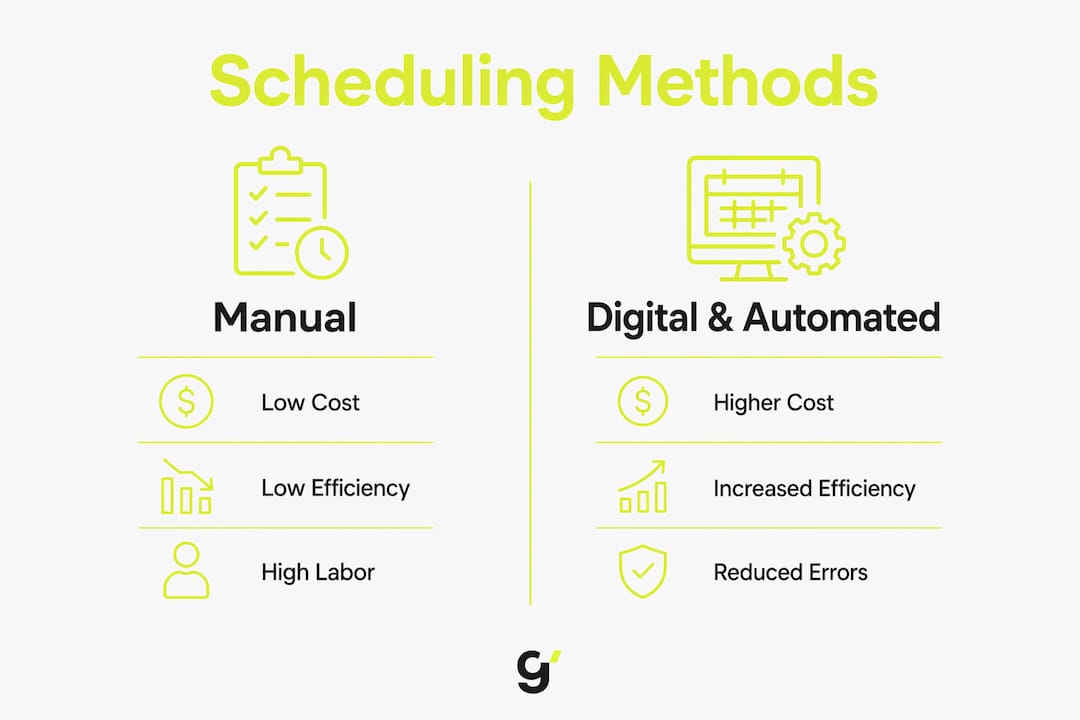
| Criteria | Manual scheduling | Digital scheduling | Automated routing |
|---|---|---|---|
| Setup cost | Low | Medium | Medium to high |
| Scalability | Collapses at 3–5 sites | Handles 10–20 sites | Handles 20+ sites |
| No-show response | Slow, phone-based | Faster, app notifications | Instant, auto-reassignment |
| Route efficiency | Poor | Moderate | High |
| Client visibility | None | Limited | Real-time updates |
Pro Tip: Build your flexible-fill client list before you need it. Approach low-volume clients during onboarding and ask if they want priority access to last-minute availability at a reduced rate. You will fill gaps faster than you think.
How do SOPs and quality audits create consistent cleaning standards?
Standard operating procedures, known as SOPs, are the single most effective tool for delivering repeatable cleaning quality across different crews and sites. The key is to write SOPs by building type rather than by individual site. An office SOP, a retail SOP, and a short-term rental SOP each cover the tasks common to that building category. Standardising SOPs by building type allows scalable training and drives 15–20% output improvements through targeted retraining. Site-specific variations get added as short addenda, keeping the core document clean and reusable.
Digital cleaning checklists turn SOPs into real-time accountability tools. When a cleaner ticks off tasks on a mobile app, you get a timestamped record of what was done, when, and by whom. That record is the basis for your quality audit. Weekly or biweekly audits produce measurable quality improvements when paired with a scoring system. Score each audit out of 100, track scores by crew and by site, and use the data to identify where retraining is needed.
The feedback loop between SOPs, checklists, and audits is what makes the system self-improving. When an audit reveals a recurring failure, you update the SOP, retrain the relevant crew, and monitor the next audit cycle to confirm the fix held. This is how you build a commercial deep cleaning schedule that actually gets executed to standard, not just planned on paper.
Pro Tip: Score audits numerically and share results with your contractors monthly. Contractors who see their scores improve are more engaged. Those who see a downward trend take corrective action faster when the data is in front of them.
The table below shows how audit frequency affects quality outcomes across site types.
| Site type | Recommended audit frequency | Primary quality risk |
|---|---|---|
| Office buildings | Biweekly | High-touch surface compliance |
| Short-term rentals | Every turnover | Presentation and odour control |
| Retail spaces | Weekly | Floor and entry standards |
| Post-construction sites | Per project milestone | Debris and residue clearance |
What communication systems reduce errors and build accountability?
Clear communication is the operational glue that holds contractor management together. The most common failure in cleaning team management is the absence of centralised, mobile-accessible documentation. Real-time mobile job details reduce communication errors and improve accountability among cleaning teams. When a contractor arrives on site without knowing the access code, the scope, or the client's specific requirements, errors follow.
Centralise all job information in one place. Every job record should include the site address, access instructions, scope of work, client contact, and any special notes. Contractors access this on their phone before they arrive. This replaces the group-text chaos that plagues operations relying on informal communication channels.
Establish a clear escalation path for issues. Every contractor should know exactly who to contact when something goes wrong, and that contact should be reachable during working hours. Ambiguity in escalation paths leads to contractors making judgment calls they are not qualified to make, or worse, saying nothing and hoping the client does not notice.
- Centralise job details in a single mobile-accessible platform, not across email, text, and spreadsheets.
- Assign a named point of contact for each site, not a generic inbox.
- Require digital check-in and check-out for every job, with photo proof of completion.
- Notify clients proactively when a backup cleaner is attending instead of the regular crew.
- Document every client complaint and the resolution taken, in writing.
Pro Tip: Photo proof of completion is not about distrust. Frame it to your contractors as client-facing evidence that protects them from false complaints. Adoption rates improve significantly when contractors understand it benefits them.
Which KPIs should you track to improve contractor performance?
KPIs give you the data to make decisions rather than guesses. The four KPIs that matter most in cleaning contractor management are inspection scores, job completion reliability, issue response time, and supply compliance. Track these monthly, not quarterly. Monthly tracking catches problems before they become client complaints. Monitoring KPI trends reduces recurring failures and improves output by 15–20%.
Schedule formal contract reviews every six months. Use the KPI data to drive the conversation. If inspection scores are declining, the review becomes a retraining conversation. If completion reliability is high and scores are strong, the review becomes a renewal conversation. Data removes the emotion from performance discussions and keeps the focus on outcomes.
The financial case for KPI tracking is direct. Improved efficiency reduces the cost of re-cleans and emergency call-outs. Better retention means less time and money spent recruiting and onboarding replacement contractors. Cleaning quality directly affects tenant retention, which means your contractor performance has a measurable impact on your property's revenue.
- Inspection score: Target above 85 out of 100 per audit cycle.
- Completion reliability: Track the percentage of jobs completed on time and to scope.
- Issue response time: Measure hours from complaint raised to resolution confirmed.
- Supply compliance: Confirm contractors use approved products, particularly where eco-friendly or non-toxic requirements apply.
How do you handle high turnover, callouts, and multi-site scaling?
High turnover in commercial cleaning runs at approximately 200% annually. That figure is not a people problem. It is an infrastructure problem. Turnover costs $1,000–$5,000 per replacement and inflates labour costs by 50–70%. Operations that treat turnover as inevitable absorb those costs silently. Operations that treat it as a systems failure build recruiting pipelines, structured onboarding, and clear accountability frameworks that reduce churn.
Scaling across multiple sites without systems in place is the fastest way to lose quality control. Manual scheduling collapses after 3–5 sites. At that point, centralised digital scheduling and standardised SOPs are not optional. They are the only way to maintain oversight without adding a supervisor for every site.
Successful operators treat their systems, including SOPs, schedules, quality controls, and recruiting pipelines, as core business assets. The operators who struggle treat these same systems as overhead costs they would rather avoid.
For emergency coverage, the solution is preparation, not improvisation. Designate backup cleaners for every recurring client before a callout happens. Maintain a short list of contractors available for urgent work. When a callout occurs, the response is a two-step process: notify the client proactively, then activate the backup. Digital verification tools like photo-stamping and GPS timestamps replace the need for onsite supervision at scale, giving you evidence-based oversight across every site from a single dashboard.
- Build a recruiting pipeline that runs continuously, not just when someone leaves.
- Document your onboarding process so a new contractor reaches competency in days, not weeks.
- Assign named backups to every recurring client before you need them.
- Standardise SOPs by building type so any trained contractor can cover any site.
- Use digital check-in, photo proof, and GPS timestamps to verify work without being onsite.
Key takeaways
Managing cleaning contractors efficiently requires documented systems, measurable KPIs, and proactive communication working together as a single operational framework.
| Point | Details |
|---|---|
| Define scope before anything else | A written scope of work anchored to a recognised standard removes ambiguity and protects quality. |
| Protect recurring revenue with structure | Fixed scheduling slots, named backups, and cancellation policies recover lost labour hours and stabilise income. |
| Use SOPs by building type | Standardising procedures by building category enables scalable training and consistent audit outcomes. |
| Track four core KPIs monthly | Inspection scores, completion reliability, response time, and supply compliance drive performance improvement. |
| Treat turnover as a systems issue | Documented onboarding, recruiting pipelines, and digital verification reduce the cost and disruption of staff changes. |
What I have learned from watching operations succeed and fail
The gap between a well-run cleaning operation and a chaotic one is almost never about the quality of the cleaners. It is about whether the person managing them has built systems that work without constant intervention.
The operators I have seen struggle share a common pattern. They improvise coverage when someone calls in sick. They keep job details in their head or in a group chat. They conduct audits only when a client complains. Every one of these habits creates a reactive cycle that is exhausting to maintain and expensive to recover from.
The operators who run clean, profitable operations do the opposite. They build their scheduling, SOPs, and communication infrastructure before they need it. They audit on a fixed cycle, not in response to problems. They share KPI data with their contractors openly, which creates a culture of accountability rather than suspicion.
The one insight that took me longest to accept is that documentation is not bureaucracy. It is the thing that lets you scale without losing your mind. A contractor who has a clear SOP, a mobile-accessible job record, and a named escalation contact needs almost no supervision. That is the goal. Not tighter control, but better systems that make tight control unnecessary.
If you manage high-traffic area cleaning across multiple properties, start with your SOPs. Get those right first. Everything else, including scheduling, audits, and KPIs, becomes easier once your baseline standard is written down and agreed upon.
— Lead
Grimescene's rapid-response cleaning for property managers
Property managers who need reliable, fast cleaning support between contractor cycles have a practical option in Grimescene.
Grimescene's rapid-response tactical clean is built for exactly the situations that catch property managers off guard: a contractor no-show before a tenant inspection, a post-construction handover that needs urgent remediation, or a short-term rental that needs a full reset before the next guest arrives. Grimescene uses non-toxic, eco-friendly agents that neutralise buildup rather than masking it, which matters when you are managing properties where chemical residue is a concern. Booking is direct and the service is designed to fit within an existing contractor management framework, not replace it.
FAQ
What are the most important KPIs for cleaning contractor management?
The four core KPIs are inspection scores, job completion reliability, issue response time, and supply compliance. Track these monthly to catch performance gaps before they reach clients.
How do you handle a cleaning contractor no-show?
Assign a named backup contractor to every recurring client before a callout happens. Notify the client proactively, activate the backup, and document the incident for your performance review.
When does manual scheduling stop working for cleaning operations?
Manual scheduling becomes unworkable beyond 3–5 sites. At that scale, centralised digital scheduling and standardised SOPs are required to maintain quality and oversight.
What is a flexible-fill client list?
A flexible-fill client list is a group of clients who have agreed to accept short-notice bookings, typically at a slight discount. It allows you to fill cancelled slots quickly and recover lost labour hours.
How often should cleaning quality audits be conducted?
Weekly or biweekly audits produce the most measurable quality improvements. Short-term rental properties should be audited at every turnover given the direct impact on guest ratings and host revenue.