
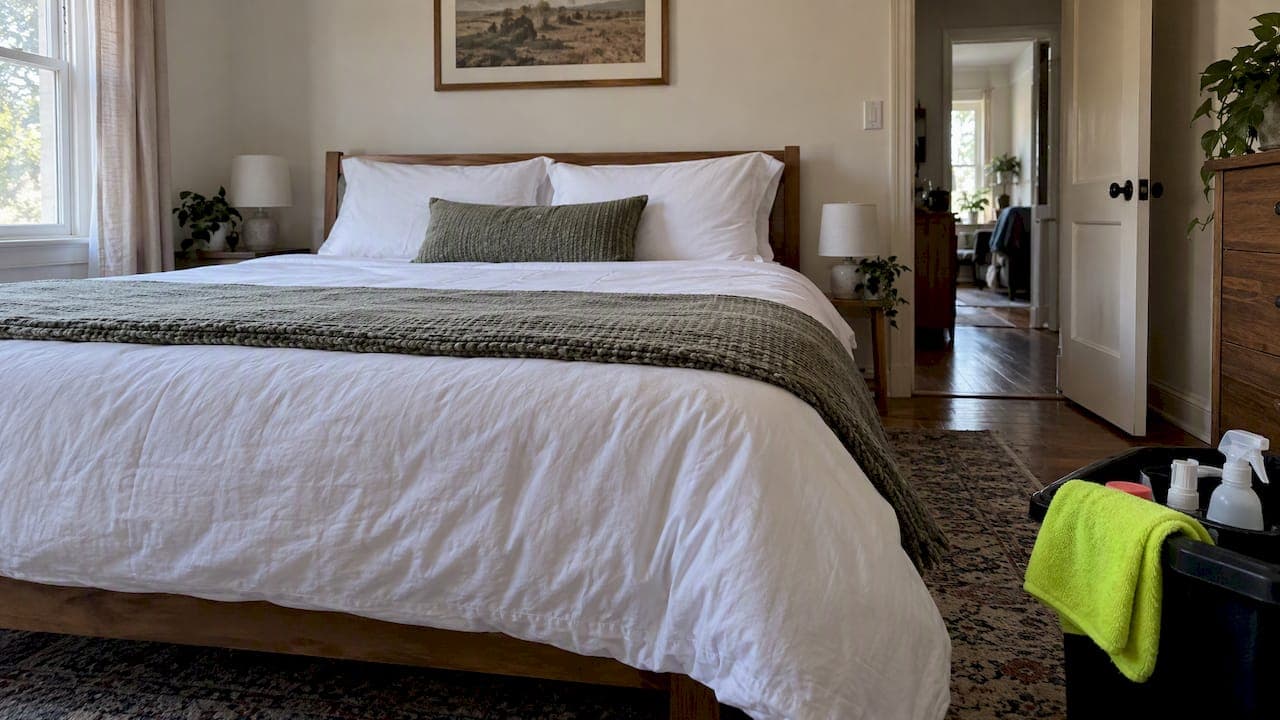
The fastest, most reliable approach to Airbnb linen turnover is running a 3 set par per bed, following a rapid strip, inspect, stage, remake checklist on every clean, and decoupling laundry from your turnover window by outsourcing or using linen rental when things get tight. Below, we walk through the par calculations, the minute-by-minute checklist, the logistics decisions and the separation rules that make this approach hold up under pressure, plus how a protocol like Scene Reset fits into that system.
TL;DR:
- Multiply each bed configuration by three sets, consider four for back to back or peak season demand, and add one emergency set per property.
- During each turnover, strip beds first, bag and inspect soiled items immediately, stage clean sets before remaking, then photograph finished beds and bathrooms.
- If same day turnovers occur more than a couple of times weekly, outsourcing laundry or renting linen avoids tying cleaners to machine cycles.
- Ask commercial laundry partners to meet thermal disinfection benchmarks: 65°C for at least 10 minutes or 71°C for at least 3 minutes.
- Keep soiled linen in labeled, dedicated bags, store clean stock in a closed area, and prevent the two handling paths from crossing.
Table of Contents
- Par levels and stock planning: the 3 set system explained
- Same-day turnover: a step-by-step rapid checklist
- Laundry logistics: home machines, commercial pickup and when to outsource
- Separation, handling and storage to avoid cross-contamination
- Stain triage and care: what to treat now, what to flag, what to replace
- Scheduling, staffing and avoiding the common bottlenecks
- How Grime Scene Services approaches linen turnover
- Host perspective: common pitfalls and a few dos and don'ts
- How Grime Scene can help with turnkey linen turnover
- FAQ
- Sources
Par levels and stock planning: the 3 set system explained
A 3 set par per bed means you hold three full sets of linen for every bed in the property: one on the bed, one in the wash cycle, and one clean and staged for the next changeover. This is the industry-standard par level for short-term rentals, and it is the minimum that lets you absorb a same-day turnover without waiting on the dryer.

Properties with back-to-back bookings or sustained high-volume seasons often benefit from increasing the sets per bed, which gives you a genuine buffer against a delayed wash cycle, a damaged sheet or a guest who checks out late. The 3-par system guidance from ALS treats four sets as the ceiling rather than the default: oversizing your stock permanently ties up cash and storage space for a benefit you only need a few weeks a year.
To calculate your own par, start with bed count, then multiply by three (or four for peak-season properties), then add one spare set per property for emergencies like a wine stain or a torn pillowcase. A two-bedroom property with a queen and two singles, for example, needs three bed configurations covered, each at three sets, plus a spare set of towels and bath mats held separately.
Once you've settled on numbers, keep stock moving on a first-in-first-out basis so no set sits idle while another wears out faster:
- Label each set by bed size and property if you manage more than one listing, so cleaners never guess which sheets fit which bed.
- Track inventory in a simple spreadsheet or a property management app, noting purchase date and retirement date for each set.
- Rotate new stock to the back of the shelf and pull from the front, so wear is even across the whole par.
For a deeper walk-through of par calculations by property type, our operations playbook on three sets per bed covers worked examples for larger properties.
Same-day turnover: a step-by-step rapid checklist
A same-day turnover lives or dies on sequence. Doing things out of order, like remaking a bed before you've checked the mattress protector, costs you minutes you don't have. Here's the order that works:
- Strip everything first. Pull sheets, pillowcases, duvet covers, towels and bath mats before you touch anything else in the room, so linen handling doesn't compete with surface cleaning.
- Bag soiled items immediately at the point of removal, separating whites from colours and heavily soiled items from lightly used ones.
- Inspect while bagging. Check for stains, tears, stray hairs or anything a guest left behind, and photograph anything that needs a stain triage decision later.
- Stage the clean set on a chair or trolley before you start remaking, so you're not hunting for a missing pillowcase mid-task.
- Remake the bed and bathroom, working top to bottom: duvet and pillows first, then bath towels, hand towels and bath mat last since they get touched most.
- Run final QA with photos of the made bed, folded towels and bathroom set-up before you leave, so there's a record if a guest raises an issue later.
Sort laundry loads by fabric weight and soil level rather than by room: towels and bath mats go together because they need a hotter, longer cycle, while sheets and pillowcases can run on a gentler setting. Wet bath mats and shower curtains should never go straight into a linen bag with dry items. Hang them separately or bag them apart to stop damp transferring to clean stock.
Pro Tip: Photograph the made-up bed and bathroom from the doorway, the same angle every time, so you build a visual record that proves consistent quality without needing to stay on-site for guest check-in.
This kind of photo verification and hand-off process is also the backbone of a reliable Airbnb cleaning checklist, and it matters because defining specific, accountable tasks with photo proof is what closes the gap between a checklist on paper and what actually happens on the ground.
Laundry logistics: home machines, commercial pickup and when to outsource
Residential washing machines often struggle with same-day turnover needs due to limited load capacity and longer wash-and-dry cycles. When you're trying to turn a property in a 45 to 90 minute window, that math doesn't work.
The Hostaway turnover checklist confirms this: cycle time and drying capacity are the most common causes of same-day turnover failure, and decoupling laundry from the on-site clean by outsourcing removes that bottleneck entirely rather than trying to manage around it.
You've got a few operational models to choose between:
- On-site DIY washing works for low-volume properties with generous turnover windows, but it ties your cleaner's schedule to your washing machine's schedule.
- Commercial wash-and-fold services take soiled linen off-site and return it clean and folded, which frees your cleaner to focus purely on the room reset.
- Linen rental swaps your soiled set for a fresh one on a fixed schedule, so you never own ageing stock or wait on a wash cycle at all.
- Pickup-and-drop laundry partners collect dirty linen and deliver clean stock on a timetable you set, which works well for multi-property operators juggling several turnovers a day.
The decision point is usually your turnover window relative to your laundry capacity: if you're running same-day turnovers more than a couple of times a week, the maths favour outsourcing over buying more machines. When you brief a laundry partner, give them your par count, your turnover frequency and your stain triage expectations upfront, so there's no ambiguity about what "clean" means for your property.
Separation, handling and storage to avoid cross-contamination
Treat every piece of soiled linen as a contamination risk from the moment it comes off the bed, not just when it looks visibly dirty. Bagging at the point of removal, rather than carrying an armful of mixed linen to a central pile, is the single biggest habit that prevents cross-contamination between rooms and between clean and dirty stock.
A few rules keep this simple and repeatable:
- Use dedicated, clearly labelled containers or bags for soiled linen, separate from anything used to carry clean stock.
- Store clean linen in a closed cupboard or bin away from the soiled collection point, and never let the two paths cross in transit.
- Avoid re-handling clean stock once it's staged. Touching it with hands that have just handled soiled items undoes the separation you've built in.
- If you contract a commercial laundry, confirm their wash cycle meets recognised thermal disinfection benchmarks rather than assuming a hot wash is enough.
On that last point, AS 4146:2024 sets out thermal disinfection parameters of 65°C for a minimum of 10 minutes, or 71°C for a minimum of 3 minutes, as the benchmark for genuine thermal disinfection. The standard itself also distinguishes between commercial, on-premises and retail laundries, so it's worth knowing which category any laundry partner you use actually falls into, since that affects what practices and guarantees you can reasonably expect from them.
Stain triage and care: what to treat now, what to flag, what to replace
Not every stain needs the same response, and treating them all the same way either wastes time or ruins linen you could have saved. A simple three-category triage keeps decisions fast:
- Surface stains (makeup, light food, dirt) get treated with a non-toxic spot treatment and rewashed on a standard cycle.
- Set-in stains (old blood, ground-in grease, mystery marks that survived a first wash) need a longer soak or targeted professional treatment, and go into a separate "needs attention" pile rather than back into general rotation.
- Potential biohazard items (bodily fluids beyond normal use, anything that looks medically concerning) get isolated immediately and handled according to your laundry partner's biohazard protocol, never thrown in with a regular load.
Keep a simple log of what you retire and why: a torn sheet, a stain that wouldn't lift, a towel that's gone thin. That record feeds straight back into your par planning, because it tells you which items wear out fastest and when to reorder before you're caught short.
Pro Tip: Spot-treat with a non-toxic stain remover as soon as you bag the item, since treating a stain cold and fresh is far more effective than letting it set during transport to the laundry.
Scheduling, staffing and avoiding the common bottlenecks
The three bottlenecks that derail turnovers are laundry throughput, travel time between properties, and a lack of staging space to sort clean from dirty on-site. Each has a specific fix rather than a general one.
- Laundry throughput gets solved by the par system itself: a full spare set per bed removes the wash cycle from your critical path entirely.
- Travel time between multiple properties gets managed by clustering turnovers geographically and building a 15 to 20 minute buffer between bookings rather than scheduling back-to-back with zero slack.
- Staging space gets solved with a simple rule: clean linen never touches the same surface as soiled linen, even temporarily, so a cleaner always needs two distinct zones in the property.
When you're building a roster across several properties, use your par levels deliberately: a 4 set par buys you the flexibility to schedule a turnover without waiting for same-day laundry at all. For predictable, high-frequency bookings, a recurring cleaning contract with a fixed schedule works better than ad-hoc bookings. For one-off gaps, like a last-minute cancellation or a damaged linen set the night before check-in, a rapid-response booking fills the hole without disrupting your regular contract.
How Grime Scene Services approaches linen turnover
A Scene Reset protocol can be built around the operational logic of strip, inspect, stage and remake, backed by a 3 set par system so laundry never sits on the critical path of a turnover. Some services verify every reset with before-and-after photo reporting, which gives hosts accountability similar to a strict checklist, without needing to be on-site.
For hosts whose turnover windows are too tight to manage laundry in-house, linen rental services can swap soiled stock for fresh sets on a fixed schedule, removing wash cycles and drying time from the turnover entirely. When a booking changes last minute or a set turns up damaged, rapid response cleaning services can cover the gap without disrupting a standing cleaning contract.
If you're weighing up where your current setup is losing time, requesting an operations review of your next few turnovers is a practical first step toward tightening the process.
Host perspective: common pitfalls and a few dos and don'ts
Hosts tend to fail at linen turnover for the same handful of reasons: understocking par to save money, letting clean and dirty linen share a bag "just this once," and skipping photo proof when a cleaner is rushed. Do hold a genuine 3 set par, do bag soiled linen at the point of removal, and do photograph every finished room. Don't rely on a single home machine for same-day turnovers, don't skip inspection to save two minutes, and don't let a damaged set go unrecorded, because it will catch you out at the worst possible booking.
— Lead
How Grime Scene can help with turnkey linen turnover
If you'd rather hand the whole linen problem to someone else, our Scene Reset protocol covers the full strip-to-remake cycle using eco-friendly, non-toxic cleaning agents, with before-and-after photo verification built in. Softest Logistics handles linen rental so you're never waiting on a wash cycle, and Rapid Response (2-Hour Tactical Clean) covers last-minute gaps between standing bookings.

If your current turnover setup is creaking under back-to-back bookings, request a quote or book a trial turnover and we'll walk through what a Scene Reset looks like for your property.
FAQ
What is the 80/20 rule for Airbnb?
For linen turnover specifically, that means prioritising a reliable par system and checklist over chasing minor cosmetic extras.
Is Airbnb revenue declining?
This article focuses on linen turnover operations rather than Airbnb's corporate financial performance, so we'd point you to Airbnb's own investor reporting for current revenue figures rather than quote a number here.
Is Airbnb still profitable in 2026?
Profitability for individual hosts depends heavily on occupancy, pricing and operating costs like cleaning and linen, rather than on any platform-wide figure. Tightening turnover operations, including par levels and laundry logistics, is one of the more direct ways hosts can protect their own margins regardless of broader market conditions.
What is Airbnb's annual turnover?
This question typically refers to Airbnb's company-wide booking or revenue figures, which sit outside the scope of this host-operations guide. For a host's own property, "turnover" more usefully refers to how efficiently you cycle a listing between guests, which is what the par system and checklist above are designed to improve.
How many sets of linen do I need per bed?
A 3 set par per bed is the standard recommendation: one on the bed, one in the wash, and one staged clean. Properties with back-to-back bookings or peak-season demand often move to a 4 set par for extra buffer.
Sources
The operational claims in this guide draw on published par-level guidance, infection-control laundry standards and host-facing turnover checklists rather than general hosting advice. AS 4146:2024 sets the thermal disinfection benchmarks referenced in the separation and storage section, while the 3-par system guidance underpins the stock planning recommendations throughout. Our own host guides go into more operational depth on specific sections of this playbook.
- Laundry and linen management in aged care: IPC best practice - Infection Prevention Services
- 3-par linen management system — ALS
- Airbnb host turnover checklist — Hostaway
- Preview: AS 4146:2024 | Standards Australia Store