
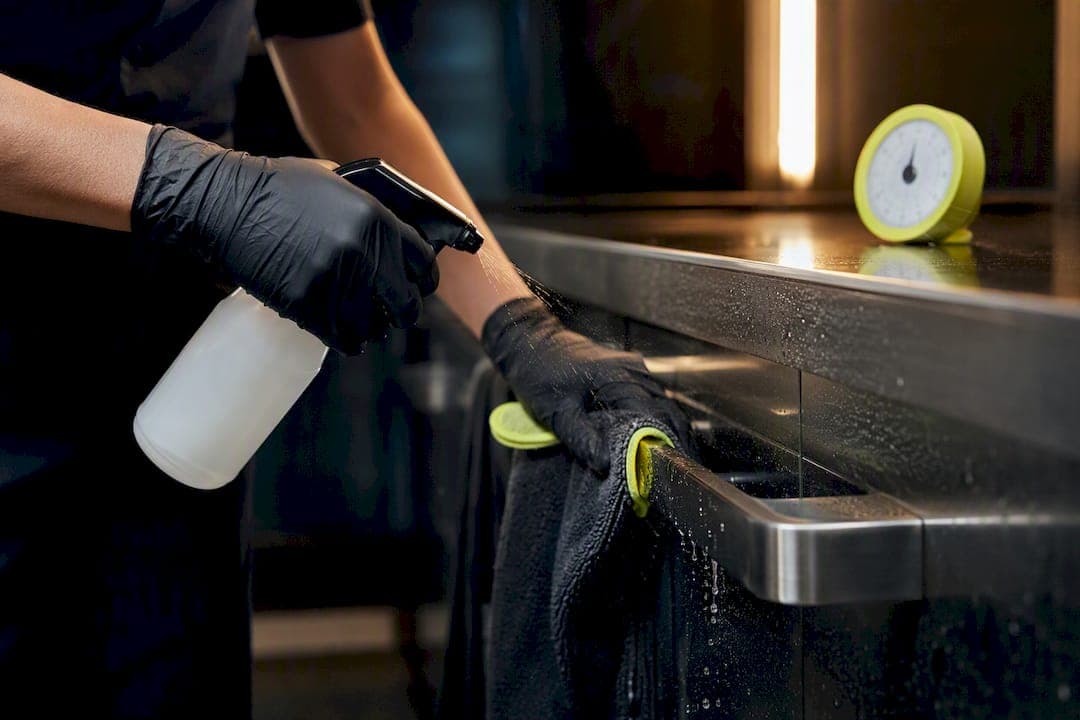
Disinfectant dwell time is the length of time a disinfectant must stay wet on a surface to kill the germs it claims to kill. The single rule that matters: check the label, then keep the surface visibly wet for that exact duration, no shortcuts. Contact times vary by product, chemistry, and target pathogen, and the number on the label isn't marketing copy. It's the figure the product was tested against to earn its claim under TGA guidance.
TL;DR:
- Disinfectant contact times vary widely based on chemical type and pathogen resistance, making it crucial to follow the label exactly without shortcuts.
- Alcohol-based products evaporate quickly, often in under a minute, while quats and bleach can stay wet longer but are affected by surface dirt and organic soil.
- Validated contact times for common bacteria and viruses range from 30 seconds to three minutes, with tougher organisms like spores requiring significantly longer.
- Proper application involves cleaning first, applying enough product to keep surfaces wet, and avoiding wiping or drying before the labeled dwell time is complete.
- In real-world use, shorter validated contact times often outperform longer ones, especially when surfaces cannot stay wet for extended periods.
Table of Contents
- What is disinfectant contact time, and why does it change by product?
- How long should disinfectant sit? Typical ranges explained
- Where contact time hides on the label, and what TGA expects
- How to actually keep a surface wet for the full contact time
- Does contact time really change the outcome? What the research shows
- Fogging, PPE, and where the safety line sits
- How Grime Scene Services matches disinfectant choice to real cleaning workflows
- The gap between the label and the mop bucket
- Sources
- FAQ
What is disinfectant contact time, and why does it change by product?
Wet contact is what lets the active ingredient reach and disrupt a microbe's cell wall or protein structure. The moment a surface dries, that chemical action stops, whether the label said two minutes or ten.
Different chemistries behave very differently once they hit a surface:
- Alcohol evaporates fast, often in under a minute, which is why alcohol-based products tend to carry short contact times.
- Quaternary ammonium compounds ("quats") and bleach solutions can stay wet longer but bind to organic soil, so a dirty surface eats into their working strength.
- Hydrogen peroxide breaks down differently again, and its label times reflect that specific decay curve.
Pathogens aren't equal opponents either. Enveloped viruses (think influenza or coronaviruses) have a fragile outer layer that's relatively easy to rupture. Bacterial spores and mycobacteria are tougher, wrapped in structures built to resist exactly this kind of chemical assault, so their validated contact times run longer. That difference alone explains why one disinfectant might carry three separate contact times on the same label, one for viruses, one for bacteria, one for fungi.
How long should disinfectant sit? Typical ranges explained
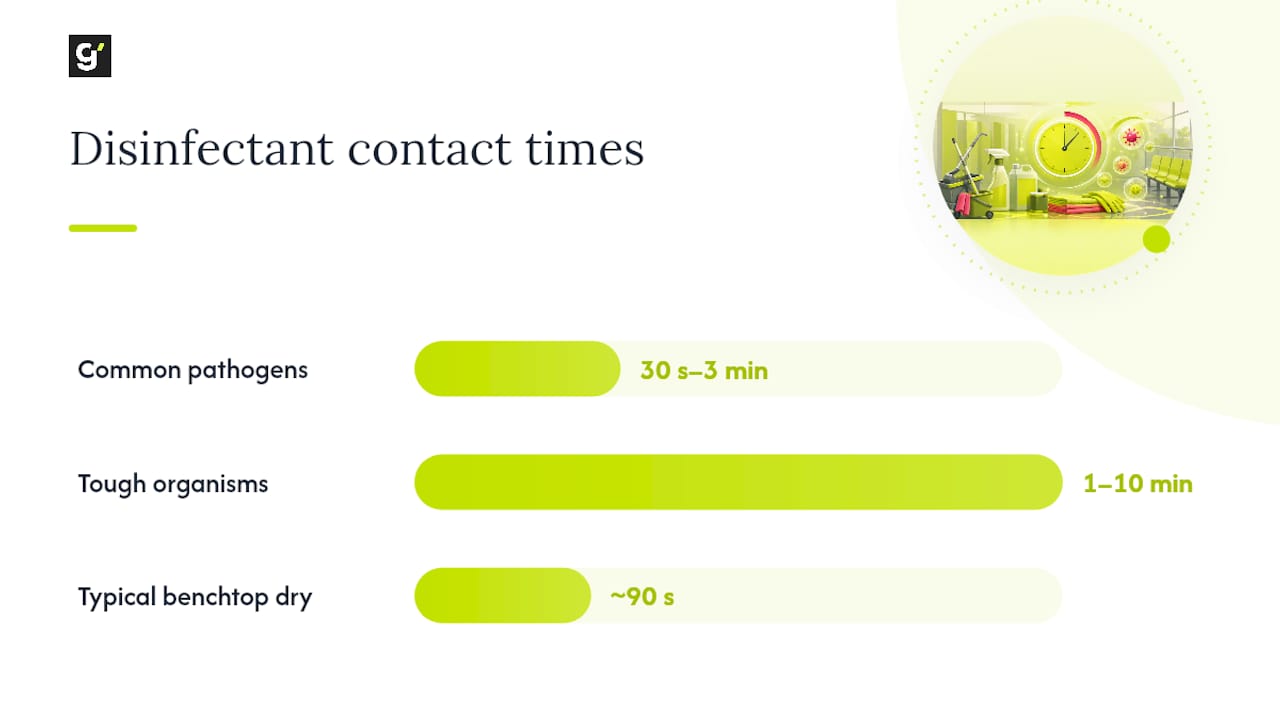
Most everyday surface disinfectants list something between 30 seconds and 3 minutes for common bacteria and viruses. Tougher organisms, including certain fungi and some bacterial strains, often need 1 to 10 minutes. Sporicidal claims, the kind used against something like Clostridioides difficile, can run considerably longer again.
What a "good" contact time actually looks like:
- Short enough that you can realistically keep the surface wet without reapplying
- Backed by a validated claim, not just a marketing phrase like "kills 99.9% of germs"
- Matched to the pathogen risk of the space, not the longest number you can find on a shelf
A longer contact time on paper isn't automatically the better buy. A 10-minute claim is worthless on a benchtop that dries in 90 seconds and gets touched again before you've walked away. This is where a lot of buying decisions go wrong: a product tested to a 5-minute standard sounds thorough, but if nobody in a busy kitchen or a short-term rental turnover is going to let it sit that long, a shorter validated contact time gets you a better real-world result. High-turnover benchtops and rental changeovers call for different products than a pathology lab bench that's wiped once and left alone.
Where contact time hides on the label, and what TGA expects
Contact time usually sits in the directions-for-use panel, sometimes worded as "contact time," "kill time," or the instruction to "leave surface visibly wet for X minutes." If you can't find it there, check the technical data sheet, not just the front-of-pack claim.
In Australia, the TGA's disinfectant testing guidance ties contact time to the specific conditions under which a product was validated, including temperature, soil load, and dilution rate. A product tested at a particular dilution and a particular level of organic soil only earns its claim under those conditions. Change the dilution and you've effectively changed the product.
Before you trust a contact time, check three things:
- The dilution ratio matches what's printed, not a "close enough" guess
- The room or surface temperature sits within the product's tested range
- Whether the label assumes pre-cleaning, since a heavily soiled surface can chew through a disinfectant's active ingredient before the clock even starts
Australian Government health guidance reinforces the same point for aged-care and health settings: the product needs full, sustained contact with the surface, and manufacturer instructions aren't optional extras. Reading warning labels properly matters just as much here as the timing itself, and it's worth understanding what those hazard symbols and phrases mean before you start diluting anything.
How to actually keep a surface wet for the full contact time
Application method decides whether you meet the label time or just guess at it.
- Clean first. Remove visible soil, grease, or grime. Disinfectant sprayed onto a dirty surface is fighting the soil before it fights the germs.
- Apply generously and evenly. Sprays need enough volume to stay wet; a light misting dries in seconds on a warm benchtop.
- Watch the surface, not the clock on the wall. If it's drying before the labelled time is up, that application has already failed.
- Reapply where evaporation outpaces the timer, especially on porous or absorbent materials, or on hot days.
- Let it air dry once the labelled time has elapsed. Don't wipe it off early just because it looks dry.
Pre-moistened wipes are convenient but hold less liquid than a spray-and-wait approach, which is exactly why manufacturers test them separately and often assign shorter times. Foams and gels cling to vertical surfaces better than sprays, which matters on splash backs and fittings. Full immersion, used for smaller items and instruments, sustains contact longest of all.
Pro Tip: Match the product to the site, not the site to the product. A cleaner working through a 40-minute rental turnover needs a validated 60-second product, not a theoretically stronger one that needs five minutes nobody has to spare.
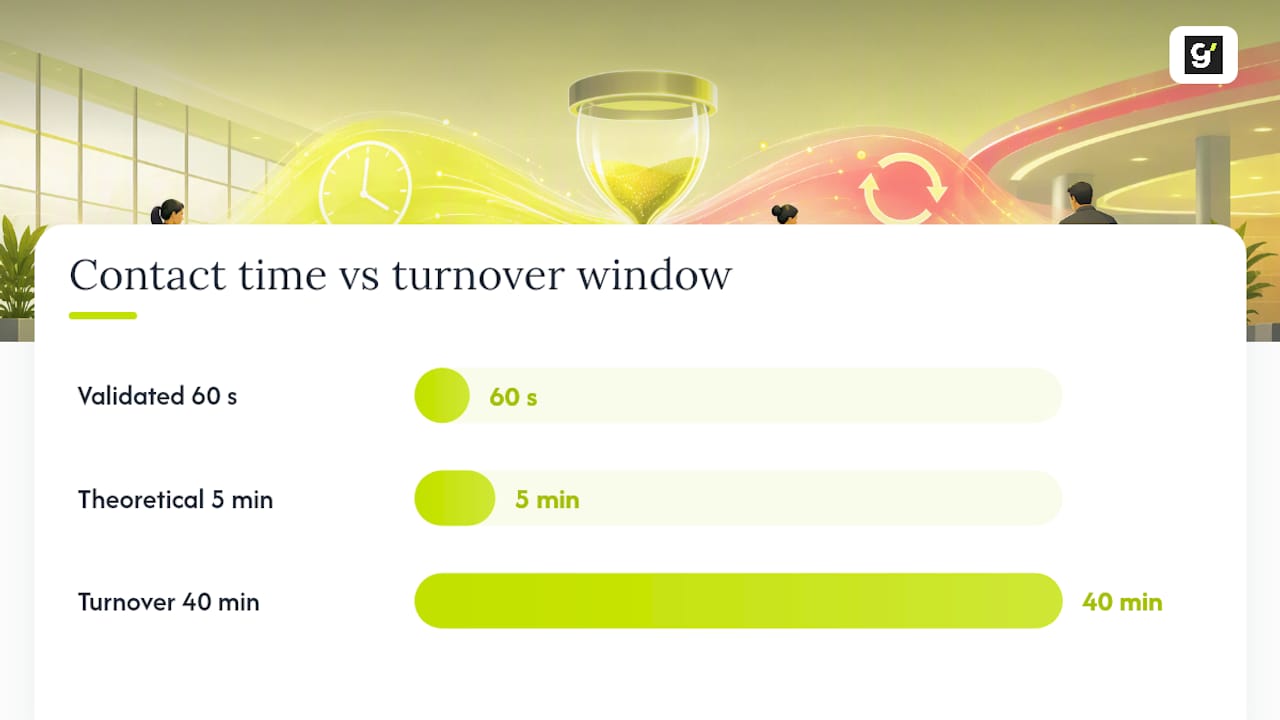
For high-turnover commercial kitchens or shared bathrooms, build a short disinfection pause into the roster rather than trying to squeeze contact time in around foot traffic. If you're managing compliance, log the product, dilution, and time used, particularly in food service or care settings where an inspector may ask.
Does contact time really change the outcome? What the research shows
Contact time matters, but not in every situation equally, and the two leading studies on this land in slightly different places.
- Lab testing published in the American Journal of Infection Control found that wet contact time directly affects antimicrobial efficacy for liquid disinfectants under controlled conditions. Under laboratory rigour, the clock genuinely matters.
- A separate study in Antimicrobial Resistance & Infection Control tested disinfectant towelettes under realistic wiping conditions and found product type mattered more than contact time. A one-minute wipe often performed no worse than a ten-minute one for many products tested.
The takeaway isn't that contact time is a myth. It's that under real cleaning conditions, a validated short-time product beats a long-time product nobody can sustain. If your team, your household, or your rental cleaner genuinely cannot keep a surface wet for five or ten minutes, don't buy a five-or-ten-minute product and hope. Buy one tested and validated at a time you can actually hit, and lean on chemistry that does the biological work properly rather than one that just sounds strong on the box.
Fogging, PPE, and where the safety line sits
Fogging and misting machines look efficient but carry real risk. Australian health department guidance warns that fogging can cause dangerous chemical exposure, needs long settling and ventilation time, and should never replace manual cleaning of high-touch surfaces like door handles, taps, and light switches.
- Fogging is a supplementary method at best, never a substitute for physical wiping with the correct contact time.
- Trained crews with proper PPE are needed for biohazard situations or high-risk clinical environments.
- At home or in the office, ventilate the space, never mix chemical products, and check the SDS before you dilute anything unfamiliar.
How Grime Scene Services matches disinfectant choice to real cleaning workflows
Grime Scene Services builds procedures around the site, not the label alone. A short-term rental turnover on a tight two-hour window needs a fast, validated contact time; a post-construction sweep or bio-hazard job justifies a slower, deeper chemistry with trained handling. Programs like The Scene Reset and rapid response cleans are built around this logic: eco-friendly, non-toxic products chosen to hit their labelled contact time inside the timeframe the job actually allows, not the timeframe a data sheet wishes existed.
The gap between the label and the mop bucket
The industry's default advice, "always use the longest contact time you can find," sounds cautious but often backfires. It pushes people toward products they can't realistically use correctly, which means the surface dries out at minute two of a five-minute claim and the disinfection never actually happened. A shorter, honestly validated contact time that a person will actually complete beats an impressive number that gets abandoned halfway through.
The towelette research backs this up in a way most cleaning advice ignores: product formulation often outweighs contact time under real wiping conditions, so chasing the longest label number isn't automatically chasing the best result. What the reader should prioritise first is honest self-assessment. How long can this space, this team, or this cleaner realistically keep a surface wet, then buy accordingly, matching a home cleaning kit to a rental turnover with an interior surface care approach that fits how quickly a room actually needs to be back in use. Regulatory contact times exist to protect people, not to be treated as a box-ticking inconvenience, and matching product to workflow is what turns that regulation into an outcome you can trust.
— Lead
Sources
For the regulatory detail behind Australian contact time claims, see the TGA's disinfectant testing instructions and Safe Work Australia's office cleaning guidance. Both the AJIC and Antimicrobial Resistance & Infection Control studies referenced above are worth reading in full for anyone managing compliance.
- Instructions for disinfectant testing — TGA
- Wet contact time directly impacts antimicrobial efficacy of EPA-registered disinfectants — American Journal of Infection Control
- Contact time has limited impact on efficacy of disinfectant towelettes under realistic use — Antimicrobial Resistance & Infection Control
FAQ
What is the dwell time of a disinfectant?
Dwell time, also called contact time, is how long a disinfectant needs to stay wet on a surface to kill the microbes named in its claim. It's set during product testing under TGA-defined conditions, including a specific temperature, dilution, and soil load.
How long should you leave disinfectant on a surface?
Leave it exactly as long as the product label states, keeping the surface visibly wet the whole time. Most everyday disinfectants need 30 seconds to 3 minutes for common bacteria and viruses, while tougher organisms can require up to 10 minutes or more.
What is considered a good dwell time?
A good dwell time is one that's validated, clearly stated, and short enough for the person using it to actually sustain without the surface drying out first. Research on disinfectant towelettes found that product type often matters more than a long contact time under realistic wiping conditions.
How long should bleach dwell on a surface?
Bleach solutions need to remain visibly wet for the specific time stated on that product's label, which varies by dilution strength and the target pathogen. Always check the technical data sheet rather than assuming a standard time, since bleach's contact time depends heavily on dilution and how much organic soil is on the surface.