
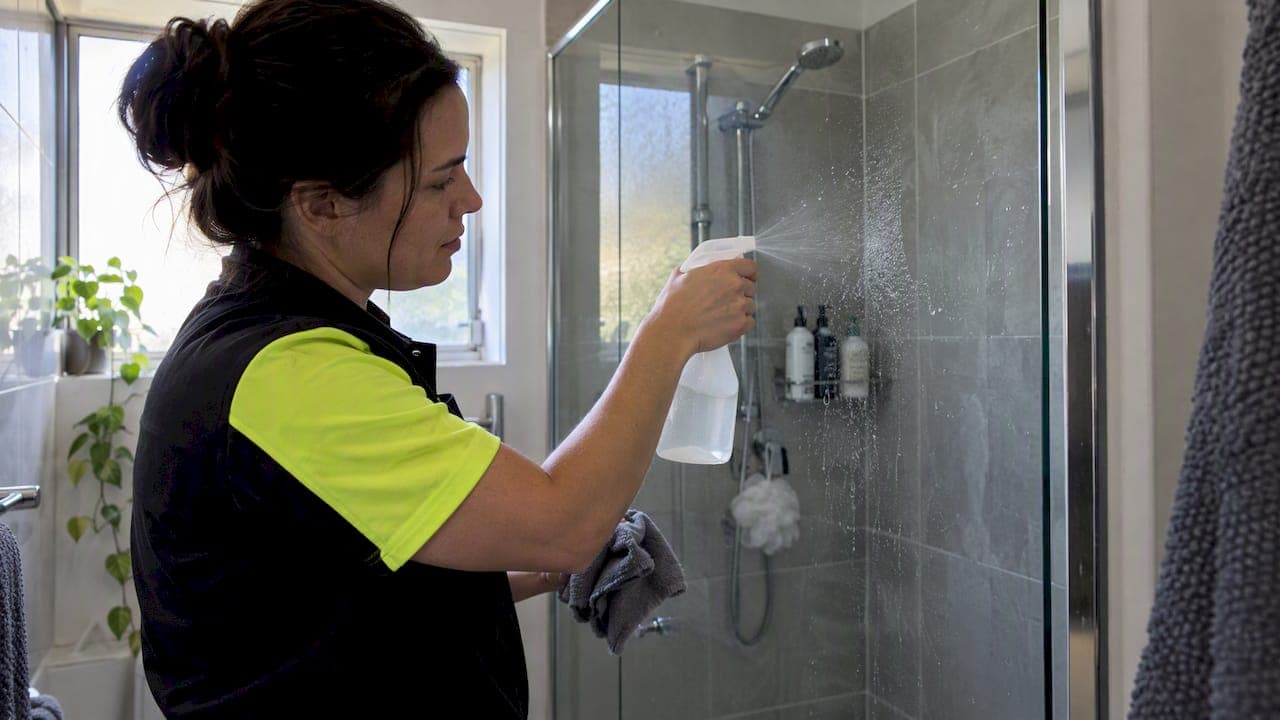
The simplest eco-friendly fix for shower glass has two stages: an acid rinse (white vinegar or a citric-acid solution) to dissolve mineral scale, followed by a mild surfactant or baking-soda paste to lift greasy soap scum. Rinse well, dry the glass, and squeegee after every shower to stop the buildup returning. Never mix acids with bleach, and wear gloves while you work.
TL;DR:
- For routine scale, spray a 1:1 vinegar and water solution, leave it for several minutes, then gently agitate, rinse, and dry the glass.
- Treat greasy scum separately with warm dish soap; use baking soda paste only after rinsing away acid, and avoid abrasive powders that can scratch glass.
- Never combine acids with bleach, wear gloves and eye protection when using concentrated solutions, and keep acids off natural stone.
- Squeegee after every shower and wipe weekly with dish soap; persistent hard water may justify filtration, while etched or failing glass needs specialist care.
Table of Contents
- Quick eco-friendly recipes: pantry mixes that actually work
- Step-by-step deep clean for limescale and hard-water buildup
- How to remove soap scum (greasy residue) without harsh chemicals
- Prevention and low-waste maintenance routine that keeps glass clear
- Safety, what not to do, and surface compatibility
- Professional perspective: when to try DIY and when to hire a specialist
- Overview of eco-friendly agents for shower glass
- Comparing eco-friendly and traditional chemical cleaners
- Environmental benefits of eco-friendly shower cleaning
- Maintenance tips to keep glass clear longer
- How our eco-friendly protocols differ for shower glass
- More DIY recipes beyond vinegar and baking soda
- What actually moves the needle on shower glass
- Consider a professional eco-friendly deep clean
- FAQ
- Sources
Quick eco-friendly recipes: pantry mixes that actually work
Most shower glass problems come down to two different substances: mineral scale from hard water and greasy soap scum. Each needs a different approach, so match the recipe to the deposit rather than reaching for one all-purpose spray.
- Vinegar and water (1:1): a general-purpose spray for light limescale and weekly maintenance, sprayed on and left to sit before wiping.
- Citric-acid solution: dissolve citric-acid powder in warm water as a vinegar alternative, useful where you want a less pungent option or are treating fittings where metal contact needs more care.
- Baking-soda and dish-soap paste: mix baking soda with a little water and a squeeze of dish soap for stubborn, built-up scum that needs gentle abrasion.
- Dish soap in warm water: the first move on greasy deposits, since surfactants lift fatty residue that acid alone will not touch.
For a pleasant scent without synthetic fragrance, infuse a jar of white vinegar with citrus peels for a week or two, then strain and dilute as usual. Keep refill bottles labelled clearly with contents and dilution ratio, and buy vinegar and citric acid in bulk to cut packaging waste.
Pro Tip: Keep your vinegar spray and your baking-soda paste in separate containers: combining them on the glass just neutralises the acid before it can work.
Step-by-step deep clean for limescale and hard-water buildup
Acid dissolves mineral scale through a straightforward chemical reaction, but that reaction stops the moment you add a base like bicarbonate of soda. The visible fizz when vinegar meets baking soda feels satisfying, but that reaction is neutralisation, not extra cleaning power: the alkaline bicarbonate cancels out the acid before it finishes dissolving the scale. Use acid first, on its own, and bring in bicarbonate only afterward as a separate polishing step.
- Clear the shower of bottles and mats, and ventilate the room.
- Spray diluted vinegar or citric-acid solution generously over the glass.
- Let it dwell for several minutes so the acid has time to work on the minerals.
- Agitate gently with a non-scratch sponge or microfibre cloth, working in small sections and never letting the product dry on the glass.
- Rinse thoroughly with clean water.
- If greasy residue remains once the scale is gone, follow with a dish-soap wipe.
- Dry the glass with a squeegee or microfibre towel and check chrome fittings for any dulling.
One pass is often enough for light to moderate limescale, since CHOICE testing found some dissolvable bathroom products performed no better than plain water, which suggests mechanical agitation and dwell time matter more than a stronger formula. Repeat only on sections that still feel rough to the touch.
How to remove soap scum (greasy residue) without harsh chemicals
Soap scum is a mix of soap residue, body oils and minerals, so the oily component needs a surfactant rather than acid. Start with dishwashing liquid diluted in warm water, applied with a non-scratch sponge, since a mild surfactant lifts the fatty layer that acid alone leaves behind. Wipe, rinse, and check whether any film remains before reaching for a stronger step.
- Dish soap and warm water: the first-line treatment for everyday greasy film.
- Baking-soda paste or mild washing-soda spray: for tougher, dried-on scum, since washing soda can help saponify fats on tolerant surfaces.
- Hydrogen peroxide and baking soda: useful where mould and soap scum are combined, used sparingly and rinsed well.
Avoid abrasive powders or pumice stones directly on glass, since they can scratch the surface permanently rather than lift the residue.
Pro Tip: Test any new paste on a small, hidden corner of the glass first: a few minutes of patience beats a visible scratch mark later.
Prevention and low-waste maintenance routine that keeps glass clear
Cleaning less often starts with stopping the buildup before it forms, and that is also the lowest-waste option available.
- Daily: squeegee or towel-dry the glass after every shower, run the exhaust fan or crack a window, and fix any dripping tap promptly, since drying surfaces immediately reduces the moisture that feeds mould and soap scum.
- Weekly: a light wipe with a dish-soap solution or a refillable eco concentrate keeps scum from building into a deeper layer, and choosing a concentrate you top up rather than rebuy cuts packaging waste.
- Longer term: if hard water is a persistent problem in your area, a water softener or filtration unit reduces the minerals reaching the glass in the first place.
When you do buy a dedicated product, look past the green label to the actual test results. CHOICE's review of an eco shower, bath and tile cleaner recorded a 66% Expert Rating alongside claims of no bleach, no ammonia and phosphate-free surfactants, which is a reminder that formulations and prices change, so check the current label before you buy. Our eco cleaning supplies starter guide covers refill systems and low-waste buying in more depth.
Safety, what not to do, and surface compatibility
Low-toxicity does not mean risk-free, and a few rules keep the process safe for you and your bathroom fittings.
- Never mix acids with bleach or chlorine-containing cleaners: combining them can release dangerous fumes, and if a chemical does contact skin, healthdirect advises flushing with cool running water for at least 20 minutes.
- Avoid acids on natural stone, and be cautious with chrome fittings and coated or tinted glass: rinse promptly and test a small patch first, since vinegar isn't suitable for every surface.
- Wear gloves and eye protection with concentrated solutions, ventilate the room, and label any refill bottle clearly.
Our guide on how eco cleaning protects home finishes goes into more detail on which surfaces tolerate acid and which need a gentler approach.
Professional perspective: when to try DIY and when to hire a specialist
Longstanding scale that has etched into the glass, or a coating that has already started to fail, often needs more than a pantry recipe to put right, and repeated acid treatment on damaged glass can make the surface worse. A specialist eco-friendly cleaner can apply non-toxic agents in a controlled, documented way and reduce packaging waste through bulk and refill systems rather than single-use sprays. None of that replaces the basics: a consistent squeegee habit remains the single biggest factor in how often you need to clean at all.
Overview of eco-friendly agents for shower glass
The eco-friendly toolkit for shower glass is short and mostly already in your pantry. White vinegar (diluted acetic acid) handles mineral scale, citric acid offers a milder-smelling alternative for the same job, bicarbonate of soda provides gentle abrasion for scum once the acid stage is finished, and plain dishwashing liquid acts as the surfactant that breaks down greasy residue. Hydrogen peroxide adds a mild bleaching and antimicrobial step where mould is mixed in with scum.

What ties these together is that each targets a specific type of deposit rather than claiming to dissolve everything at once. That is also where commercial "eco" sprays vary: some are simply a vinegar or citric-acid base in a spray bottle, while others add plant-derived surfactants to handle grease in the same formula. CHOICE's testing of eco-labelled bathroom cleaners found performance varies by product, so a green label on its own is not a guarantee of cleaning power. Reading the ingredient list for an acid (for scale) and a surfactant (for scum) tells you more about what a bottle will actually do than the marketing on the front.
For anyone cleaning a large glazed enclosure such as a spa or spa bath rather than a standard shower screen, the same chemistry applies, though the scale of the job and the equipment involved can call for a specialist spa cleaning service rather than a DIY approach.
Comparing eco-friendly and traditional chemical cleaners
Conventional shower sprays often combine a strong acid or solvent with synthetic fragrance and sometimes bleach, which can cut through scale and scum quickly but leaves fumes and residue that need good ventilation to clear. Eco-friendly pantry methods trade some of that speed for a gentler chemical profile: vinegar and citric acid are weaker acids than many commercial descalers, so they typically need a longer dwell time or a repeat application on heavy buildup.
On effectiveness, the gap is smaller than the marketing on either side suggests. CHOICE's bathroom-cleaner testing found some conventional dissolvable products performed no better than plain water, while a plant-based concentrate scored among the highest in the same test. The deciding factor is less "natural versus chemical" and more whether the product actually contains an effective acid or surfactant at a usable concentration, applied for long enough and rinsed properly.
On safety, the eco-friendly approach has a clearer advantage: a vinegar or citric-acid spray left on a child's hands is far less likely to cause injury than contact with a bleach-based product, and healthdirect's guidance on chemical burns is written with exactly those stronger, bleach-containing products in mind. That said, the warning against mixing acids with bleach applies regardless of which type of cleaner is already in the bathroom, since the two should never meet.
Environmental benefits of eco-friendly shower cleaning
Switching to pantry-based cleaners for shower glass cuts down on two things at once: the volume of packaging going to landfill and the amount of synthetic chemical residue washed down the drain after every clean. Vinegar, citric acid and bicarbonate are biodegradable, break down readily in wastewater treatment, and can be bought in bulk or refilled into the same spray bottle for years rather than tossed out with every empty.
Commercial bathroom sprays, by contrast, often combine single-use plastic bottles with concentrated surfactants or solvents that are formulated for cleaning power rather than biodegradability. Choosing a refillable eco concentrate, or simply mixing your own, reduces both the plastic footprint and the chemical load entering the water system with each clean.
There is also a household air-quality angle: a vinegar or citric-acid spray produces far less fume than a chlorine-based bathroom cleaner, so the bathroom clears faster and needs less forced ventilation after each use. Over a year of weekly cleans, that adds up to a meaningfully lighter footprint, both in what goes down the drain and what you breathe in while scrubbing.
Maintenance tips to keep glass clear longer
A shower screen that gets squeegeed after every use rarely needs an aggressive clean at all, which makes prevention the most sustainable habit in this whole routine. Keep a squeegee mounted in the shower itself so the habit takes seconds rather than becoming a chore, and follow it with a quick pass of a microfibre towel on the corners and tracks where water pools.
Running the exhaust fan after each shower, or leaving a window cracked, keeps humidity down and slows the return of both scale and mould. A weekly wipe with a diluted dish-soap solution catches the thin film that builds up even with daily squeegeeing, long before it hardens into visible scum.
For households in a hard-water area, the cycle of monthly or fortnightly acid treatments can be shortened considerably by addressing the water itself, whether through a point-of-use filter on the shower or a whole-house softening system. Track levels of the remaining pantry recipes too: running out mid-routine is often what causes people to reach for a harsher, premixed spray out of convenience.
How our eco-friendly protocols differ for shower glass
Our cleaning protocols are built around the same two-stage logic covered above, applied with non-toxic, bleach-free agents and the consistency of a trained routine rather than a one-off weekend effort. On a standard visit, we treat mineral scale and greasy residue as separate problems, using the correct agent for each and documenting before-and-after results so you can see exactly what changed.
For shower glass specifically, that means controlled dwell times on diluted acid for scale, followed by a surfactant pass for soap scum, with no bleach at any stage, helping protect the glass, the grout and the surrounding tile finishes. Bulk and refill systems reduce the packaging waste that comes with buying a new spray bottle every few weeks.
More DIY recipes beyond vinegar and baking soda
A few other pantry ingredients round out the eco-friendly toolkit for shower glass beyond the core three.
Lemon juice works similarly to vinegar and citric acid as a mild descaler, and its stronger natural scent can replace a vinegar rinse for anyone sensitive to the smell. Castile soap, diluted in warm water, is a plant-based surfactant alternative to standard dish soap and works well on both glass and surrounding tile. Cornstarch mixed into a vinegar-and-water spray gives the liquid more cling on vertical glass, so it has longer contact time with scale before sliding off. Essential oils such as tea-tree or eucalyptus, added in small amounts to a spray bottle, add a mild fragrance and some antimicrobial action, though they should be diluted properly and kept away from eyes.
As with every acid-based mix, test a new combination on a small section first, and keep it in a clearly labelled, separate bottle from any bicarbonate paste.
What actually moves the needle on shower glass
The advice that gets the most attention online, like the vinegar-and-baking-soda "volcano," is often the least efficient method in this entire routine, since the fizz works against the acid rather than for it. What actually matters is sequencing: acid first for minerals, surfactant second for grease, rinsed and dried in between. Most people skip that second stage entirely and wonder why their "eco clean" still looks hazy.
The most underrated habit is not a recipe at all. A squeegee used consistently does more to keep shower glass clear than any product, eco or otherwise, because it removes the water before minerals have a chance to dry onto the surface. If you take one thing from this routine, make it that habit, and treat the vinegar and baking soda as backup for the buildup that happens anyway.
— Lead
Consider a professional eco-friendly deep clean
When DIY mixes have taken the edge off but a haze or scum layer still won't lift, or when you simply want a guaranteed result without handling concentrated acid yourself, we offer deep decontamination and routine eco-friendly cleans built entirely without bleach or harsh chemicals.

Our DEEP DECONTAMINATION | Full Sweep service is suited to shower glass with longstanding scale or scum that pantry recipes haven't fully shifted, while The Routine Patrol provides recurring cleaning to help keep buildup under control. For short-term rental hosts, our short-term rental turnover service handles bathroom glass alongside the rest of the turnover, so guests always find a clear, streak-free shower screen. Get in touch to book a visit or check availability for your property.
FAQ
What is the best glass cleaner for a shower?
For most mineral scale, a diluted white vinegar or citric-acid spray works as well as many commercial descalers, followed by a dish-soap wipe for any greasy residue. CHOICE's testing found results vary widely between products, so the method matters more than the brand on the bottle.
Is Windex ok for glass shower doors?
A standard glass cleaner can work on shower glass for light, everyday marks, but it is formulated for windows rather than mineral scale or soap scum, so it often struggles with heavier buildup. An acid-based rinse followed by a surfactant wipe generally handles both deposit types more reliably.
How do I clean shower doors that are not glass?
Acrylic or plastic shower doors scratch more easily than glass, so skip abrasive pastes and stick to dish soap and water for everyday cleaning. For scale, use a well-diluted vinegar or citric-acid solution and a soft microfibre cloth rather than a scrubbing sponge, since even nonscratch tools need gentle handling on softer materials.
What is the best homemade shower glass cleaner?
A simple one-to-one mix of white vinegar and water handles routine scale and is recommended by CHOICE as an ammonia-free window and glass cleaner. Follow with a separate dish-soap wipe if greasy soap scum remains after the vinegar rinse.
Can I use vinegar and baking soda together on shower glass?
It is better to use them separately: the alkaline baking soda neutralises the acid in vinegar before it can fully dissolve mineral scale, so the fizzy reaction is not extra cleaning power. Apply vinegar first, rinse, then use baking soda as a separate mild abrasive if needed.
Sources
- Choice
- Chemical burns — first aid and treatment | healthdirect
- How to Remove Soap Scum—7 Proven Methods
- TikTok Is Lying To You: How To Remove Limescale the Right Way