
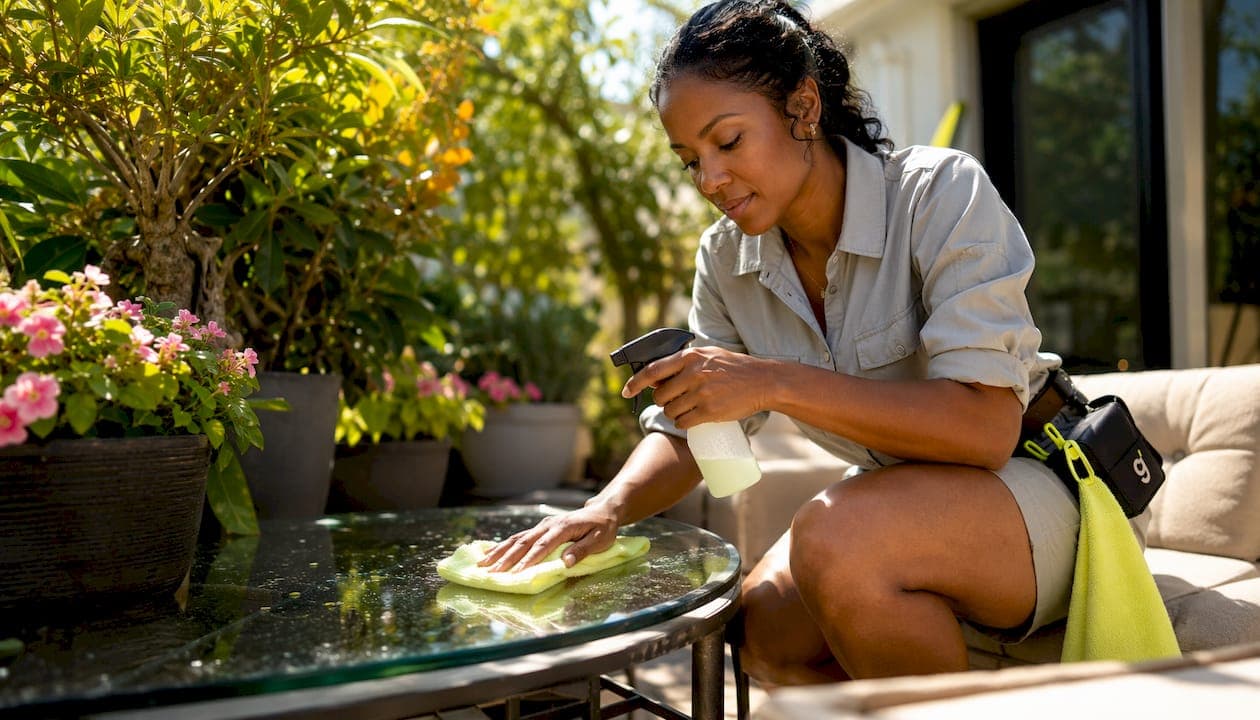
Professional eco-friendly whole-house deep cleaning is available across Australia right now, and it delivers something meaningfully different from a standard clean. Grimescene's Scene Reset protocol physically removes grime, biofilm, and chemical residue reservoirs using mechanical action, high-temperature botanical steam extraction, and concentrated non-toxic agents. The result is a home or rental property that is genuinely decontaminated, not just surface-sanitised.
Here is what a Scene Reset covers:
- Full biological and chemical grime removal from surfaces, cavities, and HVAC-adjacent zones, not just visible areas
- Mechanical agitation plus botanical steam extraction that lifts embedded contamination without leaving chemical residue
- Biodegradable tools and reusable dispensers to eliminate single-use plastic from the process
- Rapid turnover capability for short-term rental hosts who need a property guest-ready within hours
- Ingredient-transparent, non-toxic agents verified safe for families, pets, and sensitive occupants
To request an inspection or activate a rapid turnover service, visit Grimescene's deep decontamination page.
Table of Contents
- What does an eco-friendly whole-house deep clean actually mean?
- When should you hire a professional eco-friendly whole-house deep clean?
- What does the professional process actually look like on site?
- What to expect: timing, disruption, and cost drivers in Australia
- How do you choose a trustworthy eco-friendly deep-clean provider?
- DIY eco cleaning versus calling in professionals
- Grimescene delivers a whole-house Scene Reset across Australia
- Key takeaways
- The Scene Reset approach, from where we stand
What does an eco-friendly whole-house deep clean actually mean?
The phrase gets used loosely, so the distinction matters. A whole-house eco deep clean, or Scene Reset, is the physical removal of grime, biofilm, and residue that harbour microbes and odour. Sanitisation alone kills surface microbes but leaves the underlying contamination reservoir intact. A Scene Reset removes the reservoir itself.
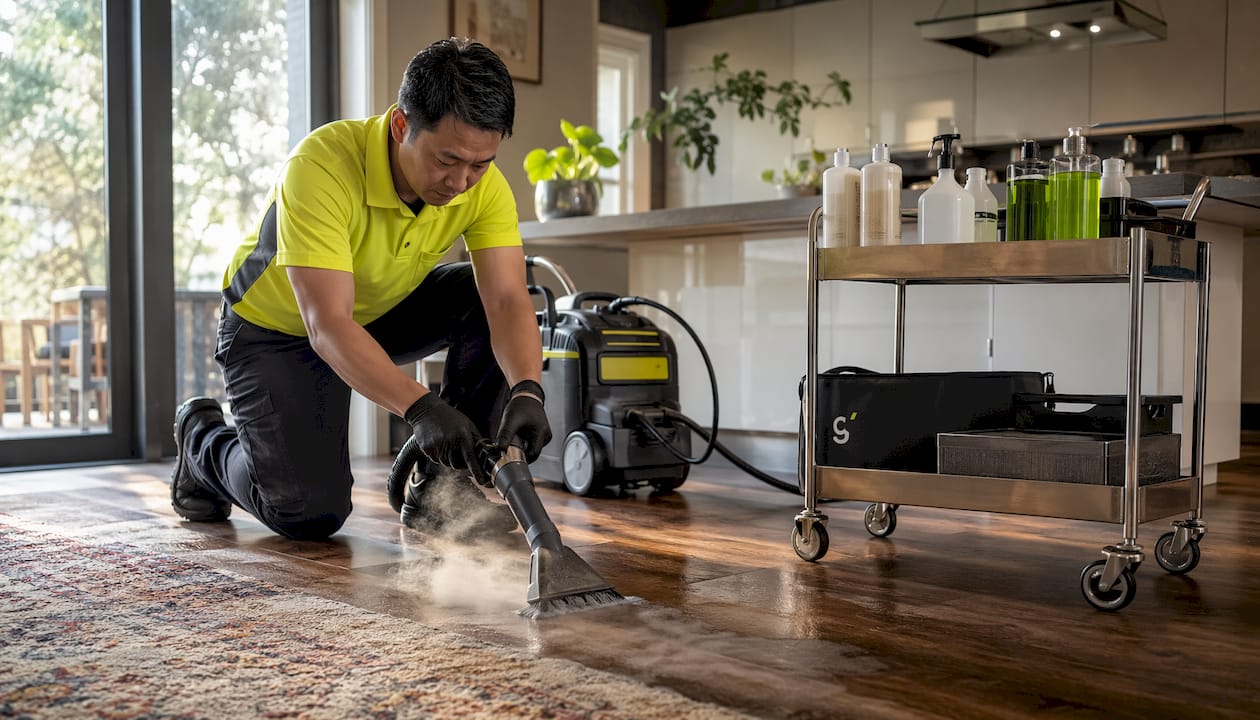
Three methods qualify as genuinely eco-friendly at professional scale:
| Method | What it does | Why it qualifies |
|---|---|---|
| Mechanical agitation | Dislodges embedded grime from fibres, grout, and cavities | No chemical dependency; physical action does the work |
| High-temperature botanical steam extraction | Eliminates bacteria and breaks down grease without chemical residue | Heat, not toxins, is the active agent |
| Concentrated non-toxic agents in reusable dispensers | Neutralises remaining buildup | Biodegradable, no synthetic fragrance, full-ingredient disclosure |
Ingredient transparency is where most providers fall short. The word "fragrance" on a label can mask dozens of undisclosed compounds, none of which the manufacturer is required to name. "Low-odour" is not the same as non-toxic. A genuinely eco-friendly provider will hand you a full ingredient list before the crew arrives.
Pro Tip: Ask for the Safety Data Sheet (SDS) for every product a provider plans to use. If they hesitate, that tells you everything. After the clean, wipe a treated surface with a dry white cloth — any colour transfer or slick residue means the rinse step was skipped.
Tea tree oil has documented antifungal and antibacterial activity and appears in some professional botanical formulations, but concentration and pet-safety labelling must be managed carefully. A reputable provider will disclose this.
When should you hire a professional eco-friendly whole-house deep clean?
Not every dirty house needs a Scene Reset. Here is how to decide:
- Post-construction or major renovation — fine dust, adhesive residue, and VOC off-gassing penetrate surfaces that a mop will not reach.
- Suspected contamination — biofluids, mould colonies, or chemical spills require containment and physical removal, not surface spray.
- Persistent odour after repeated cleaning — smell that returns within days signals a grime reservoir that sanitisation has not touched.
- Rental turnover with guest complaints — a single negative review citing cleanliness can cost more than a professional Scene Reset.
- Chronic respiratory or allergy symptoms — green cleaning reduces indoor air pollutants that conventional products introduce or leave behind.
- Visible long-term buildup in hidden cavities — grease in rangehood ducts, soap scum in shower grout, or HVAC odour all indicate reservoir-level contamination.
- Recent pest or water damage — both leave biological residue that standard cleaning cannot safely address.
For short-term rental hosts, the decision splits cleanly: a rapid response tactical clean handles routine turnovers between guests, while a full Scene Reset is warranted after extended stays, damage, or a run of poor reviews.
What does the professional process actually look like on site?
A properly staged eco-friendly deep clean follows a fixed sequence. Each step has a specific purpose, and skipping one undermines the next.
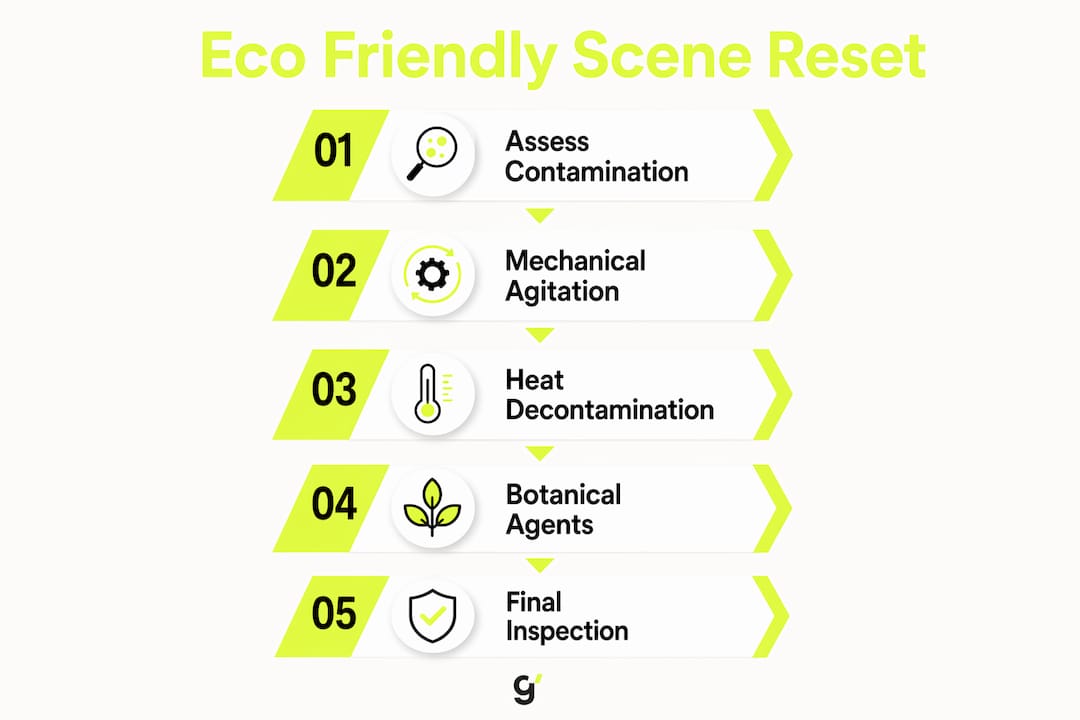
- Inspection and risk assessment — technicians identify contamination type, surface materials, and access constraints before touching anything.
- Targeted mechanical agitation — brushes, scrapers, and agitation tools dislodge embedded grime from grout, fibres, and cavities.
- High-temperature botanical steam extraction — heat penetrates porous surfaces and lifts bacteria without leaving residue.
- Application of verified non-toxic agents — concentrated formulations are applied in reusable glass or metal dispensers; coconut coir brushes and washable microfibre replace single-use tools wherever possible.
- Rinse and filtration — HEPA vacuuming captures fine particulate; surfaces are rinsed to remove all agent residue.
- Verification and reporting — a completion check confirms no residue, no odour, and guest-ready or occupancy-ready status.
| Tool / Equipment | Purpose | Sustainability note |
|---|---|---|
| Steam extractor | Heat-based decontamination | No chemical input required |
| HEPA vacuum | Fine particulate capture | Reusable filter, enclosed waste |
| Glass/metal spray systems | Agent application | Eliminates single-use plastic |
| Coconut coir brushes | Agitation on delicate surfaces | Fully biodegradable |
| Washable microfibre cloths | Wiping and polishing | Replaces disposable wipes |
One material caution worth knowing: vinegar etches natural stone permanently. Marble, granite, and travertine require neutral-pH, non-acidic cleaners. Any provider who reaches for a vinegar spray near your stone benchtops is a provider to reconsider. For surface-specific guidance, Grimescene's eco cleaning and home finishes guide covers this in detail.
What to expect: timing, disruption, and cost drivers in Australia
Timeline varies considerably by scope. A single-bedroom apartment Scene Reset typically takes 3–5 hours; a four-bedroom family home with heavy contamination can run a full day or more. Rapid turnover services for short-term rentals compress this to 2 hours for a tactical clean, though a full decontamination still requires adequate dwell time for steam and agents to work.
| Cost driver | Impact on quote | What to do |
|---|---|---|
| Contamination severity | Highest single variable | Be specific when describing the problem |
| Total surface area | Linear increase | Provide accurate room count and sizes |
| Rapid response / mobilisation | Premium fee applies | Book in advance where possible |
| Specialised waste handling | Adds cost for biohazard material | Disclose any known contamination upfront |
| Surface type (stone, timber, heritage) | Requires specialist agents | Flag these when requesting a quote |
Before the crew arrives, clear personal items from surfaces, ensure access to all rooms and HVAC vents, and flag any known surface sensitivities. This alone can reduce job time noticeably. For a practical eco cleaning supplies starter guide to maintain results between professional cleans, Grimescene's blog covers Australian-specific product options.
How do you choose a trustworthy eco-friendly deep-clean provider?
The green cleaning market has a greenwashing problem. These questions separate genuine providers from those trading on vague claims.
Ask every provider:
- Can you provide a full ingredient list and SDS for every product you use?
- Do you use steam extraction, or only spray-and-wipe methods?
- How do you handle waste, and which tools are reusable versus single-use?
- What is your turnaround capability for short-term rental properties?
- Are your workers covered by public liability insurance, and do they use appropriate PPE?
- Can you show documentation of your Scene Reset or equivalent protocol?
Trust signals to look for:
- Full ingredient disclosure, not just "eco-friendly" or "natural" on a website
- Documented step-by-step remediation protocol (not just a checklist)
- Evidence of rental turnover case results, not just testimonials
- Public liability insurance and compliance with relevant Australian workplace health and safety standards
- Willingness to discuss common eco cleaning myths and limitations honestly
Red flags:
- "Green" or "natural" claims with no ingredient list available
- Reliance on scented single-use sprays as the primary method
- Refusal to show insurance or worker safety documentation
- Using vinegar-based products on stone surfaces without flagging the risk
- No mention of mechanical action or steam in their method description
DIY eco cleaning versus calling in professionals
DIY is genuinely effective for routine maintenance. Pantry ingredients like white vinegar, baking soda, castile soap, and hydrogen peroxide cover most household cleaning tasks when matched to the right surface. The environmental footprint is low, the cost is minimal, and you know exactly what is in every formula.
Where DIY works well:
- Weekly surface maintenance between professional cleans
- Light grease on kitchen tiles and splashbacks
- Minor stains on hard floors and bathroom fittings
- Odour control in bins and drains
Where DIY falls short:
- No access to industrial steam extraction or HEPA containment
- Cannot safely address biohazardous contamination or mould colonies
- Post-construction dust penetrates cavities beyond reach of household tools
- Repeat guest complaints for rentals signal a reservoir problem that surface cleaning will not fix
One safety point that DIY guides sometimes bury: never mix bleach with vinegar or other household acids. The reaction releases hazardous fumes. Stick to one agent at a time and test on a hidden area first, particularly on stone or timber. For a fuller comparison of methods, Grimescene's eco vs traditional cleaning guide is worth reading before you decide.
Grimescene delivers a whole-house Scene Reset across Australia
Grimescene's Deep Decontamination Full Sweep is built for properties where surface cleaning has already failed. The Scene Reset protocol moves through inspection, mechanical agitation, botanical steam extraction, and verified non-toxic agent application in a fixed sequence, with a completion report confirming residue-free, guest-ready status. Every agent is fully disclosed, every tool is reusable or biodegradable, and every job is covered by public liability insurance.
For short-term rental hosts, the tactical unit service handles rapid turnovers between guests, while the Rapid Response 2-Hour Tactical Clean covers urgent situations. For properties needing a full reset, the Deep Decontamination Full Sweep is the starting point. Request a quote directly through the service page and specify your property type, size, and any known contamination.
Key takeaways
A Scene Reset physically removes contamination reservoirs using mechanical action, steam, and non-toxic agents, delivering sustained results that sanitisation alone cannot match.
| Point | Details |
|---|---|
| Scene Reset vs sanitisation | Deep remediation removes grime reservoirs; surface sanitisation leaves them intact and contamination returns. |
| Ingredient transparency | Always request a full SDS before booking; "fragrance" on a label can conceal dozens of undisclosed compounds. |
| When to call professionals | Post-construction, suspected contamination, mould, persistent odour, and rental complaint patterns all warrant a pro Scene Reset. |
| Verify results on completion | Wipe a treated surface with a dry white cloth; any residue or colour transfer means the rinse step was incomplete. |
| Grimescene's offering | The Deep Decontamination Full Sweep and Rapid Response services cover residential, commercial, and short-term rental properties across Australia. |
The Scene Reset approach, from where we stand
The most common mistake people make when hiring a cleaner for a serious grime problem is confusing a thorough clean with a decontamination. They are not the same job. A thorough clean makes a place look right. A decontamination makes it safe, and the difference shows up weeks later when the smell returns, the guest leaves a one-star review, or the allergy symptoms come back.
What the eco-friendly framing adds is not just an environmental benefit, though that matters. It is the discipline of knowing exactly what goes onto every surface. Conventional cleaning products routinely contain compounds that linger in soft furnishings, affect air quality, and accumulate in the bodies of children and pets who spend time on floors. Choosing non-toxic, fully disclosed agents is not a lifestyle preference. For families with young children, people with respiratory conditions, and guests who have no idea what was used to clean the property they just checked into, it is a straightforward health decision.
The providers worth hiring are the ones who can hand you a document, not just a claim.
Useful sources and further reading
- Green Cleaning Guide, Clean Water Action — public health framing of green cleaning as an accessibility and health issue, with guidance on reducing indoor air pollutants
- 10 Eco-Friendly Cleaning Tips, Planet Natural — practical overview of steam cleaning, reusable tools, and pantry-ingredient methods
- Green Cleaning 101, Plastic Free Everything — guidance on concentrated agents, glass/metal dispensers, and biodegradable tool choices
- Homemade Natural Cleaners, The Greenest — ingredient transparency, tea tree oil efficacy, and the regulatory gap around "fragrance" labelling
- Natural Cleaning Hacks, Stone Gable Blog — material-specific cautions, including the acid risk on natural stone surfaces
- Clean and Green Homemade Cleaners, University of Arkansas Extension — peer-reviewed extension resource on DIY formulations and surface matching
- Beginner's Guide to Green Cleaning, NPR Life Kit — accessible overview of sustainable cleaning swaps and label-reading guidance
This article is general information about eco-friendly cleaning methods and services. For contamination involving biohazards, mould, or regulated substances, consult a qualified remediation professional and check current Australian workplace health and safety requirements for your jurisdiction.