

A compliant end of lease carpet cleaning requirement means a restorative clean matched to the carpet's fibre and condition, not a generic steam clean. Book a technician who works to that standard, hand over full property details up front, and demand an itemised scope plus before and after photos. Keep the invoice, dated photos, and the exit condition report together as one file.
TL;DR:
- Proper end-of-lease carpet cleaning must be tailored to the carpet’s fibre type and condition, not a generic steam clean or flat rate quote.
- Booking a cleaner involves providing detailed property and access information upfront, then requesting an itemised scope, method, equipment, and photographic documentation.
- Keeping a comprehensive handover pack with photos, invoices, and technician notes linked to condition reports is essential for resolving bond disputes.
- Cleaning cannot fix damage such as burns, delamination, dye transfer, or severe wear; documented limitations avoid false expectations and disputes.
- Routine turnover cleaning is sufficient for most stays unless there are visible traffic lanes, odors, pet issues, or tracked-in debris requiring a deep reset.
Table of Contents
- What does a professional end‑of‑lease carpet clean involve?
- How do you brief and book the right cleaner?
- What documentation should you keep for bond disputes?
- When is cleaning not enough to fix carpet damage?
- Routine turnover or a full deep reset: which does your rental need?
- What does the lease actually say about carpet cleaning?
- What cleanliness standard do landlords actually expect?
- What does inadequate carpet cleaning cost you?
- Do the rules change by state or by landlord type?
- How should you inspect carpets before booking a clean?
- What are the most common carpet condition disputes?
- The handover pack that actually holds up
- Book a restorative clean that comes with the paperwork built in
- Sources
- FAQ
What does a professional end‑of‑lease carpet clean involve?
A competent job starts with inspection, not equipment. The technician checks fibre type, existing wear, stain age, and odour source before choosing a method, because a wool blend and a nylon loop pile don't respond the same way to heat or moisture. This is the core principle behind CPPCLO4110, the national training standard for restorative carpet cleaning: the operator selects methods, equipment, and agents suited to the specific carpet and task, rather than applying one process to every job.
From there, the workflow typically runs:
- Pre‑vacuum to lift dry soil and grit that would otherwise turn to mud under moisture
- Spot and stain pre‑treatment, targeted at the specific contaminant (protein, tannin, oil, or biological)
- Odour treatment where pet or moisture smells are present
- The restorative method itself, whether that's hot water extraction, dry encapsulation, or targeted solvent work on specific marks
- Extraction of the cleaning solution and soil
- Controlled drying, with airflow managed to avoid re‑soiling or mould risk
A successful job leaves carpet damp, not soaked, with even colour and no visible residue once dry. Record the drying time given, any areas flagged as not fully restorable, and the products used.
Pro Tip: If a cleaner quotes a flat "steam clean" price without asking about fibre type or inspecting first, that's a red flag. Restorative cleaning is a diagnosis‑led process, not a fixed script, and a one‑size price usually signals a one‑size result.
How do you brief and book the right cleaner?
The brief you send before confirming a booking does more to protect the outcome than anything you check afterwards. Property managers handling tenancy turnovers should follow the same information‑gathering discipline set out in CPPREP4123, the tenancy management competency standard, which specifies exactly what a manager needs to hand over and request.
Send this before you confirm:
- Full property address, room count, and approximate carpet area
- Carpet fibre type if it's known or listed in previous condition reports
- Furniture status (empty, partially cleared, or full)
- Parking and access details, including keys or lockbox codes
- The hard deadline for job completion, especially tight for a re‑let date
Then ask the cleaner to confirm, before you book:
- An itemised scope of work, not a lump‑sum quote
- Declared method and equipment (hot water extraction, encapsulation, or otherwise)
- Realistic drying guidance for the space and season
- A final invoice and before/after photo set as standard deliverables
- A Safety Data Sheet if the cleaner markets "eco‑friendly" or "non‑toxic" products, since even low‑hazard agents carry classification and handling notes worth sighting, per Safe Work Australia's hazardous chemical information system
Build in slack. Drying always takes longer than the quote suggests, particularly in humid or poorly ventilated units, so schedule a buffer day where you can. For a tight turnaround between tenancies, line up a backup cleaner in case the first booking falls through. As a budgeting reference, end‑of‑lease carpet cleaning in the Perth market runs roughly $210 to $525 depending on room count and condition, though prices shift by city and scope. For a fuller cost breakdown across other Australian cities, see end of lease cleaning costs across Australia.
What documentation should you keep for bond disputes?
The cleaning job only protects you if it's connected to the property's paper trail. A cleaning invoice sitting alone in an inbox proves almost nothing; a cleaning invoice cross‑referenced against a dated condition report is hard evidence.
Keep, for every job:
- Dated before and after photos, room by room
- The itemised invoice, showing method and any areas noted as limited or not fully restorable
- Technician notes on stains, damage, or drying instructions
- A copy of the relevant condition report from the tenancy file
State-based condition reports, such as the exit and entry forms tracked by Consumer Affairs Victoria, are the primary evidentiary record used to assess property condition at the start and end of a tenancy. A cleaning invoice that isn't tied to that record carries far less weight in a bond dispute.
Structure the handover pack the way you'd want to present it at an inspection: photos grouped by room, a one‑line note against each flagged stain, the method used, and written confirmation the carpet was dry before re‑letting. Guidance on structuring the broader condition report is covered well in this property condition report best‑practice guide. Retain the pack for as long as your state's tenancy authority requires bond‑related records, and have it ready to hand over at the exit inspection rather than assembling it after a dispute is already raised.
When is cleaning not enough to fix carpet damage?
Cleaning removes soil, stains, and odour. It doesn't repair the carpet itself, and setting that expectation early avoids a difficult conversation later. CPPCLO4110 explicitly cautions that certain damage sits outside what restorative cleaning can achieve.
Issues cleaning generally can't fix:
- Burns or melt marks from heat sources
- Delamination, where the carpet backing separates from the pile
- Permanent dye transfer or bleaching from spilled chemicals
- Urine wicking, where old contamination resurfaces in the pile after cleaning
- Wear so severe the pile has flattened or thinned through to backing
If a stain reappears after a proper clean, that's usually a sign of wicking or fibre damage underneath, not a failed cleaning job. A competent technician documents this as a limitation rather than repeating the same wet extraction and hoping for a different result. Ask for that note in writing. If the report flags non‑restorable damage, get a flooring specialist's assessment before deciding between a patch repair and full replacement, and keep their written recommendation with the rest of the handover pack.
Routine turnover or a full deep reset: which does your rental need?
Not every changeover needs a full restorative clean. Airbnb's own hosting guidance recommends scheduling enough time for a thorough clean between guests and keeping a backup plan ready, but it also frames deep carpet work as something triggered by specific conditions, not a same‑day default.
Book a deep reset when you see:
- Visible traffic lanes forming near entries or hallways
- Pet hair, dander, or odour building up
- Sand or grit tracked in from beachside or outdoor‑heavy stays
- A lingering smell that routine vacuuming hasn't shifted
For everything else, routine turnover cleaning (vacuum, spot check, visible maintenance) is enough between most stays. Plan deep resets for low‑occupancy windows, allow the full drying time before the next check‑in, and stagger arrivals if needed. A rolling schedule of targeted extraction on high‑traffic zones keeps carpets guest‑ready without a full reset every week. More on structuring that rotation is in this Airbnb turnover cleaning guide.
What does the lease actually say about carpet cleaning?
Most residential tenancy agreements in Australia don't specify carpet cleaning as a blanket requirement. The general obligation on a tenant is to return the property in the same condition it was received, allowing for fair wear and tear, and state tenancy laws in Victoria, New South Wales, and Queensland all frame it this way rather than mandating a specific clean.
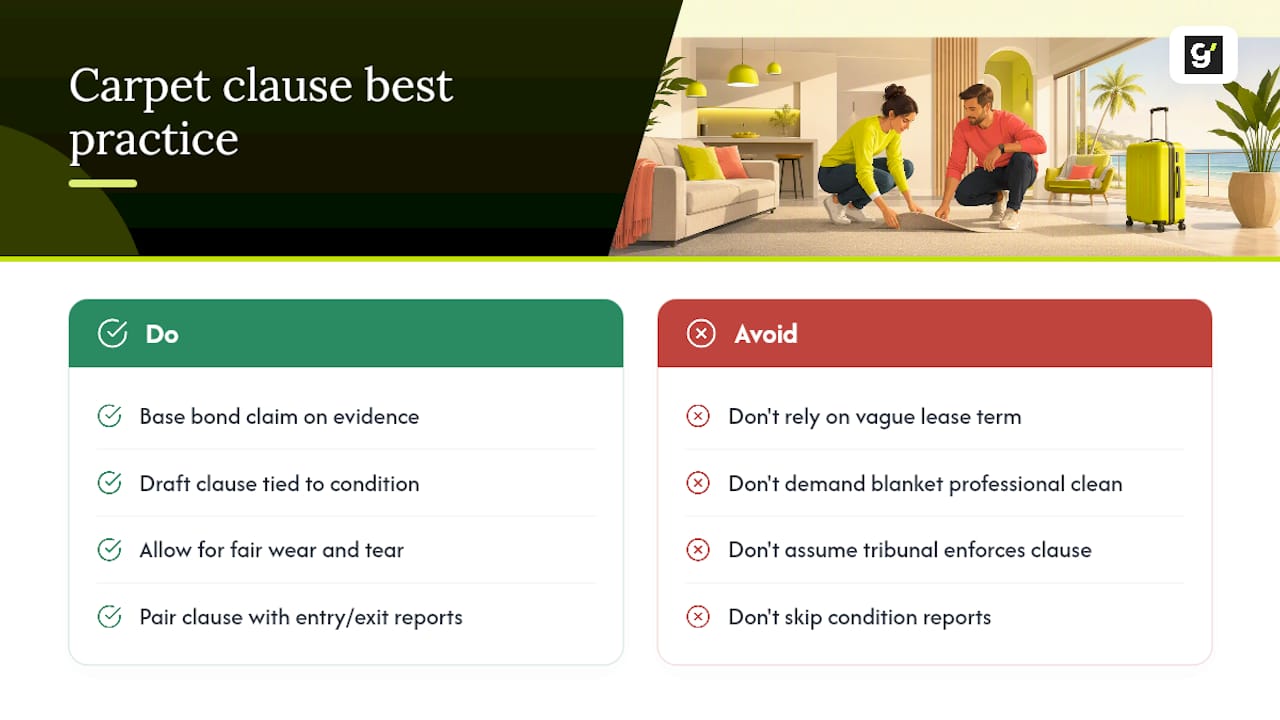
Where a lease does include a specific carpet cleaning clause, it's usually because the property had carpets professionally cleaned immediately before the tenant moved in, and the clause asks for the same standard on exit. Blanket clauses forcing professional cleaning regardless of condition have been found unenforceable in several state tribunals, because they override the "fair wear and tear" standard set in residential tenancy legislation.
For property managers, the practical takeaway is this: your bond claim for carpet cleaning stands or falls on evidence of condition, not on a clause alone. A vague lease term won't carry weight against a Civil and Administrative Tribunal member without a documented comparison between the entry and exit condition reports. That's why the condition report, not the lease wording, does the real work in a dispute. Draft any carpet clause around condition and reasonable wear, and pair it with a clear documentation process rather than relying on the clause to enforce itself.
What cleanliness standard do landlords actually expect?
The benchmark landlords and property managers apply is "reasonably clean," judged against the condition recorded at the start of the tenancy, not a showroom standard. Fair wear and tear from ordinary use, such as gradual pile flattening in walkways, isn't something a tenant or an outgoing cleaner is expected to reverse.
What does count against that standard: visible staining beyond normal use, embedded odour, ground‑in soil that wasn't there at entry, and debris left in the pile. A carpet that's simply lighter in colour after years of foot traffic, with no other issues, generally passes.
The clearest practical marker is a side‑by‑side comparison against the entry condition report photos. If the exit report shows no new staining, no new odour, and the general wear matches what several years of normal occupancy would produce, the cleaning has met the expected standard regardless of whether every fibre looks brand new. Property managers who apply a stricter, subjective standard, expecting carpets to look as they did on installation day, invite disputes that tribunals routinely resolve in the tenant's favour. Anchor your standard to the documented entry condition, and keep the comparison photo‑for‑photo rather than relying on memory or a general impression during the final walkthrough.
What does inadequate carpet cleaning cost you?
Skipping a proper restorative clean, or accepting a rushed job with no documentation, has a direct cost and a reputational one. On the bond side, a manager who can't produce before and after evidence linked to the condition report weakens their own claim; disputed bond deductions without supporting documentation are frequently reduced or rejected at tribunal.
There's also the cost of doing the job twice. A cheap, undocumented clean that fails to lift embedded stains or odour means booking a second cleaner, delaying the re‑let date, and potentially losing a week or more of rent while the unit sits vacant. For short‑term rental hosts, a carpet that still smells or shows visible staining at check‑in shows up in guest reviews almost immediately, and a run of poor reviews affects future booking volume in a way that's harder to recover from than a one‑off cleaning cost.
There's a middle‑ground risk too: a cleaner who charges premium restorative rates but delivers a surface‑level result. Without an itemised scope and photo evidence, a manager has no way to hold that cleaner accountable, and no basis to dispute the invoice. The Perth market range of roughly $210 to $525 for a proper job is a small figure next to a week of lost rent or a contested bond claim, which is why the documentation matters as much as the clean itself.
Do the rules change by state or by landlord type?
Carpet cleaning expectations don't shift dramatically between states, but the paperwork and dispute pathways do. Victoria, New South Wales, Queensland, and Western Australia each run their own condition report forms and tenancy dispute bodies, and the specific form a manager uses (such as Queensland's Form 1a entry condition report) is state‑specific even though the underlying "fair wear and tear" principle is consistent nationally.
Landlord type matters more in practice. A large property management agency running dozens of units usually has a standard cleaning brief and a panel of approved cleaners, which keeps documentation consistent across properties. An individual landlord managing one or two properties directly is more likely to skip the itemised scope and photo evidence entirely, relying on a verbal assurance from the cleaner. That gap is exactly where bond disputes tend to originate.
Short‑term rental hosts sit in a different category again, since there's no bond process at all, but the equivalent risk runs through guest reviews and platform ratings instead. A commercial host managing multiple listings benefits from the same discipline as a property management agency: a repeatable booking brief and a standard documentation pack, applied consistently across every changeover rather than improvised property by property.
How should you inspect carpets before booking a clean?
Inspecting before the cleaner arrives, not after, is what prevents most disputes. Walk the property with the entry condition report in hand and compare it room by room, checking for anything that wasn't there at move‑in.
Look for and photograph before the clean starts:
- Stains, their approximate size, and where they sit relative to furniture or entries
- Any smell, and where it seems strongest
- Wear patterns, particularly in hallways and near doors
- Any area that looks discoloured differently to the rest of the carpet, which can indicate sun fading, spill damage, or old cleaning chemical residue
This pre‑clean photo set does two things. It gives the cleaner a clear picture of what they're dealing with before they quote or start work, and it gives you a baseline to compare against the after photos, so you can tell what the clean actually fixed versus what was already permanent. Skipping this step is the single most common reason managers end up in a dispute over whether a stain existed before the tenant moved in or appeared during their occupancy. A five‑minute walkthrough with a phone camera, timestamped and stored with the file, closes that gap before it becomes an argument. Use the same checklist logic outlined in this end of lease cleaning checklist to keep the process consistent across properties.
What are the most common carpet condition disputes?
Most carpet disputes fall into a small number of repeat patterns, and knowing them in advance makes resolution faster. The most frequent is disagreement over whether a stain or wear mark existed before the tenancy started, which is resolved almost entirely by the quality of the entry condition report and its photos.

The second common dispute is over what counts as fair wear and tear versus tenant‑caused damage. A tenancy tribunal will generally side with the tenant on gradual wear from normal use, but with the landlord on specific, identifiable damage like burns, deep stains, or pet damage not disclosed at the start of the lease.
The third pattern involves the cleaning itself: a tenant arranges a clean, but the landlord disputes that it met a professional standard, usually because there's no invoice or photo evidence, just a claim that "it was cleaned." This is resolved instantly with an itemised invoice and before/after photos on file. When these disputes reach a tribunal, the outcome consistently favours whichever party has the clearer documented record, not whichever party has the stronger argument. Building that record before a dispute starts, rather than scrambling to reconstruct it afterwards, is the difference between a five‑minute resolution and a drawn‑out hearing.
The handover pack that actually holds up
Most disputes over carpet condition come down to one missing document, not one bad clean. What managers should demand from any cleaner is a small, specific set of records: a detailed invoice naming the method used, a full before and after photo set, written drying guidance, and an SDS where eco‑friendly products are claimed.
Some cleaning services build their protocols around exactly that pack, because a non‑toxic cleaning claim without an SDS and ventilation note isn't verifiable, it's marketing. Property managers who ask for this pack as standard practice find disputes resolve faster, because the evidence was collected the day the job was done, not reconstructed weeks later.
— Lead
Book a restorative clean that comes with the paperwork built in
Grime Scene Services is built around the exact brief this guide describes: a restorative clean, not a generic steam job, backed by evidence you can actually use. The FINAL CASE | Bond or Vacate Clean service on the end‑of‑lease scope page covers full carpet extraction and drying suited to the fibre and condition of the property, while Targeted Extraction handles high‑traffic zones between full resets, and The Scene Reset is purpose‑built for short‑term rental turnovers where guest reviews are on the line.

Every job typically comes with the handover pack a proper dispute file needs: an itemised invoice, dated before and after photos, details of cleaning agents used, and clear drying guidance before re‑letting or re‑listing. If you're running a portfolio of properties or a short‑term rental calendar, the Short Term Rental service page sets out scheduling options built around occupancy gaps rather than guesswork. Check availability against your turnaround date and book the clean now, before the deadline gets tight.
Sources
- CPPCLO4110 Perform restorative carpet cleaning
- Condition reports - Consumer Affairs Victoria
- Ensuring your place is sparkling clean - Airbnb resource centre
- Carpet cleaning cost - Perth (WhatstheDamage)
FAQ
What does a professional end‑of‑lease carpet clean actually include?
It includes inspection of fibre and condition, pre‑vacuum and stain pre‑treatment, a restorative method such as hot water extraction, full extraction of the cleaning solution, and controlled drying. A properly run job follows the process set out in CPPCLO4110, which requires matching the method to the specific carpet rather than applying one generic process.
How much does end‑of‑lease carpet cleaning cost in Australia?
Prices vary by city, room count, and condition, but a local snapshot from the Perth market shows end‑of‑lease carpet cleaning ranging from roughly $210 to $525. Grime Scene Services doesn't publish a fixed rate online; current pricing for its Bond or Vacate Clean is available directly through its service scope page.
Can a landlord force a tenant to pay for professional carpet cleaning regardless of condition?
Generally no. Most state tenancy laws base bond claims on returning the property in the same condition allowing for fair wear and tear, not on a blanket cleaning clause, and tribunals have found such blanket clauses unenforceable in several cases.
What if a stain won't come out after cleaning?
A stain that persists or reappears after a proper clean usually points to wicking, dye damage, or fibre issues underneath, not a failed cleaning attempt. Ask the technician to document it as a limitation rather than repeating the same wet extraction, and get a flooring specialist's opinion if replacement might be needed.
How do I prove the carpet was properly cleaned if a bond dispute arises?
Keep the itemised invoice, dated before and after photos, and the technician's notes together with a copy of the exit condition report. Records tied to a state condition report, such as those tracked by Consumer Affairs Victoria, carry far more weight in a dispute than an invoice alone.