
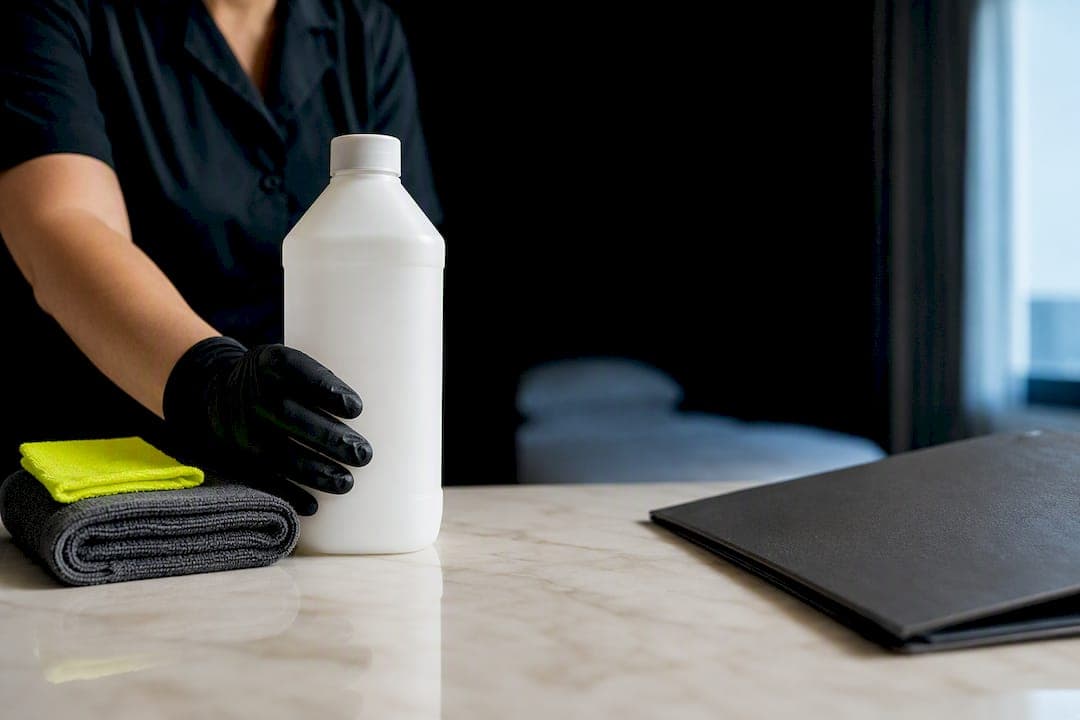
Fragrance-free professional cleaning uses unscented, non-toxic agents to remove dirt and odour at the source rather than covering it with air fresheners or scented linen sprays. Property managers, hosts and commercial owners with allergy-sensitive tenants, guests or staff should hire a cleaner who can prove this, in writing, before the first booking. If you need a turnover done properly and fast, the checklist below tells you what to demand, or you can book a professional Scene Reset service for a turnkey option.
TL;DR:
- Fragrance-free cleaning is essential in settings with allergy-sensitive tenants, guests, or staff, especially when sensitivities or asthma are disclosed.
- A proper fragrance-free clean involves source removal, use of unscented non-toxic products, HEPA vacuuming, and detailed documentation for accountability.
- Vetting cleaners requires specific questions about product disclosure, staff training, and contractual clauses to prevent masking scents or using unverified products.
- A Scene Reset approach focuses on neutralising odours at the source, avoiding scent masking or re-adsorption on fabrics and soft surfaces.
- Costs are property-dependent and may equal or be slightly higher than standard cleaning, mainly due to source-removal efforts rather than scent-free practices alone.
Table of Contents
- Why fragrance-free professional cleaning matters more than you think
- When does fragrance-free cleaning actually matter?
- What does a real fragrance-free clean actually involve?
- How do you vet and brief a fragrance-free cleaner?
- Why our Scene Reset protocol skips fragrance altogether
- How Grime Scene Services can help right now
- Sources
- FAQ
Why fragrance-free professional cleaning matters more than you think
The numbers on fragrance sensitivity are bigger than most property owners assume. A multi-country study led by Steinemann found that about one third of adults report adverse health effects from fragranced products, and a notable share describe those effects as disabling. That is not a fringe complaint. It is roughly one in three occupants who could react to a "fresh linen" spray or a heavily perfumed all-purpose cleaner.
The picture gets sharper for people with asthma. A 2016 Australian survey of asthmatic adults recorded that a majority reported adverse effects from fragranced products, and some had lost workdays or a job because of exposure. If you manage a workplace or a rental where even one guest or tenant has asthma, scented cleaning products are a genuine liability, not a nicety.
Here is the mechanism worth understanding: fragranced products are a major source of indoor volatile organic compounds, and they mask odours rather than eliminate them. Underlying grime, mould or smoke residue stays put under a layer of perfume. Research also shows a majority of people prefer fragrance-free workplaces, hotels and healthcare settings, so removing scent is as much a commercial decision as a health one.
Common triggers worth knowing before you brief a cleaner:
- Air fresheners and plug-in diffusers
- Scented laundry sprays used on linen and towels
- "Natural" or essential-oil cleaners containing limonene or linalool
- Heavily perfumed all-purpose sprays used to mask bathroom or kitchen odours
When does fragrance-free cleaning actually matter?
Not every job needs a full decontamination, but several situations make fragrance-free service essential rather than optional:
- Short-term rental turnovers, where you have no chance to ask a guest about sensitivities before they arrive.
- Leases and tenancy agreements where a tenant has disclosed asthma, chemical sensitivity or a young child with allergies.
- Hospitality and healthcare-adjacent settings, where staff or clients report symptoms tied to scented products.
- Offices where even one employee has flagged a reaction, since a shared HVAC system spreads fragrance to every desk.
- Post-construction and post-incident cleans, where dust, adhesives and off-gassing materials need source removal, not perfume.
The upside is measurable in practical terms: fewer complaint messages from guests, better accessibility for tenants who would otherwise avoid a property, and less reputational risk from a bad review that mentions "overpowering smell." That said, a light weekly tidy in a low-turnover office probably doesn't need full decontamination. Match the service level to the actual risk, not to a blanket policy.
What does a real fragrance-free clean actually involve?
A genuine fragrance-free clean is a process, not a product swap. Here's what should happen on-site:
- Source removal first. The cleaner identifies what's actually causing an odour, whether that's mould in a bathroom exhaust, pet residue in carpet, or smoke particles embedded in soft furnishings, and treats that directly.
- Unscented, non-toxic agents throughout. Every product used should carry no added fragrance, not a "light" or "reduced" scent.
- HEPA vacuuming, which captures fine particles that a standard vacuum recirculates back into the air.
- Fabric and upholstery remediation, because scent molecules and allergens adhere to soft surfaces and can re-emit for weeks after a surface wipe.
- HVAC and vent inspection where odour or allergen complaints persist, since a dirty vent system will undo an otherwise spotless clean within days.
What you should get handed at the end of the job matters as much as what happens during it. Ask for a product list with Safety Data Sheets, before-and-after photos, written confirmation that no air fresheners or scented linen products were used, guidance on how long to ventilate before re-entry, and a signed-off cleaning checklist.
Pro Tip: If a cleaner offers to "lightly scent" the space at the end of a job to make it smell finished, that's a sign they're masking rather than remediating. A properly decontaminated space shouldn't smell like anything at all.
How do you vet and brief a fragrance-free cleaner?
Most of the vetting happens before anyone picks up a mop. A short conversation exposes whether a cleaning company actually understands fragrance-free work or is just using it as a marketing line.
Ask these questions directly:
- Can you name the specific products you use and provide their SDS?
- What training do staff have in allergen-sensitive or asthma-safe cleaning?
- Have you worked short-term rental turnovers or commercial properties before?
- What insurance and indemnity cover applies if a reaction occurs post-clean?
- How long should the property sit vacant before re-entry?
Put the same expectations into the contract. Useful clauses include an explicit prohibition on fragranced products of any kind, a requirement to supply SDS documentation and photo verification with every job, and a defined remedy (re-clean or refund) if a complaint about scent or residue comes in. Set a response time for guest or tenant complaints, too. Anything past 24 hours is too slow for a rental turnover.
Watch for these red flags:
- Refusal to name or disclose the products being used.
- Any suggestion that linens be "lightly scented" for a nicer first impression.
- Marketing that leans entirely on words like "green" or "natural" without SDS backing. As one review notes, natural does not automatically mean fragrance-free, since many essential oils contain the same allergenic compounds as synthetic perfume.
- No references from allergy-sensitive clients when you ask for one.
Pro Tip: Keep a copy of the signed product disclosure with every booking. If a guest ever reports a reaction, that document is your first line of defence and your fastest path to a fix.
For readers managing the physical building alongside the clean itself, window cleaning services and other specialist contractors follow similar disclosure principles when it comes to keeping products off soft surfaces and out of shared air systems.
Why our Scene Reset protocol skips fragrance altogether
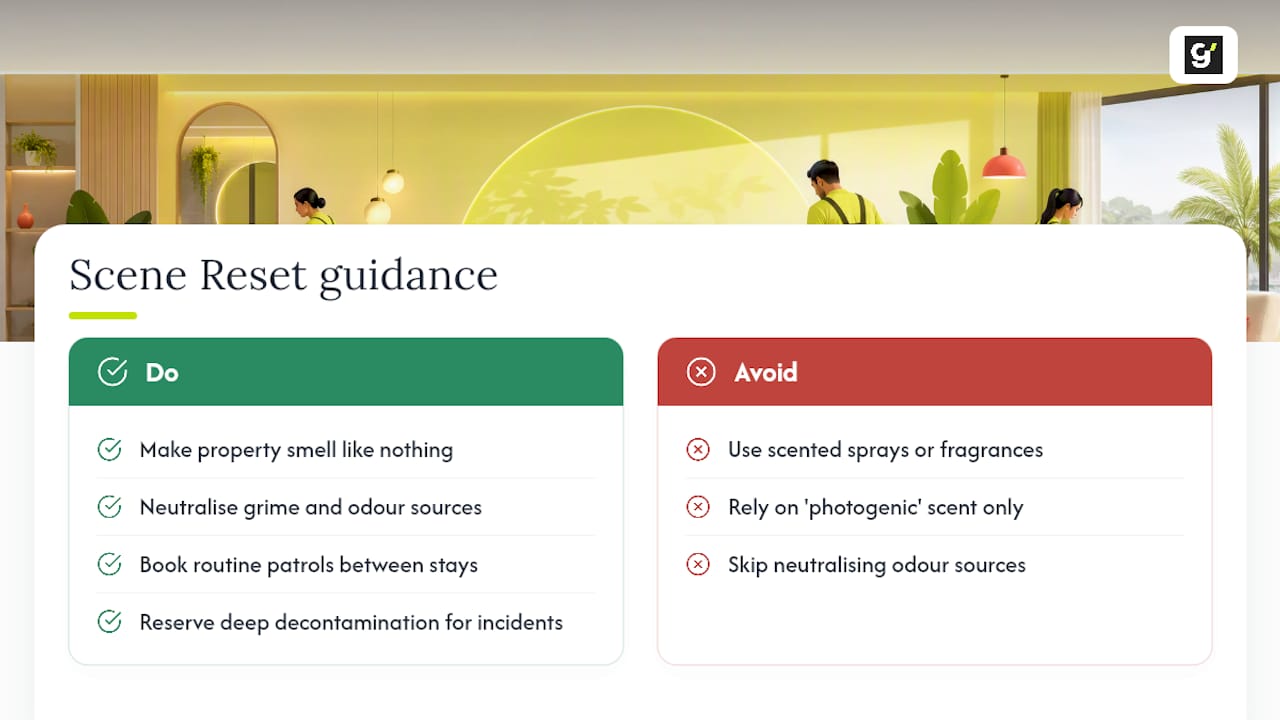
A Scene Reset protocol can be built around one principle: a property should smell like nothing, not like something. That decision came out of watching how often "fresh scent" complaints and allergy complaints turn out to be the same complaint wearing different words. Neutralising the actual source of grime and odour does more for a guest's experience than any spray ever will, and it avoids the re-adsorption problem where scent molecules cling to fabric and resurface days later.
Customer satisfaction with the Scene Reset turnover can stay high because hosts get a property that passes the smell test for sensitive guests, not just a photogenic one. General guidance for owners: book routine patrols for maintaining a property between guests or tenants, and reserve full deep decontamination for post-construction jobs, incident cleanups, or any property with a documented sensitivity complaint.
— Lead
How Grime Scene Services can help right now
If you've read this far because a guest complained, a tenant flagged a sensitivity, or you just want to stop guessing what "eco-friendly" actually means on an invoice, there are a few direct paths. Deep Decontamination (Full Sweep) covers the source-removal work described above, from fabric remediation to HVAC-adjacent odour issues, using non-toxic, bleach-free agents with no added fragrance. For an urgent situation, like a same-day guest complaint or an incident that needs sorting before the next check-in, the Rapid Response 2-hour tactical clean gets someone on-site fast.
Short-term rental hosts get the most direct fit through the Scene Reset service for short-term rentals, which bundles turnover cleaning with linen and consumable restocking, all built around the same unscented, source-removal standard covered in this article. Every booking comes with product disclosure and photo verification as standard, so you're not left wondering what was actually used in your property. If a fragrance-related complaint has already cost you a booking or a review, book a Scene Reset for your next turnover and see the difference before your next guest checks in.
Sources
- International prevalence of fragrance sensitivity (Steinemann et al.)
- Fragranced consumer products: effects on asthmatic Australians
- Fragranced consumer products: exposures and effects from emissions
These three studies underpin the health rationale behind every item in the vetting checklist above.
FAQ
How much does fragrance-free professional cleaning cost?
Pricing depends on property size and service level, from a routine patrol to a full deep decontamination, so get an itemised quote rather than a flat per-hour rate that hides what products and processes are actually included.
How long should I wait before re-entering after a fragrance-free clean?
Ask your cleaner directly, since ventilation time depends on the products and equipment used, and a proper SDS disclosure should include this guidance as part of the job sign-off.
Is "eco-friendly" the same as fragrance-free?
No. Many eco or natural-labelled products contain essential oils with allergenic compounds like limonene or linalool, so always confirm "no added fragrance" separately from any eco claim.
What should I do if a guest complains about a lingering smell after a clean?
Request the SDS and photo verification from that booking immediately, and use a contract clause requiring a re-clean or refund. Grime Scene Services' Rapid Response service is built for exactly this situation.
Do fragrance-free cleaners cost more than standard cleaners?
Not necessarily. The higher cost, when it exists, usually reflects source-removal work like fabric remediation or HVAC attention rather than the absence of scent itself.