
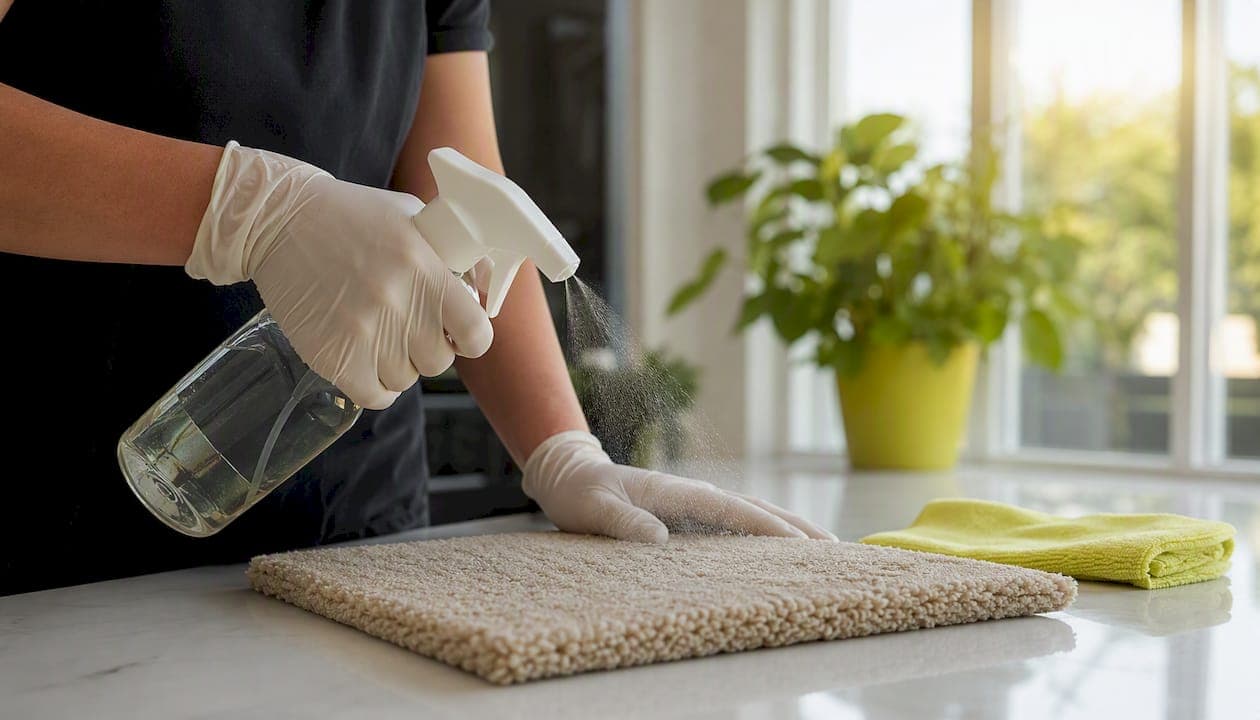
A hypoallergenic cleaning solution, in the professional context, is a non-toxic, bleach-free formulation designed to remove soils and neutralise allergens without introducing irritants, carcinogens, or synthetic fragrances into the environment. For property managers and short-term rental hosts, this is the category of product a credible specialist team reaches for on every job, whether that's a post-construction dust-out, a mould remediation, or a rapid turnover between guests. Three markers separate a genuine professional offering from a marketing claim: GECA certification, alignment with the UNSW Green Cleaning Standards, and HEPA-grade vacuuming on every job.
- Formulations are fragrance-free, dye-free, and pH-neutral
- No bleach, no listed carcinogens, no reproductive toxins
- Applied with controlled dispensing systems, not trigger sprays
- Verified by safety data sheets (SDS) and written method statements
Pro Tip: Ask any provider for their SDS before booking. A legitimate hypoallergenic cleaning service can produce one in minutes. If they hesitate, that tells you everything.
Key takeaways
Professional hypoallergenic cleaning solutions are non-toxic, bleach-free, and GECA-aligned formulations applied with HEPA equipment and controlled dispensing to deliver verifiable allergen reduction in rental and residential properties.
| Point | Details |
|---|---|
| Definition | Non-toxic, bleach-free professional formulations that neutralise allergens without synthetic fragrance or listed carcinogens. |
| Key certifications | GECA certification and UNSW Green Cleaning Standards alignment are the two benchmarks to verify before hiring. |
| Equipment matters | HEPA vacuums and hot water extraction physically remove allergen particles; standard equipment recirculates them. |
| Documentation is proof | SDS, method statements, and training records are what separate a credible provider from a marketing claim. |
| Grimescene's approach | Scene Reset protocol delivers GECA-aligned, documented hypoallergenic turnovers for short-term rental and residential properties. |
Table of Contents
- What are hypoallergenic cleaning solutions made of?
- What standards and certifications should your provider hold?
- Why professional hypoallergenic solutions often outperform consumer products
- When should you call a professional hypoallergenic cleaner?
- How professionals apply hypoallergenic solutions on site
- Questions to ask before you hire a hypoallergenic cleaning provider
- What to expect on timing and service scope
- The part of this job most providers get wrong
- Grimescene's hypoallergenic cleaning approach for your property
- Sources
What are hypoallergenic cleaning solutions made of?
The active chemistry in professional non-toxic cleaning solutions falls into a few distinct categories, each doing a specific job.
Enzyme-based cleaners use biological catalysts to break protein, fat, and starch-based soils at a molecular level. Rather than masking a stain or odour with fragrance, enzymes digest the organic matter causing it. This is why a professional enzyme pre-spray on carpet outperforms a retail product that simply lifts surface dirt.
pH-neutral detergents and surfactants lower surface tension so soils release from fibres and hard surfaces without attacking the substrate. Products like iExtract Hypoallergenic, a neutral-pH, fragrance-free carpet pre-spray built for hot water extraction, illustrate exactly this category: concentrated, purpose-built, and safe for sensitive environments.
Fragrance-free and dye-free surfactants remove the two most common irritant categories from the equation entirely. Synthetic fragrance is one of the leading causes of contact dermatitis and respiratory irritation in cleaning contexts, so its absence is a functional benefit, not just a marketing angle.
Biodegradable solvents and sequestrants handle mineral deposits and hard-water scale without the corrosive chemistry that damages surfaces and off-gasses into occupied spaces.
Some providers also use fibre-based mechanical systems, such as Ha-Ra's pH-neutral concentrates, which reduce chemical volume while maintaining commercial performance. The principle is the same: less chemistry, more mechanical action.
On concentration and dilution: Professional teams use closed dispensing systems that dose product at specified ratios to ensure consistent application. A retail bottle at 100% concentration applied by hand introduces far more chemical load than a professionally diluted solution applied at 1:40 through a controlled system. Correct dilution is where most consumer products fail by comparison.
Pro Tip: Concentration matters both ways. An under-diluted product leaves residue that irritates skin. An over-diluted one simply doesn't clean. Closed dispensing removes the guesswork.
What standards and certifications should your provider hold?
GECA certification
GECA's Cleaning Services standard (CSv2.0-2021) requires certified providers to maintain documented chemical-handling procedures, deliver regular staff training, and prohibit the use of listed carcinogens and reproductive toxins. GECA examines whole-of-life impacts, including ingredient hazards and supply-chain risks, which is why it carries more weight than a generic "eco-friendly" label. When a provider references GECA, ask to see the certificate number.
UNSW Green Cleaning Standards
The UNSW Green Cleaning Standards set a useful institutional benchmark even for private property managers. They require GECA-recognised products, HEPA-capable vacuum equipment, and operational controls including after-hours scheduling to protect vulnerable occupants. If a provider meets these criteria for a major Australian university, they can meet them for your property.
Staff training and competency
The CPP40421 qualification covers specialist cleaning and restoration skills, including product and equipment assessment for specialist tasks. Ask providers for training logs, not just a claim that "staff are trained."
Mould remediation: AS/IICRC S520
Where mould is present, the relevant standard is AS/IICRC S520, which specifies accepted procedures and precautions for professional mould remediation in residential, commercial, and institutional buildings. A provider handling mould without referencing this standard is operating below the accepted threshold.
Operational trust signals to verify:
- Current SDS and written method statements for every product used
- Colour-coded equipment to prevent cross-contamination between zones
- Documented chemical-handling procedures and incident reporting protocols
- Closed dispensing or dilution-control systems
- HEPA-grade vacuum equipment with filter change records
Why professional hypoallergenic solutions often outperform consumer products
The gap between a retail "hypoallergenic" spray and a professional formulation is not just marketing. It comes down to three things: concentration, equipment, and technique.
Professional concentrates are formulated for commercial soil loads and applied at calibrated dilutions. A retail ready-to-use product is typically a fraction of the concentration, designed for light domestic use. Enzyme activity in professional products is also higher, meaning faster and more complete breakdown of allergen carriers like pet dander, dust mite frass, and mould spores.
Equipment is the second gap. HEPA vacuums capture very fine particles, including allergen fragments, that standard vacuums tend to recirculate into the air. Hot water extraction (HWE) on carpet and upholstery physically removes soils rather than redistributing them. Industrial air movers accelerate drying to below the moisture threshold where mould can re-establish.
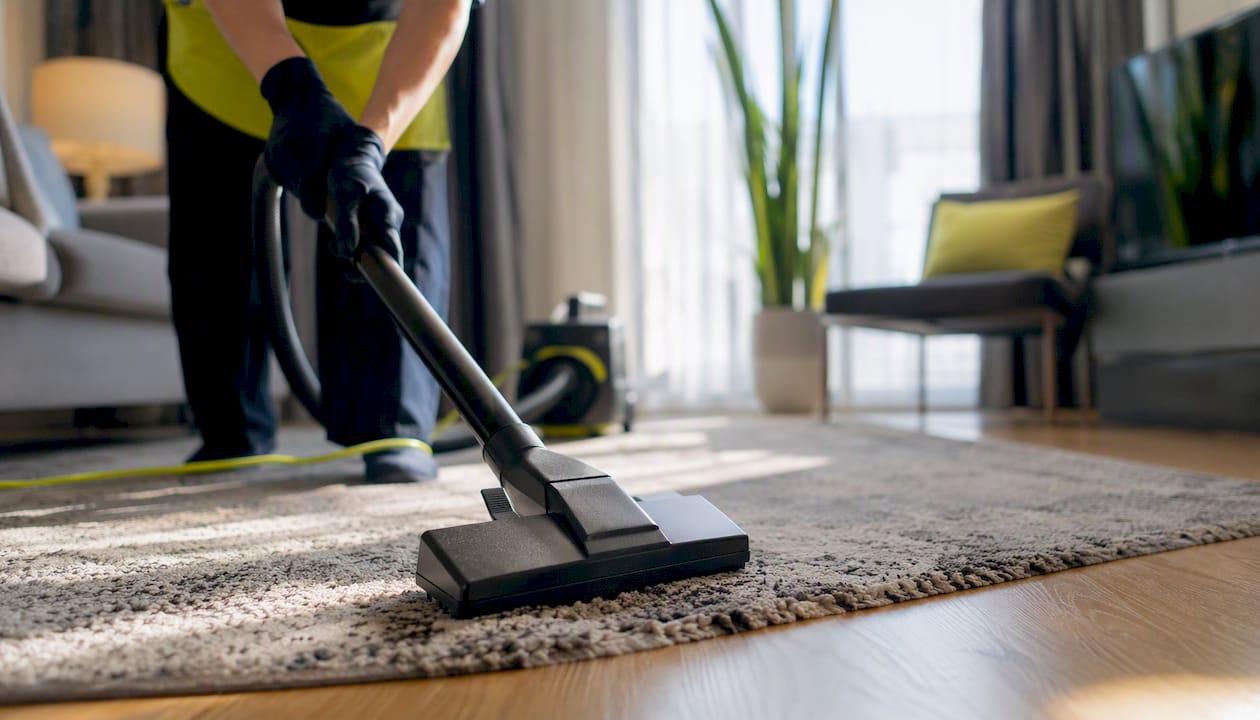
Scheduling is the third lever. After-hours or low-occupancy cleans reduce re-exposure during the critical period when surfaces are still damp and airborne particle counts are elevated.
For a deeper look at how eco cleaning compares to traditional methods, the performance differences go well beyond allergen reduction.
When should you call a professional hypoallergenic cleaner?
In-house staff with standard products can handle routine surface cleans between guests when soil loads are light and no sensitive occupants are expected. The moment any of the following applies, escalate to a specialist.
- Short-term rental turnovers with sensitive guests: guests with asthma, eczema, or chemical sensitivities need a verified clean, not a scented spray-down
- Post-construction dust removal: fine particulate from sanding, cutting, and adhesives requires HEPA extraction and surface decontamination
- Post-mould remediation: after structural mould work, a hypoallergenic clean removes residual spores and prevents recolonisation; AS/IICRC S520 governs this workflow
- Heavy pet dander or allergen build-up: enzyme-based HWE is the only reliable method for embedded dander in carpet and upholstery
- Pre-arrival cleans for vulnerable occupants: elderly guests, infants, or immunocompromised residents need a documented clean with SDS-backed products
One short-stay manager documented the shift to pH-neutral eco cleaning and found surface protection improved alongside guest satisfaction. For properties with recurring sensitive guests, this is now standard practice, not a premium add-on. See also chemical-free home remediation services for remediation-specific scenarios.
Pro Tip: If a guest flags a chemical sensitivity at booking, treat that as a trigger to schedule a professional hypoallergenic clean before arrival, not after a complaint.
How professionals apply hypoallergenic solutions on site
A credible provider follows a repeatable sequence, not a freestyle spray-and-wipe approach.
- Pre-inspection and risk assessment: identify soil types, surface materials, and any vulnerable occupants or pets
- Product selection: confirm GECA status or equivalent ecolabel; pull the SDS for every product being used that day
- Dilution via closed dispensing: dose product at the manufacturer's specified ratio; never free-pour
- Application: apply to surfaces using appropriate tools; colour-coded microfibre for different zones
- Mechanical agitation: agitate carpet and upholstery with a grooming tool or rotary brush to work enzyme solution into fibres
- Extraction: HWE removes dissolved soils and residual chemistry; HEPA vacuum for hard floors and upholstery
- Rinse and neutralise: a clean-water rinse pass removes product residue, particularly on hard floors
- Drying and ventilation: air movers and open windows bring surfaces to safe moisture levels before re-entry
- Verification and documentation: record products used, dilution ratios, and any incidents; file SDS copies with the job record
Equipment on every professional job:
- HEPA-grade vacuum (0.3-micron filtration)
- Hot water extraction machine for carpet and upholstery
- Air movers for accelerated drying
- Colour-coded microfibre cloths and mop heads by zone
Staff must have SDS access on site, not back at the depot. Incident reporting protocols should be documented before the job starts, not improvised if something goes wrong.
Pro Tip: Schedule hypoallergenic deep cleans after guests check out and before the next arrival window, not during occupancy. Airborne particle counts peak during application and drop significantly once surfaces dry.
Questions to ask before you hire a hypoallergenic cleaning provider
Essential questions:
- Can you provide current SDS for every product you'll use on my property?
- Are your products GECA-certified or equivalent?
- Do your staff hold CPP40421 or equivalent documented training?
- What dispensing or dilution controls do you use?
- Do your vacuums have HEPA filtration?
- Can you provide public liability insurance certificates and references from comparable properties?
Red flags:
- Refusal or delay in providing SDS
- Reliance on fragranced sprays described as "natural" without certification
- No documented staff training or colour-coded equipment
- No written method statement or service scope
- Verbal-only guarantees with no written verification of results
Request a written method statement as part of any service agreement. For recurring contracts, include a clause requiring SDS updates whenever products change and written notification of any substitution.
What to expect on timing and service scope
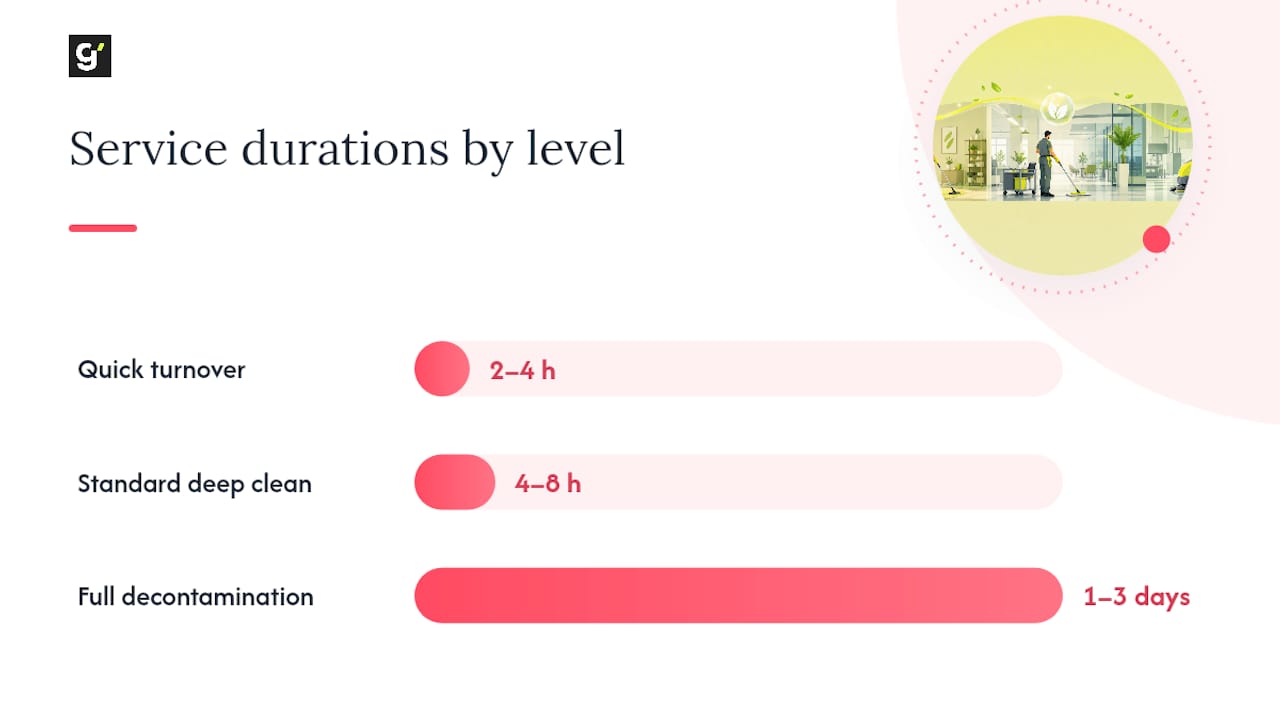
Quick turnover (2–4 hours): surface wipe-down of all hard surfaces, bathroom sanitisation with pH-neutral products, kitchen degreasing, HEPA vacuum of all floors, linen change. Re-entry: immediate.
Standard deep clean (4–8 hours): all of the above plus carpet and upholstery HWE, oven and appliance deep clean, grout and tile scrub, odour treatment with enzyme spray. Re-entry: 2–4 hours after completion (drying time).
Full decontamination or remediation (1–3 days depending on scope): structural mould remediation per AS/IICRC S520, full HEPA extraction of all soft furnishings, air scrubbing, surface decontamination, fabric protection application, and documented verification. Re-entry: 24 hours minimum; confirm with provider based on air quality readings.
Drying time is the variable most managers underestimate. Air movers cut carpet drying from 12–24 hours to 3–6 hours. Sequencing ventilation before guests arrive is the difference between a five-star review and a complaint about damp smell.
| Service level | Typical duration | Re-entry window |
|---|---|---|
| Quick turnover | 2–4 hours | Immediate |
| Standard deep clean | 4–8 hours | 2–4 hours post-clean |
| Full decontamination | 1–3 days | 24 hours minimum |
The part of this job most providers get wrong
The technical side of hypoallergenic cleaning is well-documented. GECA sets the product standard. UNSW has published the operational controls. AS/IICRC S520 governs mould work. What most providers get wrong is the verification layer: they clean well but document poorly.
A property manager who cannot produce an SDS for a product used in their building is exposed. A host who cannot show a guest with a severe allergy what was used on their mattress is exposed. Documentation is not bureaucracy. It is the proof that the clean actually happened to the standard claimed.
At Grimescene, every job includes written method statements, SDS on file, and a post-clean record. The Scene Reset protocol for rental turnovers is built around this: not just a clean property, but a verifiable one. If a guest or a body corporate ever asks what was used and why, the answer is ready.
Request a site walk-through or ask for a sample method statement before committing to any provider. Any credible team will hand it over without hesitation.
Grimescene's hypoallergenic cleaning approach for your property
Grimescene uses non-toxic, bleach-free formulations aligned with GECA principles across every service, from routine residential cleans to full-site deep decontamination. For short-term rental hosts, the Scene Reset protocol covers the complete turnover: hypoallergenic product application, HEPA vacuuming, linen service, and consumable restocking, with SDS documentation available on request. Every job is backed by written method statements and staff trained to CPP40421-equivalent standards.
If you manage a property in the Sydney area and want a provider who can hand you an SDS before the job starts, book a short-term rental turnover or request a quote for a deep decontamination. The method statement comes with it.
Sources
- Cleaning Services (CSv2.0-2021) — GECA | Good Environmental Choice Australia
- UNSW Standards - Green Clean Policy
- CPP40421_R1.pdf
- iExtract Hypoallergenic - Pre-Spray for Carpet & Upholstery
- Making The Switch — Younique Stays