
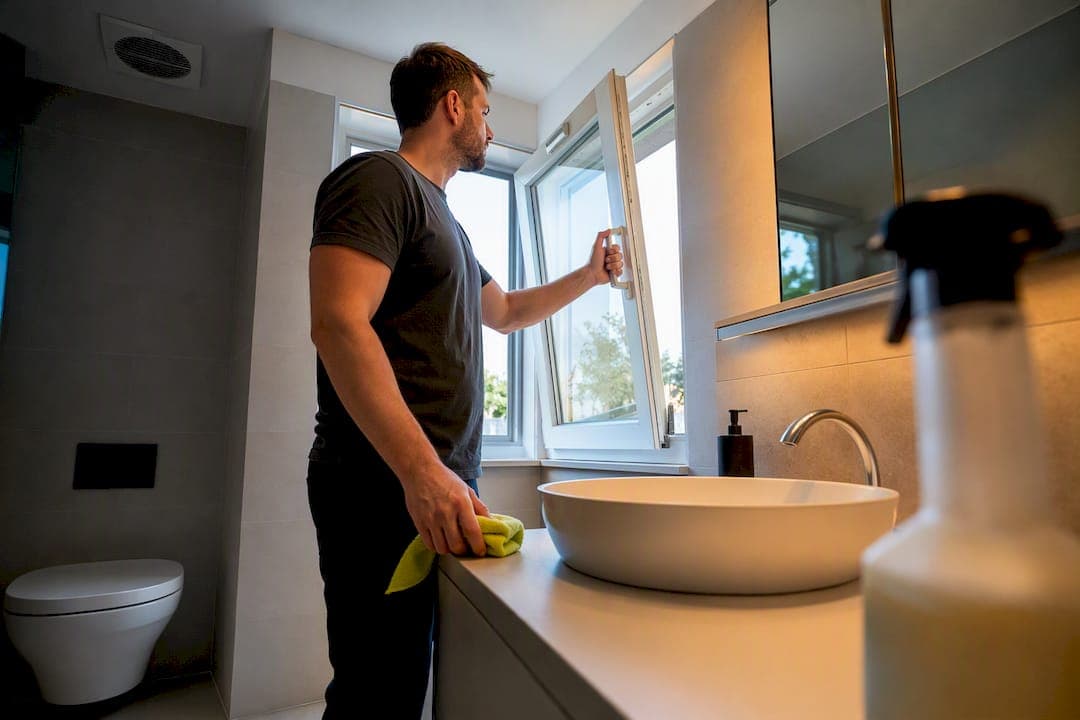
"VOC-free" means a cleaning product releases little to no volatile organic compound gas into the air you breathe indoors. The single fastest fix for a household is to drop the aerosol spray and grab a fragrance-free concentrate or pump spray instead. It won't fix everything, but it cuts your biggest daily exposure in one swap.
TL;DR:
- Switching from aerosols to pump sprays or concentrates significantly reduces VOC exposure and helps improve indoor air quality.
- Carefully reading labels to verify "fragrance-free," visible ingredients, and absence of propellants ensures genuine low-VOC cleaning.
- Everyday cleaning tasks can be effectively handled with low-VOC products like soap-based cleaners, enzyme cleaners, and diluted vinegar solutions.
- Concentrate and refill systems not only lower VOC emissions but also lessen plastic waste and environmental impact.
- Professional deep cleaning is recommended for post-construction, severe mould, or biohazard scenarios where DIY methods are insufficient.
Table of Contents
- What 'VOC-free' and 'low-VOC' actually mean
- Why VOCs matter for household health and indoor air quality
- How to choose genuinely low-VOC or VOC-free cleaning products
- Which product types and formulations work without VOCs, and what each is best at
- DIY VOC-free cleaning recipes that actually work, and their limits
- Using, storing and applying cleaners to minimise VOC exposure
- Why professional VOC-free eco cleaning matters and when to hire a specialist
- Comparative effectiveness of VOC-free cleaning products versus conventional cleaners
- Environmental impact of VOC-free cleaning products beyond indoor air quality
- Common misconceptions and myths about VOC-free cleaning
- Step-by-step guidance on transitioning from conventional to VOC-free cleaning practices at home
- What actually matters most in a VOC-free routine
- When it's time to call in a non-toxic deep clean
- Sources
What 'VOC-free' and 'low-VOC' actually mean
Volatile organic compounds are carbon-based chemicals that evaporate easily at room temperature. That evaporation is the problem: it's how solvents, fragrance oils, and propellants end up in the air of your kitchen or bathroom long after you've put the bottle away. A product marketed as "VOC-free" or "low-VOC" contains few or none of these compounds, or has been reformulated to release them at trace levels.
The label vocabulary trips up even careful shoppers. "Fragrance-free" means no fragrance ingredients were added at all. "Unscented" is a different, weaker claim. It often means a masking fragrance was added specifically to cancel out other odours, and that masking fragrance is frequently still a VOC. If you're chasing genuinely low-VOC cleaning, fragrance-free is the term to trust; unscented is the one to question.
"Natural fragrance" is its own trap. Essential oils and other plant-derived scent compounds are still volatile organic compounds by definition, chemistry doesn't care whether the molecule came from a lab or a lemon peel. A cleaner can be plant-based, biodegradable, and still off-gas noticeably if it's loaded with citrus or pine oil.
Propellants matter just as much as the cleaning agents themselves. An aerosol can needs a pressurised gas to push the product out, and that gas is almost always volatile. That's why two bottles with near-identical active ingredients can have very different VOC profiles depending on whether one comes in an aerosol and the other in a pump spray.
What to scan for on a label:
- "Fragrance-free" rather than "unscented"
- A visible ingredient list, not just "proprietary blend"
- No aerosol propellant listed (butane, propane, isobutane)
- No vague "natural fragrance" without naming the actual compound
Why VOCs matter for household health and indoor air quality
Indoor air is usually more concentrated with VOCs than outdoor air, because your home has walls and a roof holding those gases in. Cleaning products are one of the biggest contributors, alongside paints, air fresheners, and new furniture. When you spray a surface cleaner in a closed bathroom, you're not just wiping down tile, you're loading a small, enclosed volume of air with chemicals that have nowhere to go.
The health effects families report most often are eye, nose, and throat irritation, headaches, and worsened symptoms for anyone with asthma or another respiratory condition. Kids and pets breathe faster relative to their body size than adults, so the same room concentration hits them harder. This is one of the reasons green cleaning approaches are framed as reducing chemical exposure while protecting the people and pets in a home, rather than just being a marketing angle.
VOCs don't stay contained to your living room, either. Once they escape through an open window or an exhaust fan, they become part of the outdoor VOC load that reacts with sunlight and nitrogen oxides to form ground-level ozone and smog. A household's cleaning cupboard is a genuinely tiny contributor next to industrial and vehicle emissions, but it's one of the few sources you have direct control over.
Statistic Callout: The US EPA specifically flags cleaning product VOCs as an indoor air quality concern and points households toward ecolabels like Safer Choice as a practical way to screen products before buying, rather than trying to interpret raw chemical names on a label.
Certain rooms and habits push exposure higher than others. Bathrooms and laundries are usually smaller, less ventilated spaces where sprayed product lingers longer. Aerosol use in any confined space, cleaning with the door shut, or spraying directly onto a surface rather than onto a cloth, all concentrate the dose you actually breathe in. If you clean the shower recess with the exhaust fan off and the door closed, you're getting a meaningfully higher hit of whatever's in that bottle than someone spraying the same product with a window open.
How to choose genuinely low-VOC or VOC-free cleaning products
Reading a label properly takes about fifteen seconds once you know what you're looking for. Run through this before anything goes in the trolley:
- Check for "fragrance-free," not "unscented." If the label only says unscented, assume a masking fragrance is doing the work.
- Look for a real ingredient list. Brands confident in their formulation name the surfactants and acids they use; vague "proprietary blend" wording is a soft red flag.
- Skip added dyes. Colouring adds no cleaning function and is occasionally linked to skin sensitivity in more reactive users.
- Identify the active ingredient. Citric acid, sodium bicarbonate, and plant-based surfactants are transparent choices you can look up in seconds.
- Check the delivery format. Concentrates, refill pouches, and trigger pumps beat aerosols on VOC exposure every time, because there's no propellant gas involved.
Ecolabels exist precisely because most people don't have time to research every ingredient on a bottle. Safer Choice, run by the US EPA, certifies products against a screened list of safer chemical ingredients, which takes the guesswork out of ingredient-by-ingredient research. EWG VERIFIED® works similarly, flagging products that meet stricter transparency and health thresholds through its own database, so you can check a brand before you buy rather than after you've already reacted to it.
Independent testing adds a second layer of trust that certification alone doesn't cover, because a certification confirms ingredients, not performance. CHOICE's consumer testing on eco-labelled household products has found some green-branded products that simply don't clean as well as they claim, alongside others that genuinely perform. That distinction between "certified safe" and "actually works" matters if you're trying to avoid re-buying three different bottles before landing on something effective.
On delivery format specifically: concentrates and refill tablets need water added at home, which means the manufacturer isn't shipping (or storing) a volatile solvent-heavy premix. Some professional supply lines now offer perfume and dye-free floor and surface concentrates built around this exact logic, formulated with renewable resources and no added scent, which shows the concentrate approach scales from home use right up to commercial cleaning.
Pro Tip: Before buying a new "green" cleaner, do a five-minute smell test in the shop with the cap barely cracked open. A strong scent straight off the shelf, even a "natural" one, means it's still off-gassing volatile compounds. Genuinely low-VOC products tend to smell like almost nothing.
If you're setting up a wardrobe of reusable cleaning cloths rather than paper towel, recycled industrial wiping rags are a straightforward way to cut both waste and the need for spray-on convenience products in the first place.
Which product types and formulations work without VOCs, and what each is best at
Not every job needs the same bottle, and matching the formulation to the task saves you from buying five different sprays that all do a mediocre version of the same thing.
Multipurpose concentrates and refill systems cover the broad middle ground: benchtops, cupboard fronts, general wipe-downs. Dilute with water in a reusable spray bottle and you've solved most of the daily grime in a house with one product. Their limitation is grease. A watered-down all-purpose concentrate will struggle against a baked-on stovetop mess the way a dedicated degreaser will not.
Soap- and surfactant-based cleaners are the workhorses for grease and everyday dirt. Plain castile soap or a plant-derived surfactant blend breaks down oils on stovetops, rangehoods, and hands far more reliably than water alone, and without the solvent load of a petroleum-based degreaser.
Enzyme cleaners are the right tool for anything organic: pet accidents, food stains on carpet, sports gear that's started to smell. Enzymes digest the protein or starch causing the mess rather than just masking it, which is why they outperform a generic spray on set-in organic stains.
Oxygen-based whiteners (sodium percarbonate is the common active ingredient) handle laundry brightening and stain lifting without the fumes of chlorine bleach. They're slower acting, usually needing a soak, but they don't carry bleach's respiratory irritation risk.
Matched to the room:
- Kitchen: soap-based degreaser for the stovetop, all-purpose concentrate for benches and cupboards.
- Bathroom: citric-acid based cleaner for scale and soap scum, enzyme cleaner if mould has organic buildup underneath.
- Glass and mirrors: a simple vinegar-water mix or a dedicated low-VOC glass cleaner, both leave a streak-free finish without ammonia fumes.
- Floors: pH-neutral concentrate diluted per label, harsh alkaline strippers are overkill for routine mopping and can dull some finishes.
- Delicate surfaces (stone, timber, screens): always check for a non-abrasive, pH-appropriate formula, gentle cleaner choices matter more on these surfaces than on tile or laminate, where a stronger product would normally be forgiven.
DIY VOC-free cleaning recipes that actually work, and their limits
Homemade cleaners have a real place in a low-VOC routine, but only for the jobs they're actually suited to.
- Vinegar for limescale and mineral buildup. A one-to-one mix of white vinegar and water, left on tap fittings or shower glass for ten minutes before wiping, dissolves mineral scale effectively.
- Baking soda scrub for grime and light abrasion. A paste of bicarb and a little water lifts grease and light stains off stovetops and sinks without scratching most surfaces.
- Castile soap multipurpose mix. A few drops of castile soap diluted in a spray bottle of water handles general surface cleaning almost as well as a store-bought all-purpose spray.
- Hydrogen peroxide spot treatment. A 3% solution dabbed on organic stains (some food and biological marks) can lift colour without the fumes of a chlorine-based stain remover.
The chemistry has real limits, and knowing them matters more than the recipes themselves. Vinegar and baking soda fizz dramatically together, but that reaction is mostly for show. It produces water and sodium acetate, neutralising the acid and the base rather than boosting cleaning power, so mixing them in the same bucket is pointless.
Neither vinegar nor baking soda is a disinfectant. They're useful for many everyday tasks but don't kill pathogens the way a registered disinfectant does, so don't rely on either after raw meat contact or illness in the household. And never mix vinegar with bleach. The combination produces chlorine gas, which is genuinely dangerous in an enclosed bathroom or laundry.
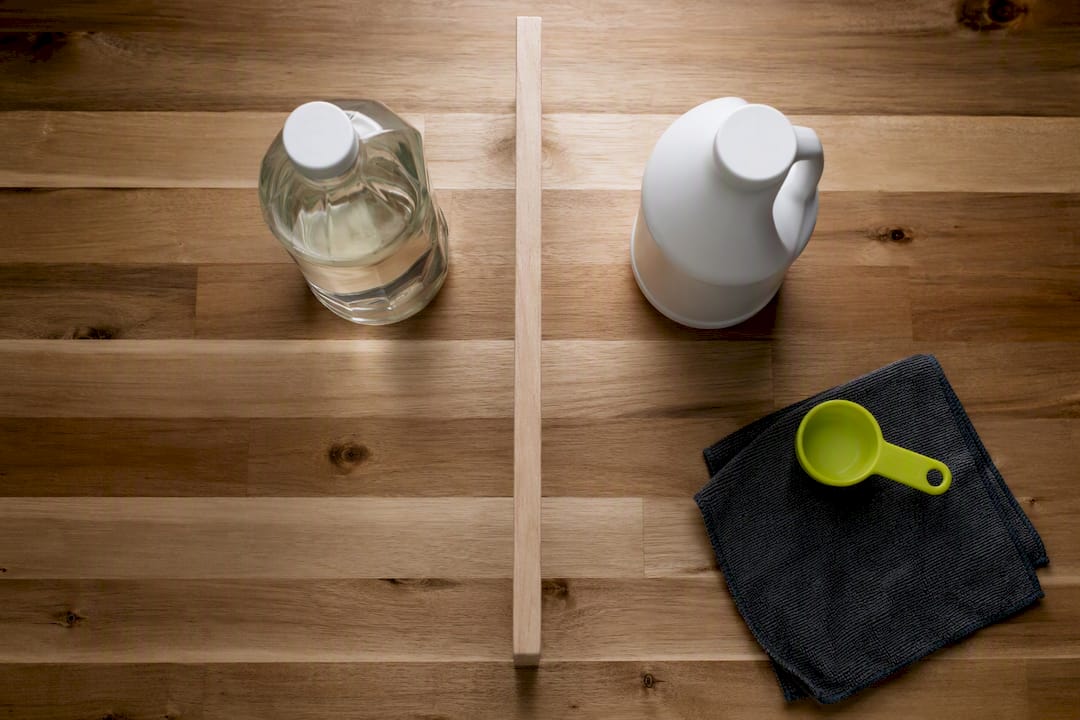
Pro Tip: Keep DIY mixes in clearly labelled bottles and make a fresh batch each time rather than storing leftovers. Homemade cleaners have no preservatives, so they can grow mould in the bottle within days.
DIY also has a ceiling. Post-construction dust, biohazard situations, heavy mould colonisation, or a rental turnover on a tight deadline are jobs where a spray bottle of vinegar simply won't get you there, and that's when a professional non-toxic clean earns its cost.
Using, storing and applying cleaners to minimise VOC exposure
How you use a product changes your exposure almost as much as what's in the bottle. A handful of habits make the real difference:
- Ventilate before, during, and after cleaning. Open a window or run an exhaust fan the entire time, not just once you're done. VOC concentration peaks while you're spraying, exactly when you're breathing closest to the surface.
- Follow label dilution ratios rather than eyeballing it. More concentrate isn't more effective, it just adds unnecessary chemical load to the air and water.
- Choose trigger pumps and pre-wetted wipes over aerosols wherever a product offers both. No propellant gas means a meaningfully smaller airborne dose.
- Spray onto a cloth, not directly onto the surface, when practical. It cuts the amount of mist actually suspended in the air.
- Store cleaners in a locked or high cupboard, away from kids and pets, and never decant into unlabelled containers.
- Dispose of leftover chemical concentrates through council hazardous waste collection, not down the drain, to limit the aquatic impact.
A practical low-VOC routine built around a family's actual schedule tends to stick better than a one-off overhaul, because ventilation and dilution habits only work if they're repeated every time, not just the first week.
Why professional VOC-free eco cleaning matters and when to hire a specialist
Deep decontamination isn't just a bigger version of your Saturday clean. Post-construction dust, for instance, embeds itself into carpet fibres, vent systems, and soft furnishings in a way a domestic vacuum and a spray bottle won't fully clear. Professional protocols are built around removing that residue completely rather than pushing it around, because trapped dust and chemical residue can keep re-releasing into the air for weeks after a renovation finishes.
There are a handful of scenarios where hiring a specialist beats persisting with DIY: post-construction handovers, severe soiling from long-term neglect or a bio-hazard incident, short-term rental turnovers where a host's rating depends on a flawless reset between guests, and households with infants, elderly residents, or anyone with a diagnosed chemical sensitivity.
A rental turnover has one shot to get it right before the next guest arrives, and a household with a newborn has zero tolerance for chemical residue on a change table or nursery floor. Both situations call for a consistent, non-toxic protocol rather than a rushed, product-heavy scrub.
A 'Scene Reset' protocol is designed for rental scenarios as a structured, non-toxic turnover process aimed at protecting host ratings without leaving chemical residue behind for the next guest. The same non-toxic deep decontamination approach applies to post-construction and severe soiling jobs, where the goal is genuine remediation rather than a surface-level mask. If you want a sense of what that standard looks like in practice, commercial-grade eco cleaning follows a different rulebook to a weekend home clean, one built around consistency across every visit, not just a good result once.
Comparative effectiveness of VOC-free cleaning products versus conventional cleaners
The old assumption that "green means weaker" doesn't hold up consistently under testing. CHOICE's independent testing of eco-labelled household products has found genuine performance variation within the low-VOC category itself, some products clean as well as their conventional counterparts, others fall short, and the eco label alone doesn't predict which.
Where conventional cleaners still hold a real edge is heavy-duty disinfection and stubborn set-in grease, tasks where a strong solvent or bleach-based formula can outperform a gentler alternative on raw speed. Where VOC-free products tend to match or beat conventional options is everyday maintenance cleaning: benchtops, glass, floors, general grime, jobs that don't need industrial-strength chemistry in the first place.
The practical takeaway is to stop treating this as one category against another. A fragrance-free concentrate handling your daily kitchen wipe-down doesn't need to out-muscle industrial bleach, it needs to out-muscle the actual grime on your bench, and for that job it usually does the work fine. Save any conventional, stronger-chemistry product for the rare job that genuinely needs it, rather than defaulting to it out of habit for tasks a gentler formula already handles.
Environmental impact of VOC-free cleaning products beyond indoor air quality
Indoor air is only half the story. Whatever goes down your drain after cleaning ends up in a waterway eventually, and this is where VOC-free formulation choices show a second benefit.
Many low-VOC cleaners are also built around plant-derived surfactants that biodegrade faster and more completely than some petroleum-based alternatives, breaking down into simpler compounds rather than persisting in waterways. That matters for aquatic life specifically. Surfactants and solvents that don't break down efficiently can accumulate in water systems and stress fish and invertebrate populations over time.
Green cleaning is framed explicitly as protecting waterways as well as indoor air, which is a useful reminder that "VOC-free" and "environmentally friendly" aren't automatically the same claim; a product can be low-VOC and still contain non-biodegradable surfactants, or biodegradable and still off-gas a strong natural fragrance. Reading past the front-of-bottle marketing toward the actual ingredient list catches both angles at once.
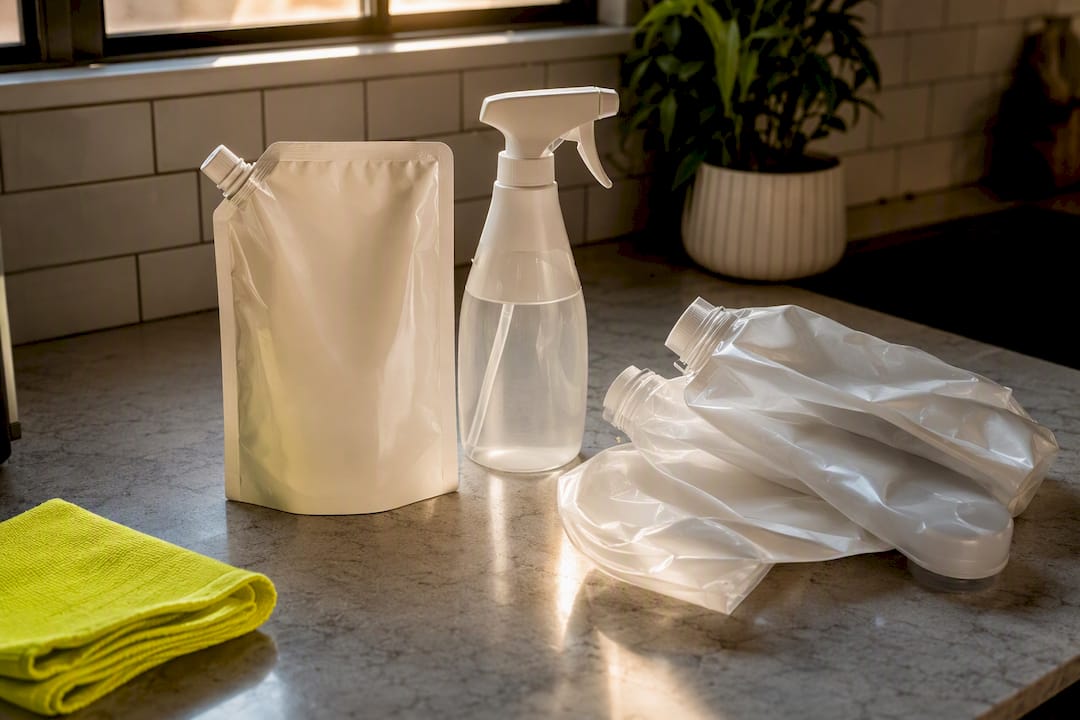
Packaging is the other piece people overlook. Concentrate and refill systems don't just cut VOC exposure from propellants, they also cut plastic volume significantly, since one concentrate pouch typically replaces several ready-to-use bottles. If you're optimising for environmental impact broadly rather than indoor air quality alone, concentrate systems tend to win on both fronts simultaneously.
Common misconceptions and myths about VOC-free cleaning
The biggest myth is that "natural" automatically means "VOC-free." It doesn't. Essential oils, citrus extracts, and pine-derived scents are volatile organic compounds regardless of their plant origin, and a heavily fragranced "natural" cleaner can off-gas more noticeably than a synthetic but fragrance-free one.
A second misconception treats "unscented" and "fragrance-free" as interchangeable. As covered earlier, unscented products frequently rely on a masking fragrance to cancel odour, which means the product still contains a fragrance compound; it's simply designed not to smell like one.
Third, plenty of shoppers assume any product with an eco-looking label has been independently verified. Genuine ecolabels like Safer Choice and EWG VERIFIED® involve real screening criteria, but plenty of packaging uses green colour schemes and leaf icons with no certification behind them at all. Common green cleaning myths get worked through in more depth here, including the assumption that price signals quality in this category, it doesn't reliably.
Finally, there's a persistent belief that VOC-free products can't disinfect. Formulation determines that, not VOC content. Some low-VOC and even fragrance-free products carry genuine disinfectant registration; VOC-free describes the volatility profile of a product, not its antimicrobial capability one way or the other.
Step-by-step guidance on transitioning from conventional to VOC-free cleaning practices at home
Swapping an entire cleaning cupboard in one weekend usually backfires, half-used conventional bottles get wasted, and you're stuck rebuying five products at once. A staged transition works better.
Step 1: Audit what you already own. Pull everything out of the cupboard and separate aerosols from pump sprays, and anything without a visible ingredient list from anything that has one.
Step 2: Replace the highest-exposure item first. That's almost always the aerosol used in the smallest, least-ventilated room, typically a bathroom spray. Swap it for a fragrance-free pump or concentrate before touching anything else.
Step 3: Finish existing bottles rather than binning them. Use up conventional products you already own on lower-frequency jobs (annual deep cleans, outdoor surfaces) while you build your low-VOC replacements for daily-use items.
Step 4: Build a small core kit. One multipurpose concentrate, one bathroom-specific acid cleaner, one enzyme cleaner, and a supply of reusable cloths covers most households without an overwhelming number of bottles.
Step 5: Adjust habits, not just products. Add the ventilation and dilution practices covered earlier at the same time you swap products, otherwise you've changed the bottle but not the exposure.
Step 6: Reassess after a month. Note which new products actually performed and which need swapping again, a full eco cleaning routine tends to settle into something sustainable only after this kind of real-world trial.
What actually matters most in a VOC-free routine
The advice that gets repeated most often, buy natural, trust the green label, is also the least useful part of this whole topic. What actually protects a household's air is boring and specific: read past "unscented" to check for masking fragrance, favour concentrates and pumps over aerosols, and accept that vinegar and bicarb are genuinely useful but genuinely limited tools, not disinfectant replacements.
Where conventional advice falls short is treating DIY as a complete solution. It isn't, and pretending otherwise leaves post-construction dust, biohazard situations, and rental turnovers handled with tools that were never built for them. That's not a failure of vinegar, it's a mismatch of tool to job.
If you take one thing from this guide, prioritise label literacy over brand loyalty. A five-second scan for "fragrance-free" and a real ingredient list will do more for your family's air quality than any amount of shopping for the greenest-looking bottle on the shelf.
— Lead
When it's time to call in a non-toxic deep clean
DIY vinegar mixes and fragrance-free sprays cover most of the daily grind, but they were never designed for post-construction dust, a severe mould outbreak, or a rental changeover with zero margin for error. Grime Scene Services exists for exactly that gap between what a spray bottle can manage and what a property actually needs.

A Deep Decontamination service strips out embedded residue and dust using non-toxic agents rather than masking it with a heavier scent, applying the same standard whether the job is a post-renovation clean or a severe soiling case. For anyone up against a tight deadline, like a same-day guest changeover or an unexpected mess before visitors arrive, a Rapid Response tactical clean can reset a property within a two-hour window without using harsh chemicals.
A typical booking starts with a quick scope of the property (photos or a walkthrough), a fixed quote, and a scheduled visit where the non-toxic protocol runs the same way every time, no guesswork about what's been used on your surfaces. If your next clean is bigger than a spray bottle can handle, book a Deep Decontamination Full Sweep and get the residue actually removed, not just hidden.
Sources
- Green Cleaning Guide | Clean Water Action
- Identifying greener cleaning products | US EPA
- The eco-friendly household products that actually work | CHOICE
- Choosing safer, non-toxic household chemicals - Environment
- EWG's Guide to Healthy Cleaning