
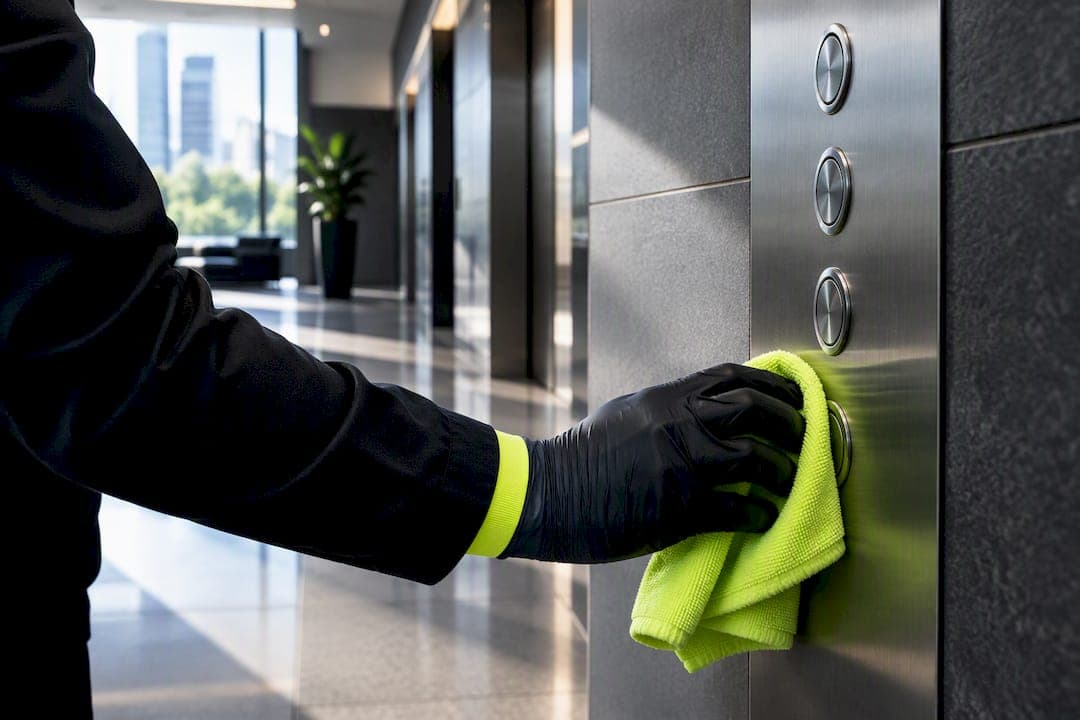
Identify every surface multiple people touch each day, clean it to remove soil, then disinfect with a TGA-registered product for the full contact time on the label. Prioritise by traffic and risk rather than a fixed roster, following ICEG and Department of Health guidance, then confirm the work actually happened with an ATP swab or fluorescent marker spot check. The full checklist below turns that into a repeatable routine for any facility.
TL;DR:
- Regular cleaning of high touch surfaces should be prioritized based on traffic and risk, with frequency adjusted to setting and recent illnesses.
- Proper disinfection requires a two-step process: first clean with detergent to remove organic matter, then apply disinfectant for the full contact time.
- Disinfectants must carry TGA registration and be used according to label dwell times, especially on sensitive materials like electronics or unsealed metals.
- Verification methods such as ATP testing and fluorescent marker checks are essential to confirm effective cleaning rather than relying on visual inspection.
- Routine cleaning is more effective when combined with human behaviors like hand hygiene and adequate ventilation, and manual wiping remains crucial over fogging or misting treatments.
Table of Contents
- What counts as a high touch surface?
- Why cleaning surfaces is only one layer of infection control
- The two-step method: clean first, then disinfect
- How often should high touch surfaces be cleaned?
- Building a routine that survives a busy shift
- How Grimescene's approach lines up with these standards
- Where facilities teams should spend their effort
- Get targeted high touch cleaning without the harsh chemical trade-off
- Sources
- FAQ
What counts as a high touch surface?
A high touch surface is anything multiple people handle repeatedly through the day, not just anything that gets dirty. Door handles, light switches and lift buttons see dozens of different hands before lunch, and that repetition is what makes touchpoint cleaning different from general dusting or floor mopping.
Frequency and context both matter. A boardroom table gets touched occasionally by a handful of people; a shared keyboard at a reception desk gets touched more frequently by multiple people. The second carries far more transmission risk even though both look equally clean.
Typical high touch area cleaning targets by setting include:
- Offices: door handles, light switches, lift buttons, shared keyboards, phones, photocopier panels, kitchenette taps
- Clinical and aged care areas: bed rails, call buttons, IV poles, over-bed tables, equipment listed by the CDC as high-touch in specialised patient areas
- Schools: desk edges, chair backs, door handles, shared tablets, drink fountain buttons
- Kitchens: tap handles, fridge doors, microwave buttons, bench edges near prep zones
- Short-term rentals: remote controls, cupboard handles, light switches, bathroom taps, entry keypads
Restroom touchpoint cleaning deserves its own mention: taps, soap dispensers, cubicle latches and flush buttons combine high contact frequency with higher contamination loads, which is why they usually sit at the top of any risk-based schedule.
Why cleaning surfaces is only one layer of infection control
Surfaces carry bacteria and viruses picked up from hands, and research on high-touch surfaces shows they act as a genuine transfer point between people who never interact directly. Cleaning reduces that bioburden, but it's one layer in a broader system, not the whole answer.
Hand hygiene, ventilation and staying home when unwell all matter alongside a solid touchpoint cleaning routine. A facility that disinfects obsessively but skips hand sanitiser stations is solving half the problem. The evidence is consistent on this point: targeted cleaning of frequently touched surfaces measurably lowers contamination and infection risk, but only when it's paired with the human behaviours that put germs there in the first place.

The two-step method: clean first, then disinfect
Skipping straight to disinfectant is the single most common mistake in touchpoint disinfection, and it's the reason so many "cleaned" surfaces stay contaminated. Queensland Health's infection prevention guidance is explicit: disinfection is a two-step process. Step one, clean with detergent and water (or a detergent wipe) to physically remove soil, grease and organic matter. Step two, apply a disinfectant to the now-clean surface. Skip step one and grime shields microbes from the chemical doing the killing.
Combined detergent/disinfectant wipes are acceptable, but only if you scrub, not swipe. A light pass with a pre-moistened wipe leaves residue behind that a proper scrub would have lifted.
On product choice, WHO guidance for non-healthcare settings recommends sodium hypochlorite at roughly 1,000 ppm (0.1%) or 70% alcohol, alongside hydrogen peroxide and quaternary ammonium compounds depending on the setting. Common options include:
- Chlorine-based solutions around 1,000 ppm for general non-healthcare surfaces
- 70% alcohol for electronics, touchscreens and quick-turnaround spots
- Hydrogen peroxide formulations for broader spectrum coverage
- Quaternary ammonium compounds for routine daily wiping in offices and schools
Every product used should carry TGA registration, and the label's stated contact time is not a suggestion. A disinfectant rated for a two-minute dwell time does nothing useful if it's wiped dry after ten seconds.
Surface material changes the calculus too. Alcohol-based products suit electronics and glass but can dull some plastics over repeated use; chlorine solutions are effective but corrosive on unsealed metals and some finishes; quats are gentler on delicate surfaces but need longer contact times to match chlorine's speed.
Pro Tip: Keep a laminated card taped inside your cleaning trolley listing each product's dwell time in bold. Staff under time pressure default to habit, not the label.
PPE matters here too. Gloves are non-negotiable with chlorine or quat solutions, and eye protection is worth it when diluting concentrates. Never mix chlorine-based products with anything else in the cupboard.
How often should high touch surfaces be cleaned?
Frequency should follow a risk assessment, not a calendar. The Department of Health's own guidance points to traffic volume, user vulnerability, shared equipment and recent illness in the building as the four factors that should set your cadence, not a generic weekly roster.
- Clinical and high-risk settings: clean between patients or hourly on shared equipment like call buttons and IV poles.
- Public high-traffic zones (transport hubs, retail counters, gym equipment): every two to four hours.
- Offices and schools: daily or twice-daily full wipe-downs, with spot cleaning after visible contact spikes like a flu outbreak in a classroom.
- Low-traffic areas (storage rooms, rarely used meeting spaces): weekly is usually enough, unless an incident changes the risk profile.
Escalate immediately after a confirmed illness on site, and de-escalate once traffic returns to baseline. One warning worth repeating: fogging or misting a room is not a substitute for manual wiping. Spray mists rarely achieve even coverage on undersides and edges, and they skip the physical soil removal step entirely.
Building a routine that survives a busy shift
A workable round follows a strict order: prepare your trolley and PPE, then work high to low so debris from upper surfaces doesn't recontaminate what's already done. Clean before you disinfect on every surface, then move dirty to clean, tackling the most contaminated zones (restrooms, bins) last so you're not carrying that soil elsewhere. Don't forget undersides of handrails and the backs of door handles, both frequently missed. Apply disinfectant and leave it visibly wet for the full contact time stated on the label, then replace wipes and cloths before they dry out, never reuse a dry one on a second surface.
A sample zone checklist for a typical office or short-term rental round:
- Entry: door handles, buzzer/keypad, welcome mat edges
- Communal areas: light switches, remote controls, shared table edges
- Kitchen: tap handles, fridge and microwave doors, bench surfaces near food prep
- Bathroom: taps, flush button, cabinet handles, soap dispenser
- Shared equipment: keyboards, phones, photocopier buttons
Verification separates a genuinely clean facility from one that just looks tidy.
| Verification method | What it checks | Best used for |
|---|---|---|
| ATP testing | Organic residue levels on a swabbed surface | Spot-checking high-risk zones after a round |
| Fluorescent markers | Whether a surface was physically wiped | Training and auditing staff technique |
| Laminated cart checklists | Task completion against the required sequence | Daily accountability on routine rounds |
| Shift huddles | Team awareness of recent incidents or missed spots | Continuous improvement over weeks |
Common mistakes worth eliminating from any protocol: reusing the same wipe across multiple surfaces (cross-contamination in action), wiping disinfectant dry before the contact time elapses, and mixing chemistries that were never designed to combine. Colour-coded microfibre systems and a strict one-wipe-one-surface rule fix the first problem outright.
How Grimescene's approach lines up with these standards
Grimescene's Deep Decontamination service targets exactly the zones this guide flags: shared equipment, restroom fixtures, kitchen touchpoints. Rapid Response covers the two-hour turnaround urgent situations demand, and Scene Reset applies the same clean-then-disinfect sequence to short-term rental turnovers between guests. Every job uses non-toxic, bleach-free chemistries that still meet the contact time a surface needs, without leaving residue that lingers for the next occupant.
Where facilities teams should spend their effort
Frequency matters less than most managers assume; verification is where the real gains sit. A team cleaning four times a day with no audit trail often performs worse than one cleaning twice with a fluorescent marker check afterwards. Automated adjuncts like UV or vapour hydrogen peroxide have a place in terminal cleans, but they complement manual wiping rather than replace it because they can't reach every undersurface a cloth can. Short shift huddles and a laminated checklist do more for consistency than any new gadget.
— Lead
Get targeted high touch cleaning without the harsh chemical trade-off
Most cleaning services either flood a space with bleach-based disinfectants or skip the science and just wipe surfaces down without any real contact-time discipline. Grimescene runs the two-step method this guide describes, using non-toxic, bleach-free agents that meet TGA-aligned contact times while staying safe around kids, pets and staff who'll be back in the room minutes later.
If you're dealing with heavy contamination after a busy office week, book Deep Decontamination for a full sweep of every touchpoint. Need something faster? Rapid Response delivers a two-hour tactical clean when a spill, illness, or urgent turnover can't wait. Running a short-term rental? The Scene Reset protocol handles guest turnovers so every touchpoint is disinfected before the next booking checks in. Head to our services overview to see what fits your property, or request a quote today.
Sources
- ICEG: Routine environmental cleaning and disinfection in the community (Australian Department of Health)
- Cleaning and disinfection of the healthcare environment (Queensland Health)
- WHO: Cleaning and disinfecting surfaces in non‑healthcare settings
- TGA listing: Aeris Active hard surface disinfecting paper (Novapharm Research Australia Pty Ltd)
- High‑touch surfaces: microbial neighbours at hand (PMC/NIH review)
FAQ
How should I disinfect high-touch areas?
Clean the surface first with detergent to remove soil, then apply a TGA-registered disinfectant and leave it wet for the full contact time on the label. Follow Queensland Health's two-step process rather than reaching straight for a disinfectant wipe.
What are high touch surfaces?
They're surfaces multiple people handle repeatedly through the day, such as door handles, light switches, handrails, keyboards and restroom taps. ICEG and Department of Health guidance flags these as priority points for more frequent cleaning in shared or high-traffic settings.
What's the difference between touchpoint cleaning and deep cleaning?
Touchpoint cleaning is a frequent, targeted wipe-down of specific high-contact spots, done multiple times a day in busy settings. Deep cleaning, like Grimescene's Deep Decontamination service, covers the whole space including surfaces that aren't touched daily but still accumulate grime and bioburden over time.
How do I know if my cleaning routine is actually working?
ATP swab testing and fluorescent marker checks are the two most reliable verification methods, both giving objective evidence a surface was properly wiped rather than relying on visual inspection alone. Weekly spot checks with immediate retraining for any misses tend to work better than one-off punitive audits.
Can fogging or misting replace manual touchpoint cleaning?
No. Spray mists rarely reach undersides, edges and crevices evenly, and they skip the physical soil-removal step that makes disinfectants effective in the first place. Manual wiping stays the foundation, with UV or vapour treatments as occasional adjuncts rather than a substitute.