
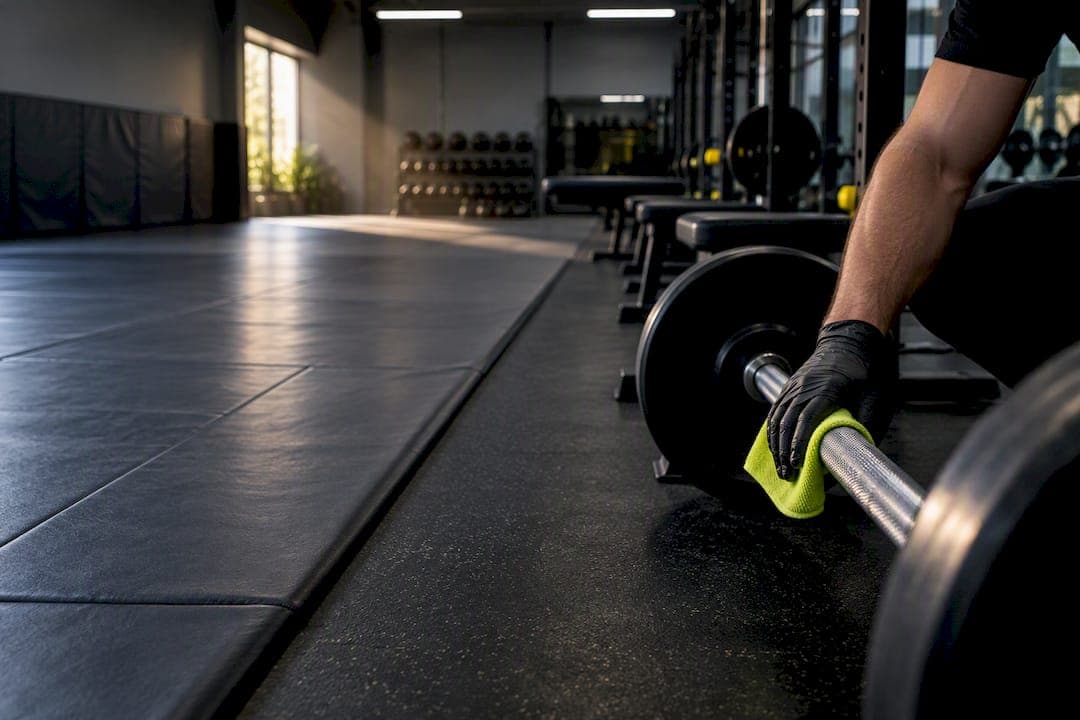
Enforce member hygiene and wound coverage, insist on proper handwashing, and disinfect shared equipment with a product carrying a labelled Staphylococcus aureus kill claim, held for its full contact time. Back this with staff-performed zone rotations during peak hours, not member wipes alone, and have a targeted deep decontamination ready to deploy the moment anyone reports a suspected case. Everything else in your MRSA cleaning gym protocol builds on those four moves.
TL;DR:
- Proper disinfection with a labeled Staphylococcus aureus kill claim and full contact time is essential for effective MRSA control on gym surfaces.
- High-contact porous surfaces like mats and foam padding require thorough, repeated disinfection and are more likely to harbor bacteria for longer periods.
- Staff-led zone rotations during peak hours, with enforced dwell times and verification checklists, improve cleaning consistency and coverage.
- Immediate isolation and targeted deep decontamination are critical steps when a suspected MRSA case is identified, to prevent wider spread.
- Member wipe-downs are insufficient alone; scheduled, verifiable staff disinfection dominates in preventing transmission.
Table of Contents
- Why MRSA is a concern in gyms
- How does MRSA actually spread around equipment?
- Cleaning and disinfection protocols for gym equipment
- Choosing the right disinfectant and hitting contact time
- Rostering and zone rotations that actually cover peak hours
- Managing locker rooms, showers, and mats
- What to do when you suspect a MRSA case
- What the evidence says and where professional cleaning fits
- Verification beats spectacle
- Getting professional support for MRSA cleaning and rapid response
- Sources
- FAQ
Why MRSA is a concern in gyms
MRSA spreads through skin-to-surface-to-skin contact. Someone with a colonised patch of skin touches a barbell or a bench pad, the bacteria survive on that surface, and the next person's skin abrasion or hair follicle picks it up. It survives on both hard surfaces like chrome and vinyl and porous ones like mat foam and towel fibre, which is why a single wipe-down policy never covers the real risk.
Some activities raise the odds more than others. Grappling and contact sports push skin against mats for extended periods. Heavy benching means sweat-soaked backs pressed into pads for sets at a time. Locker rooms combine moisture, shared surfaces, and bare skin in one small room. Research on gym surface contamination shows detection rates vary significantly between facilities, from around 10% of samples in some studies to none in others, so risk depends heavily on how well a facility runs its hygiene practices, not just its size or age.
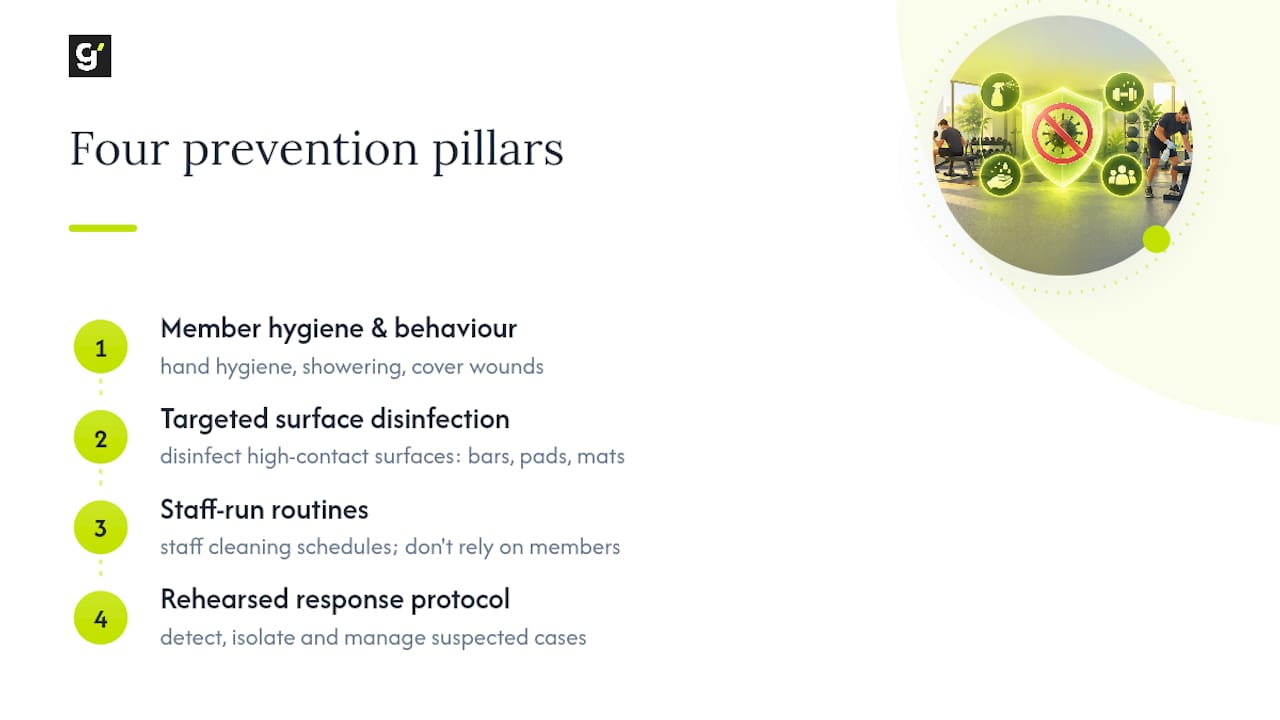
Effective prevention rests on four pillars: member hygiene and behaviour, targeted disinfection of high-contact surfaces, staff routines that don't rely on member goodwill, and a rehearsed response protocol for suspected cases. Skip any one of them and the other three carry more weight than they can hold.
How does MRSA actually spread around equipment?
The reservoirs that matter most are the ones everyone touches with sweaty or bare skin: barbell knurling, bench pads, mat surfaces, and locker-room fixtures like bench seats and shower rails. Moisture and warm skin both increase how long bacteria survive and how easily they transfer, which is why locker rooms carry more risk per square metre than the open gym floor.
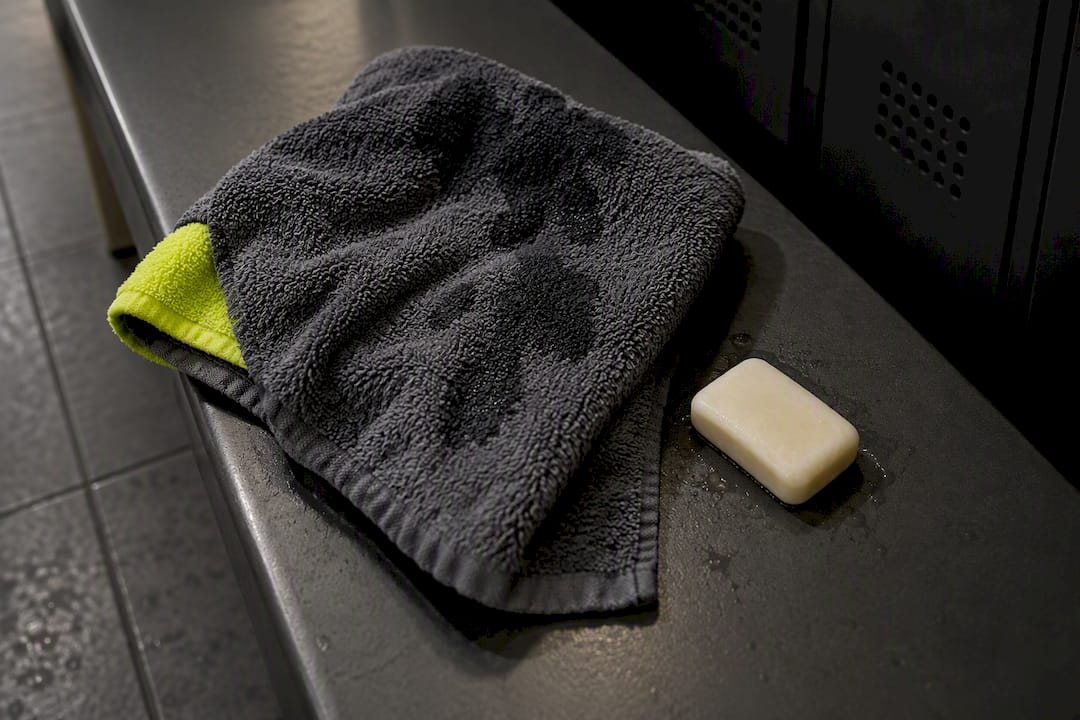
Shared towels, razors, and soap bars are among the highest-risk items in any facility because they move directly between skin surfaces with no barrier at all. A gym that looks spotless can still be a transmission risk. Visible cleanliness and disinfection are two different things, and the gap between them is contact time. A surface can be wiped, look dry and shiny, and still carry live bacteria if the disinfectant never sat on it long enough to work.
Cleaning and disinfection protocols for gym equipment
Cleaning removes visible soil. Disinfection kills the microbes left behind. You need both, in that order, every time. Wiping sweat off a bench with a dry towel does nothing for MRSA control unless a disinfectant follows it.
Different surfaces need different handling:
- Touchscreen consoles and cardio equipment — wipe with a cloth first to clear sweat and residue, then apply a disinfectant safe for electronics and let it sit for the labelled contact time before the next user.
- Barbell and dumbbell grips — spray or wipe knurled steel after each session block, focusing on areas where hands and forearms make contact.
- Bench pads and mat surfaces — these porous materials hold moisture longer, so they need a disinfectant rated for vinyl and foam, applied generously enough to stay wet for the full dwell time.
- Free weights and racks — treat handles, pins, and safety catches, not just the visible plate surfaces.
Member spray stations help, but they're a supplement, not the plan. Staff-performed disinfection at scheduled intervals is the real backstop, because member wipe-downs have wildly inconsistent compliance and almost never hit the correct contact time. The CDC's athletic-facility guidance backs this up directly, recommending scheduled cleaning and disinfection of shared equipment as a core control measure, not an optional extra.
Pro Tip: Put a small laminated card next to each spray station stating the exact number of seconds the surface needs to stay wet. Members who see a number tend to actually wait for it.
Choosing the right disinfectant and hitting contact time
Every disinfectant used on gym equipment needs a labelled claim against Staphylococcus aureus, and you should keep a record of the product's registration details on file. In Australia, that means checking the product against Therapeutic Goods Administration listings before you buy in bulk, not after a complaint lands on your desk.
The three common chemistries each trade off differently:
- Quaternary ammonium compounds (quats) — broad material compatibility, low odour, but need full contact time to work.
- Accelerated hydrogen peroxide — fast-acting, generally gentler on rubber and vinyl over repeated use.
- Diluted sodium hypochlorite — strong kill power but can degrade foam padding and some plastics with regular use.
A 2025 study on disinfectant efficacy found quaternary ammonium formulations achieved a 4 to 5 log reduction in staphylococci on gym-type surfaces, provided the surface stayed wet for at least one minute. That one-minute figure is the number most staff skip. The practical fix is a timed leave-on application rather than a single wipe, sometimes paired with a second pass to keep the surface visibly wet, with a supervisor spot-checking that staff are actually letting it sit.
Rostering and zone rotations that actually cover peak hours
A 45 to 60 minute zone sweep cadence during peak hours is the benchmark that keeps high-contact equipment covered without pulling staff off the floor constantly. Overnight, you need enough staffing to run a full deep clean of mats, benches, and locker rooms, not just a quick mop-through.
A workable zone sweep checklist covers:
- Named targets — which equipment and surfaces get hit in this specific sweep, not a vague "gym floor" instruction.
- Dwell time enforcement — a timer or a fixed count the staff member follows, not a guess.
- Verification tick box — a simple sign-off sheet so a manager can confirm the sweep happened and when.
If sweeps start slipping, it usually shows up first in locker rooms and free-weight zones, the two areas with the highest skin contact per hour. When staffing gets tight, prioritise those two over cardio equipment, which sees less direct skin-to-surface pressure. Scheduling this kind of recurring coverage across a larger facility follows the same logic used in commercial deep cleaning rosters, where fixed intervals beat reactive cleaning every time.
Managing locker rooms, showers, and mats
Showers and drains need daily scrubbing, with particular attention to grout lines where biofilm builds up quietly over weeks. Mats used for grappling or floor work need a fungicidal and bactericidal treatment after every session involving sustained skin contact, not just at closing time.
Material-safe chemistries matter here more than anywhere else in the facility:
- Vinyl and rubber flooring tolerate most disinfectants but degrade faster under hypochlorite.
- Mat polymers need products specifically rated for foam substrates to avoid breakdown.
- Towels and linen need laundering at a temperature and cycle length that meets hygiene laundering standards, not just a quick warm wash.
Drains are the part most facilities forget. Biofilm forms in wet, low-traffic corners of drains within days, and once established it keeps reseeding the surrounding tile no matter how often you mop the floor above it. Routine scrubbing at the drain itself, not just around it, is what actually stops that cycle.
What to do when you suspect a MRSA case
- Isolate immediately — pull the affected equipment or close the specific area, and notify staff so nobody else uses it in the meantime.
- Run a targeted deep decontamination — treat the isolated zone with a full disinfection pass, verify the contact time was met, and confirm before reopening.
- Communicate clearly — tell affected staff what happened and what's being done, and loop in members if the exposure risk touches shared areas.
- Escalate if needed — for a confirmed case or a cluster, contact your local public health authority for guidance on notification and further steps.
Speed matters more than scale here. A fast, contained response beats a slower, facility-wide shutdown almost every time.
What the evidence says and where professional cleaning fits
The contact-time science is consistent: disinfectants work when given the time labelled on the bottle, and staff-run sweeps outperform member self-service because they're verifiable. For gyms that need a professional response, options like Deep Decontamination or a Rapid Response tactical clean map directly onto suspected-case remediation, while a Routine Patrol covers the ongoing zone rotation work described above.
Verification beats spectacle
The gyms that stay clean aren't the ones that run one dramatic deep clean a year. They're the ones that verify the boring stuff, every shift, every zone, every contact-time check. That's the whole game, and it's where a service built on documented, eco-friendly decontamination earns its keep.
— Lead
Getting professional support for MRSA cleaning and rapid response
A professional cleaning service runs eco-friendly, bleach-free protocols designed for this kind of contamination control, without leaving harsh chemical residue in a space members walk into barefoot. For facilities managing a suspected case right now, Rapid Response (2-Hour Tactical Clean) delivers a fast, targeted decontamination of the affected zone.

For ongoing coverage, Deep Decontamination handles the full-sweep work that a suspected outbreak demands, while The Routine Patrol keeps peak-hour zones on a verified rotation between incidents. Before signing with any provider, ask three things: what kill claim does their product carry, do they provide verification reporting after each clean, and are their chemistries compatible with mat foam and vinyl. Check the full service scope and book a Rapid Response slot if you're dealing with a suspected case today.
Sources
Keep the CDC's athletic-facility guidance, the 2025 disinfectant efficacy study, and SafeWork NSW bookmarked for policy reviews and staff training updates.
- Study (2025) on disinfectant efficacy (MDPI)
- Athletic Facilities: MRSA Prevention and Control | CDC
- Gym and fitness club cleaning protocol | Opora
FAQ
Can MRSA spread from gym equipment?
Yes. MRSA transfers from skin to surfaces like barbells, bench pads, and mats, then onto the next person's skin, particularly through cuts, abrasions, or hair follicles. Regular disinfection with a product carrying an S. aureus kill claim, held for its full contact time, is the main control measure.
Should you work out with MRSA?
No. Anyone with a suspected or confirmed MRSA infection, especially an open or draining wound, should avoid shared gym equipment and mats until it's fully covered and cleared by a healthcare provider. The CDC recommends exclusion and wound care plans as part of standard athletic-facility protocol.
Can you get staph from gym mats?
Yes, mats are one of the higher-risk surfaces because porous foam holds moisture and bacteria longer than hard surfaces. Mats used for grappling or floor contact need fungicidal and bactericidal treatment after sessions involving sustained skin contact, not just at the end of the day.
How long will MRSA stay on surfaces?
Survival time varies by surface material and conditions, with porous, moist materials like mats and towels tending to harbour bacteria longer than dry, hard surfaces. This is exactly why relying on visible dryness or a quick wipe isn't reliable. Consistent disinfection with the correct contact time is what actually reduces this window.