
A compliant workplace hygiene checklist has to be documented, split by zone, scheduled by risk and assigned to a named person, because that is what Safe Work Australia's model code and state WorkSafe guidance expect a PCBU to prove during an audit. Getting this right now means adopting a zone-based checklist today, setting cleaning frequencies against contamination risk, and keeping records that show who did what and when.
TL;DR:
- Workplace hygiene checklists must be zone-specific, scheduled by risk levels, and documented with details like date, time, staff, and corrective actions.
- Daily tasks focus on high-contact surfaces and consumables, while weekly and monthly routines involve deeper cleaning and equipment maintenance, tailored to contamination risk.
- Employers are legally required to provide adequate facilities, maintain them, and keep thorough records to prove WHS compliance during audits.
- Regular training, proper chemical handling, and photo evidence are essential to avoid common audit failures and demonstrate due diligence.
- Managed decontamination services can effectively handle deep cleaning and routine replenishment needs, especially after contamination events or renovation.
Table of Contents
- What to include in your workplace hygiene checklist
- Cleaning schedules and how often each task should happen
- What WHS law actually requires of employers
- Managing cleaning staff, contractors and paperwork
- How a managed decontamination service fits the checklist
- Handling infectious disease outbreaks in the workplace
- Setting personal hygiene expectations for staff
- Reporting and resolving hygiene non-compliance
- Using PPE correctly for workplace hygiene tasks
- Common audit failings and quick fixes
- A managed alternative to running this checklist in-house
- Authoritative Australian guidance for your audit pack
- Sources
- FAQ
What to include in your workplace hygiene checklist
A checklist only earns its keep when it forces someone to look at a specific zone and tick a specific outcome, not a vague box marked "cleaned." Break the workplace into zones and build inspection items around what actually gets dirty and who touches it.
Start with the areas that matter most:
- Entrances and reception: mats, glass doors, door handles, visitor sign-in tablets
- Workstations: desks, keyboards, phones, shared monitors, chair armrests
- Kitchens and break rooms: benchtops, fridge handles, microwave interiors, kettle and tap handles
- Toilets and washrooms: basins, taps, toilet seats, cubicle locks, floors, mirrors
- Meeting rooms: table surfaces, remote controls, whiteboard markers, door handles
- Shared equipment: photocopiers, lift buttons, EFTPOS terminals, tools and machinery grips
- Ventilation and HVAC: return air vents, filter condition, visible dust build-up
- Waste and recycling stations: bin liners, overflow, odour, sharps disposal where relevant
Consumables need their own line items because a checklist that only checks surfaces misses the most common failure point: empty dispensers. Track soap and hand sanitiser levels, paper towel and toilet paper stock, and bin liner supply as a daily check, not an afterthought.
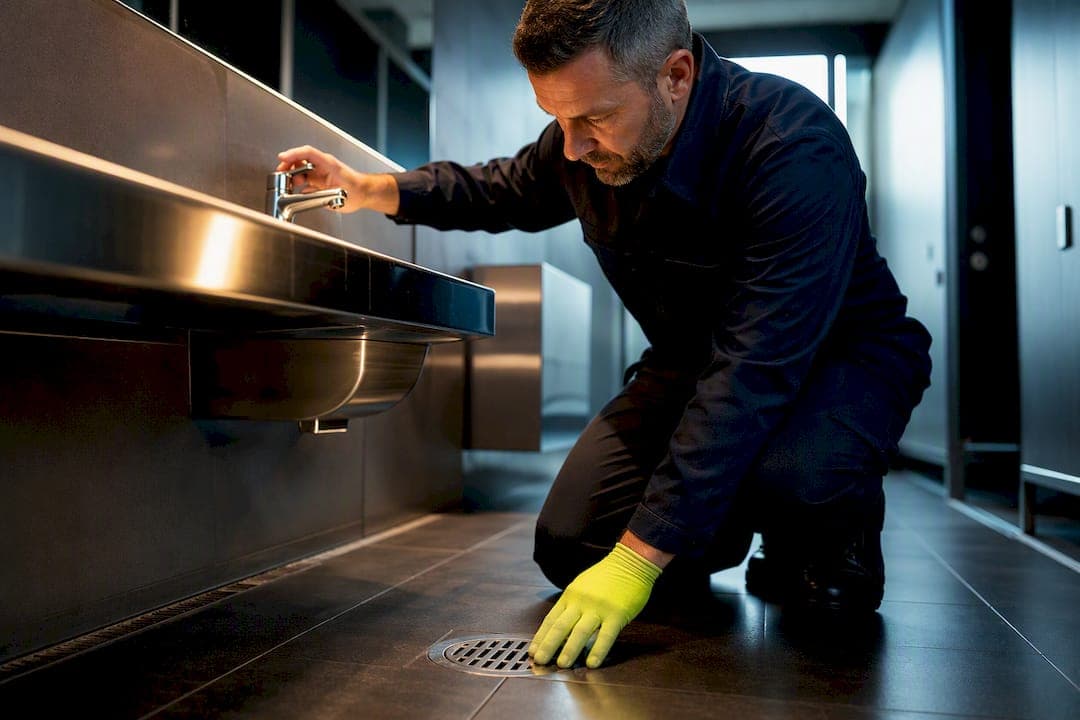
Facilities and fixtures deserve separate attention from surface cleaning. Hand basins need functioning taps and drainage, HVAC filters need a documented replacement date, and plumbing and floor drains in kitchens and bathrooms should be checked for blockages before they become a hazard. The Safe Work Australia model code's Appendix A checklist covers exactly this ground and is worth using as a starting template rather than building one from scratch.
Every entry on the checklist should capture four record fields: date, time, staff name and corrective action taken if something failed inspection. Without those four fields, a checklist is just a list. With them, it becomes evidence.
Cleaning schedules and how often each task should happen
Frequency isn't a guess. Safe Work Australia's model code sets the principle plainly: cleaning frequency depends on the type of work, the number of people using a space, and the likelihood of contamination. A call centre with 200 desks and a single-person consulting office don't need the same schedule, even if both are "offices" on paper.
Daily tasks cover anything with high hand contact or food risk: door handles, light switches, kitchen benches, toilets, and shared equipment. Time these at the end of each shift or at day's end, whichever suits the business's traffic pattern. Where a site runs multiple shifts, add a mid-shift wipe-down of the highest-touch surfaces rather than waiting until close.
Weekly tasks go deeper: full floor care, upholstery vacuuming, waste bin audits, and a proper wipe-down of surfaces daily cleaning tends to skip, like skirting boards and the undersides of desks.
Monthly or quarterly tasks include HVAC filter checks, deep cleaning of carpets and upholstery, vent dusting, and a full review of storage areas. This is also when a managed deep-decontamination service tends to get called in for spaces that don't justify daily deep attention but still need periodic reset.
Beyond the calendar, certain events should trigger cleaning outside the normal schedule:
- A suspected illness in the workplace, particularly gastro or respiratory outbreaks
- Completion of post-construction or renovation work before staff re-occupy a space
- A spill or contamination event, cleaned immediately rather than at the next scheduled slot
- A period of unusually high foot traffic, such as an open day or a large client visit
WorkSafe Queensland's guidance on cleaning and slip prevention stresses that cleaning during low-traffic periods, paired with a fast spill response and interim signage, cuts slip risk far more effectively than reactive cleaning after someone's already gone down.
Pro Tip: Schedule your heaviest floor cleaning for the last 30 minutes before close and the first 30 minutes before open. It keeps wet floors out of foot traffic windows without adding extra cleaning hours to the roster.
What WHS law actually requires of employers
Under Australian WHS law, a person conducting a business or undertaking (PCBU) carries a primary duty of care to provide and maintain a clean, safe, accessible workplace. That's not a general aspiration. It's a specific obligation to provide toilets, handwashing facilities and drinking water, and to keep them stocked and functional, so far as is reasonably practicable.
A few obligations come up repeatedly in audits:
- Handwashing basins must be provided in a ratio appropriate to worker numbers, with soap and drying facilities always available
- Toilets and washrooms need regular replenishment of consumables, not just periodic restocking
- Cleaning frequency must be set against contamination risk and worker numbers, per SafeWork SA's guidance
- Facilities in temporary or remote workplaces still need to meet the same baseline, adapted using the model code's appendix templates
When an inspector or auditor asks for evidence, the strongest response is a physical audit pack: the completed checklist history, consumable restocking logs, and a copy of the Safe Work Australia model code with your adapted checklist attached as an appendix.
Managing cleaning staff, contractors and paperwork
Hiring a cleaner isn't the same as proving they know what they're doing on your site. WorkSafe Queensland flags undocumented training as one of the most common audit failures: a business assumes competence, but has no record showing the cleaner understood site-specific risks or chemical handling.
Build these controls into every landscaping WHS requirements in Australia contractor relationship:
- Documented induction and sign-off for every cleaner or contractor before they start work
- A Safety Data Sheet (SDS) register with approval signatures for every chemical used on site
- A supplier consult before switching cleaning products, since the wrong chemical can strip slip resistance from flooring
- A written contract specifying scope, frequency and what evidence gets handed over (check sheets, photos, incident logs)
- Site-specific method statements for higher-risk zones like commercial kitchens or areas with biohazard potential
Keep the audit trail simple: check sheets, timestamped photos, training records and a corrective-action log tied back to the checklist itself. If it's not written down, it didn't happen, at least as far as an auditor is concerned.
How a managed decontamination service fits the checklist
A managed, non-toxic deep-decontamination service typically covers the checklist items ordinary rostered cleaning struggles to reach consistently: grout lines, behind fixed equipment, and full-room resets after construction or contamination events. Scheduled patrols help keep consumables stocked and every visit leaves a dated record.
- Deep decontamination targets the hard-to-reach items your monthly or quarterly checklist row calls for
- Routine patrols top up soap, sanitiser and paper stock between scheduled cleans
- Each visit generates dated evidence that slots straight into an audit pack
Handling infectious disease outbreaks in the workplace
An outbreak, whether it's COVID-19, influenza or gastro, changes what "clean" means for as long as the risk is active. Safe Work Australia's outbreak-era guidance still holds as the operational baseline: clean high-touch surfaces with detergent, then apply disinfectant where contamination is suspected or confirmed, rather than defaulting to disinfectant everywhere as a first step.
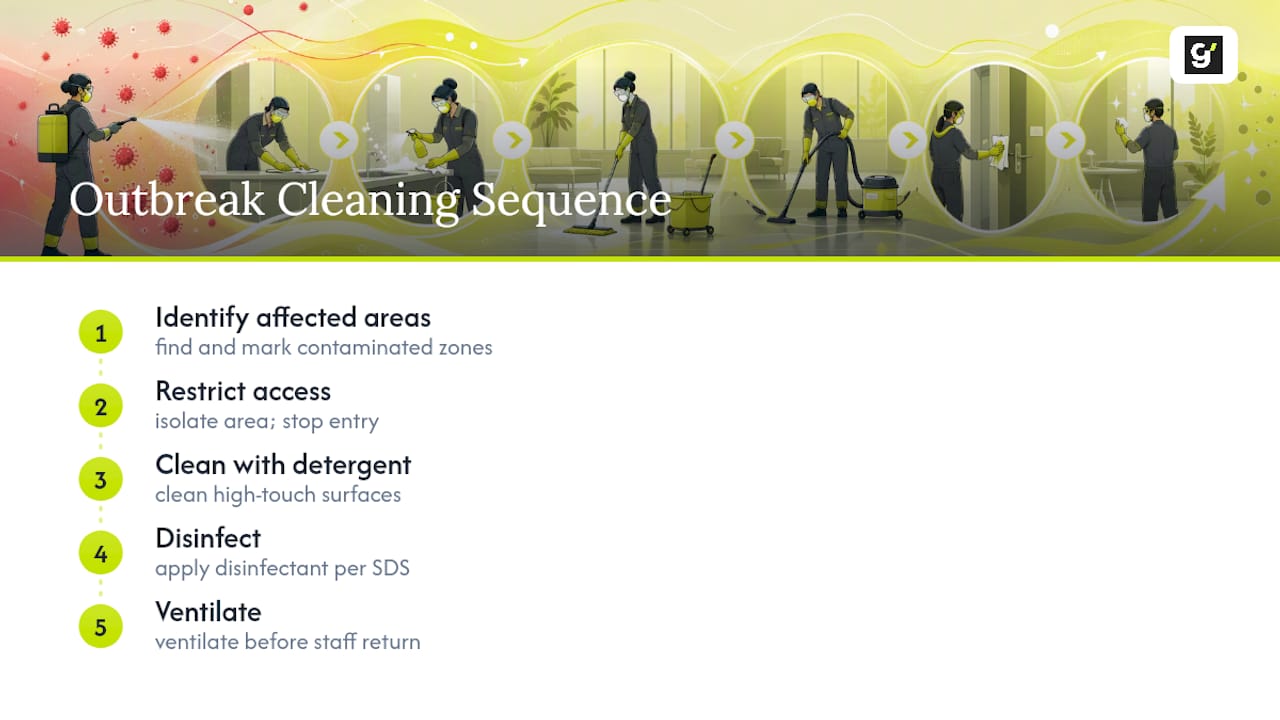
The COVID-19 cleaning checklist from Safe Work Australia sets out a workable sequence: identify affected areas, restrict access, clean with detergent, disinfect, then ventilate before staff return. Disposable gloves are recommended wherever practical, and cleaners should follow the SDS for whatever disinfectant is used, since concentration and contact time both affect whether the product actually works.
Beyond the physical clean, an outbreak response needs a communication trigger. Staff need a clear, no-blame way to report symptoms before they come to work, and management needs a pre-agreed threshold for when a single sick staff member becomes a "deep clean the whole floor" event. Waiting until three people are unwell before acting is too late, because by then the contamination has usually spread across shared equipment, kitchen surfaces and meeting rooms.
Keep a standing outbreak protocol separate from the daily checklist, but reference it inside the checklist itself, so whoever's on shift knows exactly which document to pull out the moment symptoms are reported.
Setting personal hygiene expectations for staff
A hygiene checklist covers surfaces. A hygiene policy covers people, and both need to exist for the system to actually work.
The clearest personal hygiene policies set expectations in plain language rather than legal phrasing: wash hands after using the bathroom, before handling shared food, and after using shared equipment. For workplaces with food handling or client-facing roles, add specifics, like tying back long hair, covering cuts and wounds, and not attending site with symptoms of a contagious illness.
Compliance improves when the policy is visible, not filed away. Laminated signage near basins, a line in the staff handbook, and a mention during induction all reinforce the same message without turning it into a lecture. Where a role has specific requirements, like a commercial kitchen needing hairnets or a clinical setting needing PPE, that requirement should sit in the role's induction checklist, not just the general staff handbook.
The harder part is consistency of enforcement. A policy that gets raised only after a complaint looks reactive and creates resentment. Build a light-touch review into regular team meetings instead, treating it the same way you'd treat any other safety topic, rather than singling it out only when something's gone wrong.
Reporting and resolving hygiene non-compliance
Every checklist eventually turns something up: an empty soap dispenser three days running, a contractor skipping the toilets, a staff member ignoring the food handling policy. What happens next matters more than the checklist itself.
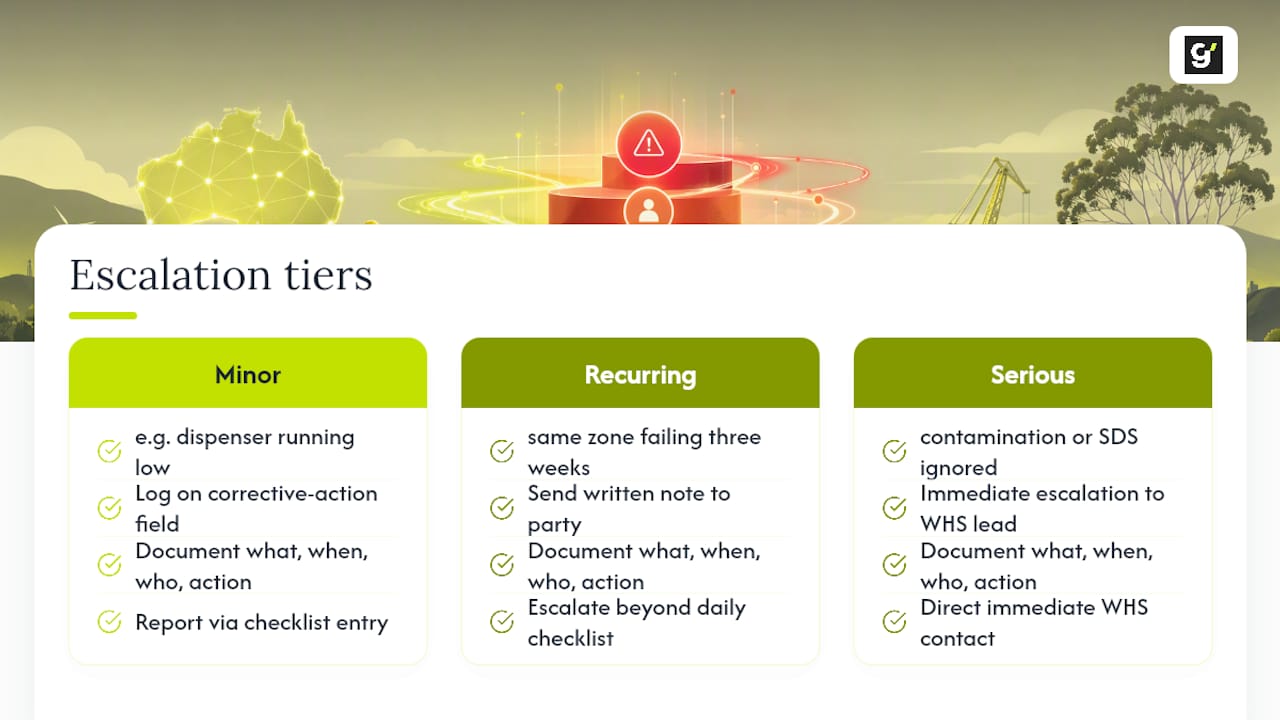
Set up a simple, tiered reporting path. Minor issues, like a dispenser running low, get logged on the corrective-action field of the daily checklist and fixed same-day. Recurring issues, like the same zone failing inspection three weeks running, escalate to a written note to the responsible contractor or staff member. Serious issues, like a contamination event or a contractor ignoring SDS instructions, need immediate escalation to whoever holds the WHS responsibility on site.
Document every non-compliance the same way, regardless of severity: what was found, when, by whom, and what corrective action followed. This isn't paperwork for its own sake. It's the evidence trail that shows a pattern was caught and addressed, which is exactly what protects a business if an incident ever ends up in front of a regulator.
Give staff a way to report hygiene issues without going through their direct manager, particularly for sensitive complaints about a colleague's personal hygiene or a contractor's conduct. An anonymous or semi-anonymous channel, even something as simple as a suggestion box near the amenities, catches issues that would otherwise go unreported until they become a bigger problem.
Using PPE correctly for workplace hygiene tasks
PPE for hygiene tasks isn't one-size-fits-all, and treating it that way is how businesses end up under-protected in high-risk zones and over-cautious in low-risk ones.
Disposable gloves are the baseline for anyone handling waste, cleaning toilets, or responding to a spill involving bodily fluids. The COVID-19 cleaning checklist recommends gloves wherever practical during any disinfection task, paired with hand hygiene immediately after removal. For biohazard situations specifically, standard gloves aren't enough. Sites handling bodily fluid spills need protocols closer to what's outlined in guidance on bloodborne pathogen cleanup, including appropriate disposal of contaminated materials.
Eye protection and masks come into play when using concentrated chemicals or working in poorly ventilated spaces. Check the SDS for every product on site. It will state exactly what PPE is required for that specific chemical, and that requirement should transfer directly into your contractor's method statement rather than being left to individual judgement.
PPE management also means storage and disposal, not just wearing it. Gloves and masks need a defined disposal path, separate from general waste where contamination risk is elevated, and PPE stock itself becomes another consumable line on your checklist, right alongside soap and paper towel.
Common audit failings and quick fixes
Auditors keep finding the same three gaps: no training record for cleaners, the wrong chemical on the wrong floor, and zero photo evidence. Fix them with a one-page cleaner induction, a supplier consult before switching products, and a photo sign-off built into the daily checklist.
— Lead
A managed alternative to running this checklist in-house
Running a compliant hygiene checklist in-house is entirely doable, but it takes a dedicated person, consistent training records and someone who actually checks the checklist gets followed, not just filled in. Grimescene offers a managed alternative for the parts of this system that are hardest to sustain internally: the deep decontamination cycle, the routine patrol that keeps consumables stocked, and photographic proof for your audit pack.
Non-toxic decontamination agents can handle the deep-clean rows on your checklist without the harsh chemicals that create their own SDS headaches, and every visit can be documented for your compliance file. For short-stay or turnover-heavy sites, the Scene Reset protocol covers the same ground between guest changeovers. If your business runs a commercial or industrial site that needs periodic deep decontamination rather than daily rostered cleaning, get a quote on a full sweep deep decontamination service and see how it slots into your existing checklist.
Authoritative Australian guidance for your audit pack
Keep these on hand when preparing an audit file: the model code of practice, WorkSafe Victoria's compliance code, and SafeWork SA's facilities guidance.
Sources
- Model Code of Practice: Managing the work environment and facilities (Safe Work Australia)
- Cleaning (WorkSafe Queensland)
- Managing the work environment and facilities (SafeWork SA)
FAQ
How often should a workplace hygiene checklist be completed?
Daily for high-touch surfaces and toilets, weekly for deeper surface and floor care, and monthly or quarterly for HVAC, upholstery and full-area decontamination, adjusted for worker numbers and contamination risk.
What records prove WHS compliance for cleaning?
Auditors expect a checklist history with date, time, staff name and corrective action, alongside training records for cleaners and an SDS register with approval signatures.
Does Safe Work Australia provide a hygiene checklist template?
Yes. The model code of practice includes an appendix checklist for facilities that businesses can adapt to their own zones and risk profile.
When should a workplace call in a deep decontamination service?
After construction or renovation work, following a suspected illness outbreak, or when a periodic deep clean is due beyond what daily rostered cleaning covers, services like Grimescene's deep decontamination handle this tier.
What PPE is required for routine workplace cleaning?
Disposable gloves are the baseline for toilets, waste and spill response, with masks or eye protection required for concentrated chemicals per the product's SDS.