
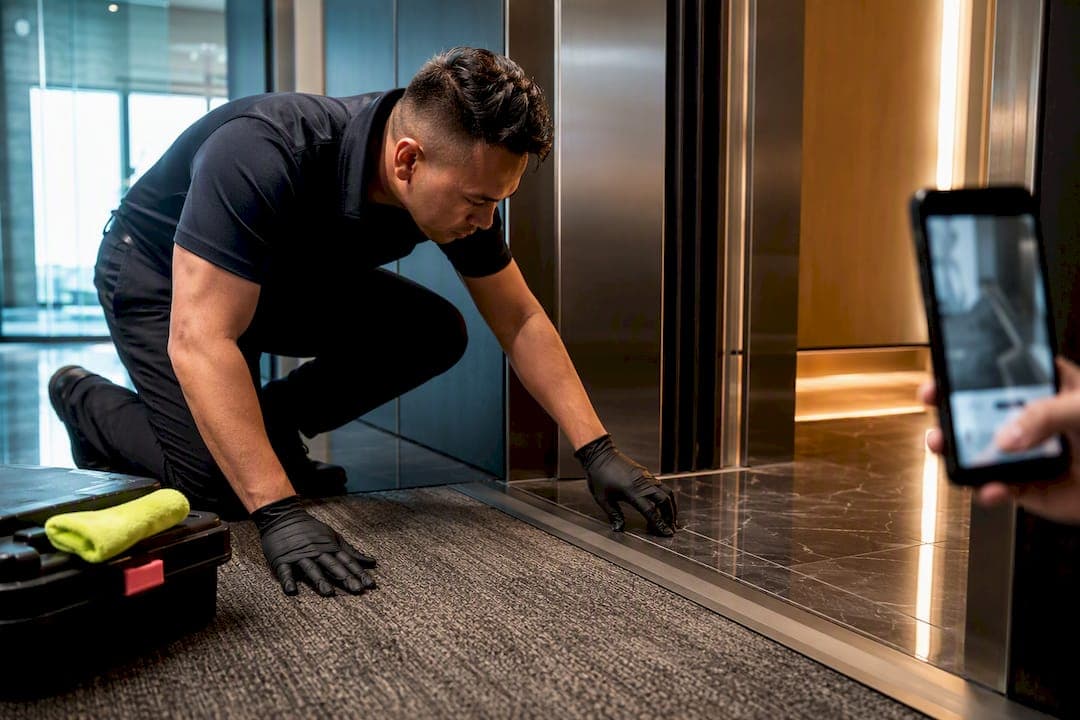
A defensible strata cleaning checklist lists every common area zone, specifies the task and how often it happens, names who owns it, and records proof the work was actually done. Without that fourth element, "it was cleaned" is just an opinion that a resident, a contractor, or a committee can dispute. With a timestamped photo or a digital sign-off attached to each line, the same checklist becomes an operational control you can point to in a dispute or hand straight to a new contractor.
TL;DR:
- Verifiable proof, such as timestamped photos or digital signatures, is essential to defend cleaning claims and prevent disputes over completed work.
- Different zones require tailored cleaning frequencies based on traffic levels, with high-touch areas needing daily sanitization and low-traffic zones manageable with weekly or monthly schedules.
- Clear responsibilities assigned to contractors, on-site staff, and committees, along with measurable KPIs and audit routines, create legally and operationally enforceable standards.
- Deep, seasonal, and specialist cleaning tasks should be scheduled well in advance to avoid omissions, focusing on high-risk areas like carpets, vents, and exterior surfaces.
- Regular review and updates of verification records and checklists ensure cleaning standards adapt to building usage changes, reducing resident complaints and maintaining safety.
Table of Contents
- Short printable checklist: daily, weekly and monthly essentials
- Zone-by-zone checklist with pass/fail indicators and verification examples
- How to set schedules and frequencies by traffic and risk
- Assigning responsibilities and making the checklist legally and operationally defensible
- Deep, seasonal and specialist cleaning tasks to calendar in advance
- Managing contractors: writing a usable SOW, KPIs and audit routines
- Supplies, PPE and choosing eco-friendly products that protect residents and finishes
- Monitoring, reporting and when to update the checklist
- Example implementation: how an eco-friendly provider runs a defensible checklist
- Emergency cleaning procedures and spill response plans
- Communication strategies with residents and stakeholders regarding cleaning schedules and disruptions
- Why verification changes the conversation with residents
- How Grime Scene Services can help
- Authoritative templates and government guidance
- Sources
Short printable checklist: daily, weekly and monthly essentials
Print this and hand it to whoever runs the site, contractor or on-site staff, so nobody is guessing what "clean" means on a Tuesday morning.
Daily
- Empty and reline bins in lobbies, corridors, and bin rooms.
- Sweep and mop entryways and lift lobbies.
- Sanitise high-touch surfaces: lift buttons, handrails, door handles, intercoms.
- Check lighting in stairwells, car parks, and corridors, and report any outages.
Weekly
- Mop and detail lobby floors and skirting on a weekly basis.
- Vacuum carpeted corridors and stairwell landings on a weekly basis.
- Clean glass entrance doors, sidelights, and directory boards.
- Inspect bin rooms for odour, spillage, and pest activity weekly.
Monthly
- Conduct carpet extraction in high-traffic corridors and lobbies on a monthly or quarterly basis.
- Clean return air vents and grilles.
- Test motion sensors, emergency lighting, and timer switches regularly following manufacturer recommendations.
- Deep clean high-touch fixtures such as door plates, lift call panels, and handrails periodically.
This structure mirrors the zone, task, and frequency format that checklist templates already used by strata cleaners follow, which is worth copying rather than reinventing.
Zone-by-zone checklist with pass/fail indicators and verification examples
A checklist only works when "done" has a fixed meaning per zone. The clearest way to build one is to organise it the same way a zone-based common area cleaning checklist is structured: task, frequency, owner, and a verification method that removes the guesswork. Here's how that plays out across a typical strata building.
-
Lobby and entrance. Sweep, mop, and clean glass daily; wipe seating and refresh door mats. Pass criteria: no visible streaks on glass, no debris in corners, mats flat and clean. Verification: a dated photo of the entrance mats and glass panels, timestamped at completion.
-
Elevators. Mop or vacuum the floor, wipe panels, disinfect buttons, and clear door tracks of grit daily in high-traffic buildings. Pass criteria: no fingerprints on stainless panels, no debris in tracks, floor free of scuffing residue. Verification: a photo of the cab interior and button panel, timestamped.
-
Corridors and stairwells. Vacuum or mop floors, wipe handrails, and spot-clean wall marks. Pass criteria: no visible marks at handrail height (where hands touch most), floors free of grit. Verification: a timestamped digital scan logged per floor, so a manager can see which levels were actually covered that day.
-
Bin rooms and waste areas. Empty bins, deodorise, hose or mop floors, and flatten cardboard for collection. Pass criteria: no lingering odour, no leachate pooling, floor drains clear. Verification: a photo of the cleaned room paired with a written odour check note, since smell doesn't show up in a photo.
-
Amenity areas (gym, pool, lounge). Wipe down equipment, restock sanitiser and towel dispensers, and test that pool equipment and gym machines are functioning. Pass criteria: equipment surfaces dry and residue-free, dispensers full. Verification: an equipment checklist ticked off against a photo of the stocked dispensers.
-
Car park and external areas. Pick up litter, sweep entrance ramps, and empty external bins. Pass criteria: no litter accumulation near entry points, bins under capacity. Verification: a timestamped sweep record, useful evidence if a slip-and-fall claim ever surfaces.
-
Common restrooms and laundries. Restock paper and soap, sanitise fixtures, mop floors, and check lint traps in shared laundries. Pass criteria: fixtures free of limescale build-up, lint traps clear, supplies stocked. Verification: a photo plus a quick inventory tally of consumables remaining.
This level of detail matters because prioritising high-traffic and hygiene-critical zones in daily schedules is what actually reduces complaints, not just having a checklist that exists on paper somewhere in a filing cabinet.
How to set schedules and frequencies by traffic and risk
Not every zone needs the same attention, and treating a quiet stairwell the same as a lobby wastes budget you could spend elsewhere.
- Low traffic (secondary stairwells, storage corridors): weekly sweep, monthly deep clean.
- Medium traffic (main corridors, amenity rooms): two to three visits a week, plus a weekly deep wipe-down of surfaces.
- High traffic and high-touch (lobbies, lifts, bin rooms): daily attention, with sanitising of touch points every visit.
A sample matrix looks like this: lift buttons and door handles get wiped daily; corridors get vacuumed three times a week; amenity equipment gets a full wipe-down weekly. When resident complaints spike in a particular zone, escalate frequency immediately rather than waiting for the next scheduled review, then re-check after two to four weeks to confirm the change actually worked. Risk-based frequency guidance built for commercial spaces applies just as well here, since the logic of matching cleaning intensity to foot traffic doesn't change much between an office lobby and a strata one.
Assigning responsibilities and making the checklist legally and operationally defensible
A checklist without a named owner per task is a wish list, not an operational document.
- Contractor delivers the recurring scope: daily and weekly zone cleaning as defined in the scope of work.
- On-site staff handle spot tasks between contractor visits: a spill, an overflowing bin, a broken light reported by a resident.
- Committee owns the audit function: spot-checking completed work and reviewing verification records against the schedule.
Match your verification method to the risk of the zone by following an AI maintenance schedule designed for property managers, which helps automate and optimise maintenance cadences. A quiet storage corridor might only need a mobile scan confirming a visit happened. A bin room or a lift, where hygiene complaints and liability both run higher, warrants a timestamped photo and, ideally, an e-signature from whoever completed the task. Digital capture methods that link inspections to auto-created work orders make this far easier to manage than paper logs.
Pro Tip: Keep every photo, scan, and sign-off linked to the specific work order and invoice it relates to. When a dispute lands months later, being able to pull one file that shows the date, the task, and the proof saves hours of arguing over what "probably" happened.
Deep, seasonal and specialist cleaning tasks to calendar in advance
Some jobs don't fit a weekly rhythm but still need a fixed spot on the calendar, or they get forgotten until someone complains.
- Quarterly or biannual: carpet extraction across all common areas, high dusting of light fittings and cornices, interior glass detailing, extractor vent cleaning.
- Annual or seasonal: exterior window washing, gutter clearing before storm season, pressure washing of paths and car park entries, pool chemistry and filtration checks.
- Specialist: post-construction silica dust remediation after renovation works, bio-contamination response for incidents involving bodily fluids or pest infestation, and degreasing of kitchen exhaust systems in buildings with shared cooking facilities.
These are the tasks most likely to get skipped when a checklist only covers the daily grind, and they're also the ones with real safety implications if left too long.
Managing contractors: writing a usable SOW, KPIs and audit routines
A scope of work that says "clean common areas" gives a contractor nothing to be held to.
- SOW essentials: a zone map of the property, itemised tasks per zone, frequency for each, the required verification method, and a clear list of consumables the contractor supplies versus what the strata provide. Note exclusions explicitly, such as specialist decontamination work that sits outside routine scope.
- KPIs and SLAs: completion rate against the scheduled task list, average time to close a corrective action after a failed audit, and pass rate on random spot audits.
- Audit routine: monthly random checks against the zone checklist, a quarterly deeper audit covering every zone, and a documented corrective action workflow when something fails.
Structured contractor management practices built around clear SOWs and measurable KPIs turn a vague service agreement into something you can actually enforce.
Supplies, PPE and choosing eco-friendly products that protect residents and finishes
- Consumables: approved disinfectants, neutral pH floor cleaners suited to the building's flooring, microfibre cloths, and quality entrance matting to cut down on tracked-in grit.
- PPE basics: gloves for all wet work, eye protection during deep cleans involving chemical concentrates, and masks when dust or fumes are a realistic possibility.
- Eco guidance: favour non-bleach, biodegradable agents where they perform the job adequately, since non-toxic cleaning products reduce fume complaints from residents. Document safety data sheets in the contractor's SOW so anyone can check what's being used on shared surfaces.
Monitoring, reporting and when to update the checklist
A checklist that never changes eventually stops matching how the building actually gets used.
- Review cadence: a full quarterly review is standard practice, with immediate interim updates whenever renovation works finish or a serious complaint lands.
- Use the data: audit outcomes and resident reports should actively move zones between frequency tiers, not just sit in a file. A lobby that keeps failing weekly audits needs daily attention, not another quarter of hoping it improves.
- Retention: keep verification evidence for at least the period required under your contractor agreement, and reference key findings in committee minutes so decisions have a paper trail. Reviewing the checklist regularly and tailoring it to the specific building's layout and amenities is what keeps it useful rather than generic.
Example implementation: how an eco-friendly provider runs a defensible checklist
An eco-friendly provider structures its strata work around an assessment first, then a zone schedule built to that specific building, then routine patrols with photo evidence attached to each visit, followed by periodic deep decontamination for zones that carry heavier wear. When a job involves post-construction silica dust or a bio-contamination incident, that work gets flagged for specialist remediation rather than folded into a routine patrol, because the equipment and protocols involved are different from standard cleaning.
Every patrol produces a documented record: photos, timestamps, and notes tied to the specific zone and task. That record becomes the audit trail a committee can reference months later, whether the question is "was the bin room actually serviced last Tuesday" or "what condition was the lobby carpet in before the renovation started."
Emergency cleaning procedures and spill response plans
Not every mess waits for the next scheduled clean. A burst pipe, a lift malfunction leaking hydraulic fluid, or a resident's medical incident in a common area all need a response plan that exists before the emergency, not one improvised on the day.
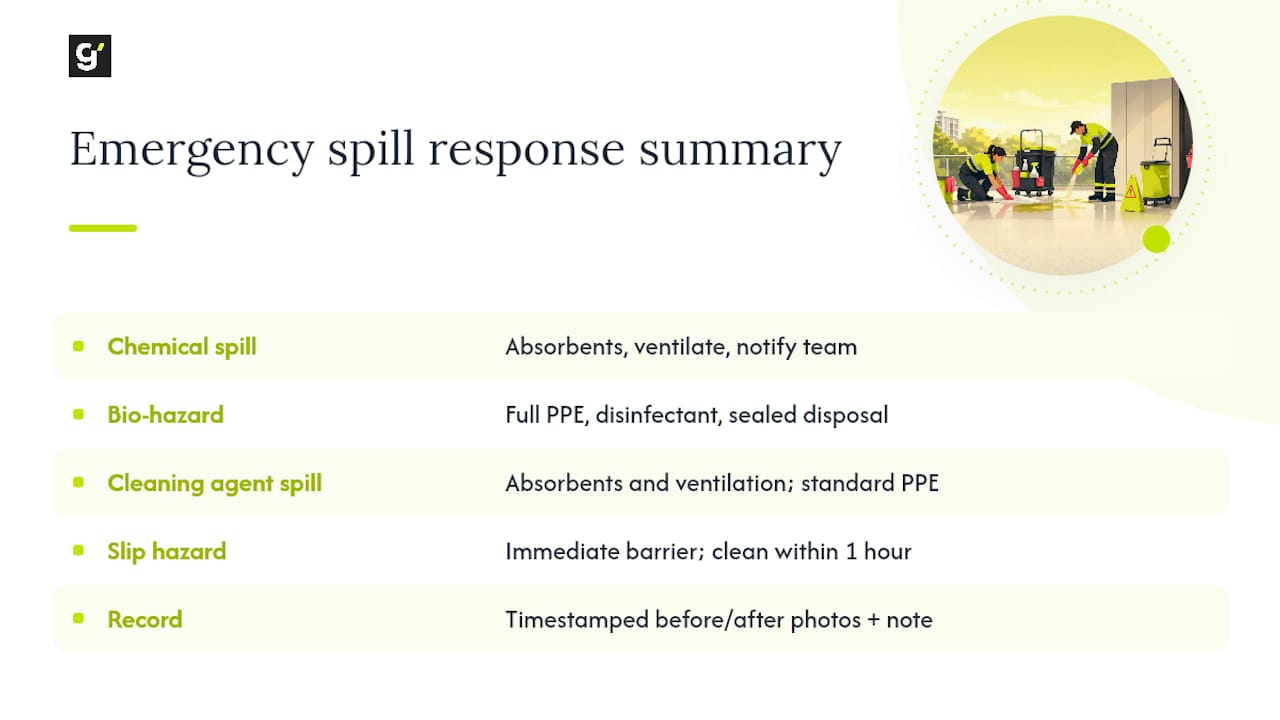
Build a simple spill response protocol into the checklist system: who gets notified first (on-site staff or the managing agent), what PPE is required for the specific spill type, and how quickly a response is expected. Chemical spills need different handling than biological ones. A cleaning agent spill might just need absorbent matting and ventilation, while a bio-hazard incident, blood, vomit, or similar, needs full PPE, appropriate disinfectant, and safe disposal of contaminated materials.
Set a maximum response window for each category. Slip hazards in lobbies or stairwells should get an immediate barrier or warning sign the moment they're reported, followed by a clean-up within the hour where possible. Document the response the same way as routine tasks: a timestamped photo of the area before and after, plus a short note on what caused the spill and what was used to treat it.
This record matters for two reasons. It protects the strata scheme if a slip-and-fall claim follows, and it flags recurring problem spots, like a leaking pipe joint that keeps causing the same puddle, so the underlying issue gets fixed rather than just mopped up repeatedly.
Communication strategies with residents and stakeholders regarding cleaning schedules and disruptions
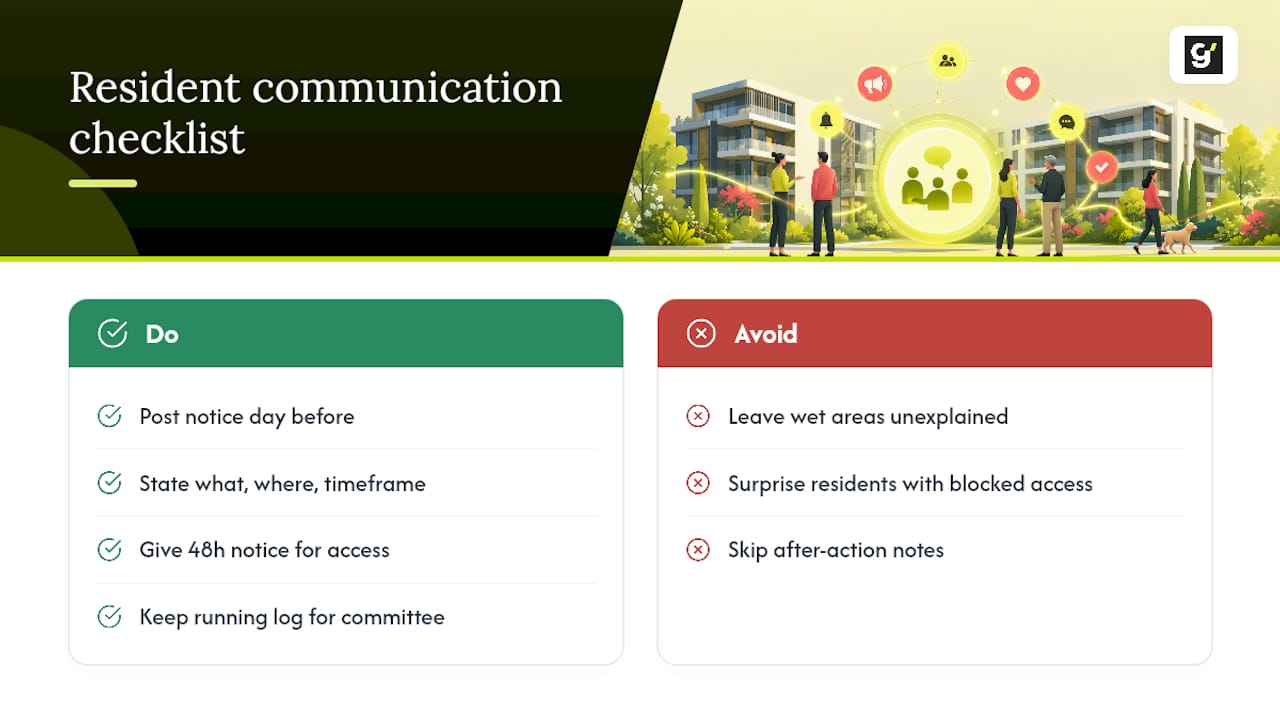
Residents tolerate disruption far better when they know it's coming and roughly how long it will last. A carpet extraction that closes off half a lobby for two hours is a minor inconvenience if there's a sign up the day before; it's a complaint-generating event if people just find wet carpet and a barrier with no explanation.
Post a simple notice at building entry points and in lift lobbies ahead of any deep clean, seasonal task, or specialist remediation: what's happening, which areas are affected, and the expected timeframe. For work that affects access, such as lift servicing tied to a deep clean of the cab, give at least 48 hours' notice where practical.
Keep a running log the committee can share in newsletters or on notice boards: what was cleaned, when, and what's coming next quarter. This does double duty. It answers the "why does the lobby smell like cleaning product" question before it's asked, and it gives the committee something concrete to point to when someone claims common areas are neglected.
For anything urgent, like an emergency spill response, a short after-the-fact notice explaining what happened and what was done closes the loop without requiring a drawn-out explanation at the next general meeting.
Why verification changes the conversation with residents
The real value of a proof-first checklist isn't the paperwork. It's what happens the next time someone complains that the lobby "never gets cleaned properly." Instead of a defensive back-and-forth, the committee pulls up a timestamped photo from that morning and the argument is over before it starts.
Prioritise verification where the stakes are highest: lifts, bin rooms, lobbies, anywhere hygiene complaints tend to cluster. You don't need photo evidence on every single task in the building to get the benefit. Committees weighing whether this is worth the effort should trial it on one zone, the lobby is the obvious starting point, before rolling it out everywhere. Buildings that maintain consistent, verifiable cleaning standards tend to see fewer repeat complaints and steadier resident satisfaction over time.
— Lead
How Grime Scene Services can help
Building and running a checklist like this takes time most property managers don't have spare, and specialist risks like silica dust or bio-contamination aren't jobs to hand to general cleaning staff regardless of how good your SOW is. This provider runs routine patrols with photo-evidenced verification built in, so committees get the audit trail this article has been describing without having to chase it down themselves. For turnovers and heavier jobs, an eco-friendly deep decontamination service uses non-toxic, bleach-free agents that handle post-construction mess and bio-hazard situations properly, rather than masking them.
If your building has a zone that keeps failing inspection, a bin room with a persistent odour problem, a lobby that never quite looks finished, that's the right place to start. Get in touch through the Deep Decontamination | Full Sweep service page for a scoped quote, and bring your existing checklist along so the assessment can build directly on what you've already got in place.
Authoritative templates and government guidance
For scope obligations, check the NSW government's strata repairs and maintenance guidance. For a ready-to-adapt printable format, the Merit Cleaning strata checklist PDF is worth downloading and customising to your own building's zone map before your next contractor review.
Sources
- Strata: repairs and maintenance — NSW Government
- Common area cleaning checklist (by zone) | CleanScan
- Apartment building cleaning checklist: operational guide — OxMaint
- Strata cleaning: guidelines for a well-managed property — StrataOne