
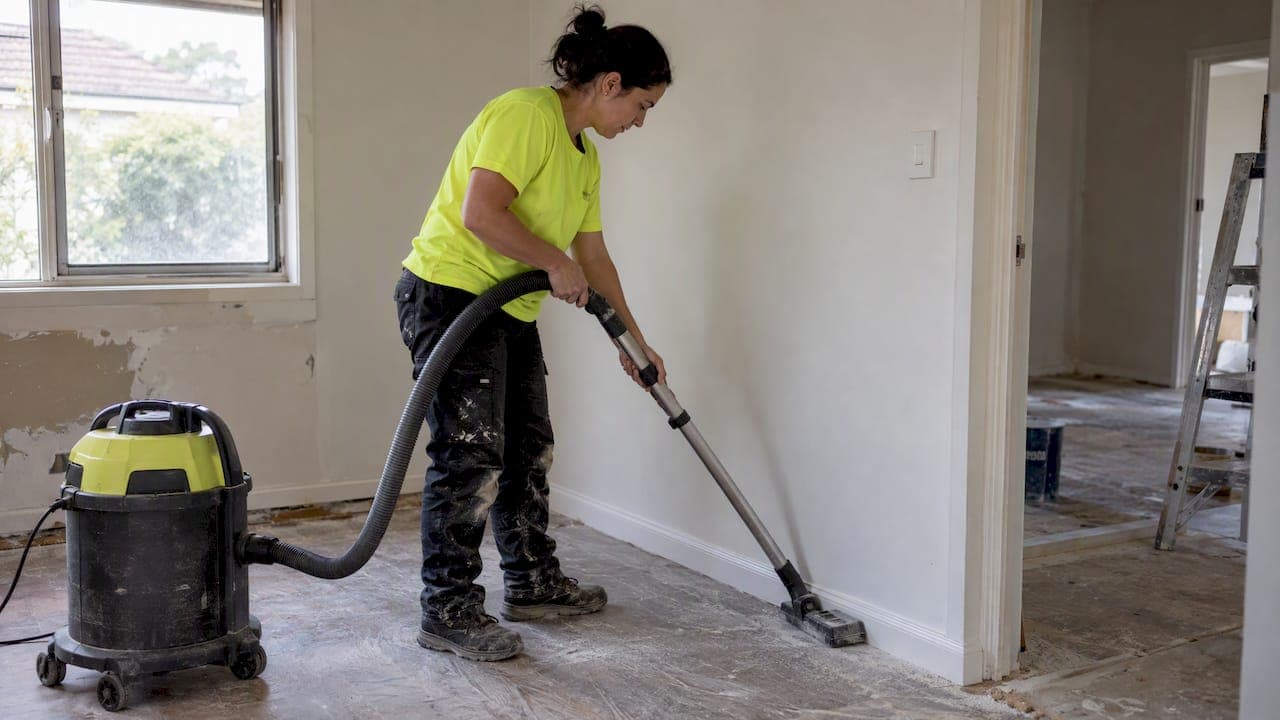
Ventilate the space and let fine particles settle for a few hours, then capture dust with a HEPA or M-class vacuum working top to bottom before finishing with damp microfibre wiping and fresh filters. This sequence stops dust resettling and redoing your work twice. If you're dealing with heavy silica dust, suspected asbestos or a tight rental turnaround, call a professional decontamination team instead of tackling it yourself.
TL;DR:
- Where schedules allow, leave the space undisturbed for 12 to 24 hours after work ends, then ventilate before detailed cleaning.
- Use a certified HEPA or M class vacuum from ceilings down to floors, then dry wipe and damp wipe; never wet clean first.
- Replace HVAC filters after cleaning and run portable HEPA air cleaners for 24 to 72 hours to capture remaining airborne particles.
- Stop work and contact a licensed assessor if asbestos is suspected; hire a professional team for heavy silica dust or a tight rental turnaround.
- Before booking a cleaner, confirm in writing that the scope includes hidden joinery, HVAC filter changes, and a photographic or written handover report.
Table of Contents
- Why construction dust is different and why sequence matters
- Step-by-step cleaning method: preparation, dry capture, detailing and final finish
- Tools, equipment and personal protection you should use
- Safety and legal considerations: silica, asbestos and lawful waste handling
- When to hire professional cleaners and what their scope should include
- Printable final checklist for a single-pass finish
- Practitioner perspective and what Grime Scene Services does differently
- Detailed health risks of post-construction dust exposure to occupants
- Effectiveness and benefits of our eco-friendly cleaning agents compared to traditional chemicals
- Maintenance tips to prevent dust resettlement after cleaning
- Differences in cleaning protocols for residential versus commercial sites post-construction
- A note on getting this right
- How to book our team for your post-construction clean
- FAQ
- Sources
Why construction dust is different and why sequence matters
Renovation and build sites generate dust unlike household grime. Gypsum from plasterboard, cement fines and crystalline silica from cutting tiles, concrete or stone break down into particles small enough to stay suspended in the air for hours, drifting back onto surfaces long after trades have packed up. That's why a clean room can look dusty again the next morning.
Dry sweeping or running a standard household vacuum over this kind of residue often makes things worse. General vacuums aren't sealed against fine particulate, so they can exhaust dust straight back into the room through the motor housing, spreading it onto surfaces you've already wiped down.
A few habits make the difference between a clean that holds and one that needs repeating:
- Let the space sit undisturbed for several hours after works finish so airborne dust has time to settle.
- Open windows and doors to encourage cross-ventilation before you start detailed cleaning.
- Work from the top of the room down, since gravity will otherwise redeposit dust on plantation shutters for owners on surfaces you've already cleaned.
- Capture dust before you introduce any moisture, because wet gypsum smears instead of lifting away.
Step-by-step cleaning method: preparation, dry capture, detailing and final finish
A post-construction clean goes wrong when steps are skipped or done out of order. Following a fixed sequence, whether you're doing it yourself or briefing a cleaner, keeps the job efficient and avoids double handling.
- Prepare the space. Clear bulky offcuts, packaging and tools first. Seal HVAC grilles and return vents with painter's tape where practical, and isolate the work zone from the rest of the property with plastic sheeting if dust has spread.
- Pause before detailing. Where your schedule allows, leave a gap of 12 to 24 hours after trades finish so the heaviest airborne particles drop out of suspension before you start the fine work.
- Dry-capture from the top. Run a HEPA or M-class vacuum across ceilings, cornices, light fittings, walls, cupboard interiors and joinery before moving to skirtings and floors. Repeat passes over heavily affected surfaces until the dust load visibly drops.
- Dry-wipe high surfaces. Use an electrostatic duster or dry microfibre cloth on shelves, window frames and fittings to lift residual dust the vacuum missed, working before any damp wiping begins.
- Damp-wipe with a neutral solution. Once dry capture is done, go over the same surfaces with a damp microfibre cloth and a mild, neutral cleaning solution to lift any bonded residue without smearing it.
- Finish floors last. Vacuum floors thoroughly, then follow with a low-pressure damp mop. Mopping too early in the process just pushes dust into corners and grout lines.
- Replace filters and run air cleaning. Swap out HVAC filters and portable air cleaner cartridges, then run portable HEPA units for 24 to 72 hours to pull down any particles still suspended in the air.
- Document the filter change. Note the date and filter type for the property file or handover report, particularly important for rental turnovers.
Pro Tip: Never mop or wet-wipe a surface before it's been vacuumed. Moisture binds fine gypsum dust into a paste that's far harder to remove than dry particulate.
This order matters because each stage removes a layer the next stage can't handle well on its own. Skipping the dry-capture pass and going straight to damp wiping is the single most common reason a post-construction clean needs a second visit.
Tools, equipment and personal protection you should use
Standard household cleaning gear isn't built for construction dust, and using it often just moves the problem around rather than solving it. The right equipment makes the method above achievable in a reasonable amount of time.
- Use an M- or H-class industrial vacuum, or a certified HEPA unit, since general-purpose vacuums aren't sealed to contain fine hazardous particulate and can vent it back into the room.
- Stock plenty of microfibre cloths and flat mop pads, which trap dust rather than just pushing it across a surface.
- Keep an extendable duster on hand for ceilings, cornices and light fittings you can't easily reach.
- Use sealed, heavy-duty waste bags for vacuum contents and disposable wipes rather than open bins.
- Run a low-pressure damp mop system on floors, and set up a portable HEPA air cleaner to run during and after the job.
- Wear a properly rated respirator (P2 or P3 depending on the dust type), safety glasses and gloves whenever you're handling or disturbing settled construction dust.
Safety and legal considerations: silica, asbestos and lawful waste handling
Construction dust isn't just an inconvenience. Respirable crystalline silica, found in concrete, tile and stone dust, is a recognised workplace hazard, and Safe Work Australia's guidance recommends controlling it with engineering measures such as on-tool extraction and M- or H-class vacuums rather than dry sweeping or compressed air.
- Avoid dry sweeping or compressed air on any dust you suspect contains silica, since both methods throw fine particles back into the air.
- Use M- or H-class vacuum extraction wherever cutting, grinding or demolition has occurred, in line with Safe Work Australia's model code.
- If you suspect asbestos, such as in older homes with fibro sheeting, stop work immediately and engage a licensed assessor rather than disturbing the material further.
- Follow NSW EPA guidance on household asbestos for packaging, transport and disposal, since friable asbestos requires sealed containers and licensed handling.
- Keep receipts and any consignment records for waste removal, which protect you if lawful disposal is ever questioned.
Illegal asbestos disposal carries significant penalties under NSW EPA rules, and non-friable material still needs secure packaging even when a licensed removalist isn't legally required. When in doubt about what you're dealing with, treat it as hazardous until a professional confirms otherwise.
When to hire professional cleaners and what their scope should include
Some jobs are reasonable to tackle yourself with the right gear; others aren't worth the risk or the time. Bring in a professional team when there's visible silica-heavy dust, any possibility of asbestos, a tenancy turnover with a hard deadline, or when the brief calls for a forensic-level finish rather than a general tidy-up.
A proper professional scope should include:
- HEPA or M-class vacuuming across every surface, not just floors and visible areas.
- Targeted extraction in cupboards, behind fittings and inside joinery where dust accumulates unseen.
- Damp finishing once dry capture is complete, using a neutral, non-abrasive solution.
- HVAC filter changes as part of the job, not as an optional extra.
- A photographic or written handover report confirming the work completed.
A small apartment might take a few hours; a larger or multi-storey property can need a full day or staged visits across a week. Get the scope confirmed in writing before booking so there's no ambiguity about what's included.
Printable final checklist for a single-pass finish
Run through this order for a final pass, whether you're doing the work or checking a cleaner's output before handover:
- Ventilate the space.
- Vacuum high surfaces (ceilings, fittings, cupboard tops).
- Dry-wipe high surfaces.
- Vacuum skirtings and joinery.
- Vacuum floors.
- Damp-mop floors.
- Change HVAC and air cleaner filters.
- Photograph vents, cupboards, windowsills and light fittings as proof of completion.
- Dispose of waste and filters lawfully, retaining receipts for the file.
Practitioner perspective and what Grime Scene Services does differently
We follow a detailed sequencing protocol using HEPA and M-class equipment and targeted extraction in overlooked spots, and provide a photographic handover report, with rapid-response options available for tight tenancy deadlines.
Detailed health risks of post-construction dust exposure to occupants
Fine dust left behind after renovation isn't just cosmetic. Respirable particles, especially silica from cut stone, tile or concrete, can irritate the airways when inhaled repeatedly, and ongoing exposure to construction dust is a recognised concern in workplace health guidance because of how deeply the finest particles settle in the lungs.
Occupants moving back into a freshly renovated space, particularly children, older residents and anyone with asthma or another respiratory condition, are more sensitive to airborne irritants than a tradesperson wearing a respirator during the works. Gypsum dust and general building debris can also trigger eye and skin irritation on contact, and settled dust that gets disturbed again, through foot traffic, HVAC airflow or a draught, simply re-enters the air and extends the exposure window.
This is part of why the Department of Health's indoor air quality guidance recommends regular dust removal and HVAC filter maintenance generally, and it matters even more directly after a renovation, when dust loads are far higher than normal household levels. Running portable HEPA air cleaners for a day or more after the physical clean helps bring airborne particle counts down before anyone moves back in full-time. Waiting out the settle period before deep cleaning, then capturing dust properly rather than redistributing it, is the most reliable way to protect the people who'll actually be living in the space.
Effectiveness and benefits of our eco-friendly cleaning agents compared to traditional chemicals
Harsh chemical cleaners are often reached for after a renovation because construction residue looks stubborn, but strong solvents and bleach-based products don't address the real problem: fine particulate sitting on and embedded in surfaces. Chemicals can strip a surface or mask odour, but they don't replace proper dry-capture vacuuming, and residue from harsh products can leave its own film that needs a second clean to remove.
We use non-toxic, bleach-free agents formulated to lift bonded dust and light residue during the damp-finishing stage without leaving chemical traces behind, which is important for homes with children, pets, or occupants with respiratory sensitivities. Our agents do not rely on strong fumes, so there is no lingering chemical smell competing with other scents often present after a build.
The sequencing still does the heavy lifting: dry capture first, damp finishing second. Our eco-friendly agents are the finishing step in that process, not a substitute for it, which is why we pair them with HEPA and M-class equipment rather than treating the cleaning solution as the whole solution.
Maintenance tips to prevent dust resettlement after cleaning
A clean finish after construction doesn't stay that way automatically, especially in the weeks immediately after trades leave. Dust that's settled in wall cavities, subfloors or ceiling spaces during the build can continue to work its way out for some time.
Keep portable HEPA air cleaners running for the first few days after occupants move back in, particularly in bedrooms and living areas where people spend the most time. Change HVAC and air cleaner filters again sooner than usual, since the first replacement after a build will likely load up faster than a normal household filter cycle. Vacuum floors and skirtings more frequently than usual for the first month, since foot traffic across recently settled dust is one of the main ways it gets stirred back into the air.

Avoid dry sweeping or shaking out mats and rugs indoors during this period, since both actions redistribute fine dust rather than removing it. A door mat at every entry point helps reduce dust being tracked back in from an unfinished exterior or garden area, a simple step the Department of Health's indoor air quality guidance also points to for everyday dust control. If you've used a professional team for the initial clean, ask whether a short follow-up visit two to three weeks later is worth scheduling, since that's often when residual dust from cavities finishes working its way out.
Differences in cleaning protocols for residential versus commercial sites post-construction
Residential and commercial post-construction cleans share the same underlying method, but the scale and constraints differ enough to change how the job is run. A residential clean usually covers a contained footprint, often a single dwelling, and can be scheduled around when occupants plan to move back in, which gives more flexibility for the 12 to 24 hour settle period before detailing begins.
Commercial sites, such as a fitted-out office or retail tenancy, tend to involve larger floor areas, more complex HVAC systems serving multiple zones, and tighter deadlines tied to lease handover or opening dates. That often means staging the clean across multiple visits rather than a single pass, and coordinating HVAC filter changes across more units. Commercial jobs also more frequently involve specialised flooring, partition glass and signage that need their own handling, on top of the standard top-to-bottom dust capture sequence.
Documentation expectations differ too. A commercial handover more often requires a written or photographic report for a managing agent or head tenant, while a residential clean's handover is usually simpler and informal unless it's an end-of-lease situation. In both cases, though, the core sequence, ventilate, dry-capture top to bottom, detail, then damp-finish, stays the same; only the scale, staging and paperwork around it change.

A note on getting this right
Most of the post-construction cleans that need a second visit fail at the same point: someone reaches for water or a chemical spray before the dry-capture pass is finished. It's an understandable instinct, dust looks like it needs wiping away, but on gypsum and silica particulate it does the opposite, binding dust into a film that's genuinely harder to shift than the original dry residue.
The other pattern worth naming is underestimating ventilation. A few hours of open windows and a settle period before detailing isn't a delay, it's the step that stops you chasing the same dust around a room for a whole afternoon. Treat the sequence as non-negotiable rather than optional, and the rest of the job gets considerably easier.
— Lead
How to book our team for your post-construction clean
Once the heavy dust settles and you'd rather hand the detail work to someone else, our Post-Construction Sweeps cover the full top-to-bottom sequence, HEPA and M-class vacuuming, targeted extraction and damp finishing. For silica-heavy sites we run Deep Decontamination, and for tight tenancy deadlines our Rapid Response (2-Hour Tactical Clean) gets a space turnover-ready fast, while The Scene Reset is built specifically for short-term rental handovers.

Before booking, have your scope, a few photos of the space, access details and your preferred time window ready. Browse the full service scope or head straight to appointments to lock in a time.
FAQ
What is the 20 minute rule in cleaning?
The 20 minute rule generally refers to tackling a cleaning task in short, focused bursts rather than letting mess build up, a habit-forming approach more suited to everyday tidying than post-construction dust removal. For construction dust specifically, stick to the full top-to-bottom sequence rather than a timed burst, since partial cleaning tends to resettle.
What is it called when you clean up after construction?
This stage is usually called a post-construction clean, and it often happens in phases: a rough clean to clear debris and packaging, followed by a final clean once trades have finished. Some projects also include a touch-up clean closer to move-in to catch dust that's resettled.
What do professional cleaners dust with?
Professional post-construction cleans rely on HEPA or M-class vacuums for capture, followed by microfibre cloths and pads for dry and damp wiping. Our own protocols add non-toxic, bleach-free solutions at the damp-finishing stage to lift residue without leaving chemical traces behind.
How do I clean walls after renovation?
Start by dry-vacuuming walls from top to bottom with a HEPA or M-class vacuum to lift loose dust before it has a chance to smear. Follow with a dry microfibre wipe, then a damp wipe using a neutral solution, working in the same top-to-bottom order.
Should I hire a professional for post-construction dust removal?
Hire a professional when there's heavy silica dust, any suspicion of asbestos, or a rental turnover with a tight deadline, since these situations call for certified equipment and documented handover. For a smaller, low-risk job, the step-by-step method above is manageable yourself with the right HEPA or M-class vacuum and PPE.
Sources
- Managing risks of respirable crystalline silica — Safe Work Australia (model Code of Practice, Aug 2025)
- Dealing with household asbestos — NSW Environment Protection Authority
- Indoor air quality — Australian Government Department of Health