
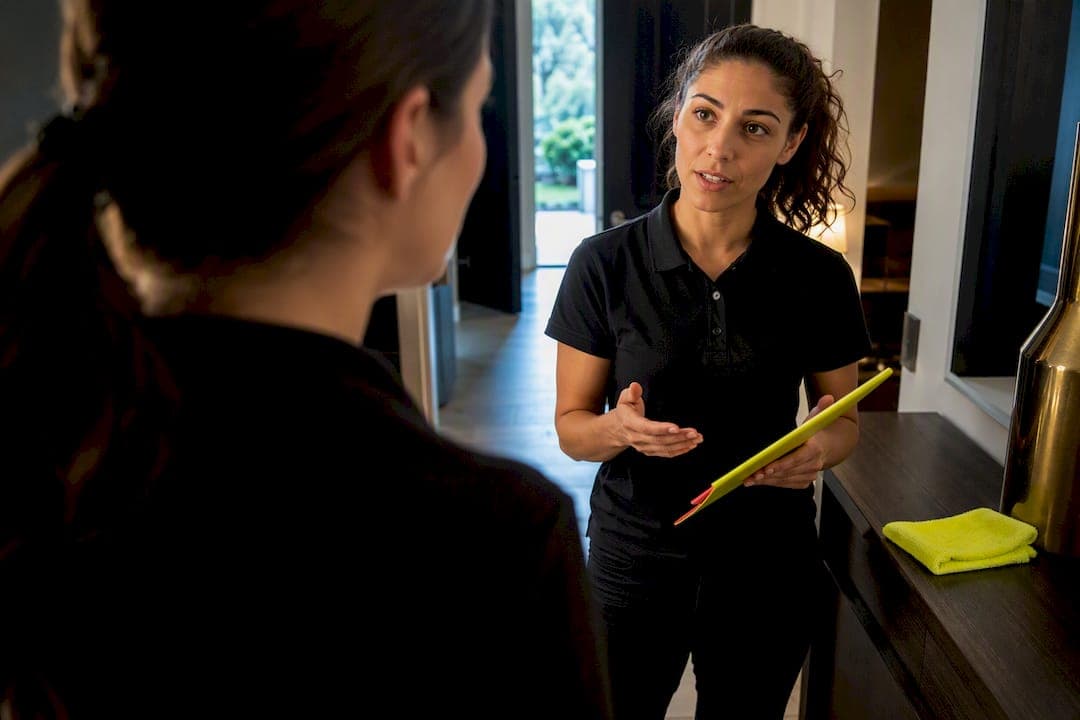
Before hiring anyone, confirm five things: proof of insurance and background checks, an itemised scope with clear pricing, their supplies and health accommodations, how they handle scheduling and access, and a written satisfaction guarantee with real references. Asking these questions upfront protects your home, your health and your budget. Each one below comes with what a solid answer actually sounds like.
TL;DR:
- Verify that the cleaning company carries at least $5 million in public liability insurance and confirms coverage for staff or subcontractors before hiring.
- Ensure the quote clearly lists included services, specifies if pricing is hourly or flat-rate, and asks about potential surcharges for heavy build-up or first-time cleanings.
- Confirm that providers can accommodate health needs with hypoallergenic products, color-coded cloths, and allow you to supply your own supplies if necessary.
- Request detailed information on scheduling, access procedures, key management, and cancellation policies to prevent misunderstandings or security issues.
- Obtain a written satisfaction guarantee detailing the process and timeframe for addressing missed spots or damage, and prepare your home by decluttering and clarifying priorities before the first visit.
Table of Contents
- The interview-ready checklist: questions to ask cleaners
- Vetting and safety: the paperwork worth demanding
- Pricing and scope: reading a quote properly
- Supplies, chemicals and health preferences
- Scheduling, access and key management
- Guarantees and what happens if something goes wrong
- Getting your home ready before the first visit
- Our perspective: what we prioritise when we take a booking
- How Grime Scene Services answers the checklist
- Sources
The interview-ready checklist: questions to ask cleaners
Run through these before you book anyone. Say them out loud on the phone, paste them into an email, or read them off your screen. It doesn't matter how you ask, only that you get real answers before money changes hands.
-
Are you insured, and can I see a certificate of currency? This is non-negotiable. A legitimate operator should carry public liability insurance and workers' compensation, and hand over proof without hesitation. Green flag: they email a current certificate within the hour. Red flag: "we've never had a claim" as a substitute for paperwork.
-
Do you run background checks on your staff? Someone is going to be alone in your house with your jewellery box a metre away. A company that vets its people will say so plainly and explain how often checks are renewed. Vague answers here are a dealbreaker.
-
Do you bring your own supplies and equipment, or do I need to provide them? This affects both price and liability. Good answer: "We bring everything, including eco-friendly options if you need them." Red flag: an extra fee appears for supplies nobody mentioned at quoting stage.
-
What exactly is included in a standard clean versus a deep clean? Ask for the task list, room by room. A company confident in its process will have this written down already, not invented on the spot.
-
How do you price, hourly or flat rate? Both models are normal, but you need to know which one you're getting quoted before you compare providers.
-
Is there a surcharge for the first clean? Many companies charge more for an initial visit because the home's condition is unknown. Reasonable. What's not reasonable is discovering this fee after the job's done.
-
Will the same person or team attend every time? Consistency matters more than people expect. A cleaner who knows your home skips the second-guessing and works faster.
-
How do you handle keys or door codes? Ask whether keys are labelled, logged, and stored securely, or if there's a lockbox system. Sloppy answers here should worry you.
-
What's your satisfaction guarantee? Ask specifically what happens if something's missed. A re-clean policy with a defined timeframe is the standard to look for.
-
Can you provide references or reviews I can actually check? Not a testimonial pasted on their homepage. Names, or verifiable third-party reviews on Google or similar platforms.
Between the vetting questions and the pricing ones, you've covered the same territory the top consumer guides recommend, including estimated time on site and whether a written contract is offered.
Vetting and safety: the paperwork worth demanding
Insurance is where corners get cut, because it's invisible until something goes wrong. Ask for a current certificate of currency covering public liability and workers' compensation, and don't just glance at it. Industry guidance points to $5 million in public liability cover as a sensible benchmark for a residential cleaning operation.
Verification matters as much as the request itself. Check the effective and expiry dates on the certificate, and confirm the insurer's details independently rather than taking a verbal assurance at face value, since policies can lapse or change without notice.
One more layer: ask whether staff are employees or subcontractors. Subcontracting isn't automatically a problem, but it can create coverage gaps if the sub isn't separately insured, and it's worth asking directly how that's managed.
Pricing and scope: reading a quote properly
Hourly pricing suits smaller, irregular jobs. Flat-rate pricing suits recurring cleans where the scope is settled. Neither is a red flag on its own, but you should know which one you're being quoted.
Watch for common add-ons that inflate the final bill:
- First clean surcharges for homes with unknown or heavier build-up.
- Public holiday rates, often 1.5 to double the standard fee.
- Heavy-condition fees for excessive grime, pet hair, or neglected bathrooms.
- Add-on tasks like inside-oven cleaning or window tracks, priced separately.
The fix is simple: ask for an itemised scope of work, not just a total dollar figure. When comparing two quotes, line up what's actually included, not just the bottom number. A $180 quote covering everything beats a $140 quote that adds $60 in surcharges once the cleaner is standing in your kitchen.
Supplies, chemicals and health preferences
If anyone in the house has allergies, asthma, or a crawling toddler, this section matters more than price. Ask for a written product list before the first visit and request hypoallergenic or fragrance-free alternatives if you need them. Most established providers can accommodate this without fuss.
- Request the full product list, not just "we use eco-friendly stuff."
- Ask whether they use colour-coded cloths to stop bathroom and kitchen cross-contamination.
- Confirm whether you're allowed to supply your own products, and how that affects pricing or liability.
- Check if fragrance-free options exist for pet or asthma-sensitive households.
Some providers, including partners like ZERO's compostable cleaning cloths, are shifting toward plastic-free supplies as a baseline, not an upsell.
Pro Tip: Take photos of anything valuable or fragile before the first visit, and mention allergy triggers by name (dust mites, specific fragrances) rather than saying "sensitive skin," which is too vague for a cleaner to act on.
For more detail on hypoallergenic product swaps, see our guide to allergy-safe home cleaning.
Scheduling, access and key management
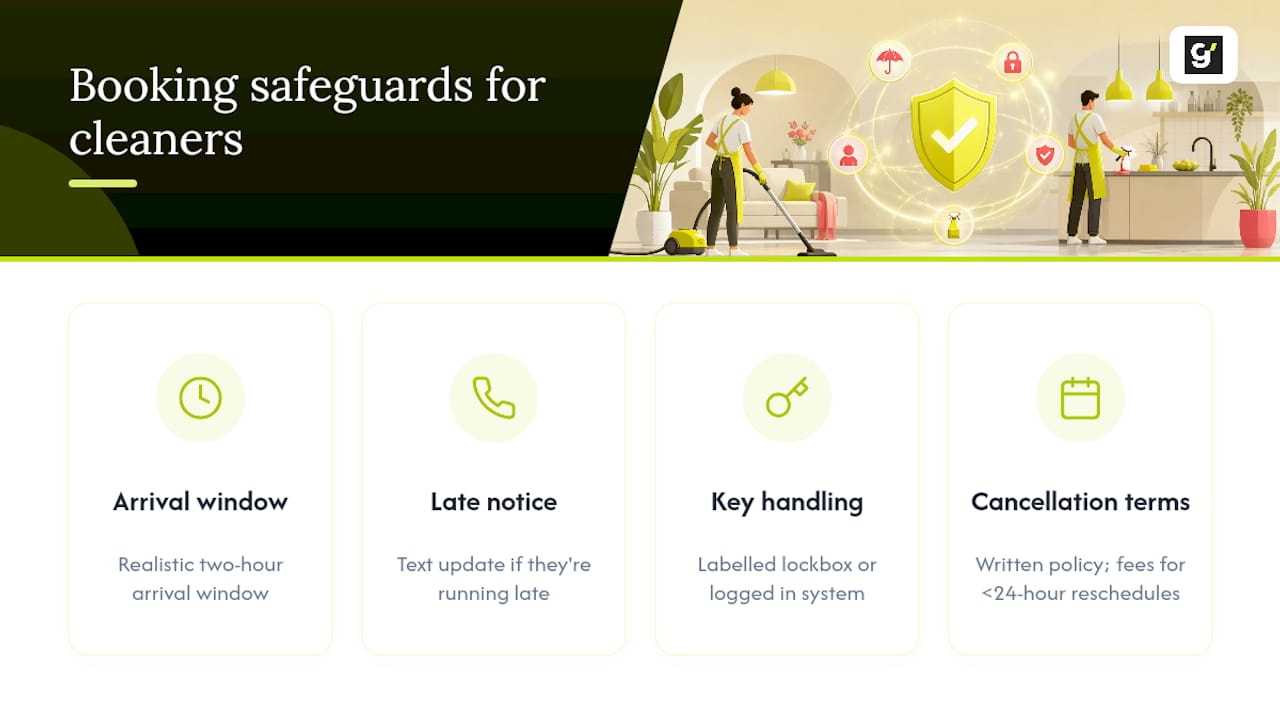
Ask for a realistic arrival window, not just "morning" or "afternoon," and find out how you'll be notified if they're running late. A two-hour window with a text update beats a vague promise every time.
Key handling deserves a direct question: is it stored in a labelled lockbox, logged in a system, or handed between staff informally? The looser the answer, the more you should worry.
Finally, get the cancellation policy in writing, including notice periods and any fee for rescheduling within 24 hours. Fair companies waive this for genuine emergencies but will still have a clear default rule.
Guarantees and what happens if something goes wrong
Ask whether a satisfaction guarantee exists and how long you have to report a missed spot or damaged item. Many providers offer a free re-clean within 24 to 48 hours of the original appointment, which is a reasonable industry standard to expect.
Push for specifics on remedy: is it a re-clean, a partial refund, or a service credit? And how is accidental damage handled, insurance claim, direct compensation, or something vaguer? Get this policy in an email or on their booking confirmation, not as a verbal promise. If a dispute ever comes up, you want a paper trail, not a memory of what someone said on the phone.
Getting your home ready before the first visit
A little prep avoids surprise fees and awkward first impressions. Clear obvious clutter, secure pets somewhere calm, and put away anything fragile or irreplaceable you'd rather a stranger not touch.
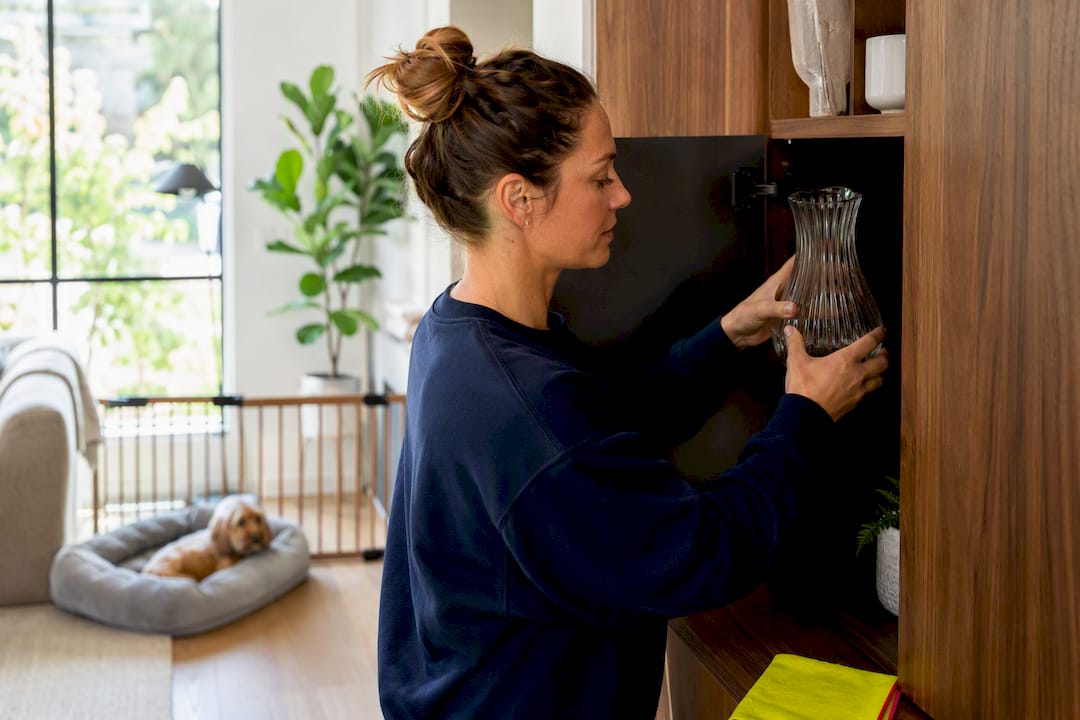
Write down your priorities before the visit, a simple room-by-room list works, and share it with the cleaner in advance rather than reciting it at the door. If there are no-go areas (a home office, a locked room), say so clearly and get it confirmed back to you in writing.
For a fuller walkthrough, our guide on preparing your home for professional cleaning covers the details room by room.
Our perspective: what we prioritise when we take a booking
We ask clients to confirm three things before any job starts: verified insurance on our end, a written scope of what's included, and any health or product preferences upfront. That last one matters more than most companies admit, we run our Scene Reset protocol using non-toxic, bleach-free agents specifically because homes have kids, pets, and people with sensitivities, not just surfaces.
The checklist above isn't a formality. It's how you tell the difference between a company that talks a good game and one that backs it up in writing. Use it on every provider you call, including us.
— Lead
How Grime Scene Services answers the checklist
If you've worked through the questions above, you already know what to look for: verified insurance, a written scope, clear product policies, and guarantees you can hold someone to. Grime Scene Services builds its bookings around exactly that structure, with an eco-friendly, non-toxic approach instead of harsh chemicals masking the problem.
Every job starts with a written, itemised quote so there are no surprise fees buried in the fine print. Our product policy is upfront too, with options for fragrance-sensitive households on request. Short-term rental hosts get a turnover protocol designed to protect ratings between guests, and it's worth a look if you manage a rental property. For a full remediation job, the place to start is our deep decontamination service, where you can request a written quote before committing to anything.
Sources
Insurer guidance on cleaner cover, Amherst Cleaning's hiring checklist, North Shore Mums' must-ask list, and Angi's 17-question guide.
- Compare the Market: Business insurance for cleaners
- Questions to ask a house cleaning service before hiring (Amherst Cleaning Services)
- 17 Questions to Ask House Cleaner Before Hiring | Angi