
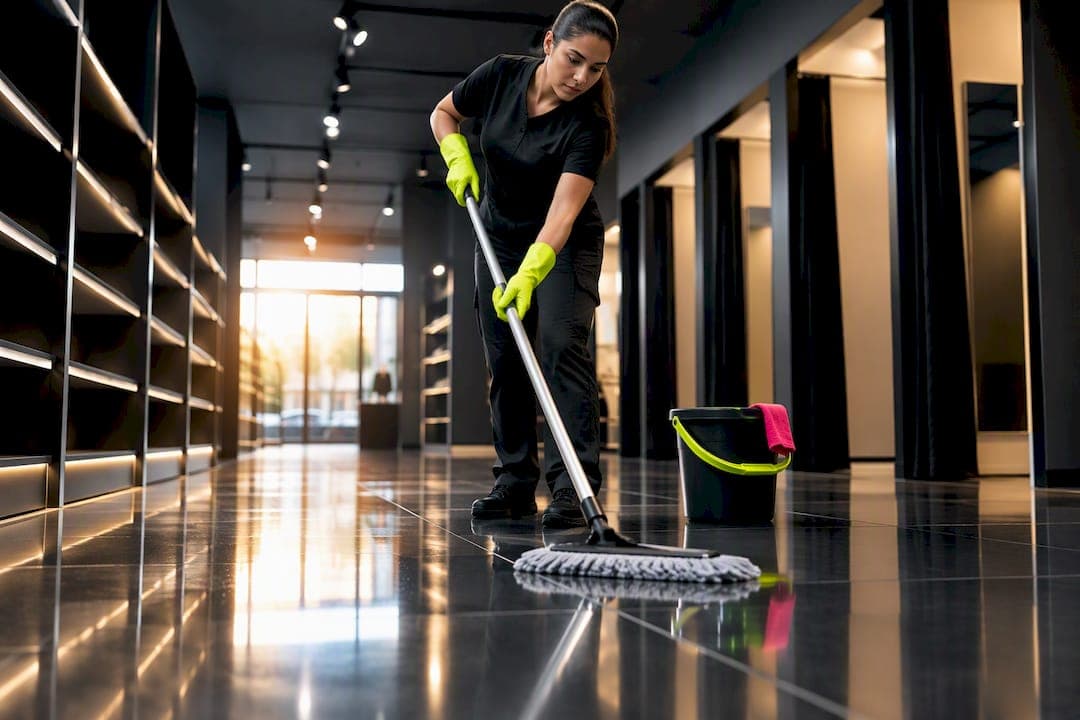
A workable green retail cleaning checklist covers five things: clean before you disinfect, schedule frequently touched surfaces several times a day, keep safety data sheets and labels current, never top up or mix products, and log every task with a name, product and time. Sanitise the POS terminal, damp dust display shelving and restock hand sanitiser this shift. The sections below cover scheduling by zone, chemical safety and staff training in full.
TL;DR:
- Cleaning before disinfecting is essential, especially on visibly dirty surfaces, to ensure disinfectants work effectively within their required contact time.
- Maintaining an up-to-date SDS register and storing chemicals in original, labeled containers prevents inspection failures and hazards from untracked or unidentified substances.
- Staff must be consistently trained on proper green product use, PPE requirements, spill response, and documenting tasks with full logs to ensure compliance and safety.
- Proper scheduling, logging, and audit trails for high-touch areas prove routine adherence and help pass safety reviews, emphasizing the importance of detailed record-keeping.
- Using eco-certified, third-party verified products, paired with low-impact cleaning techniques and waste segregation, maximizes environmental benefits without compromising hygiene standards.
Table of Contents
- The green retail cleaning checklist by zone and frequency
- How to clean before you disinfect, and what products actually work
- Managing SDS, labelling and chemical storage in a retail workplace
- Training staff and setting PPE rules for a green cleaning policy
- Scheduling, logging and proving the routine is followed
- How Grime Scene Services applies this checklist in a live retail store
- Waste management and recycling during the cleaning routine
- Energy and water efficient cleaning techniques for retail floors
- Reducing indoor air pollution while cleaning a retail store
- Keeping safety and hygiene standards high without cutting green corners
- Where retailers get green cleaning wrong
- A professional option for stores that want this handled
- Where this checklist's guidance comes from
- Sources
- FAQ
The green retail cleaning checklist by zone and frequency
Retail cleaning fails audits for one reason more than any other: tasks get done, but nobody can prove when or how. Mapping each zone to a frequency band fixes that before it becomes a problem.
Entry and front-of-house gets the heaviest traffic and the shortest cleaning interval.
- Wipe door handles, handrails and counter edges multiple times daily, since these are classic frequently touched surfaces.
- Vacuum or shake entry mats daily and launder them regularly.
- Damp wipe customer-facing counters between service peaks, not just at open and close.
POS and electronics need a clean-then-disinfect approach rather than a spray-and-wipe habit, because screens and keypads hold grime that a disinfectant alone won't shift.
- Power down or lock the screen where the product label requires it.
- Damp wipe with a microfibre cloth and a screen-safe detergent to lift grease and fingerprints.
- Apply a disinfectant rated for electronics, respecting the listed contact time.
- Dry with a separate cloth to avoid streaking or residue build-up.
Bathrooms are the highest-risk zone in any retail floor plan. Clean fixtures, taps and door handles multiple times a day, check exhaust ventilation is running, and restock soap and paper towel before they run out rather than after.
Display shelving, mirrors and soft furnishings carry a lower touch frequency but a higher visibility cost. Dust shelving and mirrors daily with a dry or lightly damp microfibre cloth. Steam clean upholstered seating or fitting-room furniture weekly, and reserve full dry cleaning for heavily soiled fabric.
Stockroom and back-of-house areas are where compliance quietly breaks down. Never decant cleaning concentrate into an unlabelled spray bottle. Sweep and mop floors daily, and keep a spill kit within reach of any area where chemicals are stored or used.
How to clean before you disinfect, and what products actually work
Clean first, disinfect second, because dirt, grease and organic residue reduce a disinfectant's effectiveness on contact, regardless of how strong the product is. This two-step approach removes soil with a detergent, then applies a disinfectant to the now-clean surface for its full listed contact time.

A combined detergent/disinfectant product is an acceptable shortcut on hard surfaces that aren't visibly soiled, which is why many retailers reach for combined wipes on POS terminals and handrails between full cleans. Save the full two-step process for anything visibly dirty, like a spill-marked counter or a grubby fitting-room door handle.
Check that any disinfectant used carries a current TGA listing, and follow the label's stated contact time exactly. Wiping it off early is one of the most common ways a "clean" surface still fails a swab test. Damp dusting, rather than a dry cloth, also keeps particles from becoming airborne instead of removed.
Managing SDS, labelling and chemical storage in a retail workplace
Once a domestic cleaning product is used at retail scale, rather than around a single household, it can trigger workplace obligations that a supermarket-bought spray bottle never carries at home. Retailers should check whether a safety data sheet is required for anything used beyond typical household volumes, and keep a simple SDS register with a folder or shared drive entry for every product on site.
- Keep every container in its original packaging with its original label; a "top up" into an unlabelled bottle is a common cause of failed inspections.
- Store incompatible chemicals separately, use a spill tray or bund under stored containers, and inspect storage areas regularly for damaged packaging or leaks.
- Dispose of expired or unidentified containers rather than keeping them "just in case".
Pro Tip: Laminate a simple label template with product name, hazard pictogram and SDS reference number, and tape it to every refill station so nobody reaches for an unmarked bottle.
A basic spill kit belongs in every stockroom: absorbent granules or pads, gloves, a disposal bag and eye protection, following Safe Work Australia guidance on chemical storage risk. When a spill happens, isolate the area first, then contain and absorb the spill, then dispose of contaminated material according to the SDS before reopening the space to customers.

Training staff and setting PPE rules for a green cleaning policy
A green product is only as safe as the person using it. Staff need training on product use, how to read an SDS, spill response and correct PPE, refreshed on a set schedule rather than once at induction.
- Match gloves and eye protection to the product label and SDS, adding respiratory protection only where the SDS specifically calls for it.
- Use wet dusting instead of dry sweeping to stop fine dust from becoming airborne.
- Set a fixed dilution ratio for concentrates and ban topping up containers, since mixing residues of different products can trigger harmful reactions.
Retail operators should also maintain a documented emergency clean-up kit and train staff on its use, so a spill response isn't improvised on the day it happens.
Scheduling, logging and proving the routine is followed
A schedule only proves compliance if someone can point to a record. Run a shift checklist for high-touch zones, an end-of-day log for the full floor, a weekly deep-clean task list and a monthly storage and stock audit.
Each log entry needs four fields:
- Staff name.
- Task completed.
- Product used, with its SDS reference.
- Time of completion.
A daily shift checklist paired with a weekly, supervisor-signed spot audit is generally sufficient evidence for most retail workplace health and safety reviews. Keep entries brief but consistent, since a gap in the log reads as a gap in the routine, not just a missed note. When an audit finds a missed task, log the correction and the date it was fixed rather than simply redoing the job silently.
How Grime Scene Services applies this checklist in a live retail store
Some professional cleaning services use non-toxic, bleach-free agents designed to neutralise buildup rather than mask it, which can matter in retail environments where customers and staff share the air all day. A Scene Reset protocol, originally built for short-term rental turnovers, can map closely onto a retail baseline reset: high-touch zones cleaned and disinfected, display and stockroom areas addressed, and the space reported as ready before doors open.
Routine patrol services can cover the daily and weekly cadence a store checklist demands, while deep decontamination and rapid response services provide for monthly deep-clean and unplanned spill scenarios that a rostered staff team may struggle to fit into a trading day. For a manager choosing between running this in-house or contracting it out, the appeal is less about the products used and more about having someone else own the audit trail.
Waste management and recycling during the cleaning routine
Green cleaning falls apart quickly if the waste stream undoes the chemical choices upstream. Separate general waste, recyclables and chemical waste into clearly labelled bins in the stockroom, not just at the back dock, so staff sort correctly during the clean rather than after.
Empty cleaning containers should be triple rinsed where the label allows it, then placed in general recycling, while anything that held a hazardous product goes into chemical waste collection instead of a general skip. Used mopheads, cloths and wipes should be bagged separately if they've contacted a hazardous product, then laundered or disposed of according to the SDS instructions rather than tossed in with general rubbish.
Packaging from consumable restocking, like paper towel wrap and refill pouches, is a bigger waste stream in retail than most managers expect, since restocking happens daily in a busy store. Buying concentrate refills over single-use spray bottles cuts plastic volume significantly across a month of restocking, and it also reduces the number of containers that need SDS tracking in the first place.
Energy and water efficient cleaning techniques for retail floors
A green checklist that burns excess power and water isn't fully green, even if every product on the shelf is non-toxic. Microfibre cloths and mop heads lift more soil per pass than cotton equivalents, which cuts both the water needed for rinsing and the volume of detergent required to finish the job.
Cold or lukewarm water works for the vast majority of retail floor and surface cleaning tasks, since hot water adds an energy cost without improving results on detergent-based cleaning. Reserve hot water for jobs where the product label specifically calls for it.
Dry or low-moisture methods, like dry dusting shelving and using a dry steam cleaner on soft furnishings, use a fraction of the water a full wet clean requires and dry faster, which matters in a store that can't close a fitting room for hours. Running cleaning equipment like vacuums and floor buffers during off-peak power periods, where a store's plan allows it, is a simple way to trim the energy cost of a daily routine without changing a single product on the checklist.
Reducing indoor air pollution while cleaning a retail store
Retail stores run recirculated air through the same HVAC system all day, so anything sprayed into that air during trading hours reaches customers and staff alike. Swap aerosol sprays for pump-trigger bottles or pre-dampened wipes wherever the task allows it, since aerosols disperse fine particles far more widely than a direct-applied cloth.
Wet or damp dusting, rather than dry sweeping or dry dusting, keeps particulate matter from becoming airborne in the first place, which is a meaningful difference in a space with limited natural ventilation.
Run exhaust fans and open loading dock doors during any task that involves a stronger-smelling product, and schedule those tasks for hours when the floor has fewer customers. Choosing verified low-VOC or third-party certified products over anything marketed only as "natural" also matters here, since an unverified natural claim carries no guarantee about what actually goes into the air after use.
Keeping safety and hygiene standards high without cutting green corners
Going green doesn't mean going soft on hygiene standards, and a checklist that treats the two as a trade-off will eventually fail one or the other. The fix is choosing verified products rather than diluting standards: a certified green disinfectant, correctly applied for its full contact time, performs the job a harsher product would, without the residue.
Test any new green product on a small, low-visibility surface before rolling it out storewide, checking for streaking, discolouration or residue before committing a whole department to it. A staged pilot in one store or department, with before-and-after checks and staff feedback, catches problems before they show up across an entire chain.
Treat any product marketed only as "eco" or "natural" with some scepticism until it carries a real third-party certificate, since a label alone proves nothing about what it actually removes or leaves behind. A showroom or display cleaning routine built around dry, low-residue methods protects delicate stock without introducing chemical risk near merchandise customers handle directly.
Where retailers get green cleaning wrong
Most retail green cleaning advice treats "eco-friendly" and "compliant" as separate boxes to tick, when they're the same box. The checklist above only works because the sequencing, cleaning before disinfecting, is a safety requirement first and an environmental one second: it means a milder product gets a fair chance to do its job instead of being asked to cut through grime it was never suited for.
The bigger failure isn't the product choice. It's the paper trail. A store can run entirely certified, non-toxic products and still fail an audit because nobody logged who cleaned what and when. Prioritise the log before the label. A consistent shift checklist with a name, product and time attached will carry a store through a workplace safety review far more reliably than a shelf full of certified sprays with no record behind them.
If there's one place to start this week, it's the SDS register and the storage area, not the product cupboard. Most gaps found in practice sit there, not in the choice of detergent.
— Lead
A professional option for stores that want this handled
Running this checklist in-house works, but it takes a rostered team, a maintained SDS register and someone checking the logs every week. Grime Scene Services' non-toxic, bleach-free protocols cover that same ground, from routine patrols through to deep decontamination, with before-and-after reporting built in.
For ongoing coverage, the Routine Patrol and related services handle daily and weekly zones, while PREMIUM CLEAN, DEEP DECONTAMINATION and FINAL CASE cover deeper resets. Need something faster, look at Rapid Response and the Perimeter Sweep for a same-day baseline clean. Request a quote with your floor size and current cleaning frequency, and Grime Scene Services will scope a schedule from there.
Where this checklist's guidance comes from
The cleaning sequence and frequency guidance above draws on Australian Government routine environmental cleaning advice, which sets out the clean-before-disinfect principle and touch-frequency scheduling. Chemical storage and labelling rules come from Safe Work Australia's guidance on storing chemicals and Safe Work Queensland's labelling and SDS guidance. Retail-specific hazard controls, including the emergency clean-up kit requirement, come from a dedicated retail sector guidance note.
For SDS documentation practices beyond the retail context, a hazmat SDS guide covers what a compliant sheet should include. Grime Scene Services also publishes a green cleaning rollout guide for stores planning a pilot.
Sources
- Infection Prevention and Control Expert Group guidance on routine environmental cleaning and disinfection in the community
- Safe Work Australia — Managing risks of storing chemicals in the workplace
- Safe Work Queensland guidance on labelling and safety data sheets
FAQ
What is the minimum green cleaning checklist for a small retail store?
At minimum, clean and disinfect high-touch surfaces like door handles and POS terminals several times daily, keep an SDS on file for every product used, and log each task with a staff name and time. Add a weekly deep-clean pass on shelving, mirrors and soft furnishings, and a monthly check of chemical storage and stock levels.
Do I need to disinfect after cleaning, or is cleaning enough?
Cleaning removes dirt and grime, but disinfecting is a separate step needed on frequently touched surfaces to reduce germs that a detergent alone won't address. The government cleaning guidance recommends cleaning first, then disinfecting, or using a combined detergent/disinfectant product on surfaces that aren't visibly soiled.
When does a retail store need a safety data sheet for cleaning products?
A safety data sheet is generally required once a cleaning product is used at a scale or frequency beyond typical household use, which most retail cleaning routines exceed. Check the Safe Work Queensland labelling and SDS guidance for the specific triggers that apply to your products.
How do I know if a cleaning product is genuinely eco-friendly?
Look for a recognised third-party environmental certification rather than relying on marketing terms like "natural" or "green" on the label, since those claims aren't independently verified. A verified environmental standard gives a more reliable read on a product's real impact than the packaging alone.
Can I mix different green cleaning products to save time?
No, mixing different cleaning products, even green ones, can cause harmful chemical reactions and should be avoided. Use each product as directed on its own, and never top up a container with a different batch or product without relabelling it.