
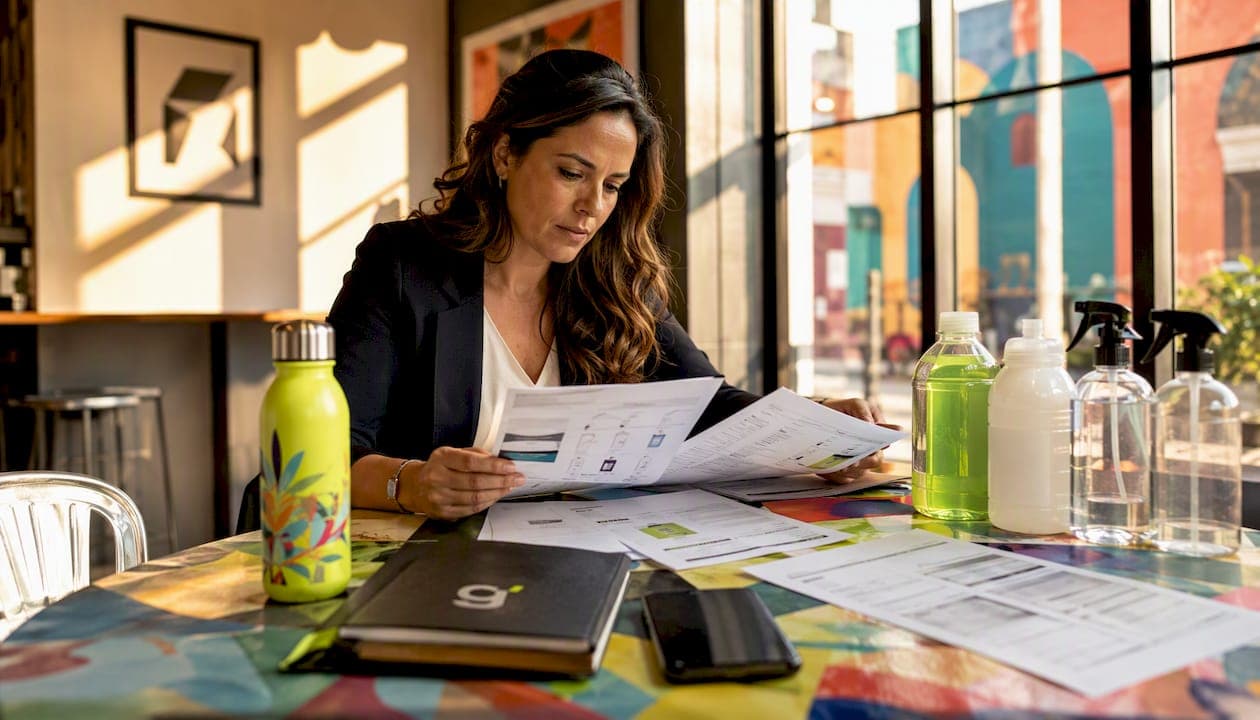
For most Australian facilities, the right answer depends on risk profile, not budget. Low-traffic offices with routine cleaning needs can run a credible in-house green programme using certified products and trained staff. High-touch environments — commercial kitchens, aged care facilities, childcare centres, and post-construction sites — need the verification, equipment, and documented protocols that a professional eco-friendly service delivers.
- Small offices and low-risk retail: In-house green products with staff training and a documented routine are usually sufficient, provided you use commercial-grade formulations (not retail consumer lines) and verify results periodically with ATP swab testing.
- Childcare, aged care, and food-prep areas: Outsource to a certified eco-friendly professional service. These environments carry regulatory obligations and pathogen-control requirements that demand documented SOPs, trained technicians, and verifiable disinfection outcomes.
- Short-term rentals and post-construction sites: A professional service with a structured reset protocol handles the variable soil loads, tight turnaround windows, and presentation standards these settings demand.
- Mid-size commercial sites (hotels, medical offices, large open-plan workplaces): A hybrid works well — in-house green products for daily maintenance, professional service for periodic deep decontamination.
For facilities that need outsourced, non-toxic, bleach-free cleaning with documented outcomes, Grimescene is the recommended professional eco-friendly service option.
Table of Contents
- Fast decision rules for busy facility managers
- What actually makes a cleaning product genuinely eco-friendly?
- How do eco-friendly products perform in commercial settings?
- Which commercial environments gain most from eco-friendly cleaning?
- Australian certification and industry guidance you can actually trust
- What to look for when hiring a green cleaning service
- Three approaches compared: which one fits your facility?
- Costs and timelines: what to budget and how long it takes
- Grimescene in action: a commercial deep decontamination example
- Key takeaways
- The gap between "green" and genuinely verified
- Grimescene's professional eco-friendly cleaning: a faster path to verified results
- Useful sources and further reading
Fast decision rules for busy facility managers
You do not need a lengthy tender process to make a sound initial call. Three questions cut through most of the complexity.
1. What is the risk if cleaning fails? If the answer involves regulatory non-compliance, a vulnerable population, or a food safety incident, outsource to a certified professional service. If the answer is "the office looks untidy," an in-house green programme is proportionate.
2. Do you have trained staff and documented SOPs? Operational outcomes depend less on the brand of product and more on application: correct dilution, adequate contact time, mechanical action, and staff training determine whether eco products meet performance expectations. Without those controls in place, even the best-certified product underperforms.
3. Can you verify the outcome? ATP swab testing and periodic microbial swabs are the standard verification tools. If your team cannot run them or interpret results, a professional service that includes verification in its scope is the lower-risk option.
Decision rule: Choose in-house green products when risk is low and you can train, verify, and document. Choose a professional eco-friendly service when risk is high, compliance is mandatory, or your team lacks the capacity to do it properly.
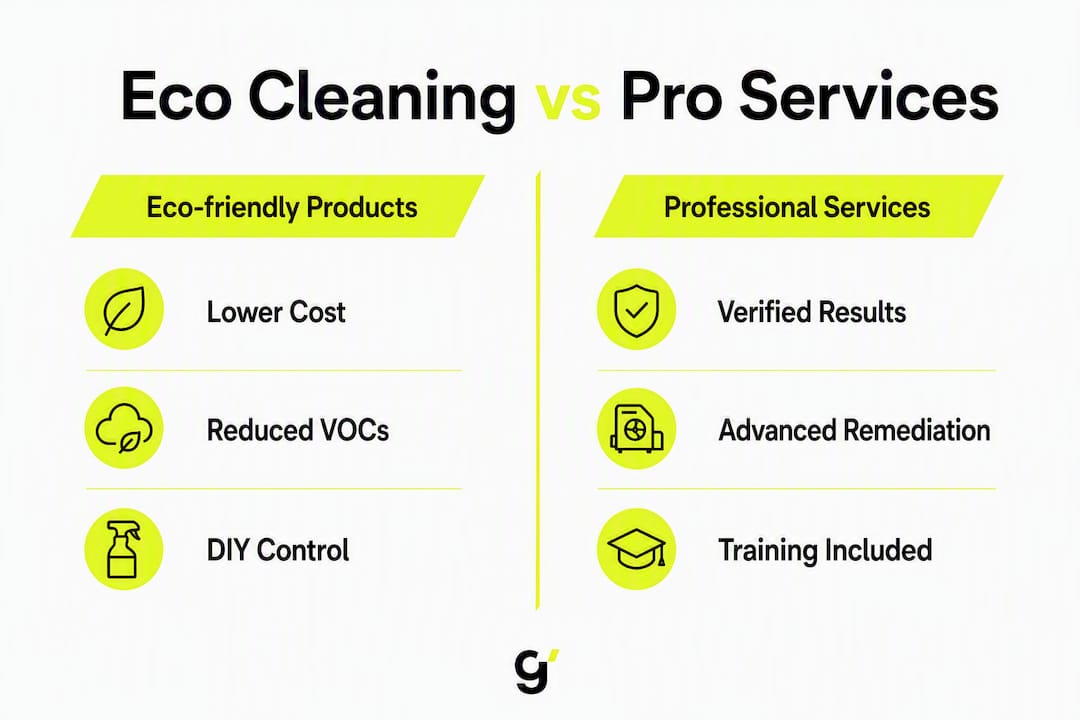
The cost and environmental trade-offs follow the same logic. In-house programmes carry higher upfront costs for dilution systems and training; outsourcing shifts those costs to service fees but removes internal HR overhead and liability exposure. On environmental impact, professional services using concentrates and dosing systems typically achieve better dilution control and lower lifecycle impact than ad-hoc retail purchases.
What actually makes a cleaning product genuinely eco-friendly?
"Green" and "natural" on a label mean nothing without evidence behind them. Greenwashing is common in the cleaning category, and procurement staff who rely on front-of-pack language rather than technical data end up buying products that deliver neither the health nor the environmental benefits they expect.
A genuinely eco-friendly commercial cleaning product has most or all of these attributes:
- Low or zero VOC formulation: — Volatile organic compounds off-gas into indoor air and contribute to respiratory irritation. Green cleaning lowers VOC exposure and reduces health risk when implemented with less toxic products and procedures.
In Australia, the most relevant certification is GECA (Good Environmental Choice Australia), which assesses products against environmental and health criteria and is recognised by government procurement programmes. The Australian Cleaning Industry (ACI) provides industry guidance on sustainable cleaning practices and supplier commitments. Internationally, the US EPA's Safer Choice label and the EU Ecolabel are credible references when evaluating imported products.
Vague claims like "plant-based," "eco," or "biodegradable" without a certifier name and registration number are marketing language, not evidence. Label programmes like EPA Safer Choice and third-party ecolabels aid purchasers precisely because they impose independent verification that self-declared claims do not.
Pro Tip: Request the full SDS and the product technical data sheet before purchasing any commercial cleaning product. The SDS hazard section and the product's dilution ratio together tell you more about real-world safety and cost than any front-of-pack claim.
For a deeper look at the difference between consumer and commercial formulations, the commercial-grade eco cleaning guide covers dilution systems and specification criteria in detail.
How do eco-friendly products perform in commercial settings?
The short answer: for everyday cleaning and indoor air quality, certified green products match or exceed conventional alternatives. For heavy-duty degreasing and hospital-grade disinfection, some conventional chemistries still lead, though the gap is narrowing.
Disinfection and pathogen control
This is where facility managers most often hesitate, and the hesitation is partly justified. Many eco-certified disinfectants carry TGA-listed active ingredients (hydrogen peroxide, citric acid, or quaternary ammonium compounds at lower concentrations) that are effective against a broad spectrum of pathogens when applied at the correct dilution and contact time. The critical variable is contact time: many common cleaning products require more mechanical effort or longer dwell time when switching to non-toxic alternatives. A product that kills 99.9% of listed pathogens in 10 minutes does not perform at that level if it is wiped off in 30 seconds.
For healthcare-adjacent environments, check the product's TGA registration and its listed kill claims against the pathogens relevant to your setting. Where a TGA-listed disinfectant is mandatory (certain aged care and food-handling regulations), confirm the eco product meets that specific requirement before substituting.
Grease, soil, and heavy build-up
Eco-formulated degreasers perform well on light-to-moderate grease in office kitchens and hospitality settings. In commercial kitchen environments with heavy carbonised grease build-up, some conventional alkaline degreasers still outperform their green equivalents on first application. The practical mitigation is pre-soaking, mechanical agitation (microfibre cloths with appropriate scrub pads), and correct dilution. Safer alternatives often require more mechanical effort, but that is a technique issue, not a product failure.
Routine maintenance and indoor air quality
This is where green products genuinely win. Eco-conscious cleaning reduces VOC exposure, improves indoor air quality, and can be cost-neutral if implemented properly. For offices, childcare centres, and any space where occupants spend extended hours, lower VOC cleaning products translate directly into fewer respiratory complaints and better air quality readings. The health and environmental benefits of eco-friendly cleaning are well-documented for everyday cleaning tasks.
Verification: how to confirm outcomes
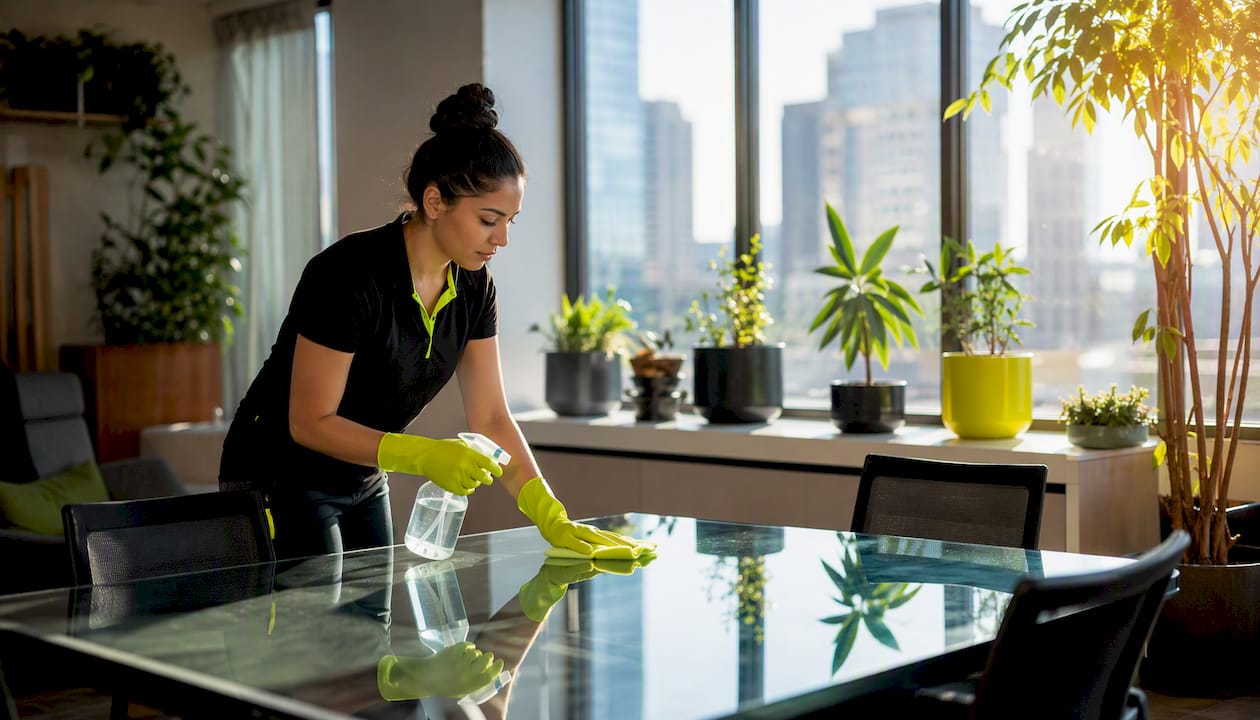
Do not assume a certified product delivers certified results without checking. Standard verification tools include:
- Microbial swab testing: — More detailed than ATP; identifies specific organisms. Useful for food-prep and healthcare-adjacent environments.
Facility buyers should prioritise certificated, commercial-grade formulations and dilution systems rather than retail-branded consumer lines — the performance gap between a commercial concentrate and a supermarket "eco" spray is significant.
Which commercial environments gain most from eco-friendly cleaning?
The answer varies by risk level, occupant vulnerability, and regulatory requirements. The table below maps the three practical approaches to common Australian facility types.
| Facility type | DIY green products | In-house green programme | Outsourced eco-friendly service |
|---|---|---|---|
| General office | Suitable for low-frequency, low-risk tasks | Good fit with trained staff and SOPs | Best for large sites or compliance-driven tenants |
| Childcare centre | Low-VOC products appropriate for surfaces; disinfection needs verification | Viable with documented protocols and TGA-listed disinfectants | Recommended where regulatory audits apply |
| Aged care facility | Not recommended without trained staff and verified SOPs | Viable only with rigorous training, testing, and documented outcomes | Strongly recommended; liability and infection control demands professional oversight |
| Commercial kitchen | Insufficient for heavy grease and food-safety compliance | Viable with commercial-grade degreasers, correct technique, and documented HACCP alignment | Recommended for deep cleans and periodic decontamination |
| Hotel / short-term rental | Suitable for light between-stay maintenance | Workable for in-house housekeeping teams with training | Recommended for turnovers, deep cleans, and post-event resets |
| Medical / dental office | Not suitable; TGA-listed disinfectants required | Viable only with strict protocols and verified kill-rate compliance | Strongly recommended; professional accountability reduces liability |
| Post-construction site | Inadequate for construction dust, adhesive residue, and debris loads | Not practical without specialist equipment | Required; specialist equipment and protocols are non-negotiable |
Caveats worth noting: Aged care facilities in Australia operate under the Aged Care Quality Standards, which include infection prevention requirements. Food businesses operate under the Food Standards Australia New Zealand (FSANZ) Food Safety Standards. Neither framework mandates a specific cleaning product brand, but both require documented procedures and verifiable outcomes — which is why outsourcing to a professional service with SOPs and testing protocols reduces compliance risk substantially.
For a closer look at when remediation-level work is needed versus routine cleaning, the eco remediation vs regular cleaning guide is a useful reference.
Australian certification and industry guidance you can actually trust
Not all ecolabels carry the same weight, and some are self-declared with no independent verification. For Australian procurement, the following are the credible references.
- GECA (Good Environmental Choice Australia): — Australia's primary independent ecolabelling programme, aligned with the Global Ecolabelling Network (GEN). Products certified under GECA have been assessed against criteria covering human health, environmental impact, and performance. Verify current certification at geca.eco — certification status can lapse, so check the register rather than relying on a logo on packaging.
- TGA registration (for disinfectants): — In Australia, disinfectants that make therapeutic claims (killing specific pathogens) must be listed on the Australian Register of Therapeutic Goods (ARTG). For aged care, healthcare, and food-handling environments, confirm the product's ARTG number and its listed kill claims.
The EPA's guidance on greener products recommends Safer Choice and Design for the Environment labels and the use of concentrates with proper handling — the same principles apply when evaluating products for the Australian market.
When verifying a provider or product, request: the current GECA certificate number (check it on the register), the full SDS for each product used, documented staff training records, and evidence of any ATP or microbial testing conducted post-clean.
What to look for when hiring a green cleaning service
A credible eco-friendly cleaning service is not hard to identify if you ask the right questions. Most greenwashed offers fall apart at the first request for documentation.
Vendor evaluation checklist
- GECA or equivalent certification: — Ask for the certificate number and verify it on the relevant register. A provider who cannot supply this is making an unverified claim.
Questions to ask in a vendor interview
- Can you provide the GECA certificate numbers for the products you use on our site?
- What is your process when a post-clean ATP test fails?
- How do you train new staff, and can I see a sample training log?
- What is your microfibre laundering protocol and replacement schedule?
- Can you provide a before-and-after example from a comparable facility?
Red flags
- No SDS available or "we use natural products" without documentation.
- Vague claims ("eco-friendly," "green," "chemical-free") with no certifier named.
- Reliance on consumer retail products (supermarket brands) for commercial jobs.
- No documented SOPs or "we train staff verbally."
- Overuse of products or disinfectants without a protocol — more product does not mean better results, and residue build-up is a common consequence of poor application discipline.
Pro Tip: Ask any prospective provider to walk you through their dilution system on-site before signing a contract. A provider who cannot demonstrate calibrated dosing is likely achieving inconsistent results regardless of what the product label says.
Three approaches compared: which one fits your facility?
| Dimension | Buy green products (DIY) | In-house green programme | Outsource to eco-friendly service |
|---|---|---|---|
| Effectiveness (disinfection) | Variable; depends entirely on staff technique and product selection | Good when SOPs, training, and verified products are in place | High; professional technicians with documented protocols and verification |
| Suitability by environment | Low-risk, low-frequency settings only | Offices, retail, low-to-medium risk commercial | All environments, including high-risk (aged care, food-prep, post-construction) |
| Health and indoor air quality | Improved over conventional if certified products are used | Strong when low-VOC products and correct dilution are maintained | Strong; professional dilution controls minimise VOC and residue exposure |
| Environmental impact | Moderate; retail packaging waste is a significant downside | Better; concentrates and bulk purchasing reduce waste | Best; dosing systems, bulk concentrates, and waste reporting reduce lifecycle impact |
| Cost profile | Low upfront; ongoing cost depends on product selection and waste from incorrect dilution | Moderate upfront (training, systems, products); lower ongoing if dilution is managed | Higher ongoing service fee; eliminates internal labour, HR, and equipment costs |
| Operational practicality | Low; no systems or training investment required | High investment in training, SOPs, and equipment | Low internal overhead; provider manages all operational complexity |
| Compliance and certification | Relies on product certification only; no service-level accountability | Requires internal compliance management and documentation | Provider holds certification and accountability; reduces facility manager's liability |
| Timeline to implement | Days (product swap) | 4–12 weeks for full programme rollout | 2–8 weeks for onboarding, depending on site scale |
| Verdict | Suitable for small, low-risk sites with engaged staff | Best for medium sites with capacity to manage a programme | Best for high-risk, compliance-driven, or large-scale facilities |
By facility type, the typical winner:
- Small office (under 20 staff, low risk): in-house green programme or DIY products.
- Childcare, aged care, medical: outsourced eco-friendly service.
- Commercial kitchen (deep clean cycle): outsourced service for periodic decontamination; in-house programme for daily maintenance.
- Short-term rental / hotel: outsourced service for turnovers and resets; in-house for light daily tasks.
- Post-construction: outsourced service only.
Costs and timelines: what to budget and how long it takes
Budget expectations vary significantly by approach, and the common mistake is comparing only product cost without accounting for labour, training, and verification.
Cost buckets to plan for
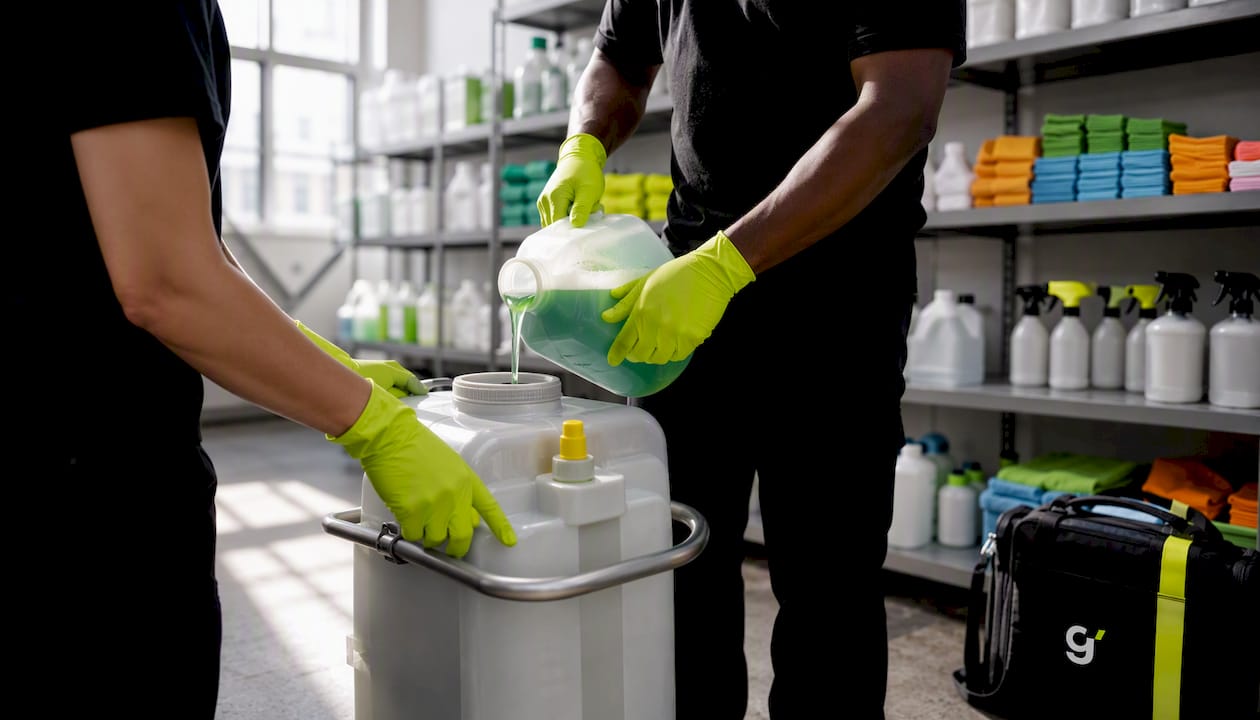
- Product purchase: Commercial-grade certified concentrates cost more per litre than retail equivalents but dilute at ratios that make the per-use cost lower. Concentrates and professional dilution practices reduce per-litre cost and environmental footprint compared to ready-to-use retail bottles.
- Dilution and dosing systems: Wall-mounted or portable dosing units for an office or commercial site typically require a capital outlay, but they pay back through reduced product waste and consistent results.
- Staff training and labour: This is the most underestimated cost in an in-house programme. Training is not a one-off event; it requires refreshers, documentation, and supervision time.
- Testing and verification: ATP meters and consumable test swabs are a recurring cost. Budget for periodic microbial swab testing in high-risk zones.
- Packaging and waste handling: Bulk concentrate delivery and return-to-supplier packaging programmes reduce waste costs over time.
- Service fees (if outsourcing): Outsourcing shifts labour and equipment costs to a service fee. The net cost comparison depends on your current internal labour cost and the frequency of service required.
Timeline expectations
A simple product swap (replacing conventional retail products with certified green equivalents) can happen in days. It is the lowest-commitment entry point, but it delivers the least operational improvement without accompanying training and SOPs.
A full in-house green programme, including staff training, SDS library, SOPs, dosing system installation, and initial verification testing, typically takes 4–12 weeks to implement properly. Rushing this phase produces inconsistent results.
Onboarding a professional eco-friendly service takes 2–8 weeks depending on site scale, complexity, and the provider's onboarding process. Larger multi-site facilities take longer; a single commercial office can be operational within two weeks.
ROI drivers: which are easiest to quantify
- Reduced sick days: — Green cleaning improves indoor air quality and reduces health risks from exposure. Fewer respiratory complaints and lower absenteeism are trackable through HR data, though attribution requires a baseline.
For practical tactics on managing costs at smaller commercial sites, the sustainable cleaning practices for small business guide covers dilution economics and programme design in detail.
Grimescene in action: a commercial deep decontamination example
A property management company engaged Grimescene for a post-construction deep decontamination of a newly fitted commercial tenancy in Sydney. The challenge was typical of the category: construction dust penetrating HVAC vents and surface cavities, adhesive residue on hard floors, and a tight handover deadline before the incoming tenant's fit-out inspection.
Protocol breakdown:
- All cleaning agents used were non-toxic and bleach-free, with full SDS documentation provided to the property manager before work commenced.
- Dilution was managed via calibrated dosing equipment, ensuring consistent product concentration across all surfaces.
- Commercial-grade microfibre cloths were used in colour-coded zones, with separate sets for wet areas, hard floors, and high-touch surfaces.
- HVAC vents and ceiling surfaces were treated with low-VOC agents to avoid off-gassing into the newly sealed space.
- Post-clean ATP swab testing was conducted across kitchen surfaces, bathroom fixtures, and high-touch entry points, with results documented and provided to the property manager.
- A written SOP was delivered alongside the completion report, giving the property manager a reference document for ongoing maintenance.
Outcomes:
- ATP swab results confirmed surface cleanliness across all tested zones before handover.
- The property manager received a full documentation package (SDS, SOPs, test results) suitable for inclusion in the tenancy file.
- No re-clean was required, and the tenant's fit-out inspection proceeded on schedule.
Verified, documented outcomes are what separate a credible eco-friendly professional service from a provider who simply uses greener products. The SDS, the ATP results, and the written SOP are the proof — not the label on the bottle.
Key takeaways
For Australian facilities, the most effective approach is to match the cleaning method to the risk profile: outsource to a certified professional eco-friendly service for high-risk or compliance-driven environments, and run a documented in-house green programme for low-to-medium risk settings.
| Point | Details |
|---|---|
| Match risk to approach | High-risk environments (aged care, food-prep, post-construction) require a professional eco-friendly service with documented SOPs and verification. |
| Verify, don't assume | Request GECA certificate numbers, full SDS for all products, and ATP test results before committing to any product or provider. |
| Concentrates beat retail | Commercial-grade concentrates with dosing systems deliver lower per-use cost and less packaging waste than retail eco products. |
| Training determines outcomes | Correct dilution, contact time, and mechanical action matter more than product brand; without training and SOPs, even certified products underperform. |
| Grimescene for outsourced eco cleaning | Grimescene delivers non-toxic, bleach-free professional cleaning with documented protocols, SDS provision, and post-clean verification for commercial and rental properties. |
The gap between "green" and genuinely verified
The most common mistake facility managers make is treating certification as the finish line rather than the starting point. A GECA-certified product in the hands of an untrained staff member, applied at the wrong dilution, wiped off before the contact time has elapsed, is not delivering the outcome the label promises. The certification covers the product's formulation. It says nothing about how it is used.
This is the argument for professional eco-friendly services that is consistently underweighted in procurement discussions. The value is not just the product. It is the system around the product: the training, the SOPs, the dosing controls, the verification testing, and the accountability when results fall short. A professional service that cannot produce training logs and ATP test results on request is not meaningfully different from a DIY approach with better marketing.
The other thing worth saying plainly: the "eco-friendly" category has a greenwashing problem that is more acute in cleaning than in most other product categories. "Natural," "plant-based," and "chemical-free" are marketing terms with no regulatory definition in Australia. They appear on products that contain known irritants, synthetic fragrances, and preservatives that would not pass a GECA assessment. The only reliable filter is third-party certification from a body with published criteria and an auditable register.
For facility managers who want to build a credible green cleaning programme, the eco cleaning vs traditional methods guide is a useful starting point for comparing approaches before committing to a procurement path.
Grimescene's professional eco-friendly cleaning: a faster path to verified results
Running a credible in-house green cleaning programme takes months of setup, ongoing training management, and internal verification capacity. For many Australian facilities, the faster and lower-risk path is outsourcing to a professional service that already has the systems in place.
Grimescene delivers non-toxic, bleach-free professional cleaning for commercial spaces, short-term rentals, and residential properties across Australia. Services include routine eco cleaning, deep decontamination, end-of-lease cleans, post-construction cleaning, bio-hazard sanitisation, and the Scene Reset protocol for rental turnovers. Every engagement includes SDS documentation for all products used, written SOPs, and post-clean verification where required.
For facilities that need documented outcomes rather than a best-effort clean, the deep decontamination service is the right starting point. Contact Grimescene to request a quote or discuss a pilot clean for your site.
Useful sources and further reading
The following resources are the most authoritative references for verifying certifications, checking product claims, and deepening your understanding of sustainable cleaning in the Australian context.
- GECA (Good Environmental Choice Australia): Australia's primary independent ecolabelling body. Use the online register to verify current certification status for any product or service claiming GECA certification.
- Australian Cleaning Industry (ACI): Industry guidance on sustainable cleaning practices, supplier commitments, and net-zero targets. Useful for understanding what credible contractor commitments look like.
- Safe Work Australia: Governing body for workplace health and safety in Australia. Relevant for chemical handling, SDS requirements, and WHS obligations for cleaning staff.
- TGA — Australian Register of Therapeutic Goods: Search the ARTG to verify disinfectant registrations and listed kill claims for products used in aged care, healthcare, and food-handling environments.
- Food Standards Australia New Zealand (FSANZ): Food Safety Standards relevant to cleaning and sanitisation requirements in commercial kitchens and food businesses.
- Clean Water Action — Green Cleaning Guide: — Accessible overview of VOC reduction, health benefits, and cost-neutral implementation of green cleaning programmes.
- Grimescene blog — eco cleaning and commercial cleaning guides: Practical guides on eco cleaning approaches, product selection, and commercial cleaning programme design for Australian facilities.