
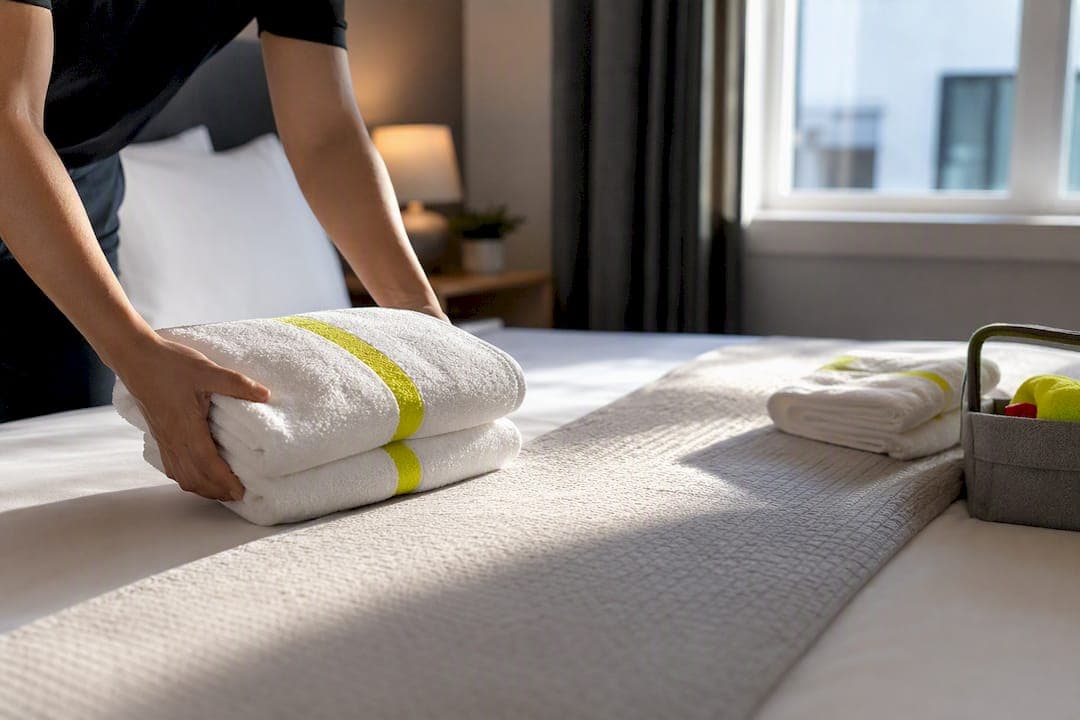
Yes — if you host longer stays, offer a light mid-stay refresh; for extended stays, schedule recurring refreshes every few days. Guests on shorter bookings rarely need one. The evidence is straightforward: a well-timed refresh raises guest satisfaction and doubles as an early warning system for maintenance problems before they become expensive.
TL;DR:
- Mid-stay cleans are recommended every four to five days for stays longer than 14 nights, especially in properties with high mess potential.
- These cleans typically take 20 to 40 minutes for a one-bedroom unit and include basic tasks such as linen changes, bin emptying, and surface wiping.
- Pricing ranges from free for simple towel swaps to over $75 for comprehensive refreshes, depending on property size and extra services requested.
- It is crucial to give guests ample notice and allow them to opt-in, preferably before or during booking, to avoid privacy complaints.
- A trial period of three to five bookings helps identify the optimal cleaning frequency, cost-efficiency, and potential for capturing early maintenance issues.
Table of Contents
- What is a mid-stay clean, exactly?
- Which bookings actually benefit, and how often?
- What's on the checklist, and how long does it take?
- What should a mid-stay clean cost?
- Running the logistics without annoying your guests
- How to pitch it without sounding like an inspector
- The Scene Reset approach to mid-stay refreshes
- What actually happens when you test this
- Book a mid-stay refresh without the guesswork
- Sources
What is a mid-stay clean, exactly?
A mid-stay clean is a light, partial housekeeping visit performed while the guest is still in the property. It's a refresh, not a reset. Linens and towels get swapped, bins get emptied, benchtops get wiped, consumables get topped up. The guest's belongings stay exactly where they left them.
A full turnover is a different job entirely. That's the deep, top-to-bottom reset between guests covering appliances, grout, skirting boards and every surface a new arrival will scrutinise, which is why our Airbnb turnover cleaning guide treats it as its own discipline.
A mid-stay visit skips most of that. What it typically covers:
- Fresh linen and towels, folded or placed per house preference
- Bathroom wipe-down, fresh soap and toilet paper
- Kitchen bench and sink clear, bin emptied
- Floors spot-cleaned, not deep-scrubbed
- Restocked consumables (coffee, dishwashing liquid, bin liners)
Time-wise, occupied cleans generally run shorter than checkout cleans. Hotel housekeeping data puts stayover cleans at 15 to 25 minutes against 30 to 45 minutes for a full checkout. In a rental, working around a guest's luggage, gear and personal items can push that time out again, so budget accordingly rather than assuming the shorter hotel figure applies exactly.
Which bookings actually benefit, and how often?
Not every booking needs one. The cadence that works across most short-term rental portfolios follows stay length:
- Under 7 nights: skip it. The disruption outweighs the benefit.
- 7 to 13 nights: offer a single optional clean, ideally around day four.
- 14+ nights: schedule a recurring refresh every four to five days.
This tiering comes from operator practice, not guesswork, and it holds up whether you're running one apartment or fifty.
Some situations justify tightening that cadence further. A family with young kids, a group booking, pets on the property, high humidity, or a beach house dealing with sand and salt all generate mess faster than a solo business traveller in a city apartment. If you're managing remotely and can't pop by to check on things, a mid-stay visit also gives you eyes on the property.
Not every guest wants someone walking through their space, even briefly. A linen and towel drop at the door, with no entry at all, captures most of the satisfaction benefit while sidestepping the privacy concern entirely.
Pro Tip: Ask at booking confirmation, not on arrival day. Guests who've already said yes to a mid-stay clean rarely change their mind, but ambushing them with the offer once they're settled in feels intrusive.
What's on the checklist, and how long does it take?
Give your cleaner (or yourself) a tight brief following this rental unit cleaning guide for Dublin tenants and landlords. A mid-stay visit isn't the time to reorganise a linen closet or deep-scrub an oven — it's a fast, respectful pass through the property. Here's a workable room-by-room order:
- Bathroom — fresh towels, replenished toiletries, sanitised surfaces, toilet checked.
- Bedroom — bed linen changed if due, surfaces dusted, floor spot-cleaned.
- Kitchen — bench and sink cleared, dishes done if left out, fridge checked for spoiling food.
- Bins — emptied throughout, liners replaced.
- Common areas — quick tidy, surfaces wiped, floors vacuumed if needed.
- Consumables — coffee, tea, dish soap, bin liners and toilet paper topped up.
Set clear boundaries before the cleaner walks in: no moving personal belongings, no touching closed luggage, and no deep appliance cleaning unless the guest has specifically requested it. Treat it as light inspection work, and if something needs flagging (a leak, a pest sign, a broken fitting), document it with a timestamped photo rather than trying to fix it on the spot.
On timing, a single-bedroom unit's mid-stay refresh usually runs 20 to 40 minutes depending on how lived-in the space is. A two or three-bedroom property with a family in residence can run closer to an hour once you factor in extra linen and more surfaces. Budget your labour cost against that range, not against a full turnover's price tag.
What should a mid-stay clean cost?
Pricing depends on what you're offering and how much labour it actually takes. A rough tiering that most hosts land on:
- Basic refresh (free): towel and linen swap only, left at the door. Costs you almost nothing beyond laundry.
- Standard refresh ($25–$75): the full room-by-room checklist above, done in-unit.
- Premium refresh ($75+): larger properties, added extras like a fridge clean-out or window wipe, or same-day requests.
Those ranges are a starting point, not a rulebook. Occupied-stay jobs often take longer than hosts expect because cleaners are working around a guest's belongings rather than an empty unit, so pricing a mid-stay clean as a flat fraction of your turnover fee usually undercuts the real labour involved.
What actually drives the cost is labour time, travel distance for your cleaner, whether linen needs collecting and laundering off-site, how many bedrooms are involved, and how tidy (or not) the guest keeps the space. You can present the fee as a listed extra at booking, a one-off invoice mid-stay, or folded into a slightly higher nightly rate for long-stay bookings. Folding it into the rate tends to get the highest uptake, because nobody has to make a decision mid-holiday.
Running the logistics without annoying your guests
The mechanics matter as much as the cleaning itself. Get the notice window wrong and even a free perk turns into a complaint.
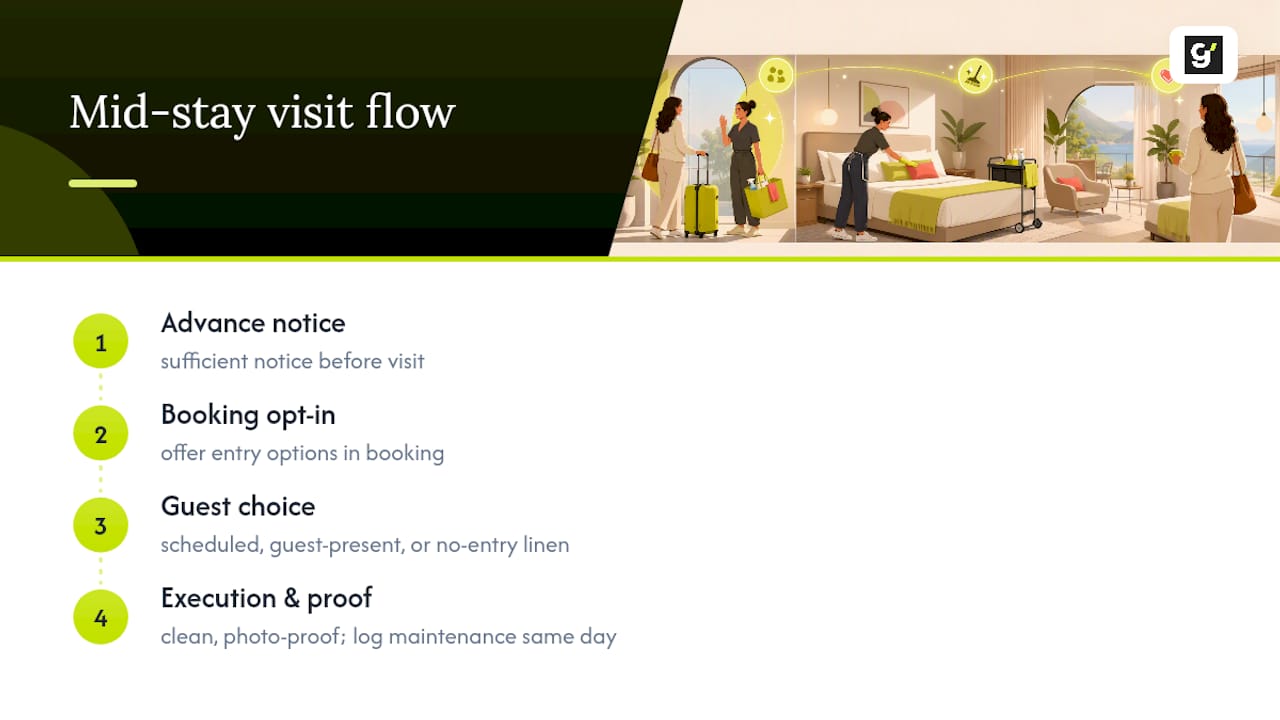
Give guests sufficient notice before any mid-stay visit — unannounced entry is a common cause of complaints and poor reviews. Build an opt-in step into your booking flow rather than assuming consent, and offer guests a choice of a scheduled entry, a guest-present visit, or a no-entry linen drop via smart lock or lockbox.
Linen and consumables run out faster than most hosts expect on long stays. The standard fix is a par level of three full sets per bed and bath, so one set is in use, one is clean and ready, and one is in the wash. That three-set buffer prevents the awkward scramble of a guest asking for towels you don't have.
If you're running more than a couple of properties, automating these tasks in your property management system with photo-proof requirements cuts down disputes and saves you from chasing cleaners for updates. Any maintenance issue found mid-clean should get logged and escalated the same day, not left for the next scheduled visit.
How to pitch it without sounding like an inspector
Wording matters more than most hosts assume. Framed as an optional hotel-style perk, uptake and satisfaction both climb; framed as something the host requires, guests get defensive fast, even when the actual clean is identical.
A workable message sequence:
- Day 1 (check-in message): mention the refresh is available, no pressure to book.
- Day 3: a short reminder with a one-tap yes/no.
- 24–48 hours before the visit: confirm the time window and ask if pets need managing.
Offer it in tiers so guests can pick their level: a free towel and linen swap at the door, a standard paid refresh with room entry, or a premium deep refresh for larger groups. Add a line to your house rules explaining the service exists and how guests opt in, and always ask up front whether pets will be loose in the property before a cleaner arrives.
The Scene Reset approach to mid-stay refreshes
A specialized cleaning protocol is designed to fill the gap between a full turnover and doing nothing. It uses non-toxic, bleach-free cleaning agents that neutralise buildup rather than mask it, which matters when a guest and their kids or pets are still living in the space during the visit.
For most long stays, a light towel and linen drop covers the need without anyone entering the unit. When a property needs more, a tactical short-term rental unit service handles the fuller refresh, restocking consumables and resetting high-touch surfaces while respecting the guest's belongings and privacy throughout.
What actually happens when you test this
Run a pilot on three long-stay bookings before rolling mid-stay cleaning across your whole portfolio. Track uptake rate, any change in review scores, cost per clean, and how many maintenance issues got caught early rather than at checkout.
The most common mistakes are scheduling too often (guests find it intrusive), skipping the notice window, and pricing the service as an afterthought rather than a real line item. A small pilot with tracked metrics tells you within a few bookings whether the programme is worth scaling, and it costs far less than guessing.
— Lead
Book a mid-stay refresh without the guesswork
A professional cleaning provider offers hosts running longer stays an alternative to juggling cleaner schedules and guest messaging themselves. Every visit uses eco-friendly, non-toxic agents safe around kids, pets and guests still living in the space, with photo-proof documentation logged for every job so you're never left wondering what got done.
For a spill, a sick guest, or an urgent bio-mess mid-stay, the Rapid Response two-hour tactical clean gets someone on-site fast. For scheduled refreshes across a portfolio, the short-term rental service packages build the Scene Reset protocol straight into your recurring cadence. If a property needs a full reset beyond a light refresh, the deep decontamination service covers it. Check availability for your property and get a quote before your next long-stay booking lands.
Sources
- Mid-Stay Clean | Hostfully
- Stayover Room Cleaning | POPProbe
- Airbnb Mid-Stay Cleans That Guests Welcome (and protect your property) | STR Specialist
- Why Every 7-Night Stay Needs a Mid-Stay Cleaning | Cavmir