
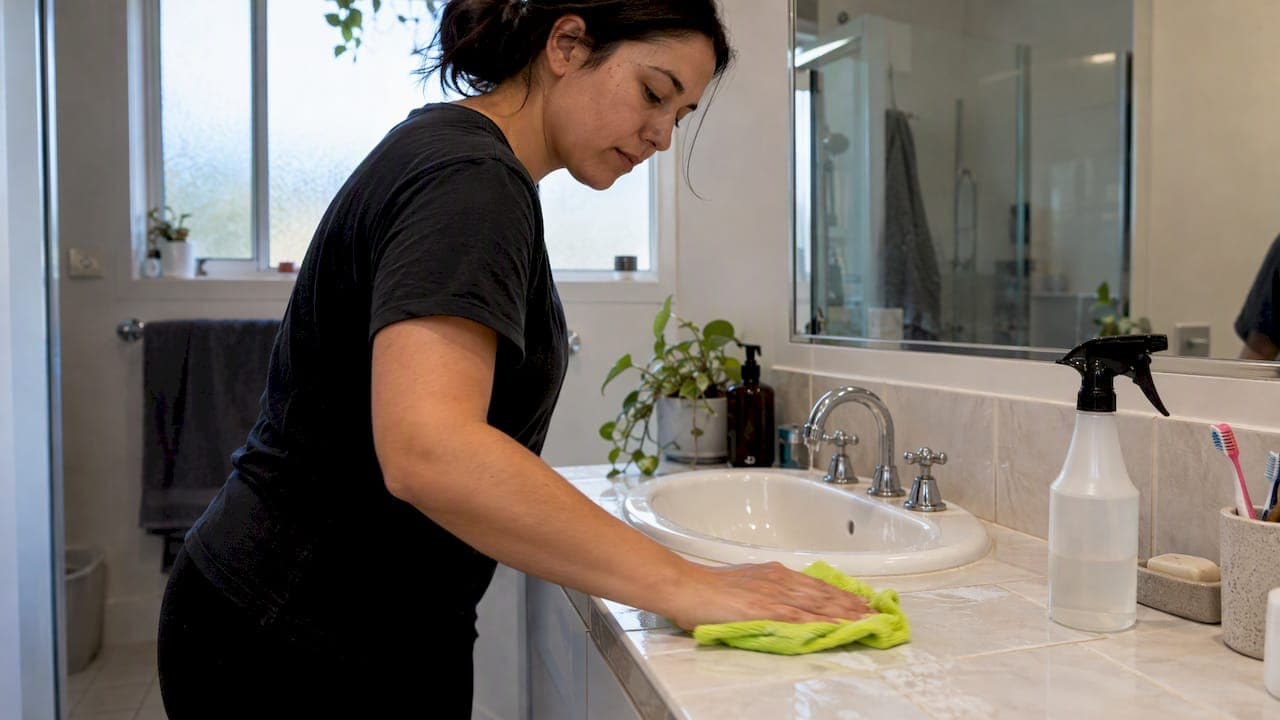
For dishes and laundry, hot water cycles and oxygen-based products close the gap. For biohazard jobs, tight rental turnarounds, or anything beyond a quick wipe-down, a non-toxic professional clean covers what a spray bottle can't.
TL;DR:
- Clean hard surfaces with detergent and warm water, then keep disinfectant wet for the label’s full contact time, typically 1 to 10 minutes.
- Use dishwasher sanitise cycles for dishes; wash laundry at its hottest safe setting, add an oxygen based booster for contamination, and dry on high heat.
- Do not use vinegar or essential oils as disinfectants; neither has a validated sanitising concentration and contact time for dishes, surfaces, or laundry.
- Choose 70% alcohol for small hard electronics, but avoid direct spraying and check screen guidance because repeated use can damage coatings.
- Use hydrogen peroxide at its labelled concentration on hard surfaces; test stone or fabric first, and never mix it with vinegar or cleaners.
Table of Contents
- Practical alternatives to bleach and when to use each
- How to sanitise hard surfaces step by step
- Sanitising dishes and kitchenware without bleach
- Sanitising laundry and linens without chlorine bleach
- Avoiding common mistakes with bleach-free methods
- When to book a professional non-toxic deep clean
- Do essential oils like tea tree or eucalyptus actually sanitise?
- How to sanitise phones, remotes, and other electronics
- Sanitising upholstery, carpets, and other soft surfaces
- Keeping doorknobs, light switches, and other high-touch spots clean
- Does vinegar work as well as bleach for disinfecting?
- Why sequence beats marketing when it comes to sanitising
- Book a non-toxic deep clean when DIY isn't enough
- FAQ
- Sources
Practical alternatives to bleach and when to use each
Every bleach-free method on this list works differently, and matching the method to the job matters more than picking a single "best" product.
Hydrogen peroxide at typical household concentrations breaks down into water and oxygen, and that oxidising action disrupts the outer structure of many microbes on contact. It's suited to hard, non-porous surfaces: benchtops, sinks, tiled splashbacks, and toilet bowls. NHMRC guidance notes that the product label, not a general rule of thumb, sets the correct concentration and contact time, and warns against mixing it with vinegar or other cleaners.
70% alcohol (ethanol or isopropyl) evaporates fast, which makes it useful for small, non-porous items such as phone screens, remote controls, and scissors. It's a poor choice for large surfaces because it dries before it can do much work, and a poor choice for fabrics because it can fade dye or dry out leather.
Heat and steam are among the most reliable bleach-free tools for anything that can tolerate temperature: dishwasher cycles, hot laundry washes, and handheld steam cleaners for grout or upholstery. Heat doesn't rely on a chemical reaction, so there's no residue and no mixing risk.
Detergent and warm water on their own won't disinfect, but they're the step that makes every other method work properly. Removing grease and grime first is non-negotiable, which the next section covers in detail.
TGA-listed disinfectants that don't contain chlorine bleach (many hydrogen peroxide and alcohol-based commercial products are registered this way) give you a tested, regulated option when you need a verified claim rather than a guess.
A few quick decision rules:
- Use heat when the item can handle it (dishwasher-safe, machine-washable, or heatproof): it's the simplest bleach-free option with no chemical handling.
- Use hydrogen peroxide or alcohol on hard surfaces when heat isn't practical, and check the label for the exact contact time.
- Use a TGA-listed product when you need a specific, provable disinfection claim, such as after illness in the household.
- Skip DIY concentration guesses: a label tells you what the product was tested to actually achieve.
How to sanitise hard surfaces step by step
Benchtops, door handles, light switches, and bathroom fixtures all follow the same sequence, and skipping the first step is the most common reason a disinfectant underperforms.
- Remove visible soil first. Wipe the surface with detergent and warm water. Health department guidance is explicit that dirt and grime physically block disinfectants from reaching the surface underneath, so this step isn't optional.
- Pick your disinfectant. Hydrogen peroxide sprays, 70% alcohol wipes, or a TGA-listed hospital-grade product are all reasonable bleach-free choices depending on the surface.
- Apply and leave it wet. Spray or wipe so the surface stays visibly wet for the full contact time stated on the label, often somewhere between 1 and 10 minutes depending on the product. Wiping it dry too early is the second most common mistake after skipping the clean step.
- Let it air-dry where possible, rather than wiping immediately, so the full contact time is honoured.
- Rinse food-contact areas if the product label calls for it before the surface is used again.
Pro Tip: Keep a kitchen timer next to your spray bottle: "wet for the labelled minutes" is the single detail most people skip.
Material compatibility matters. Hydrogen peroxide can bleach some fabrics and dull certain stone surfaces over time, so test on a small area first, particularly with interior door finishes and painted trim. Alcohol can cloud some plastics and strip the finish off timber. Gloves are worth wearing with any peroxide-based product, and ventilation matters any time you're using a spray in a small bathroom.
If a surface still feels greasy after cleaning, go back to detergent and warm water rather than reaching for a stronger disinfectant: no bleach-free product performs well over a film of grease. Porous surfaces such as unsealed grout or raw timber may need a second cleaning pass, since they hold soil in a way that a hard, sealed benchtop doesn't. Our guide on removing grease without harsh chemicals covers the degreasing step in more depth, and our piece on dwell time cleaners can actually meet goes further into getting contact times right in a real household, not just on the label.
Sanitising dishes and kitchenware without bleach
Clean first, always: a dish with food residue on it won't sanitise properly no matter what you apply next. Food Standards Australia New Zealand sets out cleaning as step one and sanitising, by heat, chemicals, or another validated process, as the separate step that follows.
For most households, a dishwasher sanitise cycle is the simplest bleach-free option that actually meets food safety expectations, because it combines heat and time in a way a quick hand wash can't replicate. Where you're washing by hand, a very hot water soak (as hot as you can safely manage) for the period stated in food safety guidance gets closer to the same result than cold or lukewarm water ever will.
Vinegar is not a food-grade sanitiser. It has some acidic activity against certain microbes, but it isn't validated or labelled for sanitising food-contact items, and Food Standards guidance doesn't list it as an accepted method. The same caution applies to most online DIY recipes for dish sanitising: without a tested concentration and contact time, there's no way to know whether they actually achieve sanitation rather than just a clean-looking surface.
Safe, practical alternatives for food-contact items include:
- A dishwasher sanitise cycle, which uses heat and time together for a validated result.
- Hot water soaking at the temperature and duration recommended for manual sanitising of utensils.
- A commercial food-grade sanitiser used exactly per its label, for items that need sanitising outside a wash cycle.
- 70% alcohol wipe-downs for quick touch-ups on non-food-contact kitchen surfaces, such as the outside of appliances, rather than for plates or cutlery.
Sanitising laundry and linens without chlorine bleach
Heat does most of the work here. This matters most for towels, bedding, and anything used by someone who's been unwell.
- Check the care label and choose the hottest wash temperature it permits.
- Add an oxygen bleach or hydrogen peroxide-based laundry additive as a colour-safe sanitising boost, following the product's dosing instructions rather than guessing.
- Dry on high heat where the fabric tolerates it, since the drying step adds further heat exposure on top of the wash.
- Use a dedicated laundry sanitiser for loads you know were in contact with illness, body fluids, or significant contamination, and follow its label precisely.
- Hand over delicates and heat-sensitive fabrics to a steam process or a professional laundry service rather than forcing a hot cycle that could damage them.
Oxygen bleach and hydrogen peroxide laundry boosters work well because they're colour-safe in a way chlorine bleach isn't, and they still provide meaningful antimicrobial action when dosed correctly. For loads you suspect carry a higher load of contamination, pairing the hottest safe wash with one of these additives, rather than relying on temperature alone, gives a wider margin of safety.
Avoiding common mistakes with bleach-free methods
The biggest safety risk in bleach-free cleaning isn't the absence of bleach, it's combining products that were never meant to meet.
- Never mix hydrogen peroxide with vinegar, or any two disinfectants, since combinations can create unpredictable and sometimes hazardous reactions.
- Always wear gloves and ventilate the room when using concentrated hydrogen peroxide or alcohol-based sprays.
- Don't assume "natural" means effective: a product's disinfecting claim is only as reliable as its label and registration.
- Don't rely on fogging or UV devices as a substitute for manual cleaning.
The TGA's Disinfectant Claim Guide sets out which disinfectant claims are regulated and notes that fogging and ultraviolet disinfection don't replace manual cleaning, since both require validated procedures, training, and personal protective equipment to be used safely. That's a useful check before trusting any gadget that promises to disinfect a room without you lifting a cloth.
When contamination is extensive, biological, or you simply can't verify the result yourself, that's the point to call in a professional rather than keep escalating the DIY approach.
When to book a professional non-toxic deep clean
Some jobs sit outside what a bottle of hydrogen peroxide and a weekend can reasonably fix: biohazard situations, post-construction dust and residue, a short-term rental turnover with a guest arriving in hours, or large-scale contamination across multiple rooms.
Our Scene Reset protocol is built specifically for rental turnovers where the standard has to be met every single time, and our Rapid Response service covers jobs that can't wait for a standard booking window.
Before hiring anyone for a sanitising job, it's worth asking:
- What products are used, and are they labelled for the specific disinfection claim you need.
- What contact time the process follows, and how that's verified rather than assumed.
- Whether before-and-after reporting is provided so the result is documented, not just promised.
Deep decontamination and rapid response work by some providers is built around client needs.
Do essential oils like tea tree or eucalyptus actually sanitise?
Tea tree and eucalyptus oils carry a pleasant scent and a reputation as "natural disinfectants," but that reputation runs well ahead of what's been established for household use. Neither is registered or labelled in Australia as a sanitiser or disinfectant for surfaces, dishes, or laundry, which means there's no validated concentration or contact time to follow the way there is for hydrogen peroxide or a TGA-listed product.
That doesn't make them useless around the home. They're reasonable choices for adding fragrance to a cleaning routine, and some people prefer them to synthetic air fresheners for that reason alone. If scent without harsh chemical residue is the goal, options like non-toxic home fragrance achieve that without the leap of calling an essential oil a disinfectant.
If sanitising is the actual goal, treat essential oils as a finishing touch after cleaning and disinfecting, not as a substitute for either step. A room can smell like eucalyptus and still carry the same germ load it had before you opened the bottle.
How to sanitise phones, remotes, and other electronics
Electronics need a different approach because liquid and moisture are the enemy of circuit boards and screens, not the allies they are on a benchtop.
Start by unplugging or powering off the device, and remove any case for a separate wipe-down. Use a soft, lint-free cloth lightly dampened, not soaked, with 70% isopropyl alcohol, since this concentration evaporates quickly and doesn't leave residue on glass or plastic housings. Avoid spraying liquid directly onto a phone, remote, or keyboard, and never submerge anything with a battery or internal electronics.

For screens with an oleophobic (fingerprint-resistant) coating, check the manufacturer's cleaning guidance first, since repeated alcohol wiping can wear that coating down over time on some devices. Ports, buttons, and seams can be addressed with a dry, soft brush rather than liquid, since moisture trapped in small gaps is a common cause of damage.
Let the device air-dry fully before switching it back on or placing it in a case. For shared devices such as remotes, light switches with touch panels, or a household tablet, a quick alcohol wipe after frequent use covers most of the practical risk without needing anything stronger.
Sanitising upholstery, carpets, and other soft surfaces
Soft surfaces trap soil and moisture in a way hard benchtops don't, which makes chemical disinfectants a poor fit: liquid disinfectants can soak in, stay damp for days, and encourage mould rather than solve the problem.
Steam is the standout bleach-free option for fabric. A handheld or canister steam cleaner applies heat directly to upholstery, carpet, and curtains without soaking the fibres the way a liquid spray would, and that heat does the sanitising work without any chemical residue left behind.

For removable soft furnishings, covers, cushion slips, and throw rugs, the laundry methods already covered (hottest safe wash, high-heat drying, or an oxygen bleach-based additive) are the most reliable bleach-free route.
For fixed carpet and upholstery that can't go through a machine, vacuum thoroughly first to lift loose soil, then use steam on the areas that see the most contact: armrests, cushion seats, and high-traffic carpet paths. Spot-test any fabric cleaner on an inconspicuous area first, since some dyes react poorly to heat or moisture. For large-scale soft surface jobs, particularly after a spill, pet accident, or illness in the household, professional steam and decontamination services cover ground a handheld unit can't reach in a single pass.
Keeping doorknobs, light switches, and other high-touch spots clean
High-touch surfaces get handled dozens of times a day, which makes them the fastest place for germs to spread between people in the same household, even when the rest of the home looks spotless.
Doorknobs, light switches, tap handles, and remote controls are small enough that a quick wipe takes seconds, which makes daily or every-second-day attention realistic in a way a full room clean isn't.
Alcohol wipes are particularly well suited to these spots because they dry fast and won't leave a sticky residue on something you're about to touch again within minutes. For light switches specifically, dampen the cloth rather than spraying directly, since liquid can seep behind the plate and into the wiring.
Our guide to high-touch surface cleaning sets out a fuller checklist for the spots people tend to forget, door handles on the inside of cupboards, light switch surrounds, and tap handles in particular, where grime builds up without ever looking visibly dirty.
Does vinegar work as well as bleach for disinfecting?
Vinegar is one of the most commonly recommended "natural" cleaners, and it does have some genuine value: its acidity cuts through mineral deposits and light grease, and it has mild activity against certain bacteria. What it doesn't have is a disinfectant registration or a validated contact time for the range of microbes a labelled disinfectant is tested against.
That gap matters most on food-contact surfaces and after illness in the household, where "probably helped a bit" isn't the same standard as "sanitised." Food Standards guidance doesn't list vinegar among its recommended sanitising options for utensils and surfaces, which is a strong signal that it sits below the bar for that specific job.
Vinegar also has practical limits: it can damage natural stone benchtops, dull some timber finishes, and its smell lingers longer than most people expect. Where vinegar earns its place is in cleaning (the step before disinfecting), cutting through soap scum, water spots, and mild grease, rather than as the disinfecting step itself. Pair it with a proper bleach-free disinfectant for the second step, rather than asking it to do both jobs at once.
Why sequence beats marketing when it comes to sanitising
The biggest gap between what people believe and what actually works isn't about which bottle to buy, it's the order of operations. Nearly every bleach-free method on this list only works because the surface was cleaned first: that single step is what most household cleaning routines skip, and it's the reason a "disinfectant" spray sometimes seems to do nothing at all.
The other gap is in how labels get read, or don't. A product's contact time isn't a suggestion, it's the tested duration the claim is actually based on, and wiping a surface dry after fifteen seconds when the label says two minutes means the surface was wiped, not sanitised. Effective bleach-free sanitising is less about finding a miracle ingredient and more about respecting the process a regulator already validated.
That's also where the limits of DIY become clear. A household can manage most daily sanitising with detergent, heat, and a labelled disinfectant. What it generally can't manage is verification, proof that a process actually met the standard it needed to, which is where professional, non-toxic cleaning earns its place for the jobs that carry real risk.
— Lead
Book a non-toxic deep clean when DIY isn't enough
For the jobs that go beyond a weekend clean, biohazard situations, post-construction dust, or a rental turnaround with no room for error, we run fully non-toxic, bleach-free protocols from the ground up, with before-and-after verification so you know the standard was actually met.
- Fully non-toxic, bleach-free agents safe for families, pets, and tenants moving in straight after.
- Verified processes with before-and-after reporting, not just a promise.
- Rapid response options for urgent jobs and rental turnarounds with tight windows.
Check availability and book a deep decontamination or rapid response clean for your next job.
FAQ
How can I disinfect without bleach?
Heat and steam are reliable alternatives for anything that can tolerate high temperature, such as dishes and laundry.
What are some ways to sanitise laundry without bleach?
Wash on the hottest cycle your fabric care label allows, then dry on high heat, since heat inactivates many common microbes without any chemical needed. An oxygen bleach or hydrogen peroxide-based laundry additive adds a colour-safe sanitising boost for towels, bedding, or loads with higher contamination risk.
Does vinegar disinfect as well as bleach?
No. Vinegar has mild cleaning and antibacterial properties, but it lacks the validated concentration and contact time that a registered disinfectant has, and food safety guidance doesn't list it as an accepted sanitiser for utensils or surfaces. It's better used as a cleaning step before a proper disinfectant, rather than as a replacement for one.
What do hospitals use to clean instead of bleach?
Many healthcare settings use hospital-grade disinfectants registered through the Therapeutic Goods Administration, which can include hydrogen peroxide-based and alcohol-based formulations alongside chlorine-based products, depending on the surface and the required claim. The product label and its TGA registration determine which specific disinfectant claim it can legally make.
Is hydrogen peroxide safe to use on all surfaces?
Hydrogen peroxide is generally safe on hard, non-porous surfaces like tile, glass, and sealed benchtops when used at the concentration and contact time stated on the label. It can discolour some fabrics, dull certain natural stone, and should never be mixed with vinegar or other cleaning products.
Sources
- Cleaning and disinfection in the community — Department of Health (Australia)
- Cleaning and sanitising surfaces and utensils — Food Standards Australia New Zealand
- Hydrogen peroxide — NHMRC guidance (treatment chemicals)