

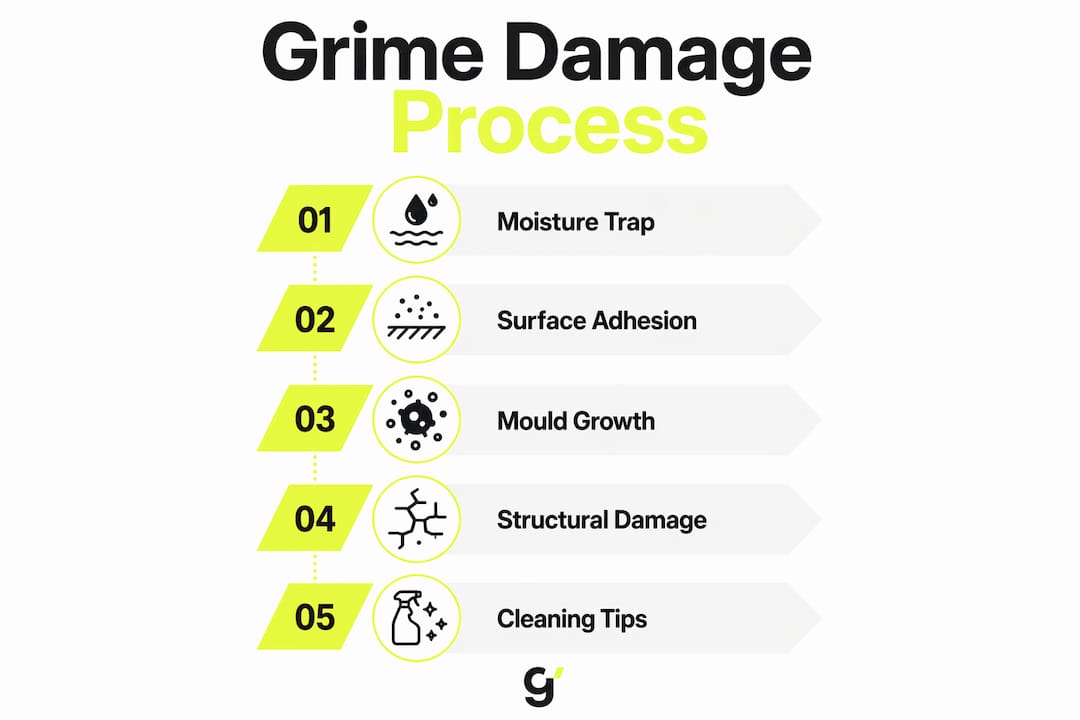
Grime buildup is defined as a sticky, layered film of organic residues, oils, dust, and moisture that bonds to surfaces and actively degrades the materials beneath it. Why grime buildup damages home surfaces goes beyond aesthetics. The film traps moisture against wood, tile, grout, and painted walls, creating conditions for mould, rot, and permanent staining. The US EPA confirms that damp materials left untreated for just 24 to 48 hours significantly increase the likelihood of permanent mould colonisation and structural damage. Left unchecked, grime does not simply look bad. It eats into your home.
Why grime buildup damages home surfaces: the chemistry behind it
Grime is not a single substance. It is a compound film made up of cooking grease, soap scum, airborne dust, skin oils, cleaning product residues, and mineral deposits from hard water. Each component contributes to surface degradation in a distinct way, and together they create a self-reinforcing cycle of damage.
Soap scum forms when fatty acids in soap react with calcium and magnesium minerals in water, producing insoluble deposits that bond firmly to tile, glass, and grout. This is not a surface-level problem. Those deposits physically etch into porous materials over time. On painted walls, the same bonding process causes paint to lift and discolour. On timber floors, grease and moisture penetrate the grain and weaken the wood fibres from within.
Hard water minerals compound this by accelerating mineral deposit formation on any surface they contact. Homes in areas with hard water see grime build faster and bond more aggressively, making routine cleaning less effective without targeted treatment.
The stickiness of grime is also self-perpetuating. Invisible grease films act as adhesive layers that trap dust and pathogens rapidly, causing grime to re-accumulate far faster than visible dirt alone. This is why a kitchen bench can feel grimy again within days of cleaning.
- Wood surfaces: Moisture trapped in grime penetrates the grain, causing swelling, warping, and rot.
- Tile grout: Porous grout absorbs grime and mineral deposits, staining permanently and harbouring mould spores.
- Painted walls: Grease and sticky residues lift paint and cause discolouration that cannot be wiped away.
- Glass and chrome: Mineral deposits from soap scum etch the surface, creating permanent cloudiness.
Pro Tip: When cleaning tiled surfaces, rinse thoroughly with clean water after applying any product. Surfactant residue left on grout attracts more grime than an untreated surface, making the problem worse with every clean.
How does grime lead to mould and long-term structural damage?
The most serious consequence of grime buildup is not the grime itself. It is what grows underneath it. Grime retains moisture against surfaces, and that trapped moisture is the primary driver of mould, mildew, and bacterial growth in homes.
"Mould can begin to colonise damp materials within 24 to 48 hours. Once established, it causes permanent staining and structural rot in wood, drywall, and grout that cannot be reversed by cleaning alone." — US EPA, A brief guide to mould, moisture and your home
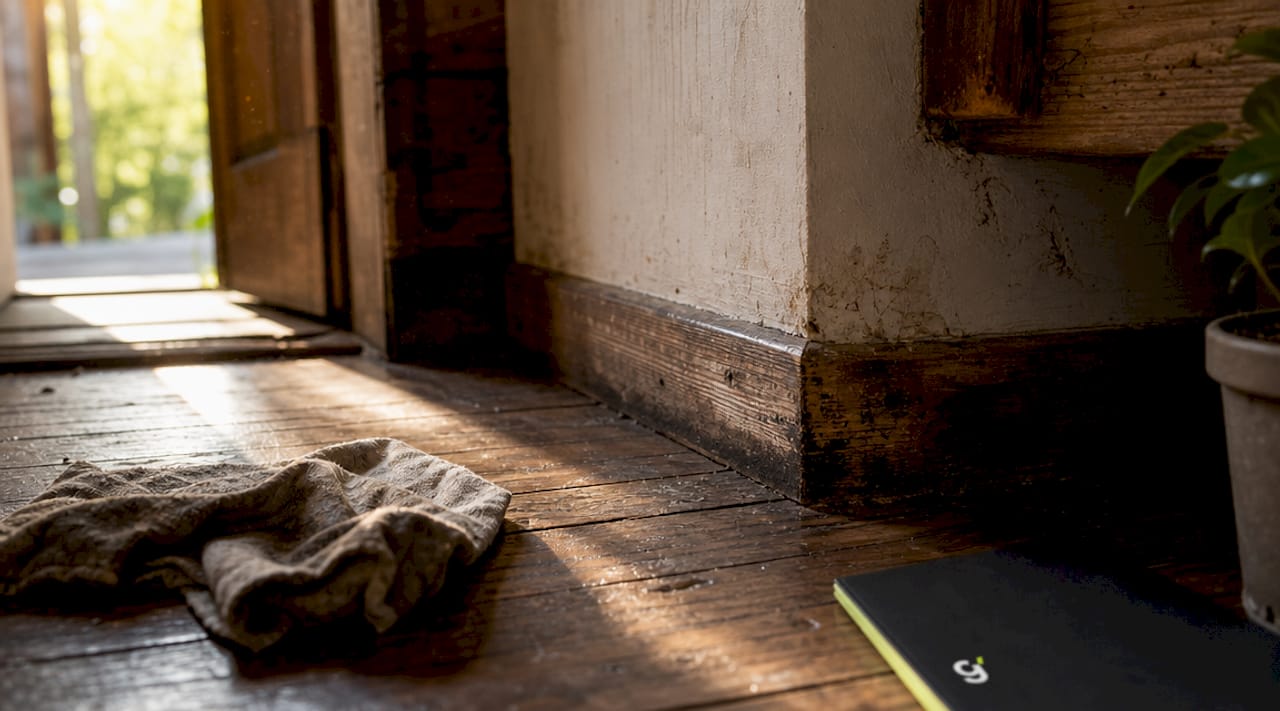
On timber floors and wooden skirting boards, grime-trapped moisture softens the wood fibres, creating entry points for mould spores. Once mould takes hold in timber, the structural integrity of the material is compromised. The same process occurs in grout lines, where poorly sealed grout absorbs moisture and grime, becoming a breeding ground for mould spores and causing permanent staining that resealing alone cannot fix.
The timeline matters. A surface that is wiped down within 24 hours of moisture exposure has a very different outcome to one left for a week under a layer of grime. Homeowners who treat grime as a cosmetic issue often discover structural damage only after it has become expensive to repair. Bathroom walls, laundry areas, and exterior cladding are the most common sites where this delayed discovery occurs.
Mould growth also carries indirect health implications for household occupants, particularly those with respiratory sensitivities. While the primary focus here is surface damage, the biological activity that grime enables does not stay contained to the material it grows on.
Which home surfaces and areas are most at risk?
Not all surfaces accumulate grime at the same rate, and not all damage looks the same. Understanding where grime concentrates helps you prioritise cleaning before damage sets in.
| Surface or area | Grime damage risk | Key maintenance tip |
|---|---|---|
| Tile grout | Very high | Reseal every 12 to 24 months to block moisture ingress |
| Timber floors and furniture | High | Wipe spills immediately; avoid wet mopping without drying |
| Kitchen benches and splashbacks | High | Degrease weekly to prevent adhesive grease film buildup |
| Bathroom walls and screens | High | Rinse after every use; squeegee glass to prevent soap scum bonding |
| Entryway floors | Moderate to high | Use mats to intercept debris before it spreads indoors |
| Air vents and exhaust fans | Moderate | Clean quarterly; blocked vents worsen humidity and grime accumulation |
| Fabric surfaces and upholstery | Moderate | Vacuum regularly; treat spills before they dry into the fibres |
Entryways deserve particular attention. Entryway mats capture up to 80% of foot traffic debris before it reaches interior floors. That statistic means a home without a quality mat at every external entry is allowing the majority of tracked-in grime to spread freely across floors and into carpet fibres. The same principle applies to high-traffic commercial floors, where grime management at entry points is a standard part of floor maintenance programmes.
Kitchen surfaces carry a specific risk that most homeowners underestimate. The invisible grease film that forms above stovetops and on rangehood surfaces acts as a permanent adhesive for airborne particles. Once that film is established, every cooking session adds another layer, and the grime becomes progressively harder to remove without a dedicated degreaser. Grimescene's guide on removing grease without harsh chemicals covers this in practical detail.
How do poor cleaning habits and environment worsen grime damage?
The way you clean matters as much as how often you clean. Several common habits actively accelerate grime buildup and surface damage rather than preventing it.
-
Overusing cleaning products. Surfactant-heavy cleaners leave a tacky residue film that attracts and holds airborne dust and oils. The surface feels clean immediately after, then becomes grimy again faster than before. Using less product and rinsing thoroughly breaks this cycle.
-
Skipping the rinse step. Cleaning product residue is one of the most overlooked contributors to grime re-accumulation. A surface that is wiped with a product but not rinsed retains a chemical film that behaves like a dust magnet.
-
Poor ventilation. Humidity and ventilation problems cause grime to clump and settle on surfaces more aggressively than dust load alone. Bathrooms without exhaust fans and kitchens without rangehoods accumulate grime at a significantly higher rate. Moisture-laden air deposits particulates onto walls and ceilings that dry into a film that is far harder to remove than dry dust.
-
Ignoring seasonal factors. Winter months bring more indoor activity, closed windows, and higher indoor humidity. Summer increases dust and pollen ingress. Adjusting your cleaning frequency to match seasonal conditions prevents grime from reaching the threshold where it begins to damage surfaces.
-
Neglecting hidden zones. Air vents, exhaust fans, and the tops of door frames collect grime that is rarely visible but actively recirculates particles through the home. Unnoticed ventilation grime makes indoor air feel stale and deposits particulates onto surfaces that have just been cleaned.
Pro Tip: After cleaning any surface with a product, follow with a wipe-down using a damp cloth and then a dry cloth. This two-step finish removes residue and prevents the sticky film that causes rapid re-soiling. Adopting a residue-free cleaning method makes a measurable difference to how long surfaces stay clean.
What are the best ways to prevent grime damage to your home?
Prevention is consistently more cost-effective than repair. The following strategies address grime at its source rather than managing it after it has already bonded to surfaces.
- Use entryway mats at every external door. A quality mat at each entry point intercepts the majority of tracked-in dirt before it reaches interior floors. Clean the mats weekly or they become a grime source themselves.
- Degrease kitchen surfaces weekly. Do not wait for visible buildup. The invisible grease film that forms between visible cleans is the adhesive layer that makes grime accumulate exponentially faster.
- Maintain bathroom ventilation. Run exhaust fans during and for 15 minutes after every shower. This single habit reduces moisture retention on walls, grout, and screens significantly.
- Reseal grout every 12 to 24 months. Aged or poorly sealed grout absorbs moisture and grime readily. Fresh sealant creates a barrier that prevents both staining and mould colonisation.
- Choose low-residue cleaning products. Products that rinse clean without leaving a film reduce re-soiling dramatically. Grimescene's overview of natural cleaning agents identifies options that clean without creating a secondary grime problem.
- Deep clean overlooked zones quarterly. Air vents, exhaust fan covers, door frames, and the undersides of furniture accumulate grime that feeds back into the rest of the home. A quarterly targeted clean of these zones prevents the cycle from restarting.
- Schedule professional deep cleaning for persistent buildup. When grime has bonded to surfaces or mould is present, DIY cleaning often moves the problem rather than resolving it. Professional services with non-toxic agents can neutralise buildup at a microbial level without damaging the surface underneath.
A sustainable cleaning routine that combines these habits reduces the frequency of intensive cleaning sessions and extends the lifespan of every surface in your home.
Key takeaways
Grime buildup damages home surfaces by trapping moisture, creating adhesive films, and enabling mould growth that causes permanent material degradation within 24 to 48 hours of exposure.
| Point | Details |
|---|---|
| Grime traps moisture | Moisture retained under grime leads to mould and structural rot within 24 to 48 hours. |
| Chemistry accelerates damage | Soap scum and grease films bond to surfaces, etching porous materials and lifting paint over time. |
| High-risk zones need priority | Grout, timber floors, and kitchen surfaces suffer the fastest and most permanent grime damage. |
| Cleaning habits can worsen buildup | Surfactant residue from overused products attracts more grime than an untreated surface. |
| Prevention beats remediation | Entryway mats, ventilation, and low-residue products stop damage before it requires costly repair. |
The damage hiding in plain sight
Most homeowners I speak with think of grime as a hygiene issue. They clean when things look dirty. The problem is that the most damaging grime is often invisible. The grease film above your stovetop, the moisture sitting under soap scum on your shower grout, the residue your cleaning product left behind last Tuesday. None of it looks alarming. All of it is working against your surfaces right now.
The mistake I see most often is frequency without technique. People clean regularly but use too much product, skip the rinse, and never address ventilation. The result is surfaces that feel perpetually grimy despite constant effort. The grime is not winning because you are not cleaning enough. It is winning because the method is feeding it.
My honest recommendation is to clean less often but with more intention. Degrease properly. Rinse thoroughly. Fix the ventilation. Reseal the grout. And when buildup has gone beyond what a household product can address, bring in a professional before the damage becomes structural. The cost of a deep clean is a fraction of the cost of replacing a timber floor or replastering a mould-damaged wall.
— Lead
When grime goes beyond DIY: how Grimescene can help

Some grime buildup reaches a point where surface-level cleaning is not enough. When moisture has been trapped under grime for weeks, when grout is stained through, or when mould has taken hold in timber or wall cavities, standard household products cannot neutralise the problem at its source.
Grimescene uses advanced non-toxic agents that target grime and microbial buildup without harsh chemicals, making them safe for families, pets, and the surfaces themselves. Their deep decontamination service addresses the biological layer beneath visible grime, not just the surface film. For persistent or widespread buildup, book a professional clean and protect your property before the damage becomes structural. You can also explore the full range of residential cleaning services Grimescene offers for ongoing surface protection.
FAQ
What makes grime different from ordinary dust or dirt?
Grime is a bonded film of grease, soap residue, mineral deposits, and moisture that adheres to surfaces chemically. Ordinary dust sits loosely on surfaces and wipes away easily, while grime requires targeted cleaning to break the bond.
How quickly can grime cause permanent damage?
Moisture trapped under grime can trigger mould colonisation and material damage within 24 to 48 hours on untreated surfaces. Timber, grout, and drywall are the most vulnerable to this rapid deterioration.
Why do surfaces get grimy again so quickly after cleaning?
Surfactant-heavy cleaning products leave a tacky residue that attracts airborne dust and oils, causing surfaces to re-soil faster than before cleaning. Rinsing thoroughly after every clean and switching to low-residue products breaks this cycle.
Which home surfaces suffer the worst grime damage?
Tile grout, timber floors, and kitchen splashbacks carry the highest risk because they are porous, frequently exposed to moisture and grease, and often cleaned with products that leave residue. Grout in particular should be resealed every 12 to 24 months to prevent permanent staining and mould growth.
Does poor ventilation really make grime worse?
Yes. Humidity and ventilation problems cause grime to clump and settle on surfaces far more aggressively than dust alone. Bathrooms and kitchens without adequate airflow accumulate grime at a significantly higher rate and are the most common sites for moisture-related surface damage.