
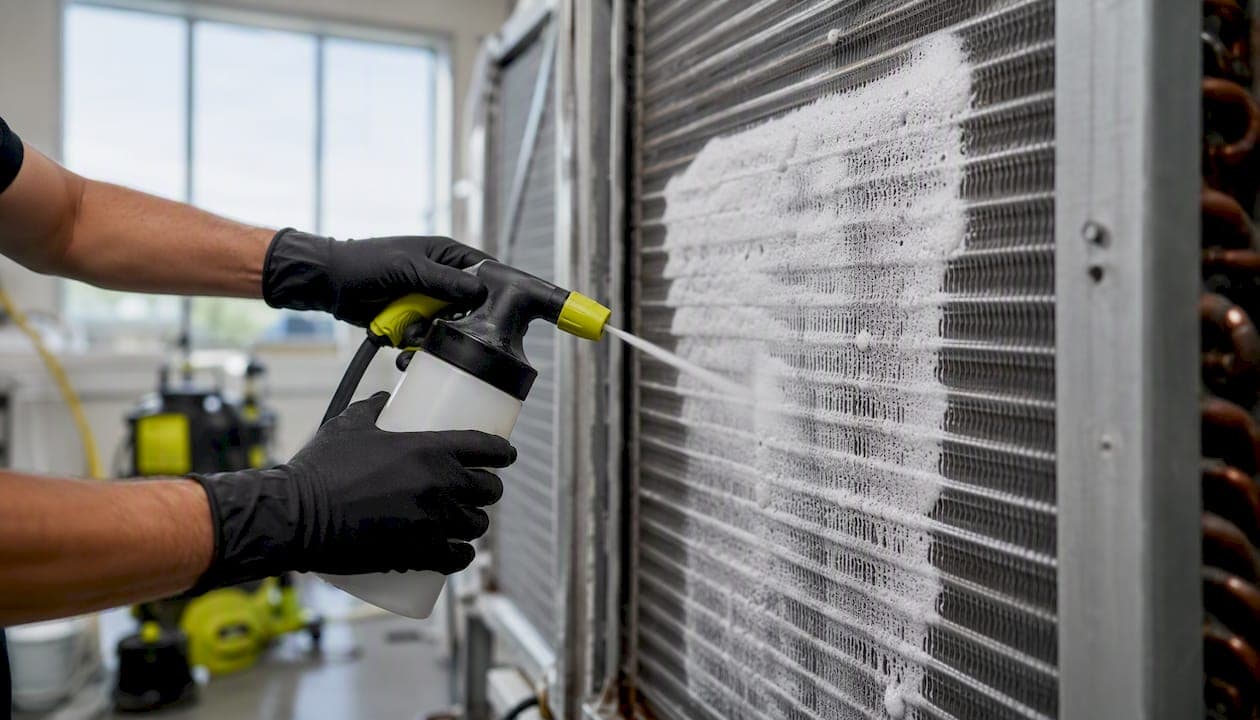
Yes, properly executed HVAC cleaning can improve indoor air quality by removing trapped particulate matter and biological material that would otherwise recirculate through your building. The benefit is real, but it depends heavily on scope, method, and verification. Duct-only cleaning with no attention to coils, fans, or drain pans rarely delivers lasting results.
The strongest supporting evidence comes from three directions:
- A 2026 pilot study using continuous real-time monitoring in four occupied schools found measurable reductions in particulate matter (PM) after certified HVAC cleaning during occupied periods, using one-minute resolution data, which is a meaningful step up from spot sampling.
- A multi-climate Energy & Buildings evaluation found that comprehensive HVAC cleaning produced fan energy savings of 41–60% and increased supplied airflow by 10–46% at intervention sites compared with uncleaned systems.
- US EPA guidance stops short of recommending routine duct cleaning for all homes, but does recommend cleaning visibly contaminated components and stresses that improperly performed work can make things worse.
Three caveats matter before you book anything. First, the quality of the service determines the outcome. Second, scope matters: cleaning coils, fans, and heat exchangers alongside ducts produces better results than duct cleaning alone. Third, no specialist clean replaces routine maintenance like regular filter changes and annual inspections.
Key takeaways
Properly executed HVAC cleaning improves indoor air quality when it targets coils, fans, and drain pans alongside ducts, uses containment, and is verified with airflow or particle measurements.
| Point | Details |
|---|---|
| Scope determines outcomes | Coil, fan, and drain pan cleaning alongside ducts produces lasting results; duct-only cleaning rarely does. |
| Evidence supports targeted cleaning | A 2026 pilot study found measurable PM reductions after certified cleaning; a multi-climate study found 41–60% fan energy savings. |
| Maintenance beats routine cleaning | Regular filter changes and annual coil inspections prevent most contamination from reaching the level that requires specialist intervention. |
| Act on confirmed indicators | Visible mould, pest evidence, post-renovation dust, or water intrusion are the clearest triggers for professional remediation. |
| Verify the outcome | Airflow measurement or PM monitoring after a clean confirms whether the intervention delivered real improvement. |
Table of Contents
- Why HVAC cleaning affects air quality: the core mechanisms
- What actually builds up inside your HVAC system
- How HVAC contamination can affect occupant health
- What the research actually says about HVAC cleaning and air quality
- Signs that cleaning is likely to help your system
- DIY cleaning versus hiring a professional: how to decide
- What a thorough professional HVAC clean actually involves
- When HVAC cleaning can make things worse
- An ongoing maintenance plan that actually delivers results
- An eco-friendly deep remediation protocol in practice
- Balancing the evidence with practical decisions for Australian properties
- Ready to book a specialist clean for your property?
- Sources
Why HVAC cleaning affects air quality: the core mechanisms
Your HVAC system does not just heat or cool air. It moves air continuously through a building, and every surface it touches becomes either a filter or a source. Understanding which one your system is right now is the starting point for any sensible cleaning decision.
Air movement and distribution are the first pathway. Supply and return paths carry particles, odours, and biological material from one zone to another. A contaminated return grille in a corridor can distribute whatever is on it into every room the system serves. In commercial buildings and schools, this cross-zone distribution is one of the main reasons a single contaminated air-handling unit can affect occupant health across an entire floor.
Filters are the intended barrier. A MERV 8 filter catches most coarse particles; a MERV 13 catches fine particles down to 1 micron, which covers a meaningful portion of respirable PM and some bioaerosols. The problem is that filters only work when they are changed on schedule and when air is not bypassing them through gaps in the filter housing. A clogged or poorly seated filter turns the system into a particle pump rather than a particle trap. Ventilation rates and system operation directly affect occupant exposure to CO₂ and PM, which is why filtration performance and ventilation effectiveness are linked.
Resuspension is the mechanism most people underestimate. Dust and debris that settle on coil fins, fan blades, and duct surfaces do not stay put. Vibration from the fan motor, changes in airflow velocity, and seasonal start-up all disturb settled material and push it back into the airstream. This is why a system that looks clean at the grille can still be distributing fine particles from contaminated internal components.
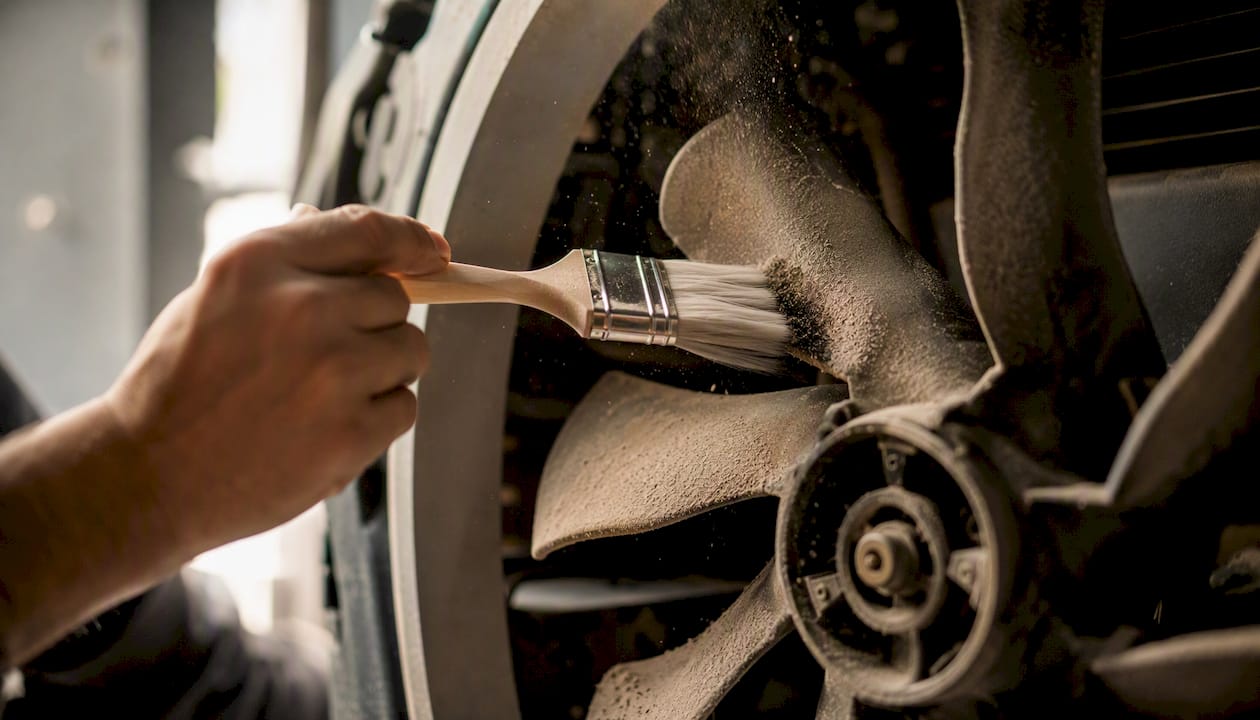
Clogged coils and dirty fan blades also increase drag on the system. The fan has to work harder to deliver the same airflow, which raises energy consumption and reduces the volume of conditioned air reaching occupied spaces. Less delivered airflow means lower ventilation effectiveness, which compounds any IAQ problem already present.
What actually builds up inside your HVAC system
Contamination is not uniform. Different components accumulate different materials, and knowing where to look tells you a lot about what kind of cleaning is actually needed.
- Return grilles and duct surfaces: Dust, pollen, textile fibres, and skin cells accumulate here first. In homes with pets, dander concentrations on return grilles can be significant. These are the most visible accumulations and the ones most often addressed by duct-only cleaning.
- Evaporator coils and drain pans: Moisture condenses here during cooling cycles, creating a persistently damp environment. Mould, mildew, and bioaerosols thrive on wet coil fins and in stagnant drain pans. This is the highest-risk location in most residential and commercial systems, and it is the component most often skipped in a cheap clean.
- Fan blades and blower wheels: Grease, dust, and biological material bond to fan surfaces over time. A dirty blower wheel is both an IAQ source and an energy drain. Cleaning it is not optional if you want lasting results.
- Insulated duct liners: Fibreglass duct liner is porous and can harbour mould if it becomes wet. Once liner is contaminated, surface cleaning is insufficient; replacement is often the only effective remedy.
- Kitchen-adjacent systems: Cooking odours, grease aerosols, and VOCs from cooking processes accumulate in systems serving kitchens or open-plan spaces adjacent to cooking areas. These residues are sticky and attract further particulate.
- Pest and rodent debris: Insects, rodent droppings, and nesting material create concentrated hotspots of biological contamination. A single rodent nest inside a duct system can distribute allergens and pathogens across an entire building.
The NCBI indoor pollutant overview catalogues the range of contaminants found in building environments and their associated health endpoints, which maps closely to what accumulates in HVAC components over time.
How HVAC contamination can affect occupant health
The health case for HVAC maintenance and air purity is strongest for people who are already sensitised or vulnerable. For healthy adults in low-contamination environments, the effects are more likely to be nuisance-level than clinically significant. That distinction matters when you are deciding how urgently to act.
Allergic and irritant effects are the most commonly reported. Dust mite allergens, pollen, pet dander, and mould fragments distributed by a contaminated system can trigger rhinitis, conjunctivitis, and asthma exacerbation in sensitised individuals. Children and the elderly are disproportionately affected. In schools and aged-care facilities, this is not a minor consideration.
Respirable particles are a separate concern. Coarse PM (PM10) irritates the upper airways; fine PM (PM2.5) penetrates deeper into the lungs. The 2026 school pilot study found reductions in both fractions after certified cleaning, which is meaningful because PM2.5 is the fraction most associated with cardiovascular and respiratory health outcomes.
Bioaerosols and pathogens are where the evidence gets more nuanced. Moist coils and drain pans can support microbial growth, and that growth can elevate occupant exposure to biological material. The link between HVAC-distributed bioaerosols and specific infections is harder to establish at a population level, but the exposure pathway is real. Legionella in cooling towers is the most documented example; in standard split and ducted systems, the risk profile is lower but not zero.
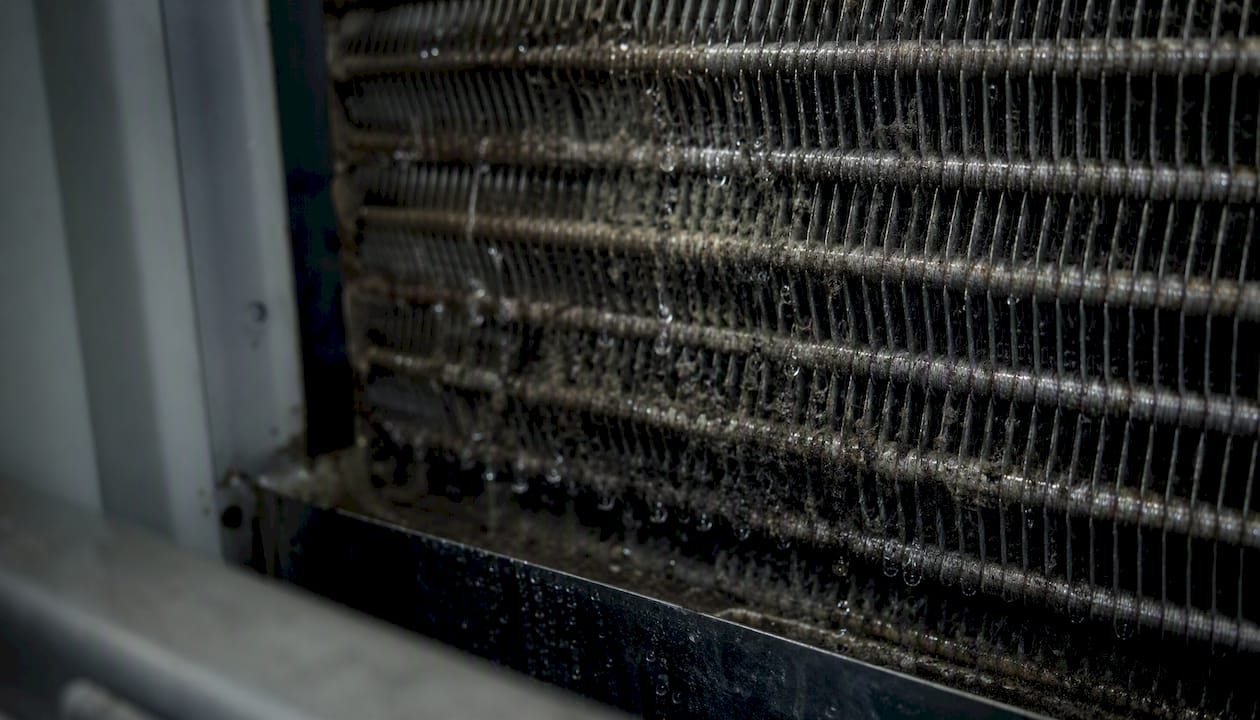
At-risk groups to prioritise: immunocompromised individuals, people with diagnosed asthma or allergic rhinitis, infants, and the elderly. For these groups, the threshold for acting on HVAC contamination should be lower than for a healthy adult population.
What the research actually says about HVAC cleaning and air quality
The evidence base is more nuanced than either the cleaning industry or sceptics tend to acknowledge. Here is what the strongest studies and official guidance actually show.
The Energy & Buildings multi-climate evaluation is the most rigorous energy-side study available. These are not marginal gains. Better airflow directly affects ventilation effectiveness, which is an IAQ outcome even before you consider particle removal.
The 2026 E3S pilot monitoring study used continuous one-minute-resolution PM monitoring in four schools across multiple seasons. Certified cleaning was associated with measurable reductions in coarse and fine PM during occupied periods. The study is a small pilot, and the findings are context-specific, but the methodology is sound and the monitoring approach is more rigorous than most prior work.
EPA guidance remains cautious: duct cleaning has not been shown to prevent health problems, and the EPA does not recommend it as a routine measure for most homes. It does recommend cleaning when components are visibly contaminated, when moisture problems exist, or when there is evidence of pest infestation. Critically, the EPA emphasises that improperly performed cleaning can worsen IAQ by disturbing settled contaminants. Updated EPA IAQ messaging now recognises source removal as a legitimate complementary IAQ strategy, which aligns more closely with what NADCA's standards have long emphasised.
A PubMed-listed study on duct cleaning effectiveness found that cleaning can temporarily increase airborne PM and bioaerosol concentrations during the work itself, but may reduce longer-term exposures post-cleaning when done correctly. This is the key argument for containment and negative-pressure collection during any professional clean.
| Study / Source | Type | Main Finding | Key Limitation |
|---|---|---|---|
| Energy & Buildings multi-climate evaluation | Full-scale field study | 41–60% fan energy savings; 10–46% airflow increase | Energy/airflow focus; not a health outcomes study |
| E3S 2026 school pilot | Continuous PM monitoring, 4 schools | Reduced coarse and fine PM during occupied periods after certified cleaning | Small pilot; context-specific (schools) |
| PubMed duct cleaning study | Older field study | Temporary PM spike during cleaning; potential long-term reduction post-clean | Older methodology; variable cleaning standards |
| US EPA guidance | Government guidance document | Routine duct cleaning not universally recommended; source removal recommended when contamination is confirmed | US-based; not Australia-specific |
| NADCA ACR standards | Industry standard | Full-system source removal with containment reduces re-contamination risk | Industry body; not independent research |
The honest summary: cleaning delivers measurable benefits when it is comprehensive, properly contained, and verified. Duct-only cleaning without coil and fan work is unlikely to produce lasting IAQ improvements.
Signs that cleaning is likely to help your system
Not every HVAC system needs a specialist clean right now. These indicators help you decide whether to act, wait, or simply improve your maintenance routine.
- Visible mould inside accessible registers, on coil surfaces, or around the drain pan. This is a clear trigger for professional intervention, not a DIY job.
- Rodent or pest evidence inside the system: droppings, nesting material, or insect debris visible when you remove a grille.
- Large dust accumulations on duct surfaces visible through registers, or heavy debris on the blower wheel when you inspect the air-handling unit.
- Persistent musty or stale odours that return within days of cleaning the rooms themselves. If the smell is coming from the vents, the system is the source.
- Measured performance problems: consistently low airflow from supply registers, filters clogging faster than their rated interval, or a noticeable rise in energy bills tied to fan operation.
- Post-renovation dust loads: construction dust is fine, abrasive, and gets drawn into return systems. After any renovation work, inspect the return grilles and filters before assuming the system is clean.
- Water intrusion events: if the system has been exposed to flooding, roof leaks, or condensate overflow, biological contamination of duct liner and coil insulation is likely.
- Unexplained increase in respiratory symptoms among occupants, particularly if symptoms improve when people leave the building and return when they come back.
For a DIY check, remove a return grille and shine a torch into the duct. A light dust coating is normal. Visible mould, heavy debris, or any sign of moisture damage means call a professional. Changing filters and wiping grilles is within any homeowner's capability; anything beyond that carries real risk of making contamination worse if done without proper containment.
DIY cleaning versus hiring a professional: how to decide
The distinction between routine maintenance and specialist cleaning is not about effort. It is about scope and risk.
Routine maintenance covers filter replacement, grille cleaning, and visual inspection of accessible components. These are tasks any homeowner or facilities team can handle on a schedule. A MERV 8–13 filter changed every 60–90 days, clean grilles, and a clear drain pan represent the baseline that prevents most contamination from becoming a problem in the first place.
Specialist cleaning means source removal: coils, fans, heat exchangers, and duct surfaces cleaned with containment and high-efficiency collection. This is what NADCA's ACR standards describe, and it is what the evidence supports for meaningful IAQ improvement.
| Factor | DIY maintenance | Professional specialist clean |
|---|---|---|
| Cost | Low | Higher upfront |
| Scope | Filters, grilles, accessible surfaces | Full system: coils, fans, ducts, drain pans |
| Risk of disturbing contaminants | Low for surface tasks; high if you go deeper | Low when containment and negative-pressure collection are used |
| Verification | Visual only | Airflow testing, photographic evidence, optional PM sampling |
| Suitable when | Routine upkeep, no visible contamination | Visible mould, pest evidence, post-renovation, water intrusion |
Red flags that mean call a professional immediately:
- Visible mould inside the system (not just on the grille surface)
- Any sign of rodent or pest infestation inside ducts or the air-handling unit
- Water-damaged duct insulation or liner
- Suspected biological contamination following a flood or condensate overflow
- Occupant health symptoms that correlate with HVAC operation
For Australian homeowners and facility managers, look for providers who reference NADCA ACR methods or equivalent documented standards. Ask specifically whether they clean coils and fans, not just ducts. A provider who cannot answer that question clearly is not the right choice.
What a thorough professional HVAC clean actually involves
A proper professional clean follows a defined sequence. Knowing what that sequence looks like helps you assess quotes and spot corners being cut.
- Pre-inspection and scoping. The technician inspects accessible components, photographs existing contamination, and documents the system layout before any work begins. This is your baseline record.
- Containment setup. Supply and return registers are sealed, and the system is placed under negative pressure using high-powered collection equipment. This prevents disturbed particles from entering occupied spaces during cleaning.
- Source removal: coils and fans first. Evaporator coils are cleaned with appropriate agents (non-corrosive, compatible with coil materials). Fan blades and blower wheels are cleaned in place or removed for thorough cleaning. These components are the highest-risk sources and the most commonly skipped in substandard jobs.
- Duct cleaning under negative pressure. Agitation tools dislodge settled debris while the negative-pressure system captures it before it can re-enter the airstream. Duct-only cleaning without the prior coil and fan work is largely ineffective.
- Drain pan and condensate line clearing. Stagnant water and biological growth in the drain pan are removed. The condensate line is flushed to prevent future overflow and re-contamination.
- Filter replacement. New filters are installed after cleaning, not before, so the cleaning process does not load a fresh filter with disturbed debris.
- Verification and documentation. Before-and-after photographs, airflow measurements at supply registers, and pressure testing confirm the work was effective. Optional particle or microbial sampling provides additional verification for high-occupancy or sensitive environments.
Questions to ask any provider before booking:
- Do you clean coils, fans, and drain pans, or ducts only?
- What containment and collection equipment do you use?
- What standards or protocols do you follow (e.g., NADCA ACR)?
- Will you provide before-and-after photographic documentation?
- What is your process if you find mould or pest evidence during the clean?
Pro Tip: Insist on negative-pressure containment as a non-negotiable. Any provider who cannot explain how they prevent particle redistribution during cleaning is a provider who will likely make your IAQ problem worse before it gets better.
When HVAC cleaning can make things worse
Poor cleaning practice is a genuine risk. The PubMed study on duct cleaning effectiveness documented temporary spikes in airborne PM and bioaerosols during cleaning work, and that is under study conditions. In a real job without proper containment, the spike can be significant.
- Inadequate containment is the most common failure. Without negative-pressure collection, agitating settled debris simply redistributes it into occupied spaces. This is worse than not cleaning at all.
- Physical damage from cutting ducts to access sections, poor resealing of access panels, or damage to coil fins and sensors during aggressive cleaning. Damaged coil fins reduce heat transfer efficiency and create new moisture-retention surfaces.
- Incomplete cleaning is the most commercially common problem. Cleaning ducts while leaving dirty coils in place means the system re-contaminates the cleaned ducts within weeks. The coils are the source; the ducts are just the distribution path.
- Inappropriate chemical use: biocides applied to porous duct liner or non-registered products used on certain materials can create new chemical exposure risks. In Australia, any biocide used in an occupied building must be registered with the APVMA (Australian Pesticides and Veterinary Medicines Authority) for that application.
- Financial and warranty risk: if a provider damages your system, liability depends entirely on what is in the service contract. Before any work begins, confirm the provider carries public liability insurance and that the contract specifies their responsibility for damage caused during the clean.
An ongoing maintenance plan that actually delivers results
A single specialist clean is not a set-and-forget solution. The best long-term IAQ outcomes come from pairing occasional specialist intervention with a consistent routine.
- Replace filters on schedule. MERV 8 filters in a standard residential system every 60–90 days; MERV 13 in higher-occupancy or allergy-sensitive environments every 30–60 days. Check the filter housing for bypass gaps each time you change the filter.
- Clean drain pans and flush condensate lines at the start of each cooling season. A blocked condensate line causes overflow, which wets duct insulation and creates the conditions for mould growth.
- Annual professional inspection of coils and blower. This does not have to be a full clean every year. A qualified technician inspecting coil condition, drain pan status, and blower wheel cleanliness annually can catch problems before they require a full remediation.
- Consider ventilation and filtration upgrades before defaulting to more frequent cleaning. Increasing outside air supply, upgrading to a higher-MERV filter, or adding a portable HEPA unit in high-occupancy zones often delivers better IAQ returns than cleaning alone. Consult NCBI ventilation and health guidance for context on how ventilation rates affect occupant exposure.
- Use simple monitoring to validate interventions. A low-cost PM sensor placed in a representative occupied zone before and after a filter change or clean gives you real data on whether the intervention made a difference. Airflow checks at supply registers with a simple anemometer are even easier.
- Schedule a specialist clean after specific triggers: post-renovation work, any water intrusion event, or persistent occupant symptoms that correlate with HVAC operation. These are the conditions where the evidence most clearly supports intervention.
Pro Tip: Pair your annual coil inspection with a filter change and drain pan check in the same visit. Bundling these tasks reduces cost and gives you a consistent baseline record of system condition over time.
Cleaning your garage and other household spaces that feed air into your home also reduces the particle load your HVAC system has to manage, which extends the interval between specialist cleans.
An eco-friendly deep remediation protocol in practice
For properties where contamination is confirmed or suspected, a structured remediation protocol produces better outcomes than an ad hoc clean. Here is what a best-practice approach looks like in practice.
- Pre-inspection with documentation: every accessible component is photographed and assessed before work begins. This establishes the contamination baseline and informs the scope of work.
- Containment first: negative-pressure collection equipment is connected before any agitation begins. Occupied zones adjacent to the work area are sealed.
- Source removal in sequence: coils and fans are cleaned before ducts, using non-toxic, non-corrosive agents compatible with coil materials and safe for occupied buildings. Drain pans are cleared and condensate lines flushed.
- Duct cleaning under continuous negative pressure: agitation tools work from the furthest point back toward the collection equipment. Disturbed material moves toward the vacuum, not toward occupied spaces.
- Verification before handover: airflow is measured at supply registers and compared with pre-clean readings. Photographic evidence of cleaned components is provided. In sensitive environments, optional PM sampling confirms particle levels have returned to baseline.
- Occupant-safe products throughout: no registered biocides on porous materials; no bleach-based agents on coil surfaces. This matters particularly in homes with children, pets, or immunocompromised occupants.
This protocol is most appropriate for high-occupancy properties, post-construction remediations, and any situation involving confirmed water intrusion or biological contamination. For post-renovation scenarios specifically, deep cleaning after renovation addresses the full scope of construction dust that enters HVAC systems.
Typical outcomes from a properly executed remediation include measurable airflow improvement at supply registers, reduced filter loading in the weeks following the clean, and a reduction in occupant-reported odour and respiratory irritation. These are not guaranteed for every property, but they are the expected results when the protocol is followed correctly and the system is not compromised by damaged insulation or structural issues.
Balancing the evidence with practical decisions for Australian properties
The evidence supports targeted HVAC cleaning, not routine cleaning as a default. That distinction is worth holding onto, because the cleaning industry has a commercial interest in recommending more frequent intervention than the research justifies.
For most Australian homes with no visible contamination, no occupant health concerns, and a consistent filter-change routine, the priority is maintenance, not remediation. A MERV 13 filter changed every 60 days and an annual coil inspection will outperform an annual duct clean with no filter discipline.
Where the calculus changes is in properties with confirmed contamination, post-renovation dust loads, water intrusion history, or vulnerable occupants. In those situations, a comprehensive specialist clean with verification is not just worthwhile. It is the responsible choice. The EPA's updated guidance now acknowledges source removal as a legitimate IAQ strategy, and the Energy & Buildings study makes the energy efficiency case independently of the health argument.
For Australian facility managers, there is an additional consideration: warranty and insurance. Some HVAC manufacturers specify cleaning intervals and approved methods in their warranty terms. Using an uncertified provider or a non-standard method can void warranty coverage. Check the manufacturer's documentation before booking any specialist work, and confirm the provider carries current public liability insurance.
The practical recommendation: start with maintenance, monitor for the indicators listed above, and commission a specialist clean when the evidence in your specific property justifies it. Verification after the clean, whether through airflow measurement or PM monitoring, is what separates a cleaning that worked from one that just looked like it did.
Ready to book a specialist clean for your property?

If the indicators in this article match what you are seeing in your property, a comprehensive deep remediation is the next step. Grimescene's Deep Decontamination Full Sweep covers full-system source removal using non-toxic, bleach-free agents that are safe for families, pets, and the building itself. Every job includes pre-inspection documentation and post-clean verification so you know the work delivered real results, not just a cleaner-looking grille.
For short-term rental hosts and property managers who need fast, thorough turnovers without compromising air quality, Grimescene's short-term rental cleaning services are built around exactly that balance.
This article is general information, not a substitute for advice from a qualified doctor. Consult a qualified healthcare professional about your own circumstances before acting on anything here.
Sources
The sources below are cited in this article. Each is noted for what it contributes and where it applies.
- Impacts of HVAC cleaning on energy consumption and supply airflow: A multi-climate evaluation
- Effects of HVAC Cleaning on Indoor Air Quality: A Multi-Season Demonstration of Exposure Assessment in Occupied Public School | E3S Web of Conferences
- Impacts of HVAC cleaning on energy consumption and supply airflow: A multi-climate evaluation
- Should You Have the Air Ducts in Your Home Cleaned? | US EPA
Australia does not currently have a national equivalent to NADCA's ACR standard. For Australian properties, look for providers who reference NADCA ACR methods, hold current public liability insurance, and can document their cleaning scope and verification process. The AIRAH (Australian Institute of Refrigeration, Air Conditioning and Heating) provides relevant technical guidance for HVAC maintenance in the Australian context.