
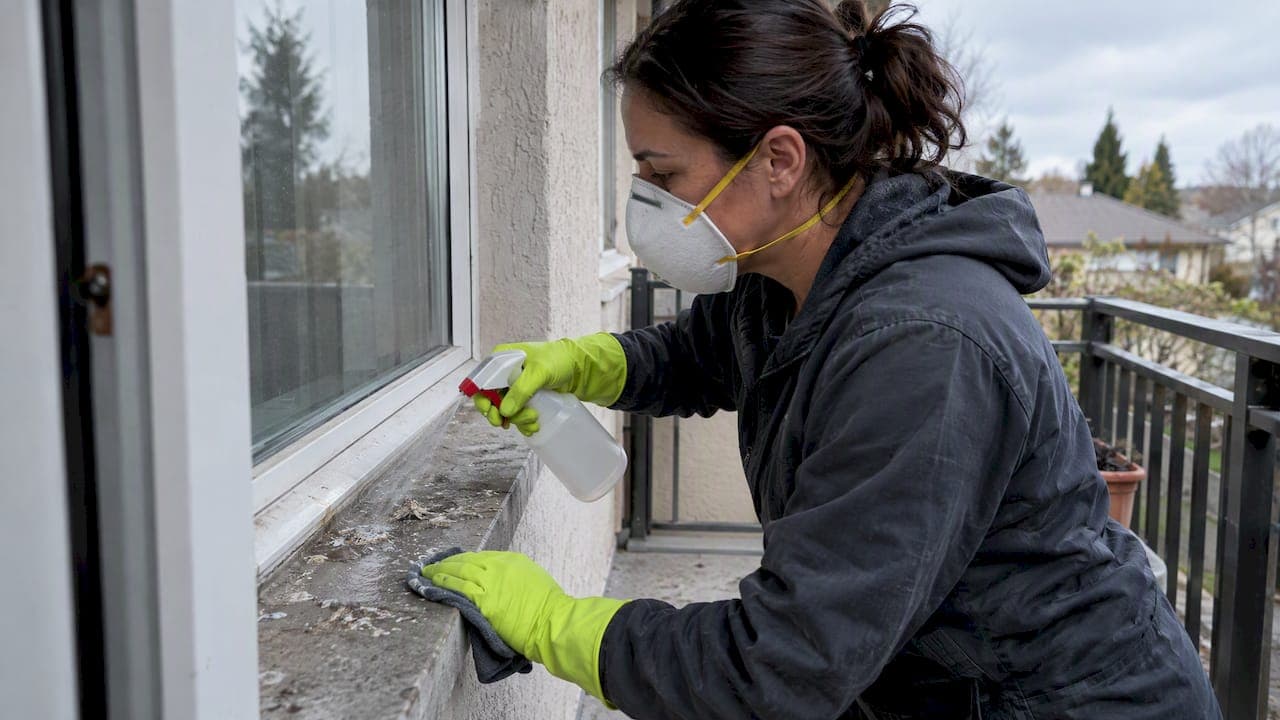
Before anything else, wet the droppings and avoid dry removal: this prevents infectious dust from becoming airborne. For a small, outdoor deposit, soap, water and basic gloves and a mask are usually enough. For anything large, indoors, old, mouldy, or near a roosting site, the safer move is to call a professional rather than disturb it yourself.
TL;DR:
- Psittacosis bacteria can survive for months in dried droppings; dried or indoor cleanup requires a fitted P2 respirator, gloves, and eye protection.
- Older adults, pregnant people, and those with lung conditions or weakened immunity should avoid even modest cleanup jobs and leave them to professionals.
- After detergent washing, use 3% hydrogen peroxide, 70% ethanol, or fresh diluted bleach, and observe the label’s full contact time, often five minutes or more.
- Never dry sweep, use a household vacuum, or pressure wash droppings, because these methods can aerosolize contaminated particles and spread them beyond the cleanup area.
- For large commercial or roof void waste, check local disposal rules or use an existing hazardous waste contractor, since household bin rules may not apply.
Table of Contents
- Health risks and when it's time to call a professional
- Step-by-step DIY cleanup for small, low-risk jobs
- Which PPE to use and how to take it off safely
- Disinfectants that work, and the order that makes them work
- How to stop birds roosting in the first place
- Why trained remediation teams handle high-risk jobs better
- Why dry sweeping, pressure washing and vacuuming make things worse
- Getting rid of the waste safely at home or at work
- Removal technique by surface: concrete, wood and metal
- Eco-friendly products that get the job done
- What this guide gets right that most advice misses
- Need an eco-friendly hand with a larger job?
- FAQ
- Sources
Health risks and when it's time to call a professional
Dried bird droppings can carry organisms that cause real illness, including psittacosis, histoplasmosis and cryptococcosis. These pathogens spread when droppings dry out, crumble and become airborne as fine dust that gets inhaled deep into the lungs. NSW public health guidance notes that the bacterium behind psittacosis, Chlamydia psittaci, can survive for months in dried droppings and spreads through inhalation of contaminated aerosols, not through casual contact.
Some people face a higher risk from exposure: older adults, anyone with a compromised immune system, people with existing lung conditions and pregnant occupants. For this group, even a modest cleanup job is worth handing to someone else. Our guide to safe cleaning during pregnancy covers aerosol risks in more detail for households managing this exact concern.
A few situations should prompt you to stop and call a professional rather than reach for a mop:
- A thick, caked layer of droppings covering a large area.
- Droppings inside a roof space, vent, air handling unit or other poorly ventilated area.
- Visible nesting material, feathers or signs of sick or dead birds nearby.
- Anyone in the household or workplace who is elderly, pregnant or immune-compromised.
Proactive maintenance matters here too. WorkSafe Queensland notes that regular removal of attractants and routine maintenance greatly reduces the need for the riskier, larger decontamination jobs described above.
Step-by-step DIY cleanup for small, low-risk jobs
Small, dry, outdoor accumulations are reasonable to handle yourself if you follow a careful sequence. Skip any step and you risk turning a five-minute job into a health hazard.
- Assess the job first. Check the size of the area, how dry the droppings are, whether it's indoors or outdoors, how well ventilated the space is, and whether there's any sign of nesting or droppings inside vents.
- Clear the area. Keep children, pets and bystanders away, open windows or doors for airflow where possible, and lay down plastic sheeting to contain runoff.
- Gather your gear before you start. You'll want gloves, eye protection, a properly fitted P2 respirator, a spray bottle, disposable cloths or paper towel, detergent, disinfectant and two heavy-duty rubbish bags.
- Wet it down. Mist the droppings with a low-velocity spray of plain or soapy water and let them sit until thoroughly soaked. WorkSafe Queensland specifically recommends wetting droppings before disturbing them to stop dust from becoming airborne.
- Scoop, don't scrape. Lift the softened material with a cloth or scraper and place it straight into a plastic bag, keeping it damp the whole time.
- Double-bag and seal. Place that bag inside a second bag, seal both tightly, and set it aside for disposal.
- Clean the surface with detergent. Organic residue shields pathogens from disinfectants, so a wash with ordinary detergent and water comes first, always.
- Disinfect and wait. Apply your chosen disinfectant and leave it on the surface for the full contact time stated on the label, often five minutes or more.
- Dispose, then wash up. Place used PPE and cloths in with the bagged waste, remove gloves last, and wash your hands and forearms thoroughly with soap.
- Check your work. Inspect the area for any remaining residue or odour before letting anyone back into the space.
Pro Tip: Keep a spray bottle of water in your cleaning kit specifically for this job; the biggest mistake people make is reaching for a broom or hose before anything's been wetted down.
Which PPE to use and how to take it off safely
For any job involving dried or indoor droppings, the minimum kit is a properly fitted P2 (or higher) particulate respirator, disposable gloves and eye protection. WorkSafe Queensland requires this level of protection whenever dried droppings are being disturbed, with disposable coveralls and boot covers added for larger clean-ups.
- Before fitting a disposable respirator, press both hands over it and exhale sharply: air shouldn't leak out around the edges or nose bridge.
- A rough fit check is fine for brief, small jobs; anyone doing this work regularly should get a formal fit test.
- Remove contaminated gear in order: coveralls and boot covers first, gloves next (turned inside out as you peel them off), then eye protection, with the respirator coming off last.
- Bag all used PPE with the droppings waste and wash your hands immediately afterwards.
WorkSafe Queensland's PPE guidance walks through this donning and removal order in detail, and it's worth a look before a first attempt. Working in full PPE on a warm day gets hot fast, so plan shorter sessions with breaks rather than pushing through in one go. P2 respirators are available at most hardware and safety supply stores.
Pro Tip: Buy a few extra respirators and gloves before you start; you don't want to be peeling off contaminated gear mid-job to go searching for a spare.
Disinfectants that work, and the order that makes them work
Cleaning and disinfecting are two separate steps, and skipping the first one undermines the second. Detergent removes the organic matter that otherwise shields pathogens from disinfectant contact, so always wash with detergent and water before reaching for anything stronger.
Once the surface is clean, effective disinfectant options include:
- Quaternary ammonium compounds, widely available in commercial disinfectant sprays.
- 3% hydrogen peroxide solution.
- 70% ethanol.
- Freshly prepared sodium hypochlorite (bleach) solution at the recommended dilution.
NSW public health guidance lists all four as effective against Chlamydia psittaci when cleaning precedes disinfection and contact time is respected, often five minutes or longer depending on the product label.
Many disinfectants are only effective with adequate dwell time on the surface, often five minutes or more. Wiping it off too soon defeats the purpose.
A few cautions worth following every time: never mix bleach with other cleaning chemicals, as the fumes can be dangerous. Prepare bleach solution fresh each session and tip out whatever's left over rather than storing it. If you keep pet birds, avoid disinfectant use around their enclosure without advice from a vet, since fumes that are mild for humans can be harmful to birds.
How to stop birds roosting in the first place
The cheapest clean-up is the one you never have to do. Removing what attracts birds, sealing gaps they nest in and checking problem areas regularly cuts down on how often you're dealing with droppings at all.
- Seal roof gaps, eaves and vents where birds might nest, and remove accessible food or water sources nearby.
- Adjust landscaping where practical, since dense shrubs and overhanging branches near structures give birds easy perches.
- Fit non-toxic deterrents such as bird spikes, angled rails or visual and sonic repellents that discourage roosting without harming wildlife.
- Walk problem areas on a regular schedule so fresh droppings get wiped up before they dry and become a dust hazard.
- Call a wildlife or pest-control specialist if you find an active nest or suspect a protected species, since removal may be restricted by law.
WorkSafe Queensland points out that this kind of proactive maintenance is the single best lever for avoiding the larger, riskier decontamination jobs altogether.
Why trained remediation teams handle high-risk jobs better
A trained remediation team brings containment, correctly fitted PPE and disposal practice that's hard to replicate on a one-off DIY job. We use cleaning protocols on non-toxic, bleach-free agents, which matters particularly indoors or around pets and children where residual chemical fumes are a real concern.
The service range, from rapid response call-outs to full deep decontamination and routine patrols, means it is possible to match the response to the size of the problem rather than applying one approach to every job. For property managers, documented reporting after the job can help limit liability on a site with recurring bird activity. For background on how remediation differs from a standard clean, see our guide to remediation cleaning.
Why dry sweeping, pressure washing and vacuuming make things worse
The instinct to grab a broom, a hose or a vacuum cleaner is understandable, and it's also the fastest way to turn a surface problem into an airborne one. Dry sweeping grinds dried droppings into fine particles and throws them straight into the air you're breathing. WorkSafe Queensland explicitly discourages this, along with high-pressure washing and household vacuuming, because all three aerosolise pathogens rather than containing them.
A household vacuum is a particular problem because its filtration isn't fine enough to trap the pathogens in question, so it can blow contaminated dust straight back into the room through the exhaust. CDC/NIOSH guidance on histoplasmosis prevention recommends water sprays or dust suppression before any removal, reserving vacuuming for industrial units fitted with HEPA filtration, and even then only for larger accumulations handled with proper containment.
High-pressure washing carries a similar problem outdoors: the force of the spray breaks up dried material and launches it into a fine mist that can travel further than you'd expect, including toward open windows, outdoor seating or neighbouring properties. If you're dealing with droppings on an elevated or hard-to-reach surface such as a roof or solar array, this risk is worth factoring in before you start, which is one reason robotic cleaning options for assets like solar panels have gained traction; BrightView's guide to bird droppings on solar panels covers that scenario specifically. The safer substitute, in every case, is a low-velocity mist of water or soapy water applied before any physical removal begins.

Getting rid of the waste safely at home or at work
Once droppings are bagged, how you dispose of them depends on where you are and how much waste you've generated. For a typical residential job, double-bagged waste can usually go into your regular household rubbish bin, sealed tightly to prevent tearing or leaking, following whatever collection rules your local council sets for general waste.
Commercial and larger residential jobs are a different matter. A heavy accumulation from a roof void, loading dock or industrial site may fall under hazardous or biological waste rules depending on your state, and local council or workplace safety guidance should be checked before it goes in a general bin. Where a site has an existing hazardous waste contractor, routing droppings waste through that channel is the simplest path to staying compliant. For sites that also need licensed removal of other hazardous material during the same works, Mission Demolition's waste removal and cleanup service coordinates that kind of specialist handling.
Whichever setting you're in, the same basics apply: keep contaminated waste separate from recyclables, never leave bagged droppings waste sitting exposed outdoors longer than necessary, and wash any bins or containers used to carry it before they go back into general use. If in doubt about classification, your local council's waste line or your workplace safety officer is the right first call rather than guessing.
Removal technique by surface: concrete, wood and metal
The core sequence, wet, clean, disinfect, holds for every surface, but the detail shifts depending on what you're cleaning.

Concrete and masonry can take a firmer scrubbing brush once droppings are wetted and loosened, since the surface itself isn't easily damaged. Detergent and water with a stiff brush lifts most residue, and porous concrete may need a second disinfectant pass if staining persists after the first clean.
Wood, including decking, fascias and outdoor furniture, is more easily damaged by scrubbing and by some disinfectants, so a softer cloth and a gentler detergent solution is the better choice. Test any disinfectant on a small hidden patch first, since bleach-based products can lighten or discolour timber finishes. Avoid pressure washing wood entirely, both for the aerosolisation risk already covered and because it can force water into joins and seams.
Metal surfaces, such as gutters, railings or air conditioning units, often show droppings as a corrosive-looking stain, since bird waste is mildly acidic and can etch some finishes over time if left too long. Wet and clean promptly, using a non-abrasive cloth to avoid scratching painted or coated metal, and dry the surface after disinfecting to limit further corrosion.
Across all three, the step that's easy to skip is the detergent clean before disinfecting. A disinfectant applied straight onto a layer of organic residue on any of these surfaces simply can't reach the pathogens underneath it, so that middle step is never optional.
Eco-friendly products that get the job done
A safe clean doesn't have to mean a toxic one. Plain detergent and water remains the right choice for the initial clean regardless of which disinfectant follows it, and it's about as eco-friendly as cleaning gets.
Where bleach is genuinely the better tool for a stubborn job, using it correctly limits its environmental footprint: mix only what you need for that session, use the lowest dilution the label allows for the surface, and avoid tipping leftover solution straight down stormwater drains. Fresh preparation each time also means you're not storing diluted bleach that degrades and becomes less effective anyway.
For anyone who'd rather not stock a cabinet of different chemicals for a job that might come up once or twice a year, a professional clean using non-toxic, bleach-free protocols removes that decision altogether while still meeting the clean-then-disinfect standard this kind of job calls for.
What this guide gets right that most advice misses
Most advice on this topic treats bird droppings cleanup as either a trivial wipe-down or a full hazmat operation, and the truth sits in between. The size and location of the job matter more than the species of bird or the colour of the mess, and that's the judgement call most guides skip over entirely.
The most overrated piece of conventional advice is reaching for a high-pressure hose because it looks thorough. It's precisely the tool most likely to turn a contained, manageable surface deposit into an airborne problem that drifts well beyond where you started. The underrated step, by contrast, is the plain detergent wash before disinfecting: it gets skipped constantly because it feels like an extra chore, yet it's the step that determines whether the disinfectant that follows actually does anything.
If there's one thing to prioritise above all else, it's the wetting step, done properly, before you touch anything. Everything else in this guide, the PPE, the product choice, the disposal, only matters once that first precaution is in place.
— Lead
Need an eco-friendly hand with a larger job?
If the accumulation you're facing ticks any of the call-a-pro boxes above, we're set up to take it off your hands without resorting to harsh chemicals.

- Rapid Response (2-Hour Tactical Clean) suits an urgent indoor job you need sorted the same day.
- Deep Decontamination is built for heavy, long-standing accumulations that need a full sweep rather than a spot clean.
- The Routine Patrol keeps roofs, balconies and ledges on a regular inspection schedule so droppings never get the chance to build up.
An inspection gives us a clear read on scope before any work starts, and every job runs on non-toxic, bleach-free protocols safe for families, pets and tenants. Browse our full range of cleaning and decontamination services to find the right fit for your property.
This article is general information, not a substitute for advice from a qualified doctor. Consult a qualified healthcare professional about your own circumstances before acting on anything here.
FAQ
What is the best way to clean up bird droppings?
Wet the droppings thoroughly before touching them, then scoop the softened material into a double-bagged container rather than sweeping or scraping it dry. Clean the surface with detergent first, then apply a disinfectant and leave it for the label's full contact time before wiping it away, as detailed in the Step-by-step DIY cleanup for small, low-risk jobs.
How long is bird poop infectious?
The bacterium behind psittacosis can survive for months in dried droppings, according to NSW public health guidance, so an old-looking deposit isn't automatically a safe one. Treat any dried accumulation, regardless of its age, with the same wetting and PPE precautions covered in this guide.
What is a good disinfectant for bird droppings?
Quaternary ammonium compounds, 3% hydrogen peroxide, 70% ethanol and freshly prepared bleach solution are all listed as effective once the surface has been cleaned with detergent first. Our Disinfectants that work, and the order that makes them work covers dilution and safety notes for each option.
Does white vinegar get rid of bird poop?
Vinegar can help loosen dried residue as part of the initial wetting and cleaning step, but it isn't established as an effective disinfectant against pathogens such as Chlamydia psittaci. Follow any vinegar-based clean with one of the disinfectants named above if you need the surface properly sanitised, not just visibly clean.
When should I hire a professional instead of cleaning it myself?
Call a professional for large accumulations, indoor or poorly ventilated spaces, signs of nesting or sick birds, or if anyone on site is elderly, pregnant or immune-compromised. Our Health risks and when it's time to call a professional sets out the specific thresholds worth checking before you start.
Sources
- Work with bird and bat droppings | WorkSafe Queensland
- Psittacosis (Ornithosis) NSW control guideline for public health units
- Elimination and engineering controls | Histoplasmosis | CDC