
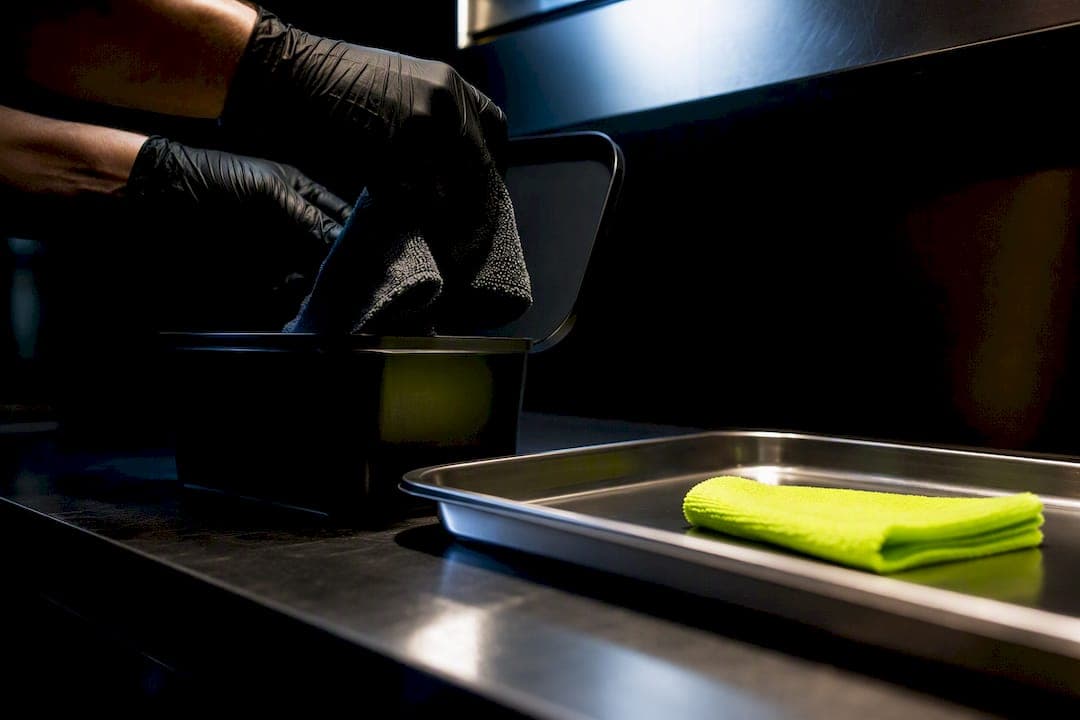
Cross contamination in cleaning happens when microbes, allergens or soils move from a dirty surface, hand or tool to a clean one. The single rule that prevents most of it is separation and sequence: keep risk zones apart and always clean before you sanitise. Food Standards Australia New Zealand and health department guidance build their advice around that order.
TL;DR:
- Using cloth-and-bucket systems without frequent disinfectant changes can transfer up to 4.8 log CFU of bacteria and spores between surfaces.
- Applying cleaning and sanitising in the correct sequence and following label instructions is critical to prevent microbial survival and cross-contamination.
- Implementing zone-specific tools, color coding, and proper storage significantly reduces cross-transfer risks across different areas.
- Layout design choices like separate pathways, dedicated sinks, and airlocks help prevent raw and ready-to-eat product contact before cleaning occurs.
- Regular staff training, meticulous record-keeping, verification, and system fixes are essential to maintaining an effective, contamination-free cleaning program.
Table of Contents
- Common sources and vectors of cross-contamination in cleaning operations
- Cleaning versus sanitising: correct sequence and common operational mistakes
- Effective cleaning methods, product use and verification for food-contact and non-food-contact areas
- Tool selection, cleaning, storage and colour coding tied to zoning
- Workflow, zoning and premises layout to reduce cross-transfer
- Record-keeping, schedules, training and incident response for a robust cleaning programme
- Practical protocol example: mapping a documented reset to anti-cross-contamination controls
- Fix the system before you fix the frequency
- How Grime Scene Services supports managers with documented anti-cross-contamination cleaning programmes
- Sources
- FAQ
Common sources and vectors of cross-contamination in cleaning operations
Most cross contamination traces back to a handful of repeat offenders. Raw food touching ready-to-eat food is the obvious one, but cleaning tools themselves are just as often the carrier: a cloth wiped over a dirty bench, then a clean one, moves whatever it picked up along the way.
Hands and shared equipment do the same job at a larger scale. A 2020 disinfectant towelette study found that ready-to-use wipes can transfer Staphylococcus aureus and Pseudomonas aeruginosa between surfaces, with the risk changing depending on the wipe's chemistry and how much surface area it covers before it's replaced.
- Raw-to-ready transfer through shared boards, knives or bench space
- Hands moving between tasks without a wash or glove change
- Shared cloths and buckets carrying diluted contamination from surface to surface
- Cleaning tools and equipment left wet or stored without separation
- Drains and drip paths spreading soil beyond the area being cleaned
Spore-forming organisms change the calculation. Vegetative bacteria die off with standard detergent and sanitiser use, but spores survive far more of what a normal clean throws at them, which is why the choice of chemistry and contact time matters more in some areas than others.
Cleaning versus sanitising: correct sequence and common operational mistakes
Cleaning removes visible soil, grease and organic matter. Sanitising reduces the microbes left behind. They are not interchangeable, and doing them in the wrong order is one of the most common reasons a cleaning programme fails without anyone noticing. Food Standards guidance is explicit that food-contact surfaces need cleaning before sanitising, because leftover food residue or detergent stops sanitiser from working properly.
The operational sequence looks like this:
- Contain the area and remove any loose or gross soil first
- Apply detergent and physically clean the surface
- Rinse if the product label calls for it
- Apply sanitiser at the correct dilution
- Hold the surface wet for the full contact time stated on the label
- Let it air dry rather than wiping it with a cloth that could reintroduce microbes
Most breakdowns happen in the gaps between these steps: a cloth that's already dirty being used for the "clean" step, a rinse skipped to save time, sanitiser mixed too weak or too strong, or contact time cut short because the next job is waiting. Australian workplace hygiene guidance frames the fix as procedural discipline rather than extra effort: detergent and warm water first, then the disinfectant, at the concentration and dwell time the label specifies.
Effective cleaning methods, product use and verification for food-contact and non-food-contact areas
The tool you choose matters as much as the chemical in it. Single-use wipes make sense for high-risk, high-touch points where you want to avoid moving anything between surfaces at all. Reusable cloth-and-bucket systems still have a place, but they carry more risk if the same cloth and solution get reused across multiple surfaces.

A 2020 Food Protection Trends study measured this directly.
Statistic: The cloth-and-bucket method transferred roughly 4.8 log CFU of Listeria innocua and 3.3 log CFU of E. coli between surfaces without disinfectant, and Bacillus cereus spores transferred efficiently even when a quaternary ammonium disinfectant was used. Spores are the hard case: a disinfectant that handles vegetative bacteria won't necessarily stop spore transfer through the same cloth.
- Change cleaning solution and cloths far more often when using cloth-and-bucket methods
- Match the disinfectant chemistry to the organism risk in that area, not just the visible soil
- Follow the label exactly for dilution, coverage and contact time rather than estimating
- Verify results with checklists, ATP swabs or periodic microbiological testing where the risk warrants it
None of this replaces the label. Manufacturer instructions on dilution, coverage and contact time exist because that's how the product was tested, and departing from them is effectively running an unvalidated process.
Tool selection, cleaning, storage and colour coding tied to zoning
Tools that are hard to clean become permanent contamination reservoirs. One-piece, hygienic-design brushes and squeegees without seams or crevices are easier to clean thoroughly and don't trap soil the way jointed or hollow-handled tools do.
- Inspect mop heads, brush bristles and squeegee blades regularly and retire damaged ones
- Launder or replace mop heads and cloths on a set schedule, not just when they look dirty
- Store tools off the floor, separated by zone, with no shared drip trays between clean and dirty areas
- Tie colour coding to a documented zoning plan, because colour without a written zone map is just decoration
Safe Food Australia's Standard 3.2.3 makes this point clearly: colour coding only prevents cross contamination when staff know which colour belongs to which zone and the storage system enforces that separation.
Pro Tip: Photograph your tool storage area once a month and compare it against the zoning plan. Drift happens quietly.

Workflow, zoning and premises layout to reduce cross-transfer
Layout does a lot of the prevention work before anyone picks up a cloth. A one-way flow from receipt through storage, prep and dispatch stops raw and ready-to-eat product paths from crossing, and the same logic applies to cleaning staff and equipment moving through a site.
- Route raw deliveries and finished product along separate paths where the layout allows it
- Where dedicated equipment isn't possible, separate tasks by time and clean thoroughly between them
- Design in cleanable materials, adequate drainage and dedicated sinks rather than shared ones
Safe Food Australia's premises chapter recommends airlocks, dedicated sinks and clear separation of dirty and clean areas as design choices that reduce both contamination opportunities and the cleaning burden itself.
Record-keeping, schedules, training and incident response for a robust cleaning programme
A cleaning schedule only works as a control if it's specific enough to check. Each line needs the area, the surface type, the frequency, the method, the person responsible, the chemical used and how it gets verified.
- Write the schedule down with all seven elements, not just "clean daily"
- Verify with supervisor sign-off, ATP checks or periodic swabs rather than a visual glance alone
- Train staff on hand washing, glove changes, spill isolation and safe chemical handling, including never mixing chemicals
Testing supports a cleaning system but doesn't replace it: an ATP reading tells you whether a specific clean worked that day, not whether the underlying procedure will hold up next week. A risk-based cleaning frequency guide and an audit-ready checklist are useful starting templates for building this out.
Practical protocol example: mapping a documented reset to anti-cross-contamination controls
A cleaning service runs a Scene Reset protocol as a worked example of the sequence above in practice: contain the space, clean, sanitise, verify, then store tools correctly before leaving. Each step gets checked off rather than assumed.
- Containment and soil removal before any chemical is applied
- Clean using non-toxic, bleach-free agents, then sanitise and hold contact time
- Verification through before-and-after photography and a completed checklist
- Tools cleaned and stored by zone immediately after use, not left for the next job
The eco-friendly, non-toxic chemistry is the point of difference the business states for itself. It doesn't change the sequence, it changes what's in the bucket, and the same checklist-and-photo verification applies either way for a rental turnover, as covered in the kitchen turnover checklist.
Fix the system before you fix the frequency
Cross contamination is rarely a cleaning-frequency problem. It's usually a systems problem: tools stored wrong, sequence skipped under time pressure, no verification beyond a glance. In the first 90 days, map product and staff flow, fix tool storage first, enforce the clean-then-sanitise order without exception, and start verifying with more than a visual check. Verification beats a clean-looking surface every time, because clean-looking and clean are not the same thing.
— Lead
How Grime Scene Services supports managers with documented anti-cross-contamination cleaning programmes
Building the system above from scratch takes time most managers don't have between shifts. A cleaning service offers routine patrols to hold the line day to day, deep decontamination when a space needs a full reset, and a Scene Reset protocol for rental turnovers, using non-toxic, bleach-free agents and documented before-and-after verification.
- Routine Patrol and Deep Decontamination cover ongoing and one-off contamination control
- Rapid Response delivers a two-hour tactical clean when a space needs to be turned around fast
- Every job comes with checklist and photo verification rather than a visual sign-off alone
| Service | Best fit |
|---|---|
| The Routine Patrol | Ongoing zone-based maintenance cleaning |
| Deep Decontamination | Full-sweep remediation of a contaminated space |
| The Scene Reset | Rental turnover with documented verification |
| Rapid Response (2-Hour Tactical Clean) | Urgent, time-boxed contamination response |
If your current programme is running on visual checks alone, a documented deep decontamination or a rapid response booking is the next practical step.
Sources
For further reading, Food Standards Australia New Zealand and the Health Department's cleaning and disinfection guidance both cover sequencing directly, and the Food Protection Trends cloth-and-bucket study provides the transfer data behind this article. For office-specific workflows, 360 Cleaning's commercial best practices guide offers additional checklist material.
- Food Standards Australia New Zealand — Cleaning and sanitising
- Characterizing microbial cross-contamination on large surfaces using a traditional cloth-and-bucket disinfection method (Food Protection Trends, 2020)
- Study on transfer of bacteria by disinfectant towelettes
FAQ
What are 5 examples of cross contamination?
Common examples include raw meat juices touching ready-to-eat food, hands moving between dirty and clean tasks without washing, a shared cloth wiped across multiple surfaces, a cleaning bucket solution reused across zones, and cleaning tools stored without separation by risk area.
What are 5 ways to avoid cross contamination?
Separate risk zones and keep raw and ready-to-eat workflows apart, always clean before sanitising, use single-use wipes or frequently changed cloths and solutions, colour-code tools tied to a documented zoning plan, and verify cleaning with checklists or ATP testing rather than a visual check alone, following Food Standards guidance on sequencing.
What are the four C's of cross contamination?
Definitions vary, but a common version covers cleaning, chilling, cooking and containing (or cross-contamination itself), used as a memory aid for the main food safety controls. It's a simplified teaching tool rather than a formal regulatory standard.
How do you prevent cross contamination when cleaning?
Contain the area, remove gross soil, clean with detergent, rinse if the label requires it, then apply sanitiser and hold the correct contact time before allowing the surface to air dry. This sequence, set out in Australian workplace hygiene guidance, is the operational core of preventing transfer during cleaning itself.