
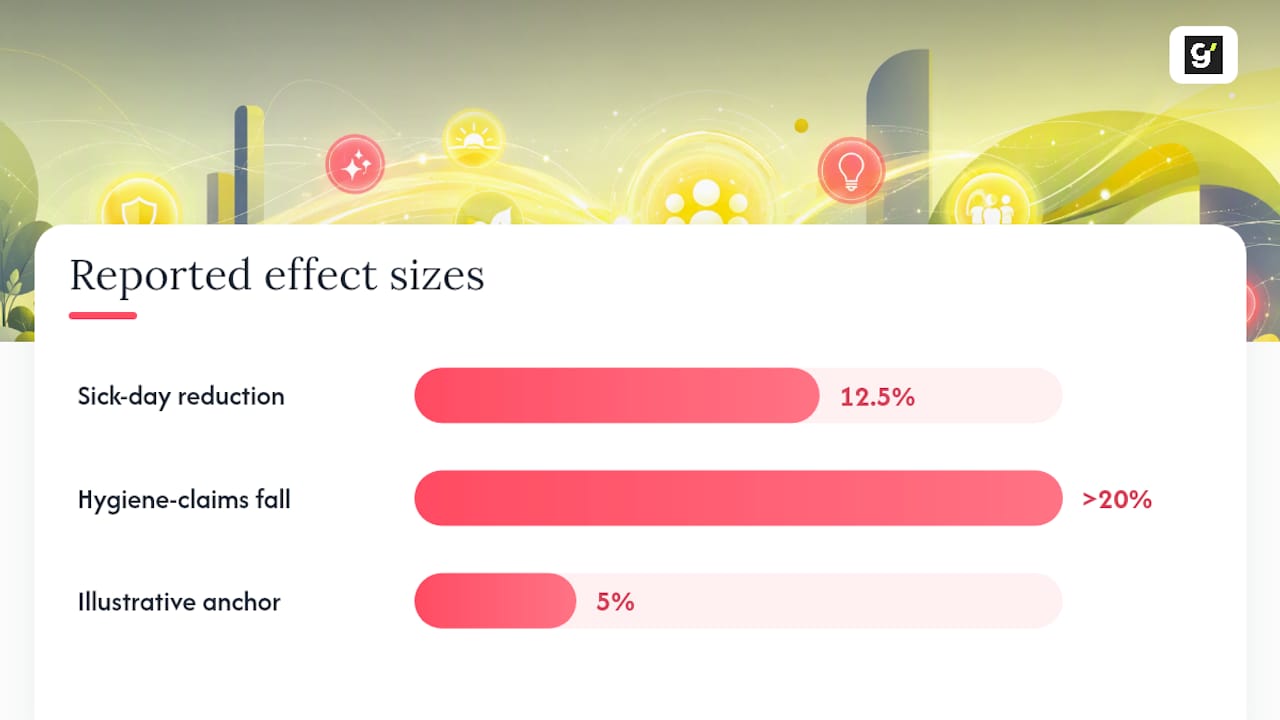
A clean workplace measurably lifts productivity and cuts absenteeism, and the effect is large enough to show up on a spreadsheet, not just in how tidy the office looks. One controlled study found that improving cleaning quality alone was linked to a 12.5% drop in sick days, and hygiene programmes that added education and hand sanitiser cut hygiene-related healthcare claims substantially
That single figure is worth repeating in a budget meeting because it converts a "nice to have" into a cost line. The three benefits managers care about most are sharper focus and fewer errors during the working day, fewer sick days and less presenteeism (people showing up unwell and working at half capacity), and a stronger first impression on clients and candidates as they walk through the door.
If you do nothing else after reading this, do one thing: pull your last six months of sick leave data and check it against your current cleaning schedule. That single comparison tells you whether cleanliness is quietly costing you more than the invoice for a cleaning contract ever would.
Key takeaways
Workplace cleanliness drives measurable productivity and financial gains through fewer sick days, less presenteeism and stronger customer impressions.
| Point | Details |
|---|---|
| Sick days respond to cleaning quality | Improved cleaning programmes have been linked to a 12.5% drop in sick days. |
| Presenteeism is the hidden cost | Working while unwell can cut individual output by roughly a third. |
| Hot desks need professional cleaning | Fewer than half of staff reliably sanitise shared desks themselves. |
| Measure before you claim success | Track sick days, complaints and audit scores for 3–6 months before judging impact. |
| Next step | Pull six months of sick leave data and compare it against your current cleaning schedule this week. |
Table of Contents
- Workplace cleanliness productivity benefits managers can act on
- Building a cleaning programme that actually sticks
- Measuring the productivity and financial impact of a cleaner workplace
- What the research actually shows, and where it's shaky
- Why sustaining a cleaning programme is harder than starting one
- Where to go deeper on the evidence and templates
- Frequently asked questions
- Sources
Workplace cleanliness productivity benefits managers can act on
Cleanliness affects productivity through several separate channels, and treating them separately is what makes the business case land with a finance team.
-
Sharper focus and fewer errors. Cluttered desks and grimy shared equipment force the brain to filter out visual noise before it can concentrate on the actual task, which slows decision-making and increases mistakes. Objective cleanliness measures, including dust and particle counts, correlate significantly with higher perceived productivity and job satisfaction in office settings. Track it by logging error rates or rework requests for four weeks before and after a cleaning schedule change.
-
Fewer sick days. This is the statistic worth leading with in any pitch to leadership: cleaning quality improvements were tied to a 12.5% reduction in sick days in the same analysis referenced above. Track sick days per full-time equivalent (FTE) monthly, and watch the trend over a full quarter rather than reacting to a single good or bad month.
-
Reduced presenteeism. Sick days only capture people who stay home. Presenteeism, workers who turn up unwell and operate well below capacity, can reduce individual output by roughly a third when someone works through illness, according to ISSA's Value of Cleaning research. Improved hand hygiene and surface cleaning reduce the spread of the colds and gastro bugs that drive this. Run a short anonymous survey asking staff how often they've worked while unwell in the last month.
-
Better morale and retention. Nobody wants to explain to a new hire why the kitchen looks the way it does. A visibly maintained workspace signals that management cares about working conditions, and that perception shows up in engagement surveys and, eventually, in who stays. Watch voluntary turnover and exit-interview themes for mentions of facilities or hygiene.
-
Stronger brand and customer impressions. Clients form an opinion about your business within seconds of walking in, and a grubby reception area undoes weeks of sales effort. This applies equally to commercial tenants and hospitality guests as to office visitors, a link explored in more detail in how cleaning quality shapes brand perception. Track customer complaint counts and, where relevant, online review mentions of cleanliness.
-
Asset preservation and lower maintenance costs. Grime left to build up on carpets, benchtops and equipment accelerates wear and shortens the life of assets you've already paid for. Regular, correctly scheduled cleaning is cheaper over three years than reactive deep cleans and early replacements, a pattern also covered in how professional cleaning extends the working life of a property. Track maintenance and equipment-replacement spend annually against your cleaning budget.
-
Better indoor environmental quality (IEQ) and infection control. Cleanliness isn't only about surfaces. Ventilation rate, temperature and perceived air quality all have measurable, quantifiable links to short-term performance and sick leave, according to a detailed review of ventilation and productivity data. Shared spaces such as meeting rooms, hot desks and kitchens are where cross-contamination spreads fastest, which is why high-touch surfaces need a different cleaning frequency to private offices. Track HVAC service intervals alongside your cleaning audit scores rather than treating them as separate budgets.
Pro Tip: Don't measure cleanliness in isolation. Pair a cleaning audit score with one soft metric, like a quarterly staff pulse survey question on "I have a clean, comfortable place to work." The audit tells you what changed; the survey tells you if anyone noticed.
Building a cleaning programme that actually sticks
Most cleaning programmes fail not because the cleaning is poor but because nobody designed the programme with real work patterns in mind. Start with three zones: high-touch surfaces (door handles, shared keyboards, kitchen taps), communal areas (kitchens, bathrooms, meeting rooms) and private workstations. Each zone needs its own frequency and standard, because treating a bathroom the same as a private desk wastes cleaning hours where they're not needed and starves the areas that actually spread illness.
A workable schedule template looks like this:
- Daily: bathrooms, kitchen benches, bins, high-touch door handles and shared equipment.
- Weekly: desk surfaces, meeting room tables, floors in low-traffic zones.
- Monthly: deep clean of carpets, upholstery and vents.
- Quarterly: full audit against your written cleaning standard, ideally by someone outside the day-to-day roster.
Hot-desking and flexible seating deserve their own line item. Fewer than half of employees actually use the sanitising wipes provided at shared desks, according to WorkSafe Queensland's hot-desk hygiene guidance, so an operations plan built on the assumption that staff will sanitise their own desk between uses will routinely fail. Build professional cleaning rotations into any hot-desk policy rather than relying on goodwill.
Behaviour change matters as much as the cleaning roster itself. Pilot programmes combining functioning WASH facilities (soap, working taps, accessible sanitiser) with repeated training and visual prompts produced strong, measurable shifts in handwashing behaviour and reported wellbeing gains, as documented in the Global Handwashing Partnership's workplace hygiene brief. Appointing a hygiene champion per floor or department, someone who flags empty soap dispensers and reminds colleagues after a sick period, costs nothing and does more than a poster campaign.
When you're deciding between in-house cleaning staff and an outsourced contractor, ask three questions: can the provider report against agreed KPIs (not just "cleaned" or "not cleaned"), do they use eco-friendly and non-toxic products suited to shared and food-prep areas, and can they scale up for a one-off deep decontamination after an incident like a burst pipe or a norovirus outbreak? A detailed 2026 deep cleaning schedule is a useful reference point when writing a brief for tenders. For jobs beyond routine maintenance, such as post-construction dust, biohazard incidents or long-overdue deep resets, professional deep decontamination services are worth bringing in rather than stretching an in-house team past its scope.
Pro Tip: Tie cleaning duties to existing rhythms rather than inventing new ones. A two-minute "clear your desk" prompt at the end of the Friday team meeting will outperform a standalone email reminder every time, because it rides on a habit that already exists.
| Point | Details |
|---|---|
| Zone your cleaning | Split high-touch, communal and private areas into separate frequencies and standards. |
| Plan for hot desks | Assume professional cleaning, not staff sanitising, since uptake sits below 50%. |
| Appoint a champion | A floor-level hygiene champion sustains behaviour change better than signage alone. |
| Brief vendors on KPIs | Ask for measurable service reporting, not just a completed job checklist. |
Measuring the productivity and financial impact of a cleaner workplace
You don't need a data science team to prove a cleaning programme is working. You need a baseline, a clear intervention, and enough patience to let a signal emerge instead of reacting to noise. Most managers underestimate how long that takes; three to six months is the realistic minimum for sick leave and error-rate data to separate signal from seasonal flu spikes or a one-off busy quarter.
Six KPIs cover almost everything a manager needs to build a business case:
- Sick days per FTE, tracked monthly against the same period last year.
- Presenteeism proxy, via a simple survey question on working while unwell.
- Customer or client complaint counts tagged by category, including cleanliness.
- Minutes lost per day to searching for documents or equipment in cluttered spaces, self-reported via a short quarterly pulse check.
- Equipment failure or replacement rate, tracked annually against maintenance spend.
- Cleaning audit score, scored against your written standard by an independent checker.
A simple KPI table you can copy into a spreadsheet:
| KPI | Unit | Baseline period | Review cadence |
|---|---|---|---|
| Sick days per FTE | Days/month | 3 months prior | Monthly |
| Presenteeism proxy | % reporting "worked while unwell" | 1 survey | Quarterly |
| Customer complaints (cleanliness-tagged) | Count/month | 3 months prior | Monthly |
| Cleaning audit score | Score | 1 audit | Quarterly |
For the dollar figure a finance team actually wants, use a plain formula: (average daily wage × average FTE headcount × estimated productivity gain) × working days per year. A 5% productivity gain, the figure reported in one office case study by ISSA's Value of Cleaning white paper, applied across a 50-person team on an average daily wage, easily outweighs the cost of a recurring commercial cleaning contract. Run the same formula using the 12.5% sick-day reduction figure and you get a second, independent number to sanity-check the first. When both formulas point the same direction, you've got a business case that survives scrutiny.
What the research actually shows, and where it's shaky
The strongest number in this space remains the 12.5% reduction in sick days tied to improved cleaning quality, alongside a greater than 20% fall in hygiene-related healthcare claims where education and sanitiser access were added. That's a controlled comparison, which makes it more reliable than most workplace wellness claims you'll come across.
Indoor environmental quality research adds a second, related thread. Peer-reviewed reviews of ventilation, temperature and perceived air quality show measurable links to short-term sick leave and performance, and improving IEQ often proves cost-effective when productivity gains are factored into the calculation, not just energy costs. Workplace hygiene interventions built around functioning facilities and behaviour change, not just a cleaning roster, drove strong reported wellbeing and productivity shifts in pilot workplace programmes. And at the desk level, measured cleanliness (not just staff opinion of it) correlates with higher perceived productivity and job satisfaction.
Here's the honest caveat: these studies measure different things in different ways. Some rely on self-reported productivity, some on objective sick-day counts, some on dust and particle measurement. That means effect sizes aren't directly comparable across studies, and a manager building a business case should treat the 12.5% and 5% figures as illustrative anchors rather than numbers that will replicate exactly in their own office.
| Evidence type | What it measures | Strength for a business case |
|---|---|---|
| Controlled cleaning-quality trials | Sick days, healthcare claims | Strong, directly financial |
| IEQ/ventilation reviews | Sick leave, performance | Moderate, useful for building specs |
| Hygiene behaviour-change pilots | Reported wellbeing, handwashing uptake | Moderate, good for engagement design |
| Perceived cleanliness surveys | Self-reported productivity | Weaker alone, best combined with hard KPIs |
The practical takeaway for a manager building a case: combine at least one hard KPI (sick days, complaint counts) with one soft measure (a staff survey) before presenting to leadership. Neither on its own tells the full story.
Why sustaining a cleaning programme is harder than starting one
The barrier most managers underestimate isn't convincing leadership to fund a cleaning programme. It's keeping it running past month three, once the initial enthusiasm fades and the roster starts slipping during busy periods. Programmes that survive tend to have one thing in common: a named owner, someone whose job it is to check the audit score and chase the schedule, rather than a cleaning contract that exists somewhere in a shared drive nobody opens.
Leadership sponsorship matters more than most managers assume, not because staff need permission to wash their hands, but because a manager who visibly cares about a tidy kitchen changes what "normal" looks like on that floor. Tie your cleaning routine to a rhythm that already exists, a Monday operations meeting, a shift handover checklist, rather than inventing a separate cadence competing for attention.
Pro Tip: If you outsource, treat the vendor relationship the same way you'd treat any recurring supplier: agree on reporting, review it quarterly, and don't wait for a complaint to raise a standards issue.
If your team is weighing a recurring service against building an in-house roster, an eco-friendly, non-toxic provider with a documented "Scene Reset"-style turnover protocol for high-use spaces, similar to what Grime Scene Services offers for commercial and short-term rental properties, removes the guesswork around chemical safety while still meeting the KPI reporting a serious business case needs.
Where to go deeper on the evidence and templates
- The ABC News report on workplace hygiene costs is the clearest single source for the sick-day and healthcare-claims figures used throughout this article.
- The Global Handwashing Partnership's hygiene behaviour brief gives practical pilot examples for designing engagement and training.
- The eScholarship review on ventilation and productivity is the go-to reference for building an indoor environmental quality case alongside cleaning.
- The ISSA Value of Cleaning white paper provides the ROI formulas referenced in the measurement section.
- Safe Work Australia offers general guidance on workplace hygiene obligations and WASH facility standards.
- For an operational template, the 2026 commercial deep cleaning schedule is a practical starting point for writing a vendor brief.
Frequently asked questions
Does workplace cleanliness really affect productivity, or is it mostly about appearances? Both. Appearance shapes client and staff perception immediately, but the harder evidence is in sick-day data. Controlled improvements in cleaning quality have been linked to a 12.5% fall in sick days, which is a direct cost saving, not just a perception shift.
How long before a new cleaning programme shows measurable results? Give it three to six months before drawing conclusions. Sick-day trends and audit scores need that window to separate a genuine shift from normal seasonal variation.
Is it better to hire an in-house cleaner or outsource to a professional service? It depends on scale and complexity. Smaller teams with simple daily needs can often manage in-house, but recurring commercial cleaning, deep decontamination or post-construction cleans usually need professional-grade equipment and eco-friendly, non-toxic products that a specialist provider like Grime Scene Services can deliver with proper KPI reporting.
What's the single most important KPI for tracking cleanliness improvements? Sick days per FTE is the most defensible number for a business case because it's objective, easy to collect, and directly tied to the strongest available research on cleaning quality.
Do hot-desking and flexible seating need a different cleaning approach? Yes. Relying on employees to sanitise shared desks routinely fails, since fewer than half actually use the wipes provided, according to WorkSafe Queensland guidance. Build a professional cleaning rotation into any hot-desk policy rather than assuming staff will do it themselves.
Sources
- Our workplaces are filthy and it's costing us all - ABC News
- Boosting business: hygiene behaviour change learning brief
- Quantitative IEQ–productivity review (eScholarship PDF)
- Impact of cleanliness on the productivity of employees (ResearchGate)