
Hydrogen peroxide, accelerated hydrogen peroxide (AHP), and oxygen-based peroxygens are the most practical eco-friendly disinfection options for Australian homes and facilities. For food-contact prep surfaces, oxygen bleach (sodium percarbonate) is a safer rinse-compatible choice. For heavy contamination or whole-room decontamination, hydrogen peroxide vapour (HPV) no-touch systems deliver the most thorough result without leaving toxic residues.
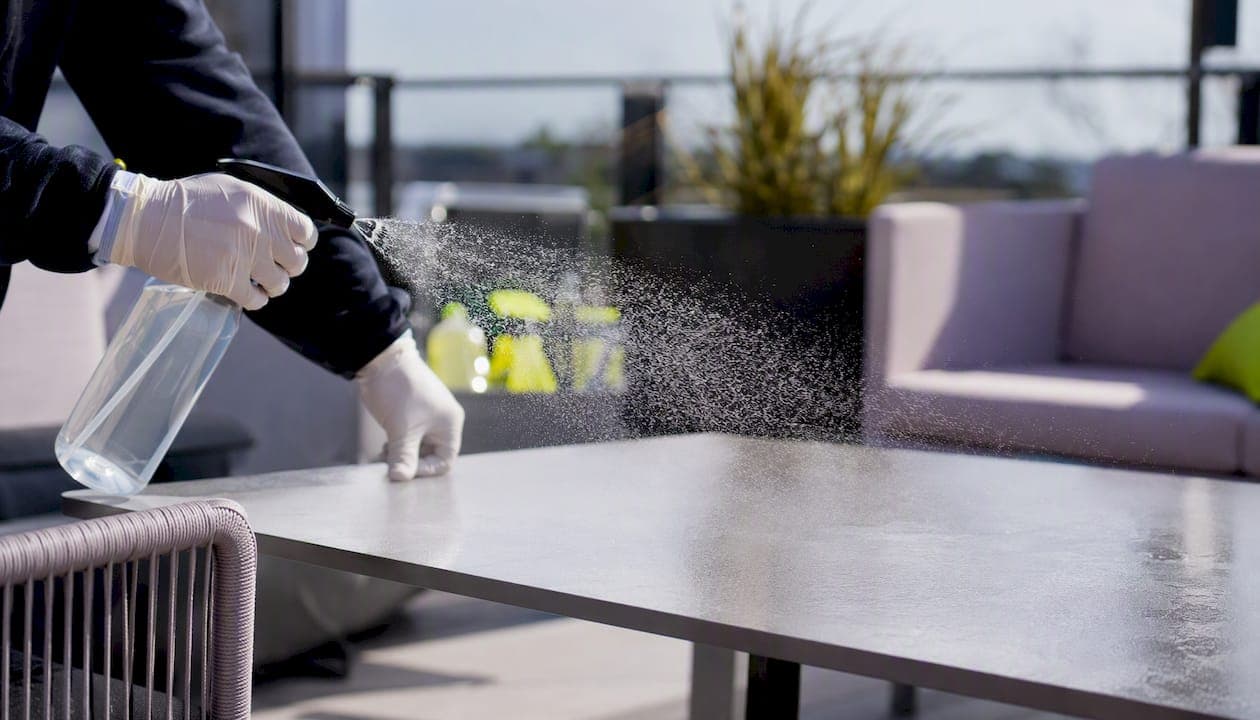
- Everyday surfaces (benchtops, door handles, light switches): Apply a 3% hydrogen peroxide solution or an AHP spray, leave for the labelled contact time, wipe off.
- Food-contact prep surfaces: Use an oxygen-based peroxygen (sodium percarbonate solution), rinse after contact time.
- Heavy contamination or large-area decontamination: Call a professional using HPV or AHP deep-decontamination protocols.
Pro Tip: Always clean visible soil off a surface before applying any disinfectant. Organic matter neutralises disinfectants fast, and skipping this step means the product never reaches the pathogen. Then follow the label's contact time exactly — wiping it off early is the single most common reason disinfection fails.
Key takeaways
Eco-friendly disinfection works when you match the right agent to the task, follow the labelled contact time, and always clean the surface before applying any disinfectant.
| Point | Details |
|---|---|
| Clean before you disinfect | Organic matter neutralises disinfectants; skip this step and the product cannot reach the pathogen. |
| Match agent to task | Hydrogen peroxide and AHP for hard surfaces; oxygen bleach for grout and laundry; steam for fixtures; HPV for whole-room decontamination. |
| Contact time is non-negotiable | Wiping off a disinfectant early is the most common reason disinfection fails; set a timer and hold the full time. |
| Check SDS and APVMA claims | Verify biodegradability, toxicity, and efficacy data before trusting any "eco-friendly" label. |
| Grimescene for heavy contamination | Grimescene's Deep Decontamination Full Sweep uses bleach-free, SDS-aligned agents with documented protocols for whole-property decontamination. |
Table of Contents
- What makes a disinfectant genuinely eco-friendly?
- Which eco-friendly agents actually disinfect?
- How to disinfect properly: a step-by-step workflow
- How to choose the right eco disinfectant for your setting
- Safe DIY options and the pitfalls that catch people out
- When to call a professional eco decontamination service
- Sources
What makes a disinfectant genuinely eco-friendly?
"Eco-friendly" on a label means almost nothing without evidence behind it. A product earns that description when it delivers proven antimicrobial action AND breaks down into benign by-products, carries a low toxicity profile for people and pets, and leaves no persistent halogenated residues in the environment.
Practically, here is what to check on the bottle or Safety Data Sheet (SDS) before you buy:
- Biodegradability: Does the product meet a recognised standard such as OECD Test No. 301 ready biodegradability? Products that pass this test break down quickly in the environment rather than accumulating.
- Toxicity profile: Low acute toxicity to humans, pets, and aquatic organisms. Check the SDS hazard classification.
- No persistent halogenated by-products: Chlorine-based products can form chlorinated compounds that persist in waterways.
- Low VOCs: Minimal volatile organic compounds means safer indoor air quality.
- Clear efficacy claims: A contact time and a named pathogen on the label. No contact time listed = no verifiable disinfection claim.
- Australian regulatory cues: Check whether the product carries APVMA registration or references independent lab efficacy data.
Greenwashing is common in this category. A product labelled "plant-based" or "natural" may still contain quaternary ammonium compounds (quats) that persist in waterways, or it may simply not disinfect at all. The EPA Safer Choice programme is a useful US-based screening tool; for Australian purchases, the APVMA public register and the product's own SDS are your primary checks.
Which eco-friendly agents actually disinfect?
The agents below have published evidence behind them. Each one is available in Australia in some form, though product names and concentrations vary.
| Agent | Efficacy / contact time | Human & pet safety | Environmental fate | Surface compatibility | Australian availability |
|---|---|---|---|---|---|
| Hydrogen peroxide (aqueous, 3–6%) | Broad-spectrum bacteria and viruses; >3 log10 reductions against E. coli and S. aureus at specified exposure times | Low toxicity at household concentrations; mild irritant at higher concentrations | Breaks down to water and oxygen; no persistent residues | Most hard surfaces; can bleach fabrics and damage some metals at high concentrations | Widely available (chemists, hardware stores) |
| Accelerated hydrogen peroxide (AHP) | Broad-spectrum; faster contact times than standard H₂O₂ due to surfactant synergy | Low irritancy; generally safe around pets when diluted correctly | Decomposes to water and oxygen | Hard surfaces, medical-grade equipment; gentler on finishes than bleach | Available via commercial cleaning suppliers; some retail products (e.g. Ecoshield Eco Disinfectant Cleaner) |
| Oxygen bleach / sodium percarbonate | Effective against bacteria and some viruses; longer contact times needed | Very low toxicity; safe for most household use | Breaks down to sodium carbonate, water, and oxygen | Fabrics, grout, hard surfaces; avoid prolonged contact with aluminium | Widely available (supermarkets, hardware stores) |
| Steam cleaners (dry steam, high temperature) | Kills most bacteria and many viruses on contact via thermal action | No chemical residue; safe for pets and children after surfaces cool | Zero chemical waste | Most hard surfaces; avoid on unsealed timber, delicate fabrics | Widely available (appliance retailers) |
| Hydrogen peroxide vapour (HPV) | Highly effective across a broad pathogen range; reaches crevices standard sprays miss | Requires room evacuation during treatment; safe after aeration | Decomposes to water and oxygen; no persistent residues | Whole-room, including soft furnishings and HVAC surfaces | Professional-grade equipment; used by specialist decontamination services |
Use-case mapping:
- Kitchen benchtops and sinks: 3% hydrogen peroxide or AHP spray, 5–10 minute contact time.
- Bathroom surfaces: AHP or oxygen bleach paste for grout; steam for tile and fixtures.
- Short-term rental turnover: AHP products for speed and surface safety; HPV for post-illness deep decontamination.
- Healthcare or clinic settings: AHP or HPV systems; verify contact times against the specific pathogen list.
Safety callout: Higher concentrations of hydrogen peroxide can irritate skin and eyes. Always wear nitrile gloves and ensure ventilation. Test AHP and oxygen bleach on an inconspicuous area before using on polished stone, anodised aluminium, or coloured grout.
For a broader look at how these agents fit into a sustainable cleaning routine, the principles are the same: match the agent to the task, follow the label, and protect your finishes.
How to disinfect properly: a step-by-step workflow
Disinfection only works when the steps happen in the right order. Skipping the clean step is the most expensive mistake — it wastes product and leaves pathogens behind.
- Remove visible soil. Wipe away food debris, dust, or organic matter with a damp cloth or paper towel. Bin the cloth or dispose of the paper towel.
- Clean the surface. Apply a surfactant-based cleaner or dish soap, scrub, and rinse. The surface should look clean before any disinfectant touches it.
- Choose your eco disinfectant. Match the agent to the surface and task (see the table above). Check the SDS for dilution instructions.
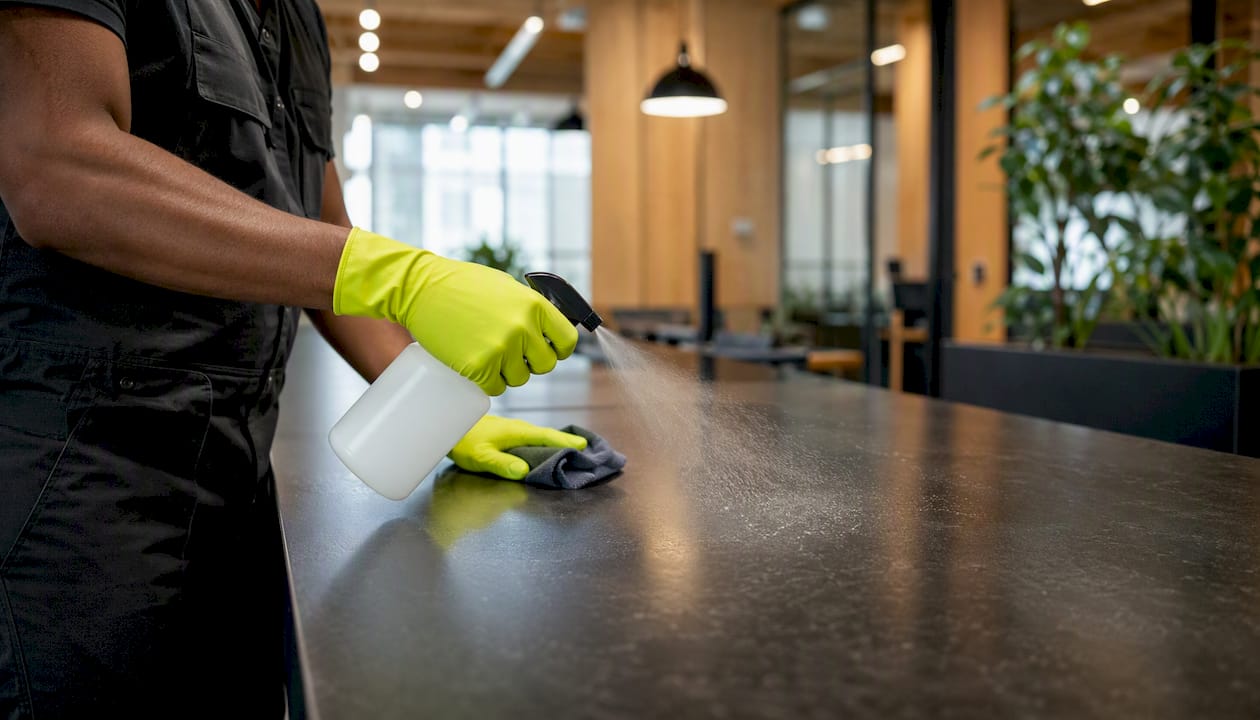
- Apply correctly. The surface must be visibly wet for the full contact time. Spray liberally or use a saturated cloth. Do not wipe off immediately.
- Hold the contact time. Leave the product on the surface for the full time listed on the label. Set a timer.
- Rinse if required. Food-contact surfaces and children's toys need rinsing after disinfection. Check the label.
- Ventilate and allow to dry. Open windows or run exhaust fans. Allow the surface to air-dry completely before use.
- PPE and pet precautions. Wear nitrile gloves for any disinfectant application. Keep pets out of the room until surfaces are dry and the area is ventilated.
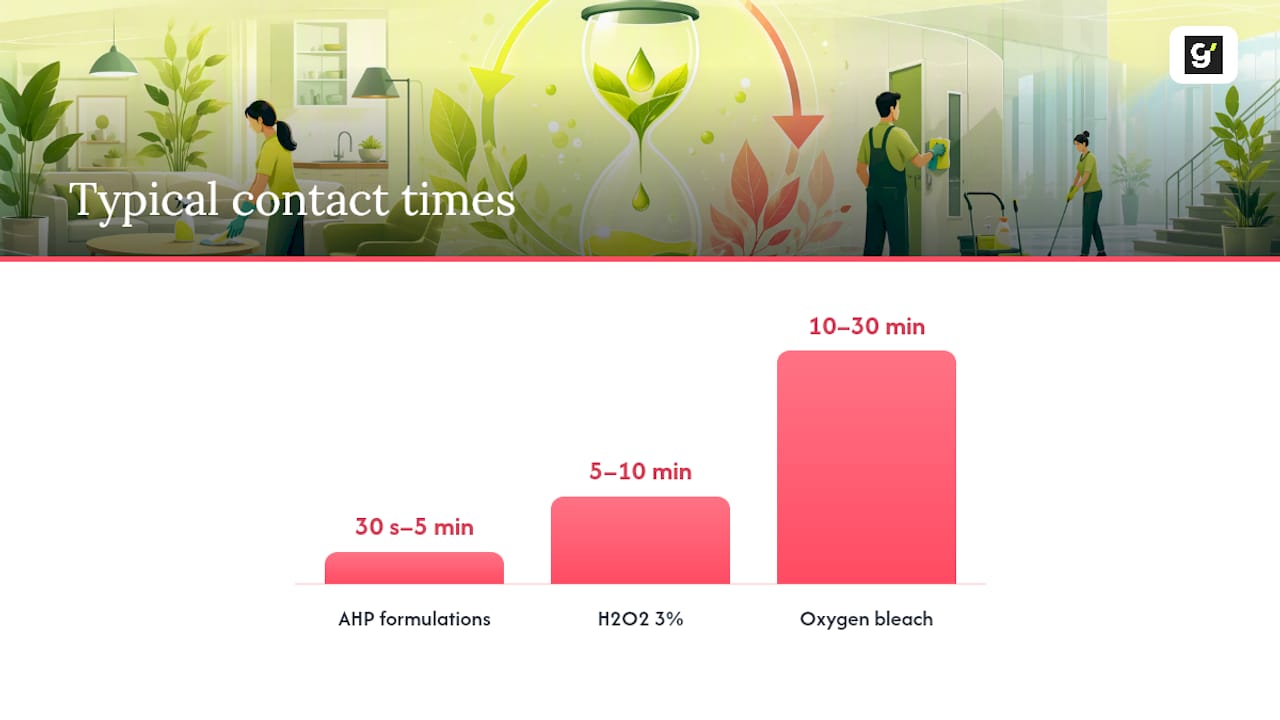
Contact time reference (sourced ranges):
| Agent | Typical contact time | Notes |
|---|---|---|
| Hydrogen peroxide 3% | 5–10 minutes | Longer with higher organic load; efficacy varies with concentration and surface load |
| AHP formulations | 30 seconds–5 minutes | Follow product label; faster than standard H₂O₂ |
| Oxygen bleach (sodium percarbonate) | 10–30 minutes | Longer for mould and heavy staining |
| Steam (high temperature) | Contact time on surface | Continuous slow pass; do not rush |
Pro Tip: For facility managers running tight turnovers, AHP products offer the best balance of speed and safety. A 1-minute contact time on a verified AHP product is far more reliable than a 10-minute contact time that staff routinely cut short.
How to choose the right eco disinfectant for your setting
The right product depends on your surface, your occupants, and your turnaround time. Work through this checklist before committing to a product:
- Match the agent to the task. Steam for fixtures and tile; AHP or hydrogen peroxide for hard surfaces; oxygen bleach for laundry and grout.
- Check APVMA registration or independent lab claims. If a product claims to disinfect, it should reference a registered efficacy claim or provide an independent test report. The APVMA public register is searchable at apvma.gov.au.
- Review the SDS. Look at Section 2 (hazard identification) and Section 12 (ecological information). If either section is missing or vague, treat the product with scepticism.
- Confirm contact time against your turnaround needs. A product requiring 30 minutes of wet contact is impractical for a 45-minute rental turnover.
- Test on an inconspicuous area. Especially important for polished stone, timber, and coloured grout. The role of eco cleaners in protecting home finishes is worth understanding before you commit to a product.
- Ask the supplier for documentation. Written protocol, SDS copies, and independent test reports are the minimum for any commercial-grade product.
Red flags to walk away from:
- "Natural" or "plant-based" with no contact time listed.
- No SDS available or SDS missing ecological data.
- Ingredient lists containing hidden quats (look for "benzalkonium chloride" or "alkyl dimethyl ammonium") marketed as eco-friendly without biodegradability evidence.
- Claims of "kills 99.9% of germs" with no named pathogen, concentration, or contact time.
Safe DIY options and the pitfalls that catch people out
A handful of DIY approaches genuinely work. Most of the internet's "natural cleaning recipes" do not disinfect — they clean, which is useful but different.
What actually works:
- 3% household hydrogen peroxide (undiluted from the chemist): Spray directly onto a pre-cleaned surface, leave for 5–10 minutes, wipe off. Effective against many common bacteria and viruses. The David Suzuki Foundation recommends this approach for home use and notes that "natural" claims alone are not a guarantee of efficacy.
- Sodium percarbonate (oxygen bleach) solution: Mix according to packet directions, apply to pre-cleaned surface, hold contact time. Good for mould removal without bleach on grout and tile.
- Steam devices: Follow manufacturer guidance on surface compatibility. No chemical required; effective for most hard surfaces.
Do and don't list:
- Do clean the surface before applying any disinfectant.
- Do follow the concentration and contact time on the label or packet.
- Do label any DIY solution with its contents and date mixed.
- Don't mix bleach with vinegar, ammonia, or hydrogen peroxide. These combinations produce toxic gases (chlorine gas, chloramine) and are genuinely dangerous.
- Don't rely on essential oils as standalone disinfectants. There is no reliable evidence they meet disinfection standards at household concentrations. They may clean, but they do not disinfect.
- Don't assume a higher concentration is always better. Hydrogen peroxide above 6% increases irritancy risk without proportionally improving efficacy on most household surfaces.
- Don't store DIY solutions in unlabelled bottles or in food containers.
For a broader look at eco cleaning myths that trip up well-meaning homeowners, the pattern is consistent: the myth usually involves a "natural" ingredient used at the wrong concentration or without the clean-first step.
Safety note for Australian households: Always check that any disinfectant product you purchase carries APVMA registration or references independent efficacy data. The APVMA public register (apvma.gov.au) lets you verify claims before you buy.
When to call a professional eco decontamination service
Some situations are beyond what a spray bottle and a microfibre cloth can handle. Knowing when to call a professional saves time, protects finishes, and ensures the job is actually done.
Scenarios where a professional is the right call:
- Large-area contamination (flood damage, sewage, post-illness whole-property decontamination).
- Biohazard events (blood, bodily fluids, vermin activity).
- Short-term rental turnovers with tight windows and a need for documented, guest-safe results.
- Specialist finishes (polished concrete, engineered timber, heritage surfaces) where product choice requires expertise.
- Post-construction cleaning where dust and chemical residues need systematic removal.
A credible eco decontamination service should arrive with written protocols, SDS copies for every product used, and a clear ventilation and contact-time plan. Ask for these before booking. If a provider cannot produce an SDS for their disinfectant, that is a hard stop.
Grimescene's Scene Reset and Deep Decontamination Full Sweep protocols use non-toxic, bleach-free agents aligned with the evidence reviewed in this article. The service includes on-site assessment, SDS-aligned product selection, documented contact times, and a ventilation plan — the observable trust signals any competent eco service should be able to show you. For facility managers, the commercial-grade eco cleaning standards that underpin these protocols are worth understanding before you brief any provider.
Why non-toxic disinfection is the only approach worth taking seriously
The CDC documents that bleach is broadly microbicidal and fast-acting, and that is true. It is also corrosive, irritating to airways, and capable of forming persistent chlorinated by-products when it reacts with organic matter in wastewater. For most household and facility disinfection tasks, that tradeoff is unnecessary. Hydrogen peroxide breaks down to water and oxygen. Oxygen bleach breaks down to sodium carbonate and water. Steam leaves nothing behind at all.
The argument for non-toxic disinfection is not ideological. It is practical. Surfaces last longer, indoor air quality is better, pets and children are not exposed to residues, and the environmental load on waterways is lower. The products that work are not compromises — they are, in most scenarios, the better technical choice. Where bleach genuinely outperforms (fast-acting sporicidal action in a clinical setting, for instance), that is the right tool. For everything else, the eco options covered here are not second-best.
Grimescene's eco decontamination services: what's on offer
Grimescene uses non-toxic, bleach-free agents across every service — no harsh fumes, no surface damage, no chemical residues left behind for pets or children to contact.
Three services worth knowing about:
- Deep Decontamination Full Sweep: Whole-property eco decontamination using AHP and HPV-aligned protocols, with documented contact times and a ventilation plan. Right for post-illness events, biohazard situations, and post-construction cleans.
- Rapid Response Tactical Clean: A 2-hour targeted clean for urgent turnovers or contamination events where speed and safety both matter.
- Short-Term Rental Turnover: Scene Reset protocol for Airbnb and short-stay hosts — eco-safe products, linen rental, consumable restocking, and a result that protects your guest ratings.
Book a service or request an assessment at Grimescene.
Sources
- Identifying Greener Cleaning Products | US EPA
- Review: Hydrogen peroxide vapour as a high‑level disinfection alternative | PMC
- Chemical Disinfectants | Infection Control | CDC
- Non-toxic disinfecting | David Suzuki Foundation
This article is general information, not a substitute for advice from a qualified doctor. Consult a qualified healthcare professional about your own circumstances before acting on anything here.