
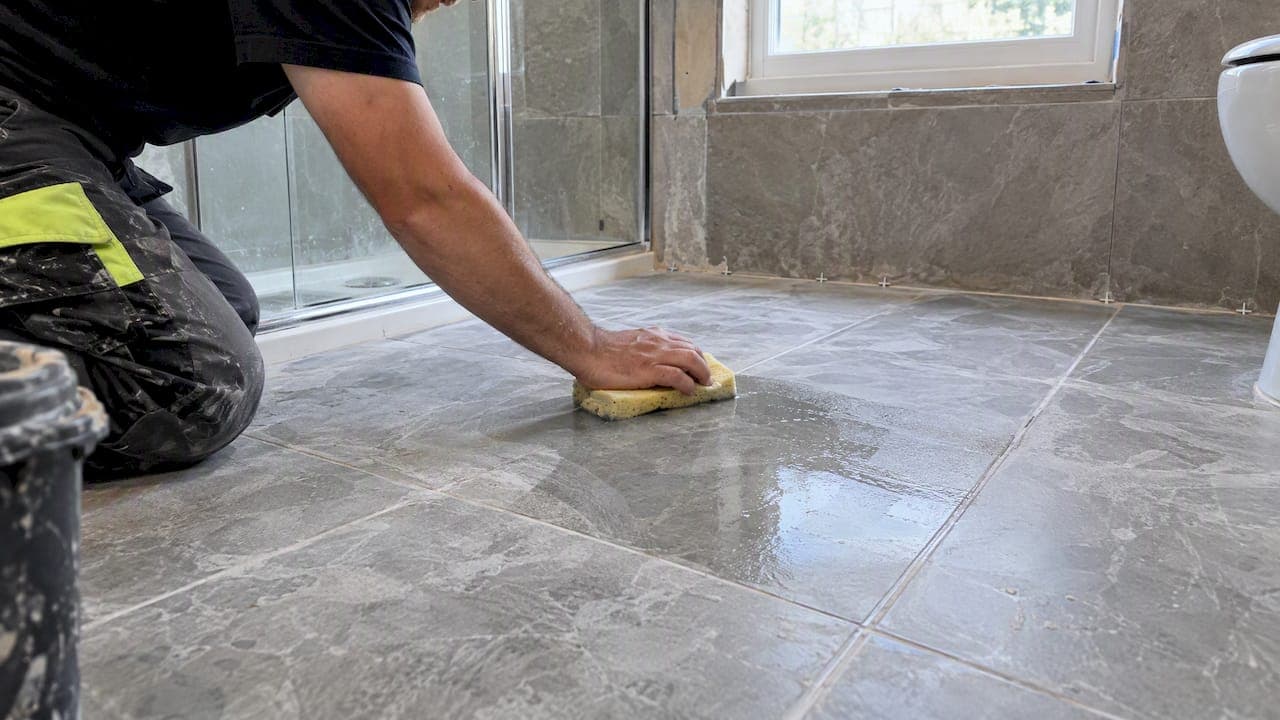
Grout haze is the cloudy, chalky film left on tile after grouting, and the right way to remove it depends on three things: how long it has been there, what grout was used, and what the tile is made of. Fresh haze comes off with water and a sponge. Older haze needs a purpose-made cleaner matched to the grout and the surface. Get the match wrong and you can etch stone, dull glaze or leave the haze exactly where it was.
This guide is written for homeowners, property managers and rental hosts dealing with a finished renovation, a new bathroom or a tired-looking floor after tilers have left.
TL;DR
- Haze is leftover grout residue, not dirt. Timing matters most: water and a sponge in the first days, a neutral tile cleaner after that, and a professional-grade product once it has cured beyond about 10 days.
- Match the product to the grout (cement, epoxy or urethane) and to the tile. Acid on marble, limestone or travertine causes permanent etching.
- Vinegar is the popular home fix, but it is a gamble on grout joints and natural stone.
- Always test a small hidden patch first, and ventilate or choose low-fume products in occupied spaces.
- If the job is large, the stone is valuable or the property is turning over soon, hiring a specialist is cheaper than repairing damage.
Table of Contents
- What grout haze actually is
- The 10-day window
- Step one: identify the grout and the tile
- How to remove grout haze, step by step
- Does vinegar remove grout haze?
- Choosing a product in Australia
- Protecting the rest of the room
- Our perspective: haze is a finishing problem, and the cleanup should match
- When to call a professional
- How Grime Scene Services can help
- Preventing haze on your next tiling job
- FAQ
- Sources
What grout haze actually is
When tilers push grout into joints, a thin layer of cement, polymer or resin is left on the tile face. The wash-off step is meant to remove it. When some stays behind and dries, it forms a dull film. The Stoneworld Tile & Stone Maintenance Manual frames it the same way: a surface finish issue caused by incomplete removal of residual grout during installation. That residue then attracts further dirt, so the floor looks worse every month.
This is why scrubbing harder rarely helps. Haze is a leftover installation problem, and the fix is chemical or mechanical removal of a bonded film, not extra elbow grease on an otherwise clean surface.
A quick way to tell haze from other problems:
- Haze: a milky or cloudy veil that shows in raking light, often following the pattern of the tiler's sponge strokes. It appears right after grouting.
- Efflorescence: white, crystalline salt deposits that can appear weeks or months later and are driven by moisture moving through the substrate. Allspec Tiling's guide points out that cleaning improves the look but does not stop the moisture movement, so the white build-up usually returns until the cause is fixed.
- Soap scum and limescale: build-up in wet areas that follows how the space is used, not how it was grouted.
If the white film is on a floor that has been in use for years, you may be dealing with efflorescence or scale rather than haze, and the approach changes.
The 10-day window
Timing decides how hard this job is. According to the Stoneworld manual, haze can often be removed with water and a sponge within the first 3 days. Between 3 and 10 days, a neutral pH tile and grout cleaner is recommended. After 10 days, professional-grade acidic or alkaline cleaners are typically required, depending on the tile or stone.
| Age of haze | What usually works | Main risk |
|---|---|---|
| Up to 3 days | Clean water, a damp sponge, then a dry cloth | Over-wetting fresh joints |
| 3 to 10 days | Neutral pH tile and grout cleaner, soft pad | Using acid too early |
| Over 10 days | Cleaner matched to grout type and tile, applied per label | Etching, dulling, grout damage |
There is a flip side. Waiting a little is not a mistake. A guide from an Australian cleaning marketplace notes that grout needs roughly 24 to 48 hours to cure, and cleaning too soon can chip it or let water in. The sweet spot is after the grout has set, but well inside the 10 days.
The Aqua Mix technical bulletin on removing cement or grout haze residue also draws the line at the first 10 days of grouting for its lighter method. Professionals advise against acidic cleaners until the grout has fully cured, since early exposure can weaken the joint itself.
Step one: identify the grout and the tile
Before you buy anything, answer two questions.
What grout was used?
Mapei's technical guide to removing grout haze explains that grouts come in three broad types: cement-based (sanded or unsanded), ready-mixed (acrylic, urethane or a mix) and reactive resin (epoxy). Their haze behaves differently:
- Cement grout haze is mineral. Acidic or acid-substitute cleaners break it down.
- Epoxy and urethane haze are not mineral, so an acid cleaner will do very little. Products designed for these, such as Fila's Epoxy Off, target cured epoxy, urethane and pre-mixed grout haze on non-absorbent surfaces like porcelain, ceramic and glass mosaic.
The Custom Building Products technical article makes the same point: the strongest remover is not automatically the best one, and an acid-based cement remover on epoxy haze can be ineffective or harmful. If you do not know the grout, ask the tiler, check the builder's documents, or have a professional identify it.
What is the tile?
This is where permanent damage happens.
- Glazed porcelain and ceramic tolerate most tile cleaners when used as directed, though over-strong acids can dull some glazes.
- Natural stone such as marble, limestone and travertine is acid-sensitive. Acidic cleaners etch it, and the damage is irreversible without professional polishing. These stones need alkaline-based cleaners, according to the Stoneworld guidance.
- Unsealed or porous surfaces can absorb cleaner and trap contaminants, particularly with solvent-based products.
We have written separately about cleaning marble without acid, which is worth reading if your haze is on a stone vanity, splashback or floor.
How to remove grout haze, step by step
This sequence suits cement grout haze on glazed tile, the most common case in Australian bathrooms, kitchens and laundries.
- Check the product label and the tile supplier's care notes. Some tile and sealer systems restrict certain cleaners.
- Vacuum or sweep so grit does not scratch the surface while you scrub.
- Try the gentlest option first. A damp microfibre cloth or cheesecloth, wrung well, then a dry buff. A dry microfibre or cheesecloth buff is often what lifts the thin film that remains after a sponge clean.
- Move to a neutral pH tile and grout cleaner if the film persists, particularly in the 3 to 10 day range. Apply, leave for the labelled time, agitate with a soft nylon pad, then rinse.
- For haze older than 10 days, use a cleaner made for it. Follow the dilution on the label. Wet the tile with clean water first, apply the cleaner in a small section, agitate, and rinse thoroughly. Wetting first limits how much cleaner soaks into the grout lines.
- Dry-test first. Choose an inconspicuous spot, such as under an appliance or behind a door, and check for dulling, colour change or reaction with the sealer.
- Rinse and dry. Residual cleaner or moisture can leave its own marks, so finish with a clean-water rinse and a dry cloth.
- Seal if appropriate. Once the surface is clean and dry, ask your tiler or supplier whether the grout or stone should be sealed.
Take care with water volume in the first days. Too much water during early cleanup can wash pigment out of fresh joints and leave patchy colour.
Does vinegar remove grout haze?
Sometimes, a little, and often at a cost. A 1:1 vinegar and water mix is the standard forum suggestion, and it can soften a light film on glazed tile. But vinegar is an acid, and the professional guidance is to avoid regular or heavy use. As the Allspec Tiling guidance says, overuse of acidic agents can attack grout and may damage glazed surfaces or etch natural stone. Cement grout is alkaline and porous, so repeated acid exposure weakens the joint over time.

If you try it at all, use it only on glazed tile, never on marble, limestone or travertine, test first, and flush with plenty of clean water afterwards. If the haze is more than a couple of weeks old, vinegar will mostly give you a wet floor and false hope.
Choosing a product in Australia
Professional-grade haze removers are sold through tile suppliers and larger hardware retailers. For example, a general tile and grout cleaner from Davco is listed as cleaning tough dirt and stains from tile and grout and removing minor efflorescence. That is a light-duty product, so read the label to see whether your haze is within its scope.
What to look for on a label:
- The grout type it is designed for (cement, epoxy, urethane).
- The surfaces it is safe on and the ones it warns against.
- Whether it is acidic, alkaline or neutral.
- Dilution and dwell time.
- Ventilation and personal protective equipment requirements.
Lower-fume options
Traditional mineral acids give off sharp fumes and need real care. Newer "acid-substitute" cleaners aim for similar results with less hazard. Fila's Deterdek Pro is described as removing cement grout haze, efflorescence, lime deposits and hard water stains, and is used indoors and outdoors on floors, walls and shower stalls. There is also a non-acidic option in Sealers Plus Haze Away, described as a professional-grade, non-acidic grout haze cleaner and inhibitor, designed to make grout clean-up easier.
Two cautions. These are specialist products, and "lower fume" does not mean "no precautions": gloves, eye protection and airflow still apply. And the product pages above are manufacturer descriptions, so the tile supplier's guidance for your specific tile still comes first.

Protecting the rest of the room
Haze removers are not selective. Splash onto timber, metal fittings, painted skirting or unsealed stone and you can make a second problem. Before you start, mask edges, cover fixed cabinetry, lift rugs and move furniture out. If timber furniture has already picked up water marks from a clean-up gone wrong, this guide to removing heat rings and water stains from oak furniture covers the gentle approach to that separate problem.
Keep pets and children out until surfaces are rinsed and dry, and keep windows open or run an exhaust fan.
Our perspective: haze is a finishing problem, and the cleanup should match
We see grout haze most often at the end of a renovation, when a property needs to go from "finished" to "ready" fast. A landlord wants a rental back on the market, a host has a booking landing in a few days, or a family wants to move into a newly tiled bathroom without the smell of harsh chemicals.
Our view is shaped by how we work. We use non-toxic, bleach-free cleaning agents, because the space has to be safe for families, pets and the people who use it next. That is the right default for routine cleaning and for the lighter end of haze, where the job is really about removing residue and not about breaking a bond with strong acid.
We are also honest about limits. Cured cement or epoxy haze on a surface that is sensitive to chemicals is a specialist job, and the best result often comes from the tiler, the supplier's recommended product, or a careful combination of both. What we can do is take care of the rest: post-construction cleaning, dust and residue removal, and a documented before-and-after record so a property manager or owner can see exactly what was done. If you want the background on how that kind of work differs from everyday cleaning, our piece on janitorial versus remediation cleaning explains the roles.
The biggest lesson is the one tilers repeat: preventing haze with a proper wash-off at installation is far easier than chasing it weeks later. If a job is still being grouted, ask the tiler how and when they will clean the faces, and check the work before they leave.
— Lead
When to call a professional
DIY is reasonable for fresh haze on glazed tile. Bring in help when:
- The haze is older than 10 days and your first neutral clean has not shifted it.
- The surface is marble, limestone, travertine or another natural stone.
- The grout is epoxy or urethane and you are not sure which cleaner suits.
- The area is large, such as a whole floor, a commercial entry or multiple bathrooms.
- You are on a deadline, such as a handover, an inspection or a guest changeover.
- The space is occupied and you cannot expose people to strong fumes.
For a property manager, the cost comparison is not the price of a bottle against the price of a service. It is the cost of a bottle plus time plus the risk of etched stone or damaged joints against a single engagement done properly.
How Grime Scene Services can help
If haze is part of a wider post-renovation clean, or you want an eco-conscious reset before a handover, our Deep Decontamination | Full Sweep is built for heavily soiled spaces, and our post-construction sweeps cover the dust and residue that tradies leave behind. We use non-toxic, bleach-free agents and provide before-and-after reporting. For a rental that needs to be guest-ready quickly, see our short-term rental services. Not sure which fits? Start at our main page and tell us about the property.
For more reading, our guides on removing stubborn grout build-up and grout and tile cleaning best practices cover ongoing maintenance once the haze is gone, and post-construction dust removal for rentals covers the rest of the renovation clean.
Preventing haze on your next tiling job
If you are renovating, these steps save the most effort:
- Ask about the wash-off plan before grouting starts, including how many passes and when the final buff happens.
- Use clean water and change it often. Dirty water just redeposits grout on the tile.
- Do not over-wet. Excess water can wash pigment out of the joints.
- Buff with a dry microfibre or cheesecloth after the sponge clean to lift the thin film.
- Inspect in raking light from a window or torch before the tiler leaves, when haze is easiest to fix.
- Consider a haze-inhibiting product if your tiler recommends one for your grout.
FAQ
Can you remove dried grout haze?
Yes, but the longer it has cured the stronger the cleaner you need. After about 10 days, professional-grade cleaners matched to the grout type and tile are typically required. Test a hidden patch, follow the label, and avoid acid on natural stone.
Does vinegar get rid of grout haze?
It can soften a light, recent film on glazed tile, but it is not reliable on cured haze. Repeated use can attack the grout and etch natural stone, so professional guidance advises against heavy or regular use. Keep it off marble, limestone and travertine entirely.
What is the strongest grout haze remover?
The strongest is not always the best. A mineral acid suits cement haze on acid-tolerant tile but does little to epoxy haze and can ruin stone. Choose by grout type and surface, then check what the label allows.
Is there an eco-friendly way to remove grout haze?
For fresh or light haze, water, a microfibre cloth and a neutral cleaner are low-impact. For cured haze, acid-substitute or non-acidic products reduce fumes compared with mineral acids, though they still need gloves and ventilation. Check the label and test first.
Does grout haze come back?
Haze itself does not return once fully removed. A white film that reappears is more likely efflorescence, which signals moisture moving through the substrate and needs the cause addressed, not just another clean.
Sources
- Stoneworld Tile & Stone Maintenance Manual
- Aqua Mix Technical Bulletin: Removal of cement or grout haze residue
- Mapei: Removing grout haze
- Allspec Tiling: Efflorescence on tiles and grout
- Maid2Match: How to remove grout haze
- Fila Epoxy Off
- Fila Deterdek Pro
- Sealers Plus Haze Away
- Davco 1L Tile and Grout Cleaner