
A cleaning checklist turns a written standard into repeatable daily action and verifiable proof, closing the gap between what a business promises and what actually happens on-site. Task-level instructions, assigned ownership, set frequencies, and a way to verify completion do the work. Without that structure, quality depends on who showed up and how they felt that day.
- Training gets faster because new staff follow steps instead of guessing at intent
- Disputes drop because there's a record of what was done and when
- Clients get the same result on visit fifty as they got on visit one
A checklist-driven system paired with SOPs and audits standardises cleaning across crews and creates the feedback loop needed to keep improving it.
Key Takeaways
A cleaning checklist works because it converts a written standard into task-level action, assigned ownership, and verifiable proof, which is what actually produces consistent results.
| Point | Details |
|---|---|
| Task-level wording wins | Vague instructions like "clean the area" produce inconsistent results; specific action-target-standard wording doesn't. |
| Separate tasks from inspections | Keep the checklist that records what was done separate from the one that records what a supervisor found. |
| Pair checklists with audits | Weekly or biweekly audits for most sites, daily spot checks for high-risk environments, close the feedback loop. |
| Digital evidence beats checkboxes | Timestamps and photos attached to each item turn a claim of "it's clean" into a record clients can trust. |
| Grimescene applies this system already | Grimescene runs SOP-backed checklists with photo evidence across residential, commercial and short-term rental turnovers. |
Table of Contents
- The role of a cleaning checklist in consistency
- What consistent checklists actually deliver
- Which checklist type fits which job
- Building a checklist staff will actually use
- Making checklists stick: SOPs, training and audits
- Sample checklist items for common jobs
- Measuring consistency and proving it happened
- Why checklists plus audits beat experience alone
- A publisher's view on checklist-driven consistency
- Get a checklist-driven clean without building the system yourself
- Sources
The role of a cleaning checklist in consistency
A checklist's job isn't to describe cleaning in the abstract. It's to standardise tasks so two different cleaners, on two different days, produce the same result. It also converts a standard operating procedure (SOP) into an instruction a person can act on right now, rather than a philosophy they need to interpret. And it creates a paper or digital trail that supports billing, resolves disputes, and proves the work happened.
The difference shows up in wording. "Clean the common area" tells a cleaner almost nothing. "Disinfect door handles, empty bins, vacuum under tables" tells them exactly what done looks like.
- Standardises output regardless of who's on shift
- Converts SOP intent into an executable action list
- Documents service for accountability and billing
- Removes ambiguity that leads to skipped or half-finished tasks
What consistent checklists actually deliver
The business case for checklist discipline isn't abstract. It shows up in four measurable places.
Consistency and quality hold steady across crews and sites when everyone works from the same task list, not personal habit. Efficiency improves because predictable task times make rostering easier and cut the rework that follows a missed step. Accountability improves too. Documented completion gives you proof of service, which directly reduces client complaints and disputes over incomplete work and is a major factor in reducing client churn for cleaning businesses and the property managers who hire them.
Health and safety compliance also runs through the checklist. Workplace infection control guidance points to hygiene measures a checklist can operationalise, from high-touch surface disinfection to bin management.
- Predictable quality regardless of which crew turns up
- Fewer scheduling blowouts from unplanned rework
- Proof of service that shortens or ends billing disputes
- A structured way to fold infection control practice into daily routine
- Completion data that flags which tasks need more staff training
Which checklist type fits which job
Not every task belongs on the same list, and not every list runs on the same clock. Matching the checklist to the risk and the traffic pattern is where most operators go wrong.
- Daily task checklists cover what happens every shift: bins, high-touch surfaces, restocking, spot-checking floors.
- Weekly and monthly checklists handle periodic work: grout, upholstery, window tracks, deep vacuuming under furniture.
- Specialised checklists apply to higher-risk or higher-stakes settings, such as healthcare environments guided by infection prevention and control standards, food service, or short-term rental turnovers.
- Task checklists and inspection checklists are different documents. One records what a cleaner did; the other records what a supervisor found. Mixing them confuses staff and weakens the audit.
An office needs a different cadence to a rental turnover, and a rental turnover needs a different cadence to an aged care facility where verification has to be near-total.
Building a checklist staff will actually use
Most checklists fail not because the idea is wrong but because the document is unusable. Here's a sequence that avoids the usual traps.
- Map the physical route. Order items to match how the cleaner actually moves through the space, not how you imagine the space on paper. A mismatched order causes backtracking and skipped tasks.
- Break zones into task-level items. Each line needs an action, a target, and an acceptance standard, like "wipe kitchen benchtop until residue-free," not "clean kitchen."
- Assign frequency, time and ownership. Every item needs a cadence, a realistic time estimate, and a named role responsible for it.
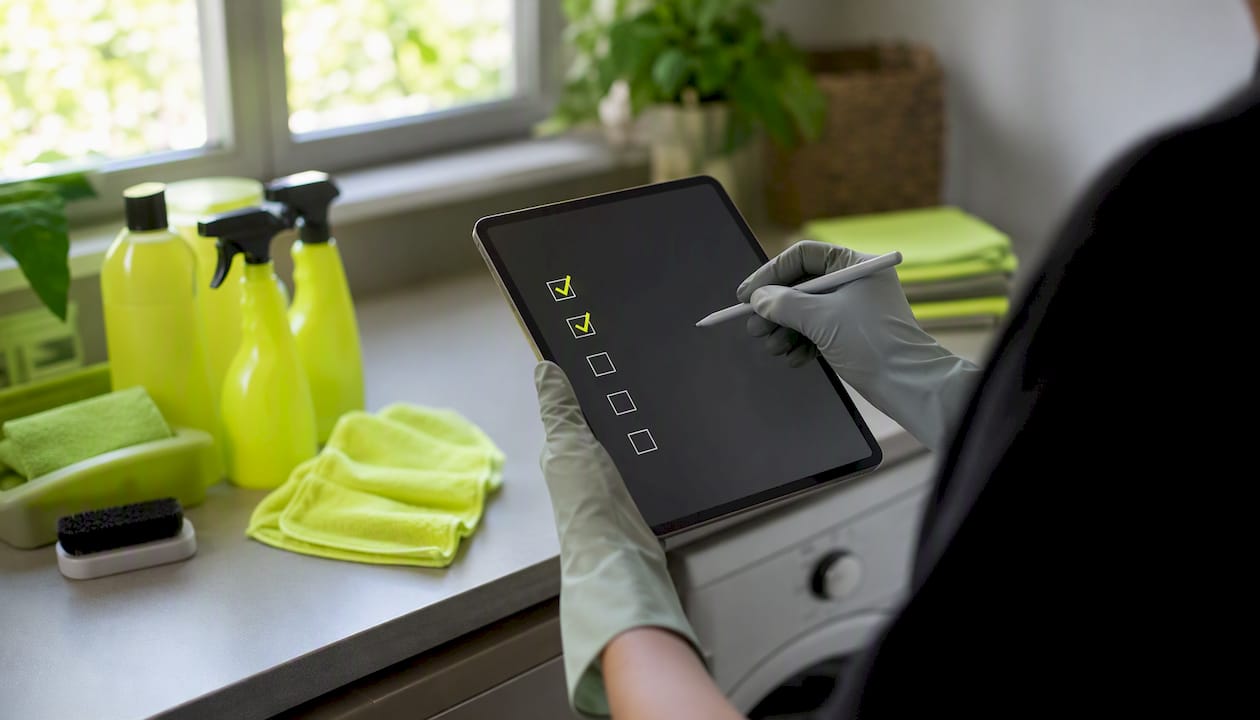
- Add verification fields. Initials, a timestamp, a photo, and a line for exceptions turn a to-do list into a reusable, auditable template.
- Pilot it, then lock the version. Run it on one site, collect feedback from the people using it, adjust, and only then roll it out broadly.
Common mistakes are predictable once you've seen them a few times: vague wording ("tidy area"), a single list forced onto sites with completely different traffic and risk profiles, task and inspection items jammed together, and time estimates set by someone who's never actually done the job. Unrealistic time budgets are what push staff into tick-and-flick behaviour, where boxes get ticked without the work happening.
Pro Tip: Keep the list short and prioritise the handful of tasks that actually determine whether a client is happy. An exceptions field for the unusual stuff beats bloating the main checklist with items that apply once a year.
Making checklists stick: SOPs, training and audits
A checklist on its own is just paper. It needs three supporting structures to actually hold quality steady.
SOPs and checklists play different roles: the SOP explains technique and standard, the checklist records that the action happened. Training should combine shadow shifts, a laminated quick-reference card, and a formal competency sign-off before someone works unsupervised. Enforcement runs on a mix of scheduled audits and unannounced spot checks, with the data reviewed on a set cycle rather than only when a complaint lands.
| Factor | Paper checklists | Digital checklists |
|---|---|---|
| Evidence quality | Signature only, easy to backdate | Timestamp, photo and location attached |
| Analytics | Manual, slow to spot trends | Automatic trend and exception reporting |
| Scalability | Struggles past a handful of sites | Scales across many sites with less admin |
Audit cadence should track risk. Weekly or biweekly inspections suit most commercial sites, while high-traffic or high-stakes environments justify daily spot checks.
Pro Tip: If you can only fund one upgrade this year, fund photo evidence before you fund a fancier app. A timestamped photo of a clean bathroom settles more disputes than any software feature.
Sample checklist items for common jobs
A short office shift checklist might run: wipe reception desk (5 min, daily), disinfect meeting room tables and remotes (10 min, daily), empty kitchen bins and wipe benchtops (8 min, daily), restock restroom consumables and disinfect handles (12 min, daily), each with an initials or photo field attached.
A short-term rental turnover checklist runs differently: strip and change all linen, disinfect high-touch surfaces (door handles, light switches, remotes), restock consumables (soap, toilet paper, coffee), and photograph the kitchen, bathroom and bedroom as proof of condition before the next guest arrives.
Template fields to standardise across any checklist: task, frequency, expected time, owner, verification method, and an exceptions note. Scale the item count up for larger sites and high-traffic common areas, and scale it down for compact studios where a bloated list just slows the crew down.
Measuring consistency and proving it happened
Consistency you can't measure is just a hope. Track completion rate, time per shift against the estimate, audit score, exception rate, rework incidents, and client complaint rate. Capture timestamps, photos, checklist version, staff ID and site location against each entry, and you've got a record that stands up when a client disputes what happened.
That data feeds two things: training, because a task that's constantly late or constantly failing audit is a training gap, not a discipline problem, and client reporting, because documented service history reduces churn far more effectively than a verbal assurance.
- Track completion rate, time-on-task, audit score, exceptions and complaints
- Attach timestamp, photo, checklist version and staff ID to every record
- Use trend data to target training, not just to police individuals
- Expect task times to shift with site layout, foot traffic and task complexity, not just headcount
Why checklists plus audits beat experience alone
Relying on an experienced cleaner's judgement feels efficient until that person leaves, gets sick, or has an off week. A system beats a person because a system doesn't have bad days.
SOPs set the standard, checklists drive the daily execution, and audits close the loop that tightens performance over time. Digital evidence, timestamps and photos attached to each item, turns a subjective claim of "it's clean" into an objective record a manager or client can actually check.
The practical starting point isn't an enterprise rollout. It's a single-site pilot pairing one task checklist with weekly audits and photo evidence, run long enough to show whether complaints and rework actually drop.
Pro Tip: Run the pilot for at least four weeks before judging it. Anything shorter just measures the novelty of a new process, not whether it holds up.
A publisher's view on checklist-driven consistency
We built our own operations around this same logic: a task checklist backed by a fixed audit cadence and photo evidence, particularly for rental turnovers where a host's rating depends on a guest never seeing what happened before they arrived. It's the difference between a clean that looks fine and a clean you can prove.
Get a checklist-driven clean without building the system yourself
Designing task-level checklists, training staff against them, and running a weekly audit cycle is a real operational lift, and most property managers and hosts don't have spare hours to build it from scratch. Grimescene runs that system already, applying SOPs, task checklists and digital evidence capture (timestamps and photos) to every job, so you get the consistency this article describes without assembling the framework yourself.
For rental hosts specifically, the Short Term Rental turnover service pairs a locked checklist with consumables restocking and photo evidence for every changeover, which is exactly the kind of proof that protects a listing's rating. If a site needs a heavier reset first, before the routine checklist takes over, the Deep Decontamination Full Sweep service handles that starting point using non-toxic agents. Check availability for your property and get a quote today.
Sources
- How to standardize cleaning processes across crews with SOPs, checklists and audits - Janitorial Manager
- Cleaning checklist system teams actually follow - CleanLog
- How to create a cleaning checklist template - Trillium Facility Solutions
- Workplace safety: infection control - Better Health Channel
- How optimized cleaning checklists ensure proof of service and retain clients | freshOps