
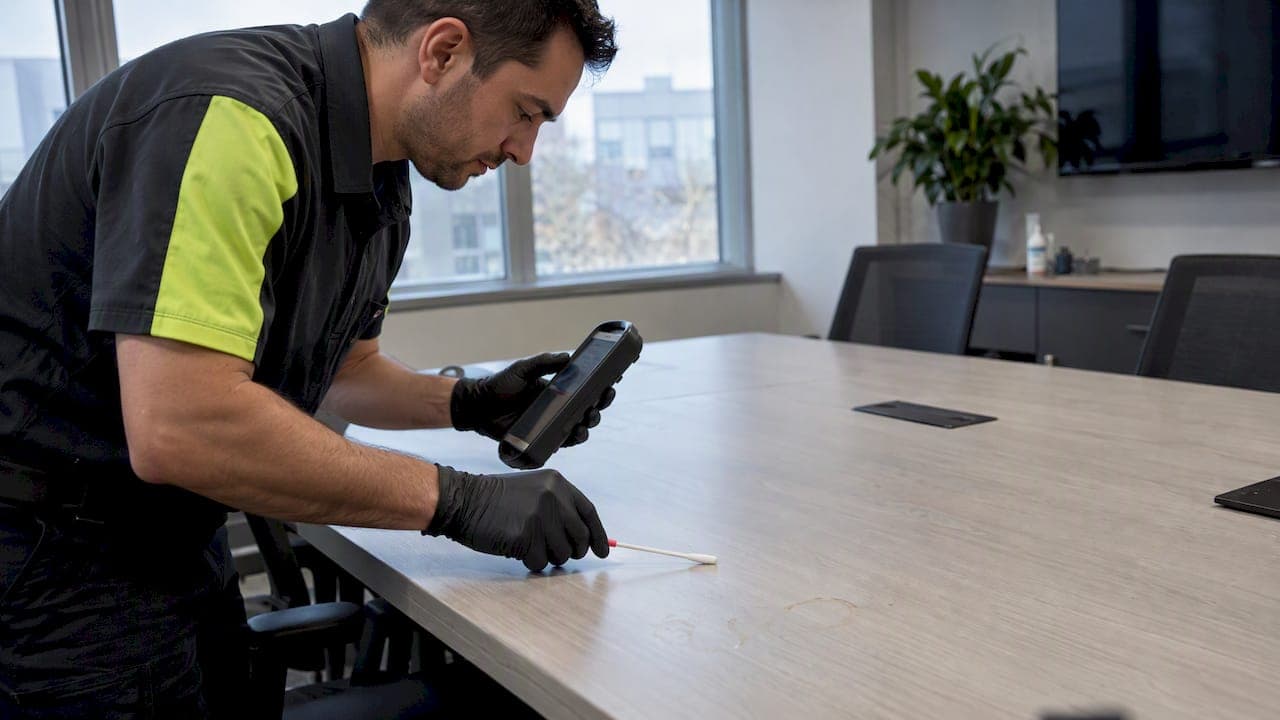
ATP testing is a quick swab-and-meter check that shows whether organic residue is left on a surface after cleaning. A handheld luminometer reads the swab and gives a number in about 10 to 15 seconds. It tells you whether a surface was cleaned well. It does not tell you whether a surface is free of a particular germ. That difference matters most when the question is a norovirus outbreak or flu season in the office.
This guide is for property managers, business owners and hosts who buy cleaning and want to know what ATP results can reasonably prove.
TL;DR
- ATP testing measures organic residue (food, skin cells, microbes) on a surface. It is a fast check on cleaning quality, not a test for specific viruses or bacteria.
- There is no universal "normal" reading. Results are specific to the meter brand, so a site needs its own baseline from surfaces known to be clean.
- Residue from bleach or sanitiser can distort a result, so surfaces need to be rinsed before testing.
- A luminometer starts at roughly $3,520 AUD and swabs cost about $0.90 to $1.50 AUD each in bulk, so the real cost is in the discipline of using it well.
- For norovirus and flu, the controls that count are thorough cleaning and disinfection, handwashing and keeping sick people away. ATP can show the cleaning step was done properly.
Table of Contents
- What an ATP test actually measures
- What a good reading looks like
- How to run a test properly
- What ATP testing costs in Australia
- Where ATP testing falls short
- Norovirus and office cleaning
- Flu season and office cleaning
- Our perspective: proof of clean, not theatre
- Where a professional clean fits
- How to ask a cleaner for verifiable results
- FAQ
- Sources
What an ATP test actually measures
Adenosine triphosphate (ATP) is the energy molecule found in every living cell and in most food residues. A swab picks up whatever is on a surface. Inside the swab, an enzyme reaction produces light in proportion to the ATP present. The luminometer reports that light as Relative Light Units (RLU). Results appear in 10 to 15 seconds, which is why the method suits real-time checks on a job rather than waiting days for a lab.

What the number represents is overall biological load. ATP tests measure organic matter plus microorganisms, not any named bacterium or virus. A clean-looking bench with a thin film of dried coffee and skin oils can read high. A surface wiped with a contaminated cloth can look fine and read high too. That is the value of the test: it catches what the eye misses.
The method was built for food processing and healthcare, where cleanliness needs evidence. Meat & Livestock Australia has published research on selecting and using ATP machines in Australian meat processing plants to improve the hygiene of equipment and surfaces. Offices, rentals and gyms borrow the same logic.
What a good reading looks like
People searching this topic usually ask what a "normal" ATP level is. The honest answer is that no single figure exists.
- RLU values are specific to each manufacturer's machine. You cannot compare a reading from one brand with another.
- Sites set their own limits by testing surfaces known to be clean and building a baseline from those readings.
- A pass means low organic matter. A fail means the surface should be re-cleaned. Some facilities set the fail limit as a multiple of the pass limit, for example three times, so there is a warning band between the two.
If a cleaner quotes you a single RLU figure as a universal standard, ask which meter it applies to and how the limit was set. A number without a baseline is decoration.
A simple worked example
Say a meeting room table is cleaned to the best standard your contractor can deliver. You swab ten sites over several days and find a typical reading in a tight range. You set the pass limit just above that range and a fail limit at a multiple of it. From then on, a reading above the fail limit means the table needs another wet clean, whatever it looks like. The same table on a different brand of meter needs its own baseline.
How to run a test properly
Bad technique produces bad data, and a bad result invites an argument that goes nowhere. These steps reflect the guidance in the research we reviewed.
- Test after wet cleaning and rinsing. Surfaces should be cleaned and rinsed first. Chemical residue can inhibit or amplify the reaction, so a bleach or sanitiser film can give a false result.
- Standardise the area. Swab a 10 x 10 cm area each time so readings are comparable.
- Never re-swab the same spot. Repeated swabbing degrades the surface and distorts the data.
- Test before and after where you can. A before-and-after pair shows what the clean achieved. Many sites only have the resources for post-clean checks, which is still useful.
- Choose points by risk. Frequency should be proportional to the risk of the area. Kitchen benches, door handles and shared keyboards come before a window ledge.
- Record everything. Date, location, meter, reading, result and the action taken. A log is what turns a swab into evidence.
What ATP testing costs in Australia
Cost is a common question. Pricing varies by brand and volume, and these figures are a guide rather than a quote.
| Item | Indicative cost | Source |
|---|---|---|
| Entry-level professional luminometer | About $3,520 AUD | Anaeron ATP |
| Test swabs, bought in boxes of 100 | About $0.90 to $1.50 AUD per test | Anaeron ATP |
The swab is the small cost. The larger cost is the person who takes the readings, trains staff to use the result and acts on failures. A meter sitting in a drawer proves nothing. For most offices and rental portfolios, buying cleaning from a provider who reports against a defined standard is more practical than owning a meter yourself.
Where ATP testing falls short
An honest guide includes the limits.
- It is not a pathogen test. The research we reviewed describes ATP as a fast proxy that flags organic residue, not a substitute for culture-based testing in critical environments.
- It is one part of a programme. Practitioners including the European Hygienic Engineering and Design Group advise that ATP sits alongside documented procedures, visual inspections and targeted lab methods where needed.
- It can be misread. Unrinsed chemicals, repeat swabbing and a changed meter all produce misleading numbers.
- It is not a legal requirement for offices. We have found no Australian rule that obliges an office or a short-term rental to run ATP tests, so treat it as an assurance tool you choose.
Norovirus and office cleaning
When norovirus hits a workplace, the instinct is to ask for a test that proves the office is safe. ATP cannot do that, because it does not detect viruses. What it can do is show that the cleaning step removed soiling, and disinfectant works far better on a surface that has been cleaned first.
Australia's national public health guidelines for norovirus say that cleaning and disinfection, regular handwashing, and exclusion of ill people should be applied in the management of all outbreaks. Those are written for public health units, but the logic carries to a workplace.
What that means in practice:
- Focus on the surfaces many hands touch: door handles, tap handles, kitchen benches, fridge doors, lift buttons, shared microwaves.
- Treat toilets and kitchens as the highest-risk zones.
- Keep ill staff home. No cleaning schedule replaces that.
- If you have a confirmed outbreak, follow the advice of your state or territory health department. A contractor's report is not a clearance from a health authority.
For a confirmed outbreak, such as several staff with vomiting and diarrhoea, call your local public health unit first. The decision on disinfectant, contact time and closures is theirs, not a cleaner's.
Flu season and office cleaning
Flu spreads mainly person to person, but surfaces matter in shared spaces. The practical question for a manager is how to keep high-touch points consistently clean through winter.
Hygiene writers make a point that suits this: consistency matters more than the strength of the product, and many failures come from human error such as poor rinsing or missed coverage. ATP results work as a training tool for that reason. A cleaner who sees a high reading on a keyboard learns straight away that the wipe pass missed it.
A sensible winter routine for a workplace:
- Define a list of high-touch points per floor and clean them daily, not weekly.
- Give staff wipes or sprays at shared desks and meeting rooms, and show them how to use a cloth rather than just spread soil around.
- Schedule a deeper clean of shared kitchens and amenities on a fixed day.
- Ask your cleaner for a record of what was done and when.
Cloth quality is part of this. Reusable and disposable cloths are graded differently, and a buyer's guide to how industrial wiping rags are graded shows why a grade label alone says little without tests behind it. The same scepticism applies to cleaning claims in general.
Our perspective: proof of clean, not theatre
We are a cleaning company, so we have a stake in this, and we would rather say what we think plainly.
Cleaning that only masks grime is the problem we exist to solve. Our approach uses non-toxic, bleach-free agents that leave no harsh chemical residue, and we verify with before-and-after reporting. That fits the ATP lesson well, because residue is the enemy of a good reading and a good clean. A surface that has been neutralised and rinsed properly is easier to check than one coated in sanitiser.
Here is how we think about evidence:
- Look first, then measure. A visual check is still the fastest first filter. Measurement should back up the eye, not replace it.
- Report what changed. A before-and-after record is more useful to a property manager than a promise. It shows the job was done and where the effort went.
- Match the proof to the risk. A kitchen in a short-term rental, a shared amenity block and a storage room do not need the same scrutiny.
- Never overstate. A clean surface is not a sterile surface. Nobody can honestly promise that a space will stop an outbreak.
If you want a documented standard for your site, tell us what you need to show and to whom, whether that is an owner, a strata committee or an insurer, and we will build the reporting around that.
— Lead
Where a professional clean fits
If you manage an office, a rental or a residential portfolio, there are three situations where a documented deep clean makes sense:
- Before and after a bad stretch, such as a norovirus case in the building or a heavy flu month.
- At turnover, when a short-term rental needs to be reset between guests and the host's rating depends on it.
- After building works, when fine dust and residue sit on every surface.
Our Deep Decontamination | Full Sweep is built for the first case, and our Rapid Response 2-hour tactical clean is for when you need a space turned around fast. Hosts can look at our short-term rental services, which include linen rental and consumable restocking. For ongoing office cover, see the full range on our services page, or start from Grime Scene Services. We do not publish prices, so ask for a quote against your site.
For more on setting up checks and logs, our workplace hygiene checklist for Australian safety managers covers audit-ready records, and our guide to managing cleaning contractors covers what to ask for in a contract. Strata managers can use the strata cleaning checklist.
How to ask a cleaner for verifiable results
Whether or not ATP is involved, these questions separate documented cleaning from cleaning that merely looks good:
- What is the standard, and how is it measured? Visual checklist, photos, ATP or something else?
- If ATP is used, which meter, and how was the baseline set for my site?
- Are surfaces rinsed before testing, so chemical residue does not distort results?
- What happens when a surface fails? Is the re-clean included?
- Where are the records kept, and can I see them?
- What do you use on surfaces, and does it leave residue?
A provider who answers these clearly is probably running a real system. One who answers with a single universal pass number probably isn't.
FAQ
What does a high ATP reading mean?
It means more organic material was on the swabbed surface than your pass limit allows. That could be food residue, skin cells, microbes or a combination. The usual response is to re-clean and re-test, and then check technique if the same spot keeps failing.
Can ATP testing show that norovirus or flu virus is gone?
No. ATP does not identify specific viruses or bacteria. It shows whether organic residue remains, which is useful for checking the cleaning step. For a confirmed outbreak, follow your state or territory health department's directions.
How much does ATP testing cost?
If you buy equipment, an entry-level luminometer starts around $3,520 AUD, and swabs bought in bulk run about $0.90 to $1.50 AUD per test, depending on brand and volume. Staff time and training add to that. Many businesses instead ask their cleaning provider to report results.
How do you perform an ATP test?
Clean and rinse the surface, swab a standard 10 x 10 cm area once, place the swab in the luminometer and read the result. Compare it with your site's baseline and record it. The key point is not to swab the same spot twice.
Sources
- CSY Handheld ATP Bioluminescence Luminometer, InstrumentHive
- Selection and Use of ATP Machine for hygiene monitoring in Australian Meat Processing Plants, Meat & Livestock Australia
- Luminometers: Rapid Hygiene Monitoring, Manitoba Agriculture
- Lucipac A3 AOAC method summary, FMCG IS
- Anaeron ATP
- EHEDG
- Norovirus and suspected viral gastroenteritis national guidelines, Australian CDC
- How to Slow the Cold and Flu, CleanLink