
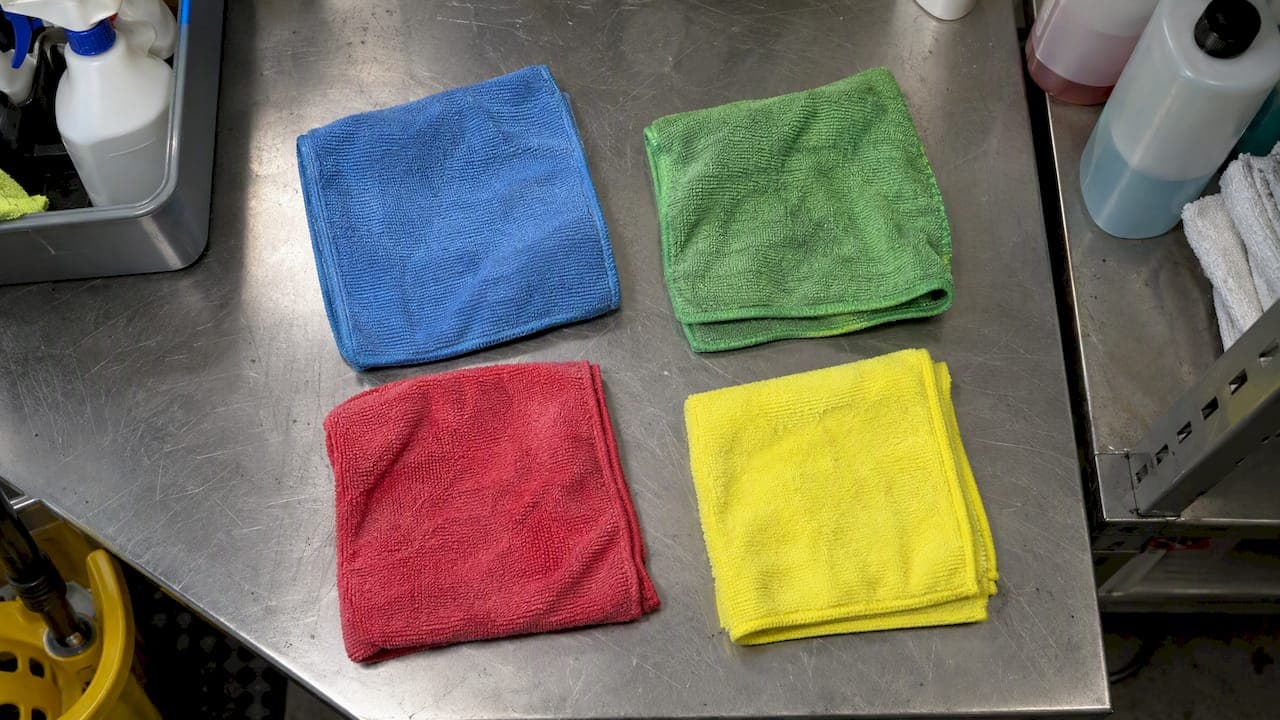
Colour-coded cloths let you keep the cloth that touched a toilet away from the bench where food is prepared. The most widely used Australian scheme is red for toilets and washrooms, green for kitchens and food areas, blue for general and low-risk areas, yellow for infectious zones and white for clinical areas. That scheme follows the NSW Health guidance that businesses commonly adopt, though no single national law forces one scheme on every industry.
This guide covers what each colour means, how to set the system up in a home, office or rental, the habits that make it work, and how to wash microfibre so it keeps cleaning. It also answers a question we hear from building managers: how to clean elevator buttons without damaging them.
TL;DR
- The common Australian scheme: red for toilets and washrooms, green for kitchens and food areas, blue for general areas, yellow for infectious zones, white for clinical areas.
- The colour only helps if people stick to it. One cloth set per zone, used clean to dirty, then straight into a separate laundry bag.
- Wash microfibre away from cotton, skip fabric softener, and replace cloths that no longer pick up dust.
- Spray cleaner onto the cloth, never onto elevator panels or other electronics.
- Schemes differ between suppliers and countries, so write your own chart and put it where the cleaners can see it.
Table of Contents
- What each colour means in Australia
- Why colour coding works (and when it fails)
- Setting up a system, step by step
- Choosing the cloths themselves
- Washing coded cloths so they keep working
- Where colour coding is a compliance matter
- Cleaning elevator buttons without wrecking them
- Our perspective: the cloth is the easy part
- When to hand it to a professional
- Common mistakes to avoid
- FAQ
- Sources
What each colour means in Australia
Colour coding assigns a colour to reusable cleaning gear for designated areas. Restricting each piece of gear to its area reduces the risk of cross-contamination, as Nisbets explains in its colour-coded cleaning guide. The five main colours are red, green, blue, yellow and white, and the guide points to the NSW Government's healthcare cleaning directive for how they are assigned.
| Colour | Typical use | Examples |
|---|---|---|
| Red | Toilets, washrooms, dirty utility rooms | Toilet bowls, urinals, bathroom floors |
| Green | Kitchens and food areas | Benches, food prep and service areas |
| Blue | General, low-risk areas | Offices, desks, reception counters |
| Yellow | Infectious or isolation areas | Rooms with infectious cases |
| White | Clinical areas | Healthcare settings |
The NSW Health Policy Directive PD2020_022 is the reference point in the Australian wall charts that suppliers sell. Even so, there is no single national law fixing one scheme for every industry. Treat the table as the common baseline, not a statute.
Why schemes sometimes disagree
Some hospitality sources use a different logic. One infection prevention article describes yellow for bathrooms, green for general cleaning, red for beds and blue for glass in a housekeeping setting. That is a legitimate scheme for that operation, but it is the opposite of the Australian baseline for red and yellow.
If you buy cloths from an overseas retailer or hire staff who trained elsewhere, check which scheme they know. The worst outcome is a mixed system where half the team treats red as the toilet cloth and the other half treats yellow that way.
Why colour coding works (and when it fails)
The point is more than tidiness. Industry experts describe colour coding as a control measure for cross-contamination and a visual audit trail that shows clients a site takes hygiene seriously. The same source is blunt about the weak point: a well-documented scheme is useless if staff do not follow it.
A cloth's colour tells a cleaner where it belongs, but it cannot stop a rushed person grabbing the nearest one. Three things make the system hold:
- Training. Every person who cleans the space knows the chart, including the occasional helper or the host's friend who "just wipes down".
- Storage. Each colour lives in its own bag, caddy or trolley section, so the wrong cloth is never within reach.
- Checks. Someone looks at the trolley at the end of the shift and notices a red cloth in the blue pile.
Work from clean to dirty
Infection control specialists stress a clean-to-dirty sequence. Colour coding pushes cleaners to move deliberately through a space, from low-risk areas towards high-risk ones such as bathrooms, so pathogens from the dirtiest areas are not carried into living or food spaces.
In practice, for a home or short-stay apartment: bedrooms and living areas first with blue, then the kitchen with green, and the bathroom and toilet last with red. The red cloths never come back out of the bathroom.
Setting up a system, step by step
- List your zones. In a house that might be kitchen, bathrooms, and everything else. In an office add reception, meeting rooms, amenities and the kitchenette.
- Assign colours. Use the baseline in the table above unless an industry body or client requires another scheme.
- Buy enough cloths. Plan one set per room or zone per clean. Industry-grade practice is to use one set of cloths per room or zone, then place used cloths straight into a separate container. Rinsing a cloth mid-job is not enough to remove pathogens.
- Extend the code beyond cloths. Mops, buckets, handles and spray bottles can follow the same colours, which is how commercial colour-coded systems are normally applied.
- Write a one-page chart. Pin it inside the cleaning cupboard or on the trolley. Include the colours, the zones, and the order of work.
- Separate the laundry. Colours come out of the wash in their own loads or bags, so nothing gets muddled on the way back.
A worked example: a two-bathroom rental
A host turning over a two-bedroom, two-bathroom apartment might use blue cloths for bedrooms, living room, windows and surfaces, green for kitchen benches, appliance fronts and the dining table, and red for both bathrooms and toilets. That is three colours and perhaps a dozen cloths. Each bag is laundered separately, and the red bag is never opened near the kitchen.

The same logic applies to the linen side of a turnover, which we cover in our piece on same-day sanitising for busy hosts.
Choosing the cloths themselves
Most coded cloths sold in Australia are microfibre. A typical commercial pack is 40 x 40 cm, 80% polyester and 20% polyamide, sold in boxes by colour. Microfibre lifts and holds soil rather than pushing it around, and it reduces the chemical you need to buy and carry.
What to look for:
- Dense, even weave. A cloth that sheds lint or feels slick is not doing the job.
- Colours that stay put. Dyes that bleed or fade into a muddy grey defeat the system.
- A size you can fold. A 40 cm cloth folded into quarters gives you eight clean faces per cloth before it needs swapping.
- Durability. Good reusable microfibre can last up to 500 wash cycles and handle water up to 90°C, according to one commercial manufacturer's selection guide. Home use and cheap packs will wear out sooner.
The microbe numbers are impressive too. A commercial split-microfibre product is reported to remove 99.9% of tested microbes with water alone in third-party testing. That is a manufacturer's result on its own product, so do not assume every cheap cloth matches it. It does explain why microfibre suits households and rentals that want fewer harsh chemicals.
Washing coded cloths so they keep working
The cloth only cleans if its fibres are intact. Three habits matter most:
- No fabric softener. It coats the fibres and destroys their ability to capture dust and grime, causing smearing, as microfibre suppliers warn.
- No cotton in the same load. Lint embeds in microfibre and compromises it. Separate cloths by colour or cleaning area and never mix them with cotton towels.
- Match disinfection to the cloth. In healthcare laundering, if disinfection is required, only bleach-safe cloths should be treated with chlorine bleach at carefully controlled dilutions such as 50 to 150 ppm. For ordinary homes and rentals, a hot wash with plain detergent is the simpler path.
Red cloths go in their own wash. A hot cycle is fine for most microfibre within its stated limits, but check the label on the pack you bought.
Where colour coding is a compliance matter
For most households it is good practice. For aged care and healthcare it is closer to evidence. Australian compliance guides list colour-coded microfibre cloths and mop heads among the supplies aged care facilities need, alongside TGA-registered hospital-grade disinfectants. The same guide notes that documentation can matter as much as the cleaning, because it is the main evidence in regulatory audits.
If you run a facility like that, keep a cleaning log that records the zone, the product, the time and the person. Our audit-ready cleaning checklist shows one way to lay that out, and our cross-contamination playbook for managers covers how to roll a system out over a quarter.
Cleaning elevator buttons without wrecking them
People searching for coloured cloths often want to know how to handle lift buttons, one of the most touched surfaces in a commercial building. The rules are simple:
- Never spray the panel. Liquid seeping behind the buttons can destroy the electronics and circuitry. Spray the cleaning agent onto the cloth first, then wipe.
- Avoid ammonia-based cleaners. They can make plastic components brittle over time, according to the same source.
- Check the finish. The same elevator guidance says sensitive lacquered and plastic surfaces should be cleaned delicately, with alcohol-based cleaners avoided on them. Where alcohol is suitable, 70% is the usual strength. Follow the lift maker's instructions first, and ask your lift maintenance company if you are unsure.
- Use the right colour. A blue cloth is the usual choice for panels in an office lobby. A cloth that has touched a washroom never goes near a lift button.
As a rule, use a clean, dry-ish cloth, wipe in one direction and fold to a fresh face for each panel.
Our perspective: the cloth is the easy part
We clean homes, offices and short-term rentals, and the colour system itself is rarely where things go wrong. A box of coloured cloths costs very little. The failure is the missing habit: the cleaner in a hurry who uses the green cloth on a vanity because the red ones ran out, or the host who launders everything in one load with a fabric softener tablet.
We care about the result a cloth leaves behind. Our work is built on non-toxic, bleach-free protocols, so the cloth and the technique do more of the work than a bottle of strong chemical ever could. That makes how you use the cloth matter even more. A dirty cloth with a gentle product spreads soil just as readily as it does with a harsh one.

Our advice is to keep the system boring. Three colours cover most homes. Work from clean to dirty. Count the cloths in and count them out. Check the log, or in a rental, check the photos. We use before-and-after reporting for that reason: you can see the result rather than take our word for it.
If you manage several properties, write the chart once and make it identical everywhere. Consistency across sites is worth more than a perfect scheme at one.
— Lead
When to hand it to a professional
Do-it-yourself colour coding works well for a household or a small office. It is harder to sustain when you are juggling back-to-back guest changeovers, a post-renovation mess, or a site with a compliance audit coming.
Our professional cleaning services cover routine cleans, deep decontamination and bond or vacate cleans for homes and offices. For hosts, our Scene Reset turnover includes linen rental and consumable restocking. If a space needs attention quickly, our Rapid Response 2-hour tactical clean is the option to look at. We don't publish prices, so get in touch through our site for a quote.
If you would rather get the basics right yourselves first, these guides help: maintaining a clean home between deep cleans, chemical-free bathroom scrubbing for Australian homes and 12 hidden dirty spots at home.
Common mistakes to avoid
- Reusing a cloth across rooms. This is the most common pitfall. One cloth, one zone.
- Rinsing instead of laundering. A rinse mid-job does not remove pathogens.
- Mixing schemes. Pick one chart and stick with it.
- Washing with softener or cotton. Both shorten the working life of microfibre.
- Skipping the training. Without it, the system fails however good the chart looks.
- Spraying electronics. Spray the cloth, not the panel.
FAQ
Which colour cloth do I use to clean a toilet?
Red. In the common Australian scheme, red is for toilets, washrooms and dirty utility areas. Keep red cloths and any red bucket or mop strictly in those rooms, and launder them separately from every other colour.
Why are microfibre cloths sold in different colours?
The colours let you assign each cloth to an area, which reduces the chance of carrying germs from a toilet to a kitchen bench. The colour itself does not clean anything. The system works only when everyone follows the same chart.
Do I need colour-coded cloths at home?
Not legally, but it is cheap protection. Most homes need only three: red for bathrooms and toilets, green for the kitchen, and blue for everything else. Businesses in food, healthcare or aged care may have to demonstrate a system during audits.
How often should I replace coded cloths?
Replace them when they stop picking up dust, feel stiff, or leave streaks or smears. Manufacturers say quality microfibre can last up to 500 washes, but that is a best-case figure for commercial products that are washed correctly. Cheap cloths and softener use will shorten it.
Can I use the same cloth on elevator buttons and desks?
You can use the same colour, usually blue, but do not share a cloth between different rooms or zones. Spray the cleaner onto the cloth and not onto the panel, and avoid ammonia-based products on the buttons.
Sources
- What is Colour Coded Cleaning? | Nisbets Guides
- Colour Coding Cleaning Equipment | Taren
- Understanding Microfiber's Role in Infection Prevention | Infection Control Today
- Microfibre Cleaning Cloths for Commercial Cleaning | Microfibre World
- Sabco Microfibre Cleaning Cloths (Colour Coded) Box 50 | KempClean
- Microfibre selection guide | Rubbermaid Commercial
- HYGEN disposable microfibre | Rubbermaid Commercial
- How to Wash Microfibre Cloth | Rubbermaid Commercial
- Cleaning Supplies for Aged Care Facilities: Compliance Guide | Matthews Cleaning Company
- Sterilization and Cleaning Tips for Commercial Elevators | ECI America