
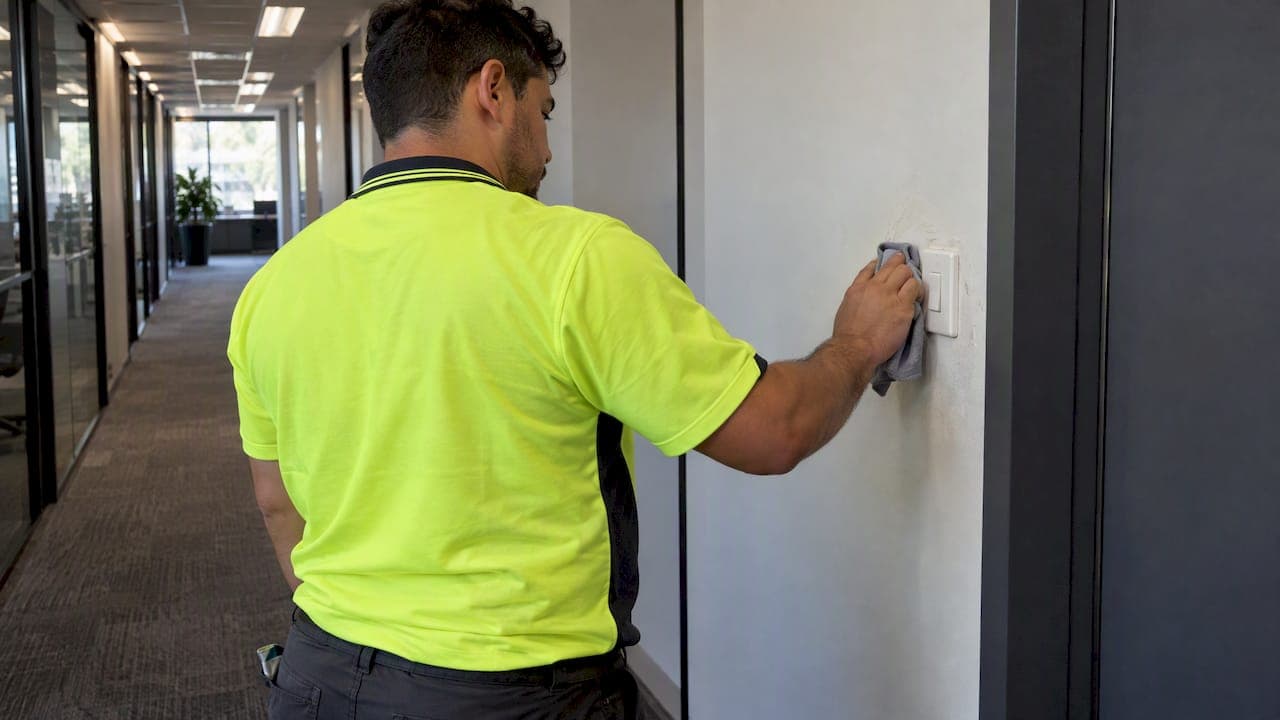
You can disinfect without bleach. The most dependable options are TGA-listed disinfectants built on hydrogen peroxide or similar non-chlorine actives, used on a surface that has already been cleaned and kept visibly wet for the full contact time on the label. Vinegar, baking soda and essential oils are fine cleaners, but they are not a substitute when you need to kill germs. This guide covers what to use, what to skip, how to apply it, and when it makes sense to hand the job to professionals.
TL;DR
- Clean first with detergent and warm water, then disinfect. Dirt and grime reduce how well a disinfectant works.
- For a real germ-kill claim, look for a product on the Australian Register of Therapeutic Goods (ARTG) that states activity against viruses, not a generic "natural" label.
- Hydrogen peroxide-based disinfectants are the most common non-chlorine choice. Vinegar and baking soda clean, but they are not listed disinfectants.
- "Bleach-free" does not mean "no risk". Ventilate, wear gloves, read the Safety Data Sheet and never mix products.
- Most of the time, you do not need to disinfect at all. Cleaning does most of the work.
Table of Contents
- First, decide whether you need to disinfect
- Why people look for non-chlorine disinfectants
- Bleach alternatives that actually disinfect
- What about vinegar, baking soda and tea tree oil?
- How to read the label in Australia
- The two-step method: clean, then disinfect
- Bleach-free is not the same as risk-free
- Where to use what: a room-by-room guide
- Our perspective
- When to call in professionals
- FAQ
- Sources
First, decide whether you need to disinfect
Cleaning and disinfecting are different jobs. Cleaning removes dirt, oils and a good share of germs along with them. Disinfecting uses a chemical to kill what is left. The US Centers for Disease Control and Prevention notes that in most situations, cleaning alone with soap and water can remove germs, and that disinfection is for times when someone is sick or a surface carries a specific risk. The Washington State Department of Health gives the same advice for homes: disinfect only when needed, and if you do, clean first.
In practice, disinfection earns its place in these situations:
- Someone in the household has a gastro bug, flu or COVID-19.
- Vomit, faeces or other body fluids have been cleaned up.
- Raw meat juices have been on a bench or board.
- A short-term rental or shared workspace has had a new guest or user group every day.
- You are cleaning high-touch points in a busy commercial space. We cover that in more detail in our guide to high touch surface cleaning.
For everything else, such as a dusty shelf, a dry floor or a bathroom mirror, a good detergent clean is the right answer, and a disinfectant adds cost and chemical exposure with no benefit.
Why people look for non-chlorine disinfectants
Chlorine bleach is cheap and effective when it is diluted correctly, but it has real drawbacks around the home and in a workplace:
- Fumes. Bleach irritates the airways, which matters for people with asthma, children and pets.
- Mixing hazards. Combined with ammonia or acids, it can release dangerous gases. The healthdirect page on chemical burns lists never mixing chemicals among the basic safety rules.
- Surface damage. It can fade fabrics, pit stainless steel and degrade grout, rubber seals and some stone.
- Residue and rinsing. Strong solutions need rinsing from food-contact and skin-contact surfaces.
- Strength depends on dilution. Our research found that where chlorine products are used for virus control, the guidance calls for a minimum of 1000 ppm available chlorine. That is easy to get wrong with a splash-and-hope approach, and it weakens as the mixed solution ages.
None of that makes bleach unusable. It makes it a product that needs care, which is why many households, hosts and businesses prefer an alternative they can use with less fuss.
Bleach alternatives that actually disinfect
The CDC's overview of disinfection methods lists a range of disinfectant types used in health care, including alcohols, chlorine compounds, hydrogen peroxide and others. For homes, rentals and offices, three non-chlorine options come up most.
Hydrogen peroxide-based disinfectants
These are the workhorse alternative. Hydrogen peroxide breaks down into water and oxygen, so it leaves little residue, and many commercial formulations are listed for use against bacteria and viruses. Two points matter:
- Concentration and formulation matter. The 3% bottle from a chemist is not the same as a formulated, TGA-listed product. Stabilised commercial products are tested for specific claims. A bottle in the cupboard is not.
- Contact time is not optional. The label will give a time, often in the range of one to ten minutes depending on the product, during which the surface must stay visibly wet. Wiping it off early is the same as not disinfecting.
Alcohol-based products
Alcohol is quick-drying and handy for phones, keyboards, door handles and light switches. It does not cut through grease or soil, so it works only on a surface that is already clean. It is also flammable and can dry out or mark some plastics, finishes and sealed timber. Keep it away from heat sources and use it in a ventilated space.
Other TGA-listed hospital-grade disinfectants
Some listed products use quaternary ammonium compounds, accelerated hydrogen peroxide or other actives. The active ingredient is less important than what the label and the ARTG entry say the product has been tested to do. A public ARTG summary will name the sponsor, the product and its grade, so you can check what you are buying before you put it on your bench.
What about vinegar, baking soda and tea tree oil?
They have a place, just not as disinfectants.
- White vinegar is a useful descaler and light cleaner. NSF notes that a vinegar and water solution can clean and freshen many household surfaces. Cleaning and freshening is a different claim from a registered germ kill. Vinegar also damages natural stone, can etch some finishes and should never be mixed with bleach.
- Baking soda is a mild abrasive for scrubbing. It removes soil, which is a cleaning job.
- Essential oils such as tea tree are marketed with antibacterial claims, but a product without an ARTG listing cannot back up a virucidal claim. Treat them as fragrance.
The practical takeaway: use these for the cleaning step if you like, and use a listed product for the disinfecting step when you truly need one. Our blog has a fuller look at what actually kills germs when you go eco-friendly.
How to read the label in Australia
The Therapeutic Goods Administration (TGA) regulates cleaners and disinfectants according to the claims a product makes. In short, disinfectants that make specific biocidal claims, such as killing viruses, must be included on the ARTG before they are sold. That gives you a simple checklist:
| What to check | Why it matters |
|---|---|
| ARTG number or "AUST L" listing on the label | Shows the product is registered for the claims it makes |
| Named claims, such as bacteria and viruses | A product that only says "antibacterial" tells you nothing about viruses |
| Contact time | The time the surface must stay wet for the claim to hold |
| Dilution instructions | Ready-to-use or concentrate, and how long a mixed solution stays valid |
| Surface compatibility | Food-contact, porous or sensitive surfaces may need rinsing or a different product |
| Safety Data Sheet (SDS) | Hazards, first aid and ventilation needs |
In Australia, "hospital-grade" and "household-grade" describe performance testing standards, not only where the product is used. For a busy rental or a commercial space, professionals favour listed hospital-grade products that explicitly state activity against viruses. If you want to understand the label wording, we explain it in what hospital-grade disinfectant means for hosts.
The two-step method: clean, then disinfect
This is where most DIY attempts fail. Spraying a disinfectant over a dirty surface wastes the product. The Australian Government's infection prevention guidance is clear that cleaning should come first, with detergent and warm water and a clean cloth, followed by the disinfectant. Soil, grease and biofilm act as a physical barrier and can neutralise or block the active ingredient.
- Prepare. Open windows or turn on the exhaust fan. Put on gloves, and eye protection if you are using a concentrate.
- Remove loose soil. Wipe or vacuum crumbs, hair and dust first.
- Clean. Use detergent and warm water with a clean cloth. Rinse or wipe off the suds if the disinfectant label asks for it.
- Apply the disinfectant. Cover the surface so it is visibly wet. Do not skimp.
- Wait. Keep to the label's contact time. Set a timer on your phone if you need to.
- Finish. Let it air-dry, or rinse food-contact surfaces as directed.
- Change cloths. Use a clean cloth for each area, and wash used ones hot.
Some products are combined detergent-disinfectants. For fast turnovers these are sensible, since they merge two steps into one, provided the product has proven activity against the relevant viruses. Even then, they work best on a surface that is not heavily soiled.
Common mistakes that make a disinfectant useless
- Wiping too soon. Ignoring contact time is the most common failure in turnover cleans.
- Topping up bottles. Infection control experts advise against topping up a container of disinfectant. It can contaminate the fresh solution and dilute the active ingredient.
- Using one cloth throughout. A dirty cloth moves germs from room to room.
- Mixing products. Never combine a disinfectant with another cleaner unless the label says you can.
- Using an expired mix. Diluted solutions lose strength. Follow the label's shelf life.
Bleach-free is not the same as risk-free
It is tempting to assume that anything without bleach is gentle. It is not. Alcohols and hydrogen peroxide can irritate the nose, throat and eyes if used in a closed room or at concentrate strength. Whatever you use:
- Read the SDS and the label before the first use.
- Wear gloves and ventilate.
- Keep products in their original containers, locked away from children and pets.
- Keep pets and young children out of the room until surfaces are dry.
If a chemical gets on your skin, wash it straight away. healthdirect advises holding the area under cool running water for at least 20 minutes, and continuing even after the chemical seems to have gone. If it gets in your eyes, is swallowed or you are breathing difficulties, call the Poisons Information Centre on 13 11 26, or Triple Zero (000) in an emergency. For a skin burn that is large, deep or on the face, see a doctor.
If you want to learn which ingredients to avoid in the first place, our guide to toxic cleaning ingredient warning labels explains what to look for on the back of the bottle.
Where to use what: a room-by-room guide
Bathroom and toilet
Bathrooms need a good clean far more often than a disinfectant. Scrub with detergent and a non-scratch pad, then use a listed disinfectant on the toilet seat, flush handle, taps and basin if there has been illness. Our chemical-free bathroom scrubbing guide shows how to do the cleaning step without harsh products.
Kitchen
Clean benches and boards with hot water and detergent. Disinfect only after raw meat contact or illness, and check that the product is suitable for food-contact surfaces. Rinse if the label says to.
Bedrooms and living areas
Most of this is cleaning and laundering. Wash bedding hot where fabric allows. Disinfect high-touch points such as remotes, switches and handles only when needed.
Short-term rentals and offices
The volume of guests or staff changes the maths. High-touch points are handled by many people, and a missed step can show up in a review. A repeatable process matters more than any single product: clean, disinfect high-touch points with a listed product, observe contact time, and check the result.

Our perspective
We get called in when the DIY approach has stalled, and the pattern is consistent. The product is rarely the problem. The sequence is. People spray a strong disinfectant on a bathroom that has not been scrubbed, wipe it off in ten seconds, and conclude that bleach alternatives do not work. They do, when they are used as directed.

Our whole approach is built on non-toxic, bleach-free protocols, so a home, a rental or a workplace is safe to walk back into straight away, including for kids and pets. We treat the job in two parts: remove the buildup properly, then disinfect where it is warranted, rather than masking grime with fragrance or a heavy chemical smell. Where we do disinfect, we want the reason to be clear, the product to be appropriate for the surface and the result to be checked, which is why we use before-and-after reporting.
One more thing we say to hosts and property managers: do not disinfect everything on every visit just because you can. Disinfect the surfaces that matter, give it the time on the label, and put the rest of the effort into a thorough clean. It is cheaper, it is kinder on the building and on the people in it, and it works.
— Lead
When to call in professionals
A bottle and a cloth are enough for everyday needs. Consider a professional clean when:
- You turn over a short-term rental regularly and need a consistent standard that protects your ratings.
- There has been a significant illness outbreak in a workplace or shared property.
- A property needs a deep reset after construction, a long vacancy or a tenancy ending.
- You have body fluids, mould-affected areas or other contamination that you would rather not handle. Our guide to non-toxic hazardous waste cleaning solutions outlines how we approach these.
Our Deep Decontamination service is built for properties that need more than a surface wipe, and our short-term rental offering covers turnovers with linen rental and consumable restocking. You can see the options on our services page, see how Deep Decontamination | Full Sweep works, or look at the short-term rental units. If you want to understand how a non-toxic approach compares for your home, read our overview of non-toxic home cleaning services. Prices are not published on the site, so request details for your property directly.
For a wider look at the idea behind this article, see our posts on sanitising without bleach and eco-friendly disinfection for homes and facilities.
FAQ
What can I use instead of bleach to disinfect?
Use a TGA-listed disinfectant that is not chlorine-based, such as a hydrogen peroxide product, and check that the label states the germs it works against. Clean the surface with detergent first. Follow the contact time on the label, because the surface must stay wet for that long.
Is vinegar a disinfectant?
Vinegar is a useful cleaner and descaler, but it is not a registered disinfectant, so you cannot rely on it to kill viruses. Use it for the cleaning step on suitable surfaces, and avoid it on natural stone. Never mix it with bleach.
Can I disinfect without bleach after someone has been sick?
Yes. Clean up the mess with detergent and warm water while wearing gloves, then apply a listed disinfectant that states activity against viruses, and keep it wet for the contact time on the label. Wash your hands and launder cloths hot afterwards. If symptoms are severe, see your GP.
Are bleach-free disinfectants safe for pets and kids?
Safer in some respects, but not risk-free. Alcohols and hydrogen peroxide can irritate airways and eyes, so ventilate and keep children and pets out until surfaces are dry. If someone swallows a product or gets it in their eyes, call the Poisons Information Centre on 13 11 26.
How do I know a product really disinfects?
Look for an ARTG listing and a label that states the specific claims, such as activity against bacteria and viruses. Products with virucidal claims need to be on the ARTG, and you can check the public summary. A label with only words such as "natural" or "antibacterial" does not give you that assurance.
Sources
- Infection Prevention and Control Expert Group: cleaning and disinfection in the community
- TGA: regulation of cleaners and disinfectants
- healthdirect: chemical burns, first aid and treatment
- CDC: cleaning and disinfecting
- CDC: disinfection methods
- Washington State Department of Health: safe cleaning practices
- NSF: green or natural cleaners