
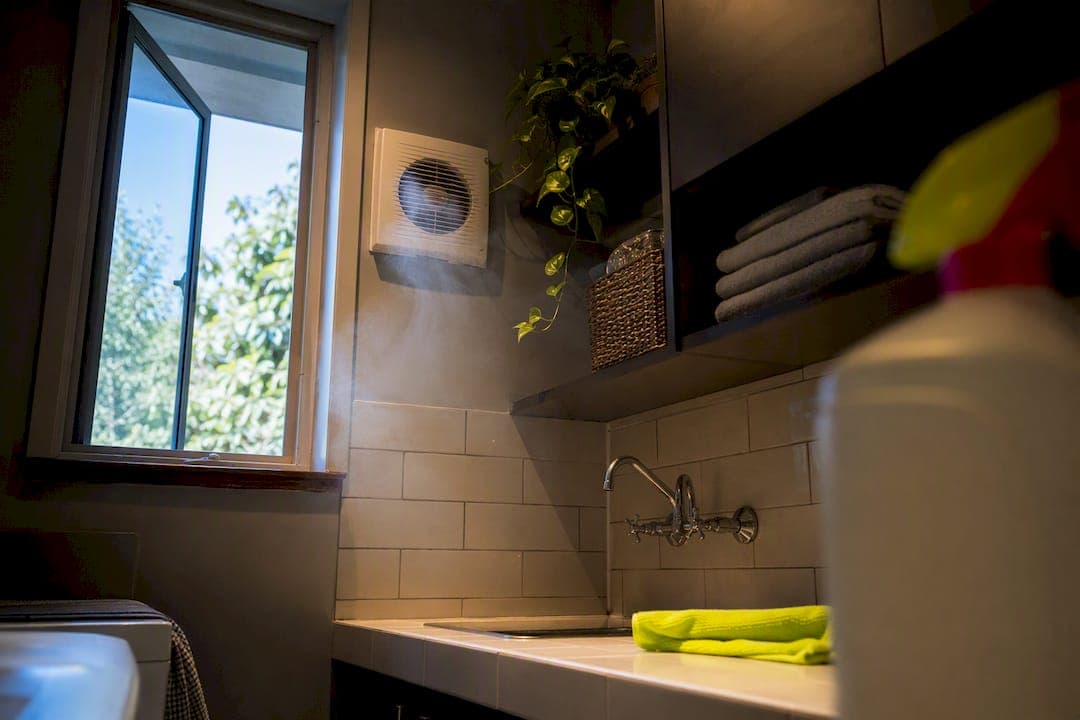
Breathing bleach fumes irritates your eyes, nose and throat almost immediately, and repeated exposure raises your risk of asthma and reduced lung function. The most dangerous scenario is mixing bleach with ammonia or acidic cleaners, which produces toxic chlorine or chloramine gas. If you're overcome by fumes, get outside into fresh air straight away, open windows, never combine cleaning products, and call for urgent medical help if breathing becomes difficult.
TL;DR:
- Mixing bleach with ammonia or acidic cleaners releases toxic chlorine or chloramine gas, causing immediate respiratory emergencies and airway injury.
- Frequent household bleach use, especially without proper ventilation, is associated with increased risks of non-allergic asthma and long-term lung function decline.
- Ultrafine particles generated from bleach reacting with indoor VOCs can penetrate deep into the lungs and may contribute to chronic respiratory inflammation.
- Using less concentrated bleach solutions, ventilating well, and avoiding product mixing significantly reduce inhalation risks during cleaning tasks.
- Vulnerable populations such as people with asthma, children, older adults, and professional cleaners face higher risks of airway irritation and long-term lung damage from repeated bleach exposure.
Table of Contents
- What breathing bleach fumes does to your body, now and over time
- How dangerous fumes actually form in your home
- What the research and health agencies actually say
- Who faces the highest risk from bleach exposure
- Cutting your exposure: substitution, ventilation and PPE that actually work
- First aid after bleach fume exposure, and when to call for help
- What's actually happening in your lungs at a cellular level
- Not all bleach is equal: concentration and formulation matter
- Are there official exposure limits for bleach fumes?
- Why room conditions change how strong bleach fumes get
- Can bleach fumes affect your mood or thinking?
- Beyond asthma: what long-term bleach exposure might mean for your lungs
- Publisher perspective: why bleach-free cleaning is the safer default
- A bleach-free option when the job's too big to DIY
- Sources
- FAQ
What breathing bleach fumes does to your body, now and over time
Sodium hypochlorite, the active ingredient in household bleach, is a strong irritant. The moment you inhale concentrated fumes, your airways react. Eyes water, your throat burns, and a dry cough sets in within minutes. For most people using bleach in a well-ventilated room for a short job, that irritation fades once the air clears.
The picture changes with concentration, duration, and how often it happens. Short bursts of high-level exposure, such as an accidental gas release, can trigger genuine emergencies. Chlorine gas exposure can cause pulmonary oedema, a build-up of fluid in the lungs that needs immediate hospital treatment.
The acute symptoms most people report include:
- Stinging or watering eyes and a burning throat
- Coughing, sometimes persistent
- A tight feeling in the chest or wheeze
- Shortness of breath after heavier exposure
- Headache or nausea in enclosed, poorly ventilated spaces
Longer-term, the concern shifts from a single bad afternoon to years of low-grade exposure. Several observational studies have found that people who use bleach frequently at home, particularly women cleaning regularly, show higher rates of non-allergic adult-onset asthma and measurable declines in lung function compared with infrequent users. This isn't an allergic reaction in the classic sense. It looks more like slow airway damage from repeated irritant exposure, the kind that builds quietly across a career or a decade of weekly cleaning.
How dangerous fumes actually form in your home
Two separate chemical stories explain why bleach fumes turn from mildly annoying to genuinely hazardous, and most people only know the first one.
The obvious danger is mixing. Combine bleach with ammonia based glass cleaners, or with acidic products like some toilet bowl cleaners and descalers, and you get chlorine or chloramine gas. Sodium hypochlorite is caustic on its own, but the gases released from mixing are far more aggressive, capable of causing severe airway injury within minutes of exposure.
The less obvious danger involves ultrafine particles, or UFPs. A 2025 occupational study found that bleach reacting with everyday indoor VOCs, things like residue from air fresheners, cooking, or other cleaning products, generates UFPs even when nobody has mixed a single product. These particles are small enough to penetrate deep into lung tissue and may drive chronic inflammation over time, which helps explain respiratory symptoms in cleaning workers that acute chlorine exposure alone doesn't fully account for.
Watch for these mixing traps specifically:
- Ammonia-based glass or multi-surface cleaners used near bleach
- Acidic toilet cleaners, rust removers, or vinegar applied straight after bleach
- Leftover residue from a previous cleaning product still on the surface
Pro Tip: Rinse a surface thoroughly with plain water before switching from one cleaning chemical to another. Residue left behind, even a thin film, is enough to trigger a reaction with the next product you apply.
What the research and health agencies actually say
The strongest recent evidence comes from a 2025 study characterising chlorine gas and UFP emissions during bleach disinfection, which identified two distinct exposure pathways worth taking seriously in occupational settings. Around the same time, a task force from the European Academy of Allergy and Clinical Immunology reached consensus recommending substitution of bleach and ammonia-based cleaners wherever practical, minimising disinfectant use generally, and never mixing products.
On the public health side, CDC and NIOSH guidance for employers is blunt: several disinfectant ingredients, including bleach, are linked to work-related asthma, and routine cleaning with soap and water is often sufficient without reaching for a disinfectant at all. The epidemiological studies behind the asthma link are observational, meaning they show association rather than strict cause and effect, and many participants used multiple cleaning products at once, which makes isolating bleach's individual contribution harder. Even with that caveat, the consistency across different cohorts and countries is hard to dismiss. Every major guidance document converges on the same practical advice: read the label, don't mix, ventilate.
Who faces the highest risk from bleach exposure
Anyone with asthma or COPD reacts faster and harder to irritant fumes than someone with healthy lungs, and even brief exposure can trigger a flare. Children breathe faster relative to their body size, so they absorb more airborne irritant per kilogram than an adult in the same room. Older adults and pregnant people also sit higher on the vulnerability list, alongside professional cleaners who face the exposure day after day rather than once a week.
That daily repetition is what turns a manageable irritant into a cumulative occupational hazard. It's why disinfectants and work-related asthma guidance specifically targets employers, not just individual workers, pushing substitution and ventilation controls as the first line of defence. Even occasional home users should treat mixing risks and ventilation seriously. There's no safe "one-off" exception when the chemistry involved doesn't care how often you use it.
Cutting your exposure: substitution, ventilation and PPE that actually work
Start with substitution, because it removes the risk rather than managing it. Most household jobs, benchtops, floors, light bathroom grime, don't need disinfection at all. Soap, water, and a microfibre cloth handle the job, and Grimescene's own chemical-free bathroom scrubbing guide walks through techniques that skip bleach entirely. Reserve actual disinfection for defined situations, illness in the household, raw meat contamination, and reach for a low-VOC, non-chlorine product when you do.
Here's a practical sequence to follow whenever bleach or any chlorine-based product is unavoidable:
- Open windows and doors first, before you open the bottle, not after.
- Run an extractor fan or portable fan to keep air moving across the room, not just near you.
- Apply the product without spraying it into the air where possible; pouring onto a cloth cuts airborne exposure compared with aerosol triggers.
- Never combine it with another cleaning product, and rinse the surface with water before switching to anything else.
- Keep ventilating well after you finish, until any smell has genuinely cleared, not just faded.
- Leave the room if fumes build up rather than pushing through a headache or cough.
For contact protection, gloves and eye protection are the baseline for any direct handling. For prolonged exposure or higher concentrations, especially in commercial or occupational settings, a properly fitted P2 or N95 respirator adds meaningful protection, and employers should be assessing that risk rather than leaving it to individual judgement.
Pro Tip: If you can smell bleach strongly enough to notice it from across the room, your ventilation isn't keeping pace with the fumes. That's your cue to open another window, not push through the job.
For readers wanting a deeper look at effective alternatives, Grimescene's guide to eco-friendly disinfecting that actually kills germs covers what genuinely works without the chlorine trade-off. If you're storing multiple household chemicals, organising them safely with clear separation prevents the kind of accidental mixing that catches people out during a routine tidy-up.
First aid after bleach fume exposure, and when to call for help
Move to fresh air immediately if you or anyone else starts coughing, wheezing, or feeling breathless around bleach fumes. Flush eyes and skin with plenty of water if there's been direct contact, and remove any contaminated clothing.
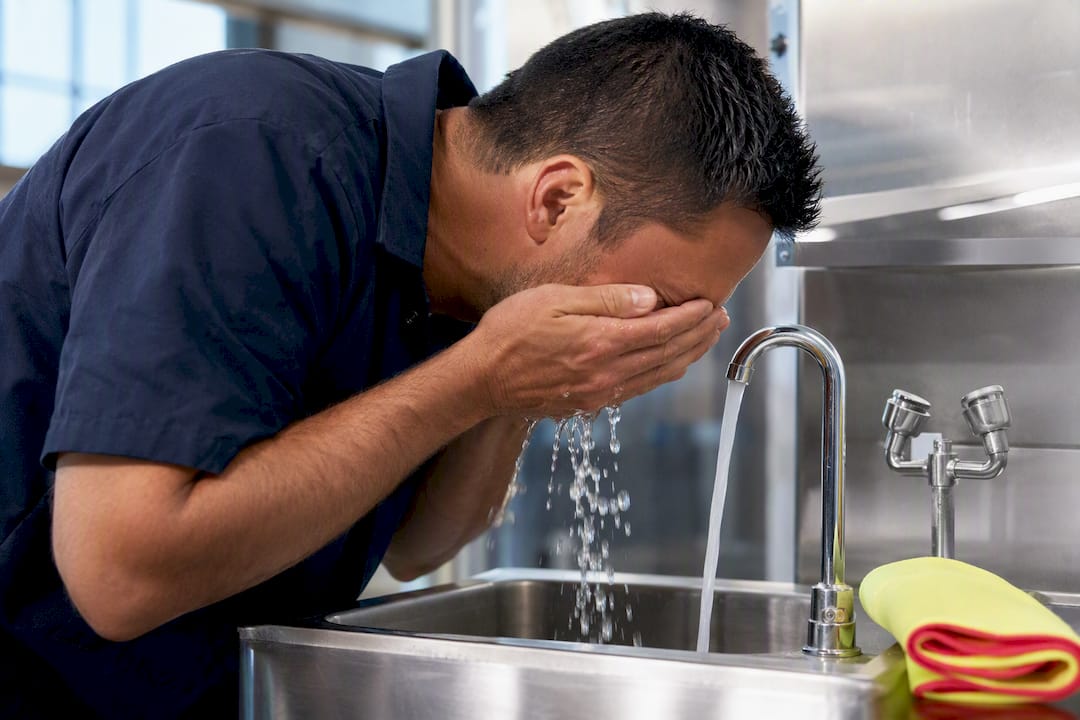
Call emergency services if breathing difficulty worsens, if there's chest pain, if someone coughs up blood, or if a person becomes unresponsive. Chlorine exposure guidance from the CDC is clear that these are signs of a genuine medical emergency, not something to wait out at home.
Even after moderate exposure that seems to resolve, keep an eye on symptoms for the next day or two. Some inhalation injuries worsen after a delay rather than showing everything up front, so if a cough, tightness, or fatigue develops or lingers 24 to 48 hours later, get it checked by a GP or emergency department rather than assuming it will pass on its own.
What's actually happening in your lungs at a cellular level
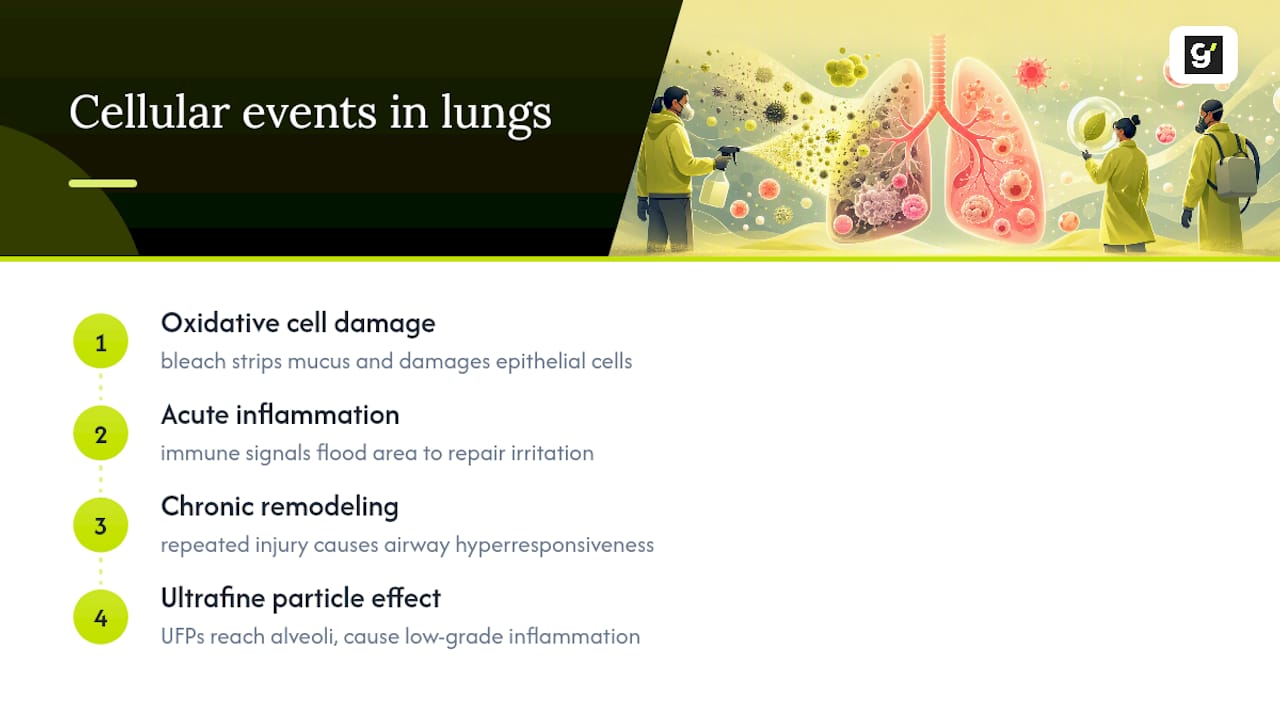
The tissue damage from bleach fumes comes down to oxidative chemistry. Sodium hypochlorite is a strong oxidising agent, meaning it reacts aggressively with the proteins and lipids that make up the cells lining your airways. On contact, it strips away the protective mucous layer and damages the epithelial cells beneath it, the same cells responsible for filtering and clearing airborne debris before it reaches deeper lung tissue.
That damage triggers an inflammatory response. Your immune system floods the area with signalling molecules meant to repair the irritation, but repeated insult keeps that inflammatory cycle running rather than letting it settle. Over months or years, this pattern of injury and incomplete repair is thought to be part of what drives the airway hyperresponsiveness seen in frequent bleach users, a heightened sensitivity where airways narrow more readily in response to triggers that wouldn't have bothered them before.
Ultrafine particles complicate this further. Because they're small enough to bypass the usual filtering mechanisms in the upper airway, UFPs reach deep into the alveoli, the tiny air sacs where oxygen exchange happens. Once there, they can provoke a low-grade inflammatory response in tissue that has far less capacity to recover than the upper airway does. It's a slower, quieter mechanism than the immediate burn of a chlorine gas exposure, but it's the one researchers now think explains chronic symptoms that don't line up neatly with any single acute incident.
Not all bleach is equal: concentration and formulation matter
Household bleach typically contains sodium hypochlorite at concentrations varying by brand and formulation, with more concentrated industrial products posing greater risks. Commercial and industrial-strength products can run considerably higher, and that difference in concentration translates directly into fume intensity and risk.
A dilute bleach solution used briefly with good ventilation poses a modest irritant risk for most healthy adults. A concentrated industrial product used in an enclosed space is a different proposition entirely, closer to the scenarios where genuine chlorine gas poisoning occurs. Powdered or tablet forms of chlorine-releasing disinfectants, common in commercial kitchens and swimming pool maintenance, carry their own handling risks because they can react violently if they get wet unevenly or contact incompatible chemicals.
Scented or "thickened" bleach formulations add another variable. Fragrance compounds and thickening agents are themselves VOCs, and mixing them into a chlorine-based product may contribute to ultrafine particle formation described earlier, on top of whatever reaction happens with residues already on a surface. Gel and thick-liquid formulations cling to vertical surfaces longer, which extends the off-gassing window compared with a thin liquid that's wiped away quickly. If you're managing a pool area, cleaning tiles safely without generating harmful fumes is worth reading before reaching for a chlorine-based tile treatment near an enclosed pool room.
Are there official exposure limits for bleach fumes?
Workplace exposure to chlorine gas, the byproduct most relevant to bleach fume safety, is governed by occupational exposure limits set by regulatory bodies, typically expressed as parts per million averaged over an eight-hour shift. These limits exist specifically because chlorine is recognised as a pulmonary irritant at concentrations well below what would register as an obvious, overpowering smell.
There's no equivalent household regulatory limit for the sort of casual bleach use most people do at home, largely because domestic cleaning isn't monitored the way an industrial workplace is. That gap matters. It means the burden of managing exposure at home falls entirely on the person doing the cleaning, through ventilation and sensible product choice, rather than any external safety threshold stepping in.
For workplaces, NIOSH and CDC guidance for employers frames bleach and similar disinfectants as products that fall under pesticide labelling requirements in some jurisdictions, which brings additional handling obligations. Cleaning businesses, aged care facilities, and commercial kitchens using bleach-based disinfectants regularly should treat those exposure limits as a floor, not a target, and lean toward substitution wherever the job allows it rather than routinely operating close to a regulatory ceiling.
Why room conditions change how strong bleach fumes get
Temperature and humidity both influence how quickly bleach fumes build up in an indoor space, and neither factor gets talked about often enough. Warmer air speeds up the evaporation of volatile compounds released from bleach, meaning a bathroom cleaned in summer heat, or one with hot water running, will off-gas faster than the same job done in a cool room.
Humidity works differently but matters just as much. High humidity can slow the dispersal of airborne particles and gases because moisture-laden air is denser and moves less freely, effectively letting fumes linger closer to breathing height for longer. A steamy bathroom after a shower, then cleaned with bleach straight afterwards, is close to a worst-case combination for fume concentration.
Room size and airflow patterns compound both effects. A small, enclosed bathroom with no window will always trap fumes more than an open-plan kitchen, regardless of temperature, simply because there's less air volume to dilute the chemical load. That's part of why the standard advice to open windows and run extractor fans matters more in ensuite bathrooms and laundries than in larger, better-ventilated rooms. If you're cleaning after any kind of heavy soil or renovation work, deep cleaning your home after renovation covers the ventilation sequencing that makes the biggest difference in those larger jobs.
Can bleach fumes affect your mood or thinking?
Acute exposure to strong chlorine or chloramine fumes can cause headache, dizziness, and a foggy, unsettled feeling, symptoms that tend to resolve once you're back in clean air and the irritant effect passes. These are consistent with general irritant gas exposure rather than evidence of lasting neurological damage from a single incident.
Documented, well-established research specifically linking long-term neurological or psychological effects to bleach fume exposure is limited. What's better established is the indirect route: people managing chronic respiratory symptoms from repeated exposure, tightness, breathlessness, disrupted sleep from coughing, often report anxiety around cleaning tasks or reduced quality of life tied to that physical discomfort, rather than a direct chemical effect on brain function. Professional cleaners repeatedly exposed to fumes as part of their job have also reported headache and fatigue as recurring complaints, though these overlap heavily with general irritant exposure rather than pointing to a distinct neurological pathway.
The honest position here is that this is an area with far less research than the respiratory effects, and drawing firm conclusions beyond "acute fumes can make you feel unwell" would outrun what the evidence actually supports.
Beyond asthma: what long-term bleach exposure might mean for your lungs
Asthma and reduced lung function get most of the attention, but they're not necessarily the ceiling on long-term risk. Chronic irritant exposure of any kind can contribute to broader respiratory conditions over years, including patterns resembling chronic bronchitis in people with heavy, repeated occupational exposure to cleaning chemicals.
The ultrafine particle mechanism described earlier adds a genuine open question around cumulative lung inflammation. Researchers behind the 2025 occupational study have flagged that UFP formation from bleach disinfection may help explain chronic respiratory symptoms in cleaning workers that don't map cleanly onto acute chlorine incidents. That's a hypothesis under active investigation rather than a settled finding, and it's worth being precise about that distinction. Nobody credible is currently claiming bleach fumes are a proven carcinogen. The honest state of the evidence is that repeated irritant and inflammatory injury to lung tissue is a plausible pathway toward chronic disease, and it's one more reason substitution matters more than PPE alone.
For occupational settings specifically, this is exactly why guidance bodies keep circling back to the same conclusion: reducing the frequency and intensity of exposure beats trying to manage it after the fact.
Publisher perspective: why bleach-free cleaning is the safer default
The evidence keeps pointing the same direction: minimising bleach use isn't caution for caution's sake, it's the approach every major guidance body now recommends first. Non-toxic cleaning agents can't generate chlorine gas from an accidental mix, and they sidestep the ultrafine particle pathway entirely because there's no chlorine chemistry to react with indoor VOCs in the first place.
That doesn't mean every job suits a DIY swap. Large-scale contamination, homes with vulnerable occupants, and short-term rental turnovers with tight timeframes are situations where managing ventilation and PPE properly gets genuinely hard for a household to pull off alone. That's when bringing in professional help, rather than reaching for a stronger chemical, makes more sense. Readers curious about the chemistry behind why some conventional methods fall short can find more detail in Grimescene's piece on why conventional cleaners fail against biohazards.
— Lead
A bleach-free option when the job's too big to DIY
Some jobs go past what ventilation and gloves can safely handle at home, heavy contamination, post-construction dust and residue, or a rental property that needs turning around fast without anyone breathing questionable fumes in the process. Non-toxic cleaning agents can neutralise buildup without the chlorine gas risk or ultrafine particle formation that comes with bleach-based disinfection.
That matters most for households with kids, older family members, or anyone with asthma or COPD, and for hosts who can't afford a turnover that smells like a chemical lab. The Deep Decontamination Full Sweep service is built for heavily soiled or high-risk properties where a standard clean won't cut it, and the Short Term Rental Scene Reset package handles bleach-free turnovers, linen, and consumable restocking between guests. If your next clean falls into either category, check availability on the service page and book a slot before your next changeover.
This article is general information, not a substitute for advice from a qualified doctor. Consult a qualified healthcare professional about your own circumstances before acting on anything here.
Sources
- Chlorine gas and ultrafine particle emissions from bleach disinfection: exposure risk characterization | Journal of Occupational Medicine and Toxicology
- Disinfectants and Work-Related Asthma: Information for Employers
- Sodium hypochlorite poisoning: MedlinePlus Medical Encyclopedia
- Chlorine | Chemical Emergencies | CDC
FAQ
Can bleach fumes cause permanent lung damage?
Repeated high-level exposure is linked to reduced lung function and non-allergic asthma in observational studies, though a single mild exposure typically resolves without lasting damage.
What happens if you accidentally mix bleach and ammonia?
Mixing produces chloramine gas, a toxic irritant that can cause severe coughing, breathing difficulty, and in serious cases, pulmonary injury requiring emergency care.
How long should you ventilate a room after using bleach?
Keep windows open and fans running until any chlorine smell has fully cleared, not just faded, which usually takes longer in small or humid rooms.
Is bleach safe to use if you have asthma?
People with asthma or COPD react faster to bleach fumes and should prefer non-chlorine alternatives; Grimescene's eco-friendly disinfection approach avoids that irritant risk entirely.
What are the first signs of bleach fume poisoning?
Early signs include burning eyes, throat irritation, coughing, and chest tightness; worsening breathlessness or chest pain needs immediate medical attention.