
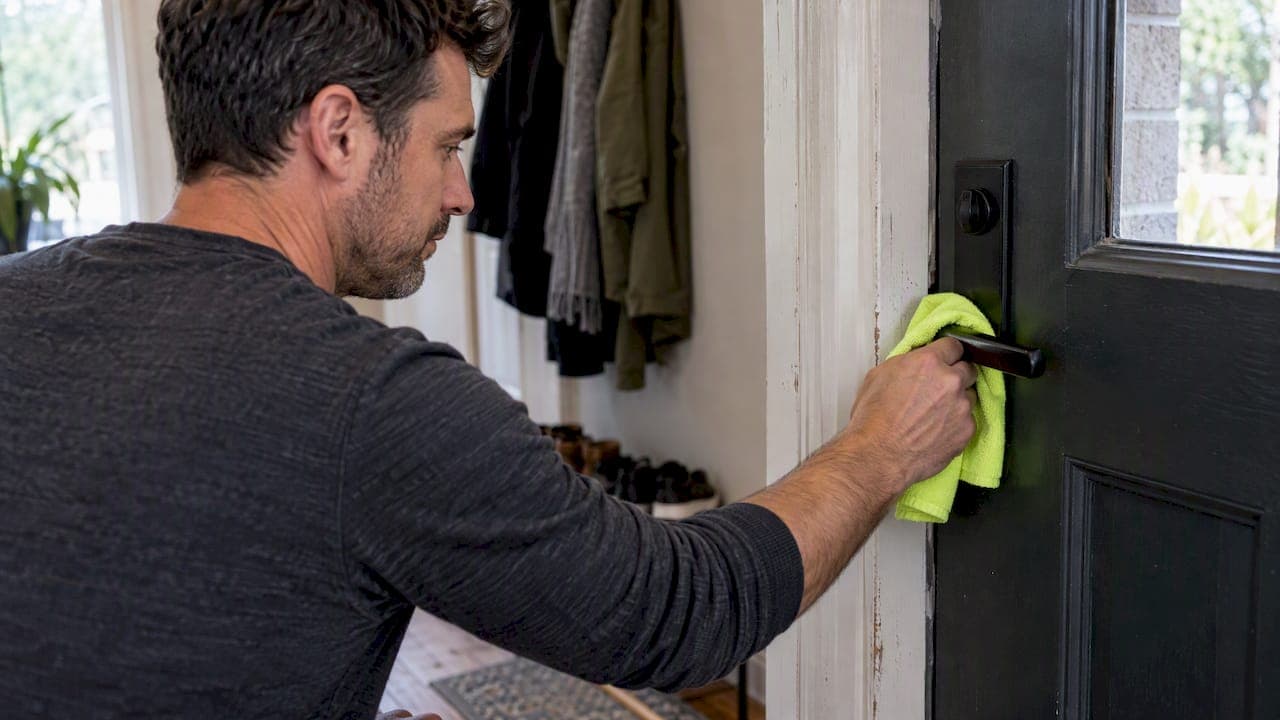
To sanitise a home after illness, clean first with detergent and warm water, then disinfect the surfaces people touch most, and let the disinfectant stay wet for the time printed on its label. Wash bedding and towels hot, ventilate the rooms, and wear gloves. That order matters more than which product you buy, and it matters most after gastro, where the virus is hardy and the cleaning is unpleasant. Below is how to do it properly, what you can skip, and when it makes sense to hand the job to a professional crew.
TL;DR
- Clean before you disinfect. Dirt shields germs from the disinfectant, so detergent and warm water come first.
- Focus on high-touch points (door handles, taps, remotes, phones, light switches, toilet and bathroom surfaces) rather than wiping every inch of the house.
- Keep the surface visibly wet for the full contact time on the label, then let it dry or wipe as directed.
- Gastro (norovirus) is the hard case: use soap and water on hands, not alcohol gel, and keep the sick person away from food preparation for 48 hours after symptoms stop.
- Heavy contamination, a vomiting incident on carpet, or a rental turnover is a good reason to book a specialist clean.
Table of Contents
- Do you actually need to sanitise after a cold or flu?
- Before you start: set up safely
- The two-step method: clean, then disinfect
- Room-by-room checklist
- Gastro is a different job
- How long do germs actually last?
- What you can skip
- Our perspective: why order and evidence beat strong smells
- When to call a professional
- How we can help
- A simple one-hour plan
- FAQ
- Sources
Do you actually need to sanitise after a cold or flu?
Sometimes, and less than the internet suggests. NSW Health and Healthdirect both make the point that close contact with an infected person is the main way illness spreads at home, not a doorknob. Surfaces matter, but they are the second line of defence. The CDC says routine disinfecting is likely unnecessary unless someone in the home is sick, which is exactly your situation if you are reading this.
So the goal is realistic: reduce the load of germs on the things the whole household touches, remove the obvious sources (used tissues, soiled linen, bathroom splashes), and stop the bug being passed around again by a shared hand towel.
How hard you go depends on the illness:
| Illness | How much effort | Why |
|---|---|---|
| Common cold | Light: wash hands, wipe high-touch points, launder bedding | Spread is mostly through close contact and coughs |
| Influenza, COVID-19 | Moderate: detergent then disinfectant on high-touch surfaces, hot-wash linen | Household transmission is common, so reduce what is shared |
| Gastro (norovirus, salmonella, shigella) | Thorough: bathroom, kitchen, floors, soiled linen, PPE for the cleaner | Virus is hardy and a vomiting episode can spread particles through the air |
| Vomiting or diarrhoea accident on soft furnishings | Specialist-level | Porous materials hold contamination |
Before you start: set up safely
Good preparation prevents you carrying germs from room to room, and it protects you if you are cleaning up after someone else.
- Open windows and doors for airflow before you begin, and keep them open while you use any product.
- Wear disposable gloves. After gastro, add a mask and an apron or old long-sleeved shirt you can wash hot afterwards. Healthdirect's norovirus guidance notes the virus can spread through particles released by vomiting, which is why professional crews gear up for these jobs.
- Use fresh cloths. Microfibre cloths that go straight into a hot wash, or disposable wipes and paper towel, beat a sponge that has been sitting in the sink.
- Do not top up containers. Australian infection-control guidance warns that topping up a half-empty bucket or spray bottle with fresh solution contaminates the whole batch. Empty, wash, dry, and refill.
- Never mix products. Bleach and ammonia-based cleaners in particular must stay apart. Mixed chemicals can release hazardous fumes.
The reader's question here is often "which product?" The honest answer is the one you will use correctly. A TGA-listed household disinfectant or a bleach-based product diluted exactly as the label says will do the job. If you would rather avoid bleach in a home with kids, pets or asthma, our guide to sanitising without bleach explains how to clean first and choose a disinfectant that still earns its claim.
The two-step method: clean, then disinfect
This is the single most useful idea in the whole topic. Australia's infection-control guidance for the community is blunt: cleaning removes pathogens, disinfection kills them, and dirt and grime reduce how well a disinfectant works. Spraying a disinfectant over a greasy bathroom tap and wiping it away straight away is mostly theatre.
Step one: clean
Wipe the surface with detergent and warm water on a clean cloth. You are physically lifting the film that protects germs. Rinse the cloth often, or swap it.
Step two: disinfect
Apply the disinfectant and leave it wet for the contact time on the label. This varies by product and can be several minutes, so a quick pass with a wipe often falls short. If the surface dries in 30 seconds, apply again. We cover this in detail in our piece on disinfectant dwell time that Australian cleaners can actually meet.
For a product made from household bleach, the standard referenced in Australian infection-control guidance for care facilities is a TGA-listed hospital-grade disinfectant or a solution with at least 1,000 ppm available chlorine. At home, the practical version is simple: follow the dilution on the bottle, make it fresh, use it with ventilation and do not store it mixed.

The wiping technique
Work from high to low and from clean to dirty. Start with shelves and switches, finish with floors, and do the toilet last. Wipe in an S-shaped pattern so you lift dirt rather than drag it back across the surface you just did. Change cloths when you move from the bathroom to anywhere else.
Room-by-room checklist
Bedroom and sick bed
Strip the bed. Put sheets, pillowcases and doona covers straight into the machine without shaking them out, which can fling particles into the air. Wash on the hottest setting the fabric allows, and dry fully, ideally in the sun or a hot dryer. Wipe the bedside table, lamp switch, tissue box holder and anything the patient kept within reach. A mattress protector can go in the wash too. The pillow and doona often get forgotten: check the care label and launder if possible.

Bathroom
The bathroom is the priority after gastro and a sensible second stop after any respiratory illness. Clean and then disinfect the toilet seat, flush handle, taps, basin, shower screen controls, door handle and light switch. Replace toothbrushes if the sick person's was stored touching others. Hang fresh towels and keep individual hand towels for the next few days. If you want a low-chemical approach to the scrubbing stage, we've written a chemical-free bathroom scrubbing guide for Australian homes.
Kitchen
Benchtops, fridge handle, kettle, tap, microwave buttons and the dishwasher door are touched by everyone. Run mugs, cutlery and plates the sick person used through a hot dishwasher cycle or wash in hot soapy water. Make sure nobody who has had gastro prepares food for others until the exclusion period has passed (see below).
Living areas
Remotes, game controllers, phones, tablets, door handles, stair rails and light switches. Electronics need gentle treatment: check the manufacturer's guidance, use a product made for screens or a lightly dampened cloth, and never spray directly onto a device. For a ranked approach to what to hit first, our guide to high-touch surface cleaning walks through the order and frequency.
A concise overview of sanitising priorities after illness, including hypoallergenic considerations, is also given in this guide to hypoallergenic home cleaning, which is a useful second read if someone in your household has allergies or sensitive skin.
Floors and soft furnishings
Vacuum carpets and rugs with a HEPA-filter vacuum so fine particles are not blown back into the air, then mop hard floors with detergent and warm water. Fabric couches and carpet cannot be disinfected the way a benchtop can. Remove visible soiling, clean with detergent, and where gastro contamination is involved consider steam cleaning or professional extraction.
Gastro is a different job
Norovirus, salmonella and shigella deserve more care than a cold. Healthdirect states that norovirus spreads easily and prevention rests on hygiene, cleaning and staying away from others while unwell. A few facts worth knowing:
- Exclusion periods. Healthdirect advises avoiding food preparation for at least 48 hours after norovirus symptoms stop, with similar timeframes for other gastro bugs: 24 hours for salmonella food prep, and 48 hours before returning to school or work for shigella. Your state or territory health department and GP have the final word, especially for childcare, aged care and food handlers.
- Alcohol gel is not enough. Alcohol-based hand sanitisers are largely ineffective against non-enveloped viruses such as norovirus. Healthdirect's hand washing advice is to use warm soapy water, especially when hands are visibly dirty.
- Clean spills straight away. The ACT Government advises cleaning contaminated benches, floors and toilets immediately with detergent and hot water, then disinfecting with a bleach-based product diluted to the manufacturer's instructions. Remove and wash soiled clothes and bedding in hot water with detergent.
- Protect yourself. Gloves, a mask and an apron are sensible when you are cleaning a vomit incident.
If the incident happened on carpet, an upholstered chair or a mattress, that is when a DIY job tends to fall short: the contamination soaks in where a wipe cannot reach.
How long do germs actually last?
This is a common question, and a firm answer depends on the bug and the surface. Hard, non-porous surfaces such as stainless steel and plastic usually hold viable virus longer than soft ones such as fabric, though the picture varies by pathogen and conditions. Norovirus is notable for lingering on surfaces. We would rather not hand you a single number that sounds authoritative, so treat the practical rule as the guide: once the sick person has recovered, a thorough clean and disinfect of shared surfaces resets the clock. Clean frequently touched surfaces daily while someone is unwell, as NSW Health's hygiene-at-home page recommends, using a household detergent followed by disinfectant, or detergent-disinfectant wipes scrubbed hard.
What you can skip
- Fogging and fumigating the house. No Australian health guidance we have cited recommends it for homes.
- Disinfecting everything daily once everyone is well. Routine cleaning is enough.
- Homemade mixtures. Vinegar and essential oils smell clean, but a product claiming to kill viruses should be TGA-listed. Check the label and ARTG number.
- Alcohol gel as a gastro measure. Use soap and water instead.
- Wiping with a damp cloth and calling it done. That moves germs around.
One caution on labels: in our experience people read "eco" or "natural" as "disinfects". Those words do not guarantee a kill claim. Our explainer on what actually kills germs in eco-friendly disinfecting and on what hospital-grade disinfectant means sets out what to look for.
Our perspective: why order and evidence beat strong smells
We clean for a living, and the thing we see most often after illness is effort spent in the wrong order. A householder sprays a strong product on a dirty surface, wipes immediately, and feels satisfied because the room smells of chemicals. The smell tells you nothing. What counts is whether soil was removed, whether the right product stayed wet for the right time, and whether the cloth that did the work went back into the next room.
That is why our approach is built on non-toxic, bleach-free agents and on checking the work rather than assuming it. A home that has just been through illness often has children, pets, an elderly relative or an asthmatic in it, and the people recovering are the last ones who should be breathing harsh fumes. We also believe in showing the result: our crews work to a defined scope and verify with before-and-after reporting, so you can see what was done, not just trust that it was.
We'd also say plainly that most colds do not need a professional. A bucket, detergent, a label-compliant disinfectant and half an hour will do. Where we are useful is when the job is bigger than a wipe-down: gastro in several rooms, a household with immunocompromised members, a guest turnover on a short-term rental the same afternoon, or a home where nobody is well enough to clean.
— Lead
When to call a professional
Think about a specialist clean when:
- Someone vomited or had diarrhoea on carpet, upholstery or a mattress and you cannot be sure it is fully removed.
- The whole household has been sick at once and nobody has the energy to do it.
- A vulnerable person is returning home from hospital, such as a newborn, an older person or someone on chemotherapy. Ask their treating team what they advise.
- You manage a short-term rental or shared property and guests become unwell mid-stay, where turnover time and reviews are on the line.
- The illness involved blood or other body fluids, which moves the job into bio-hazard territory. Our overview of non-toxic hazardous waste cleaning solutions explains how that work is approached.
If you are comparing options, ask any provider which products they use, whether they are TGA-listed for disinfection claims, what contact time they observe, how they avoid cross-contamination between rooms, and what proof of work they provide. Our manager's guide to stopping cross-contamination in cleaning lists what a good protocol looks like.
How we can help
For a home that needs more than a wipe-down, our Deep Decontamination Full Sweep works through the property with bleach-free, non-toxic agents, targeting high-touch points and bathrooms, kitchens and floors. If you need someone quickly, the Rapid Response 2-hour tactical clean is built for urgent jobs. Hosts and property managers can look at our short-term rental services, and the full list of what we do sits on our scope page. We don't publish prices online, so ask us about your property and we'll tell you what the job involves.
A simple one-hour plan
If you want a practical sequence for an average three-bedroom home after a flu, here is a workable order:
- 0 to 5 minutes: open windows, glove up, strip beds and start the first hot wash.
- 5 to 20 minutes: detergent-wipe all high-touch points, starting high (switches, handles) and moving low (cupboard doors, rails).
- 20 to 30 minutes: apply disinfectant to those same points, working room by room and leaving each wet for the full contact time. While you wait, bag tissues and rubbish.
- 30 to 45 minutes: bathroom: detergent, then disinfectant, toilet last. Swap cloths.
- 45 to 55 minutes: vacuum with a HEPA-filter machine, mop hard floors with detergent and warm water.
- 55 to 60 minutes: peel off gloves, bag cloths for the hot wash, wash your hands with soap and running water for at least 20 seconds, and move the first load to the dryer.
For gastro, add time for the kitchen and double-check the toilet area, and remember the exclusion period applies to people, not just surfaces.
FAQ
How do I sanitise a house after being sick?
Ventilate, put on gloves, then clean high-touch surfaces with detergent and warm water before applying a disinfectant for its full contact time. Hot-wash bedding and towels, and vacuum with a HEPA-filter machine. Finish by washing your own hands with soap and water.
Should I use bleach to disinfect after the flu or gastro?
Bleach-based products are a common, effective choice for hard surfaces, and health departments such as the ACT Government suggest them for norovirus clean-ups when diluted as the label directs. Never mix bleach with other cleaners, and ventilate the room. If you prefer to avoid bleach, use another TGA-listed disinfectant, and always clean first.
How long do cold or flu germs live in a house?
It depends on the virus, the surface and the conditions, so no single figure is reliable. Hard surfaces generally hold germs longer than fabrics. Daily cleaning of shared touch points while someone is ill, and a thorough clean once they recover, is the sensible approach.
Is hand sanitiser enough after gastro?
No. Alcohol-based sanitisers are largely ineffective against norovirus. Wash hands with soap and running water, particularly after the toilet, after cleaning up and before touching food.
Sources
- Norovirus infection, healthdirect
- Hand washing, healthdirect
- Cleaning and disinfection in the community, Department of Health and Aged Care
- Norovirus, ACT Government
- When and How to Clean and Disinfect Your Home, CDC